
The Radiant Virtue of Charity in Islam: Quranic Verses, Hadiths, Scholarly Wisdom, and Humanitarian Legacy Quoets on Charity in Islam. Introduction Charity, known as “Sadaqah” and “Zakat” in Islam, is a radiant expression of compassion, empathy, and social justice. It embodies the fundamental principle of giving to those in need without expecting anything in return. This comprehensive article delves into the profound significance of charity in Islam, enriched with Quranic verses, Hadiths, quotes from esteemed Islamic scholars, and the enduring legacy of those who exemplify the virtue of giving. Quotes On Charity In Islam I. Quranic Verses on Charity Zakat (Obligatory Almsgiving): Charity (Sadaqah): 4. Surah Al-Baqarah (2:263): “Kind speech and forgiveness are better than charity followed by injury. And Allah is Free of need and Forbearing.” Helping Others: 8. Surah Al-Baqarah (2:267): “The example of those who spend their wealth in the Way of Allah is like that of a grain that sprouts seven ears, and in every ear, there are a hundred grains. Thus Allah multiplies the action of whomsoever He wills.” These Quranic verses emphasize the importance of charity, kindness, and helping those in need as integral aspects of Islamic faith and practice. II. Hadiths on Charity Zakat (Obligatory Almsgiving): Charity (Sadaqah): 3. Charity as a Shield: The Prophet (peace be upon him) said, “Charity does not decrease wealth, no one forgives another except that Allah increases his honor, and no one humbles himself for the sake of Allah except that Allah raises his status.” (Sahih Muslim) Helping Others: 5. Helping in Difficulties: The Prophet (peace be upon him) said, “Whoever helps his brother in his time of need, Allah will be there in his time of need.” (Sahih al-Bukhari) These Hadiths highlight the importance of giving Zakat and Sadaqah, helping those in need, and serving others in various ways as integral aspects of Islamic practice and ethics. III. Quotes from Islamic Scholars These quotes reflect the wisdom of Islamic scholars and the emphasis in Islam on acts of charity, kindness, and helping others as essential aspects of faith and community. IV. The Humanitarian Legacy of Heroes of Islam A. Abdul Sattar Edhi Known as the “Angel of Mercy,” Abdul Sattar Edhi dedicated his life to humanitarian work. He established the Edhi Foundation, one of the largest and most respected charitable organizations in Pakistan, providing healthcare, education, and social services to millions in need. B. Sheikh Zayed bin Sultan Al Nahyan The founder of the United Arab Emirates, Sheikh Zayed bin Sultan Al Nahyan, was a philanthropist who dedicated his resources to improving the lives of people globally. He supported countless charitable initiatives, including education and healthcare projects. C. Umm Kulthum Umm Kulthum, a revered Islamic scholar, was also known for her charitable acts. She spent her life helping those in need and advocating for women’s rights, making a profound impact on society. V. Conclusion Charity in Islam is a powerful and transformative act of kindness, deeply rooted in the faith’s core principles of compassion, empathy, and social justice. It holds profound meanings, is supported by numerous Quranic verses and Hadiths, and is guided by specific rules and principles. By understanding the significance of charity and following the guidance of the Quran and Hadith, Muslims can engage in acts of benevolence that not only alleviate the suffering of the less fortunate but also promote social welfare and spiritual growth, reflecting the true essence of charity in Islam. As Islamic scholars have affirmed and heroes of Islam have demonstrated through their actions, charity is not merely a financial transaction but a profound expression of faith and a means to alleviate suffering, uplift communities, and bring people closer to their Creator. It is the radiant virtue that illuminates the path of compassion and righteousness in Islam. In the spirit of charity, let us remember the words of the Prophet Muhammad (peace be upon him): “The believer’s shade on the Day of Resurrection will be his charity.” (Tirmidhi) This article serves as a comprehensive exploration of the virtue of charity in Islam, offering guidance, inspiration, and a profound understanding of its significance in the life of a believer. Here are some well-known Islamic charity organizations that operate globally: These are just a few of the many Islamic charity organizations that work tirelessly to alleviate suffering and provide support to communities in need worldwide. Each of these organizations has a unique focus and approach, but all share the common goal of helping those in need in accordance with Islamic principles of charity and compassion. You May also like this: (98)Surah Bayyinah: Step-by-step easy study with activities 20 short stories of Good Manners for kids
Quotations from the Quran: 40+ Powerful Verses of the Quran
Here are 40 quotations from the Quran, along with their references: List of powerful Quran Verses with Verse numbers and Surah Numbers. 40 quotations from the Quran Here are some verses that highlight these attributes: These are just a few verses from the Quran. The Quran is a rich source of guidance, wisdom, and inspiration for Muslims and people of various backgrounds. You may also like to read Quran short surah tafseer Hadith with stories Islamic stories
Umrah and Hajj packages 2023/2024 from USA Best Guide
Umrah and Hajj Packages 2023 from the USA: A Complete Guide Choosing the Right Agency for Your Sacred Journey and select your plan according to your budget. Introduction: Hajj packages 2023 from USA The Hajj, one of the Five Pillars of Islam, is a sacred pilgrimage to the holy city of Mecca in Saudi Arabia, and it is an obligation for every capable Muslim to undertake at least once in their lifetime. Muslims from all over the world travel to Mecca to fulfill this religious duty, including those from the United States. Planning a Hajj pilgrimage requires careful consideration, as it involves numerous logistical, religious, and cultural aspects. This article provides a comprehensive guide to selecting the right Hajj package from the USA, including information on agencies, package types, pricing, and essential considerations. I. Understanding Hajj and Its Significance 1.1 The Significance of Hajj Hajj is a profound religious journey that holds immense spiritual significance in Islam. It symbolizes the submission to Allah, and unity among Muslims, and commemorates the experiences of Prophet Ibrahim and his family, particularly the willingness to sacrifice for the sake of faith. As one of the Five Pillars of Islam, the Hajj is obligatory for those who meet the criteria. 1.2 Hajj Preparation Preparing for the Hajj involves several key steps, including: II. Choosing the Right Hajj Package 2.1 Understanding the Types of Hajj Packages Hajj packages can vary in terms of services, accommodation, transportation, and overall experience. The primary types of Hajj packages from the USA include: 2.2 Factors to Consider When Selecting a Hajj Package When choosing a Hajj package from the USA, consider the following factors: III. Agencies Offering Hajj Packages from the USA 3.1 Notable Hajj Agencies in the USA There are numerous reputable agencies in the USA that specialize in organizing Hajj packages. Some of the well-known agencies include: 3.2 Research and Due Diligence When selecting an agency, conduct thorough research and due diligence to ensure the agency is licensed and accredited. Seek recommendations from friends, family, or community members who have previously undertaken the Hajj. Reading reviews and testimonials can provide valuable insights into the experiences of past pilgrims with a particular agency. IV. Hajj Package Pricing 4.1 Understanding the Cost of Hajj Packages 2023/2024 The cost of a Hajj package can vary significantly depending on factors such as the type of package, the quality of accommodations, the proximity to the Haram, and the agency’s reputation. As of 2023, 2024, a basic group Hajj package from the USA can range from $6,000 to $8,000 or more, while private packages tend to be more expensive. 4.2 Hidden Costs When evaluating the pricing of Hajj packages, be aware of potential hidden costs, including: V. Important Considerations 5.1 Early Booking To secure your preferred Hajj package, it is recommended to book well in advance. Agencies often have limited spots, and early booking ensures better choices in terms of accommodations and group size. 5.2 Health and Safety Before embarking on your journey, consult with a healthcare professional to ensure you are in good health and have received any required vaccinations. Additionally, familiarize yourself with safety protocols and health guidelines related to the Hajj. 5.3 Spiritual Preparation The Hajj is a deeply spiritual journey, and it is essential to prepare both physically and mentally. Study the rituals and significance of Hajj, engage in prayer and supplication, and seek guidance from religious scholars or leaders. Conclusion Selecting the right Hajj package from the USA is a crucial step in your sacred journey to Mecca. It is essential to research and choose a reputable agency that aligns with your budget, preferences, and expectations. With proper planning and preparation, your Hajj experience can be a spiritually enriching and fulfilling one, allowing you to fulfill this important religious duty with ease and peace of mind. https://dev.121islamforkids.com/praying-to-be-honest-and-kind-how-to-pray/
Islamic Stories: Reflection of the Surah Al-Bayyinah:
This new Islamic Story a Reflection of the Surah Al-Bayyinah: This story has been crafted to teach Surah Al-Bayyinah in a very interesting and reflectiong methods. We encourage our students to craft their own Islamic stories after learning these short Surahs of the Quran. These are our online classes for teens/preteens and bigginers. More detail is available in the link below. Title: The Clear Sign – A Story of Farid and the Wise Sage (islamic stories) In a peaceful village nestled between rolling green hills, there lived a curious and kind-hearted boy named Farid. Farid’s days were filled with wonder and questions about the world around him. One sunny morning, a wise and elderly traveler from a distant land arrived in their village, known as the Sage of Clarity. Word spread like wildfire through the village, and soon, the villagers gathered around the sage, eager to hear his wisdom. Among the crowd, Farid was particularly intrigued by the idea of “The Clear Sign,” something he had never heard of before. After a while, as the villagers eagerly listened to the sage’s words, Farid quietly slipped away and made his way toward the wise sage. Respectfully, he asked, “Honorable Sage, could you please explain to me what ‘The Clear Sign’ is?” The sage looked down at Farid with a gentle smile and said, “Of course, young one. ‘The Clear Sign’ is like a guiding light, a beacon of truth and wisdom from Allah.” Farid was genuinely interested now. “How can one find ‘The Clear Sign,’ and why is it so important?” he inquired. The sage responded, “You find ‘The Clear Sign’ by seeking wisdom in the Quran, a book that contains Allah’s guidance and the keys to a good and righteous life. But remember, it’s not enough to just read the words; you must also understand and live by its teachings.” Farid’s eyes sparkled with curiosity. “How can I make sure that ‘The Clear Sign’ shines in my heart?” he asked eagerly. The wise sage continued, “To keep ‘The Clear Sign’ bright in your heart, you must act with honesty and kindness. These qualities are like the fuel that ignites the light of Allah’s wisdom within you. When you follow these virtues, you share the light of ‘The Clear Sign’ with others.” Farid took this advice to heart and understood that merely reading the Quran was not enough. To truly bask in the radiance of “The Clear Sign,” he had to delve deep into its meanings and act upon its teachings. As the wise sage shared stories about people who had received Allah’s guidance through scriptures, Farid learned that while some had embraced it with open hearts, others had turned away. “But why,” Farid wondered, “would anyone turn away from such a wonderful light?” The sage explained, “Fear of change and a desire to hold onto power or old beliefs can lead some astray. That’s why it’s crucial to keep your heart open to the wisdom of ‘The Clear Sign.’” From that moment forward, Farid was determined to live a life of honesty and kindness. He knew that these qualities were key to understanding and spreading the light of “The Clear Sign.” Farid not only read the Quran but also made an effort to comprehend its deeper meanings and act upon its teachings. As Farid grew older, he continued to be a beacon of light and goodness in his community. His life’s mission was to embody “The Clear Sign” and help others understand that reading the Quran was just the beginning. True success in this life and the hereafter came from deeply comprehending its teachings and living by them. A new Islamic Story in a video on Channel (English) A new Islamic Story in a video on Channel (Urdu) Islamic courses online ~ Surah Al-Bayyinah in 11 easy steps (dev.121islamforkids.com/) More Islamic / Quranic stories Stories in Urdu Our online courses and classes for kids and beginners Stories Books
Key Features of Islamic Education Centers Across the Globe
An Islamic Education Center is an institution that focuses on providing educational and religious instruction rooted in Islamic teachings and principles. It serves as a hub for individuals, families, and the community to learn about Islam, its beliefs, practices, and values. Islamic Education Centers aim to impart knowledge and understanding of Islamic teachings, promote spiritual growth, and facilitate the development of a strong Muslim identity. Key Features of an Islamic Education Center: Islamic Education Centers play a vital role in nurturing a strong Islamic identity, fostering knowledge, and promoting a sense of belonging within the Muslim community. They serve as educational, spiritual, and social centers, offering resources, support, and opportunities for individuals and families to deepen their understanding of Islam and live their lives in accordance with its teachings. Islamic education centers in the United Kingdom Here are some well-known Islamic education centers in the United Kingdom: Please note that the availability and services offered by these Islamic education centers may vary, and it’s recommended to visit their respective websites or contact them directly for more detailed information, the Islamic Education Centers in Australia provide educational and cultural services to the Muslim community, including Islamic schools, mosques, and community centers. These institutions play a vital role in promoting Islamic education, providing religious guidance, and fostering a sense of community among Muslims in Australia. Here are a few prominent Islamic Education Centers and institutions in Australia: These are just a few examples of Islamic Education Centers in Australia. Many other mosques, Islamic schools, and community centers across the country contribute to the well-being and education of the Muslim community in Australia. It’s important to note that the availability and services provided by these centers may vary from one location to another, so it’s advisable to contact them directly for specific information or visit their websites for details on their offerings and activities. programs, and services they provide. Other big cities UK Certainly! Here are additional Islamic education centers in various cities across the United Kingdom: Manchester: Leicester: Birmingham: Glasgow: Cardiff: These are just a few examples, and there are many more Islamic education centers across various cities in the United Kingdom. Remember to visit their websites or contact them directly for more information about their specific programs, services, and activities. Islamic education centers in USA cities brief Here are some well-known Islamic education centers in cities across the United States: New York City: Los Angeles: Chicago: Houston: San Francisco Bay Area: These are just a few examples, and there are many more Islamic education centers across different cities in the United States. It’s recommended to visit their websites or contact them directly for more detailed information about their programs, services, and activities. Here are some well-known Islamic education centers in various countries across Europe: Islamic education centers in Europe France: Germany: Netherlands: Spain: Sweden: These are just a few examples, and there are many more Islamic education centers across different countries in Europe. It’s recommended to visit their websites or contact them directly for more detailed information about their programs, services, and activities. Islamic education centers in Australia Here are some well-known Islamic education centers in Australia: Islamic Education Centers in Australia provide educational and cultural services to the Muslim community, including Islamic schools, mosques, and community centers. These institutions play a vital role in promoting Islamic education, providing religious guidance, and fostering a sense of community among Muslims in Australia. Here are a few prominent Islamic Education Centers and institutions in Australia: These are just a few examples of Islamic Education Centers in Australia. Many other mosques, Islamic schools, and community centers across the country contribute to the well-being and education of the Muslim community in Australia. It’s important to note that the availability and services provided by these centers may vary from one location to another, so it’s advisable to contact them directly for specific information or visit their websites for details on their offerings and activities. Please note that the availability and services offered by these Islamic education centers may vary, and it’s recommended to visit their respective websites or contact them directly for more detailed information, the programs, and services they provide. ISLAMIC EDUCATION CENTERS in Africa Here are some well-known Islamic education centers in various countries across Africa: Egypt: South Africa: Nigeria: Morocco: Tanzania: These are just a few examples, and there are many more Islamic education centers across different countries in Africa. It’s recommended to visit their websites or contact them directly for more detailed information about their programs, services, and activities. How’s My content? Please leave a comment. About this site
Praying to be honest and kind: How to Pray? 10 Tip
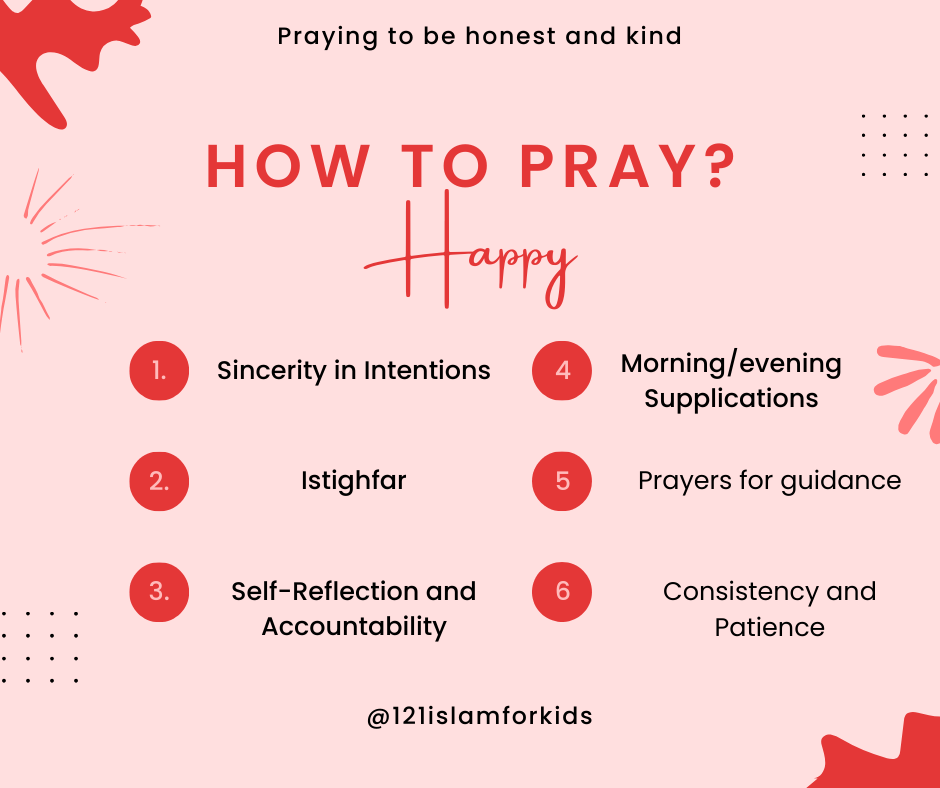
Praying to be honest and kind is a noble intention. Let’s learn, How to Pray. You can incorporate this into your daily prayers and life by following these steps and using relevant supplications (duas): Let’s learn How to Pray. Sincerity in Intention (Niyyah): Begin by making a sincere intention to be honest and kind in all your actions. Your intention should be solely for the sake of pleasing Allah and following the path of the Prophet Muhammad (peace be upon him). Morning and Evening Supplications: Incorporate the morning and evening supplications (adhkar) recommended by the Prophet Muhammad (peace be upon him) into your routine. For example, recite the following du’a in the morning and evening: “O Allah, I ask You for truthful speech and for a heart full of honesty and kindness.” Istighfar (Seeking Forgiveness): Seek forgiveness from Allah for any past dishonesty or unkindness. Use the supplication: “Astaghfirullaha Rabbi min kulli dhambin wa atubu ilayh” (I seek forgiveness from Allah, my Lord, for every sin, and I turn to Him). Self-Reflection and Accountability: Regularly evaluate your actions and words to ensure they align with honesty and kindness. Make a sincere effort to rectify any wrongdoings. Charity and Acts of Kindness: Engage in acts of charity and kindness toward others, as these actions promote honesty and kindness. Seek opportunities to help those in need. Prayers for Guidance: During your daily prayers (Salah), ask Allah for guidance to remain on the path of honesty and kindness. Make a personal supplication from your heart, expressing your desire to embody these qualities. Reading and Reflecting on Quranic Verses: Read Quranic verses and stories of the Prophet’s life emphasizing honesty and kindness. Reflect on their meanings and how you can apply them in your life. Seeking Knowledge: Learn about the Prophet Muhammad’s (peace be upon him) character and his interactions with others. Study Islamic ethics and morals to understand better how to practice honesty and kindness. Surround Yourself with Good Company: Associate with people who encourage and exemplify honesty and kindness. Positive peer influence can help reinforce these values. Consistency and Patience: Remember that personal growth takes time. Be patient with yourself and continue to pray, seek knowledge, and make a conscious effort to improve. By incorporating these steps and supplications into your life, you can strive to be a more honest and kind individual, following the teachings of Islam and the example set by Prophet Muhammad (peace be upon him). More Islamic / Quranic stories Stories in Urdu Our online courses and classes for kids and beginners Stories Books
Surah Ad-Duha Revelation story: Stories of Prophets
Stories of the Prophets: Surah Ad-Duha and the Prophet Muhammad” This story highlights the emotions and challenges faced by Prophet Muhammad (peace be upon him) during the pause in revelations and how Surah Ad-Duha brought him comfort and reassurance. It also emphasizes the importance of patience, faith, and trust in Allah’s plan. “The Dawn of Hope: Prophet Muhammad (peace be upon him) was born in Makkah, a city surrounded by vast deserts and rocky mountains. He grew up in a community where most people followed different beliefs and did not know the true path to Allah. Muhammad was known for his honesty, truthfulness, kindness, and humility from a very young age. Little did he know that Allah had chosen him to be a messenger, a guide for the people of Makkah who lived in ignorance. Prophet Muhammad had received Allah’s messages for several years, guiding him on how to be a good person and how to teach others about Allah’s love and kindness. But then, something strange occurred. The revelations stopped coming. For days, weeks, and even months, there was silence from Allah. Muhammad (peace be upon him) began to worry. He wondered if he had done something wrong or if Allah was upset with him. His heart felt heavy, and he missed the comforting words of Allah. He felt lonely and sad, not knowing when the next revelation would come. The people of Makkah, who opposed his message, saw this as an opportunity to mock him. They laughed and taunted him, saying, “Your Lord has abandoned you!” Some even made up stories to spread doubt among the believers. But deep down, Prophet Muhammad (peace be upon him) never lost faith. He knew that Allah had a plan, and he continued to pray and seek Allah’s guidance. He spent his days helping the poor, comforting the oppressed, and spreading love and kindness, even in the face of adversity. Then, one morning, as the sun was rising, something beautiful happened. Prophet Muhammad (peace be upon him) received a revelation from Allah. It was Surah Ad-Duha, the Chapter of the Morning Hours. Allah spoke to him through these verses, saying, “Did He not find you an orphan and give [you] refuge? And He found you lost and guided [you], And He found you poor and made [you] self-sufficient.” Tears of joy filled Muhammad’s eyes as he realized that Allah had not abandoned him. Allah was reminding him of all the blessings and guidance he had received throughout his life. It was like a warm hug from the Most Merciful. Prophet Muhammad (peace be upon him) was overwhelmed with gratitude and relief. He knew that Allah had a plan all along, and this pause in revelations was a test of his faith and patience. Surah Ad-Duha brought him immense comfort and reassurance. He continued his mission with even more determination, spreading Allah’s message of love and kindness. The people of Makkah may have mocked him, but he knew that Allah was with him, guiding him every step of the way. And so, Surah Ad-Duha became a source of hope and strength for all believers, reminding them that even in the darkest moments, Allah’s blessings and guidance are always near. This story highlights the emotions and challenges faced by Prophet Muhammad (peace be upon him) during the pause in revelations and how Surah Ad-Duha brought him comfort and reassurance. It also emphasizes the importance of patience, faith, and trust in Allah’s plan. A new Islamic Story in a video on Channel Islamic courses online ~ Surah Ad-Duha in 11 easy steps (dev.121islamforkids.com/) More Islamic / Quranic stories Stories in Urdu Our online courses and classes for kids and beginners Stories Books
(98)Surah Bayyinah: Step-by-step easy study with activities
Teaching Surah Bayyinah is not just about memorization but understanding and living by its message. Here is a step-by-step study and the Complete Teaching method. This method of teaching has been created for teachers/homeschooling parents and beginners to learn this Surah. Introduction surah Bayyinah Surah Bayyinah is the 98th chapter of the Quran and is composed of eight verses. Its name, “Al-Bayyinah,” translates to “The Clear Evidence” or “The Manifest Proof.” This Surah was revealed in Madinah and holds a central place in the Quran due to its powerful message and clarity in conveying divine guidance. The Surah begins by emphasizing the clarity and unmistakable nature of the signs and guidance provided by Allah. It highlights the profound and unequivocal evidence presented by Allah to guide humanity. These signs, often called “Bayyinah,” are meant to remove any doubts or misconceptions about the truth of Islam and the message of the Prophet Muhammad (peace be upon him). Surah Al-Bayyinah serves as a reminder to all people of the importance of recognizing and accepting divine guidance when it is presented clearly. It discusses the distinction between believers who embrace the truth and disbelievers who reject it, providing insights into their respective fates in the Hereafter. The Surah beautifully conveys the message that the path to righteousness and salvation is marked by faith in Allah, good deeds, and a profound fear of displeasing the Creator. It also warns of the consequences for those who knowingly deny the evident signs of divine guidance. In summary, Surah Al-Bayyinah sets the stage for its key themes of faith, good deeds, divine proof, reward, and punishment. It serves as a powerful reminder of the importance of recognizing and following the clear evidence provided by Allah for the guidance and betterment of humanity. Surah bayyinah Word-to-Word Meanings: Verse no 1: لَمْ يَكُنِ ٱلَّذِينَ كَفَرُوا۟ مِنْ أَهْلِ ٱلْكِتَـٰبِ وَٱلْمُشْرِكِينَ مُنفَكِّينَ حَتَّىٰ تَأْتِيَهُمُ ٱلْبَيِّنَةُ ۗ Transliteration: Lam yakunilladhīna kafarū min ahli-l-kitābi wal-mushrikīna munfakkin hattā ta’tiyahumu-l-bayyinatu Word-to-Word Meanings: لَمْ (Lam): Not.يَكُنِ (yakuni): Were.ٱلَّذِينَ (alladhīna): Those who.كَفَرُوا۟ (kafarū): Disbelieved.مِنْ (min): From.أَهْلِ (ahli): The people of.ٱلْكِتَـٰبِ (al-kitābi): The Book (Scripture).وَ (wa): And.ٱلْمُشْرِكِينَ (al-mushrikīna): The polytheists (those who associate partners with Allah).مُنفَكِّينَ (munfakkin): Separated, divided.حَتَّىٰ (hattā): Until.تَأْتِيَهُمُ (ta’tiyahumu): Comes to them.ٱلْبَيِّنَةُ (al-bayyinatu): The clear evidence/sign Translation: The disbelievers from the People of the Book and the polytheists were not going to desist ˹from disbelief˺ until the clear proof came to them: Verse 2 رَسُولٌۭ مِّن ٱللَّهِ يَتْلُوا۟ صُحُفًۭا مُّطَهَّرَةًۭ Transliteration: Rasūlun minal-lāhi yatlū ṣuḥufan muṭahharatan. Word-to-Word Meanings: رَسُولٌۭ (rasūlun): A Messenger.مِّن (min): From.ٱللَّهِ (l-lāhi): Allah.يَتْلُوا۟ (yatlu): Reciting.صُحُفًۭا (ṣuḥufan): Scrolls or scriptures.مُّطَهَّرَةًۭ (muṭahharatan): Purified. Translation: a messenger from Allah, reciting scrolls of ˹utmost˺ purity, Verse 3: وَمَا تَفَرَّقَ ٱلَّذِينَ أُوتُوا۟ ٱلْكِتَـٰبَ إِلَّا مِنۢ بَعْدِ مَا جَآءَتْهُمُ ٱلْبَيِّنَةُ ٤ Transliteration “Wa maa tafarraqa allatheena ootoo alkitaba illaa min ba’di maa jaa’at humu albayyinatu.” Word-by-Word meanings: وَمَا (Wa Ma) – And not تَفَرَّقَ (Tafarraqa) – they differ ٱلَّذِينَ (Alladhina) – those who أُوتُوا۟ (Ootoo) – were given ٱلْكِتَـٰبَ (Al-Kitab) – the Scripture إِلَّا (Illa) – except مِنۢ بَعْدِ (Min Ba’di) – after مَا (Ma) – what جَآءَتْ (Jaat) – came ٱلْبَيِّنَةُ (Al-Bayyinatu) – the clear evidence Translation: “And not those who were given the Scripture differ except after the clear evidence came to them.” Verse 4: وَمَا (Wa ma): And not تَفَرَّقَ (tafarraqa): they became divided ٱلَّذِينَ (allatheena): those who أُوتُوا۟ (ootoo): they were given ٱلْكِتَـٰبَ (alkitaba): the Scripture إِلَّا (illa): except مِنۢ بَعْدِ (min ba’di): after مَا (ma): what جَآءَتْهُمُ (ja’athum): came to them ٱلْبَيِّنَةُ (al-bayyinatu): the clear evidence Translation: “And those who were given the Scripture did not become divided except after there had come to them clear evidence.” Transliteration: Wa ma tafarraka allatheena ootoo alkitaba illa min ba’di ma ja’athumu al-bayyinatu. Verse 5: وَمَآ أُمِرُوا۟ إِلَّا لِيَعْبُدُوا۟ ٱللَّهَ مُخْلِصِينَ لَهُ ٱلدِّينَ حُنَفَآءَ وَيُقِيمُوا۟ ٱلصَّلَوٰةَ وَيُؤْتُوا۟ ٱلزَّكَوٰةَ ۚ وَذَٰلِكَ دِينُ ٱلْقَيِّمَةِ Transliteration: Wa maa umiroo illa liya’budoo Allah mukhliseena lahu alddeena hunafaa’ wayuqeemoo a(l)ssalata wayu/too a(l)zzakata wathalika deenu alqayyimah. Word-by-Word Meanings: Translation: “And they were not commanded except to worship Allah, [being] sincere to Him in religion, upright, and to establish the prayer and to give alms. And that is the right religion.” Verse 6: إِنَّ ٱلَّذِينَ كَفَرُوا۟ مِنْ أَهْلِ ٱلْكِتَـٰبِ وَٱلْمُشْرِكِينَ فِى نَارِ جَهَنَّمَ خَـٰلِدِينَ فِيهَآ ۚ أُو۟لَـٰٓئِكَ هُمْ شَرُّ ٱلْبَرِيَّةِ Transliteration: Inna allatheena kafaroo min ahli alkitabi wa(a)lmushrikeena fee nari jahannama khalideena feeha olaika hum sharru albariyyah. Word-by-Word Meanings: Translation: “Indeed, those who disbelieve among the People of the Book and the polytheists will be in the Fire of Hell, abiding eternally therein. Those are the worst of creatures.” Verse 7: إِنَّ ٱلَّذِينَ ءَامَنُوا۟ وَعَمِلُوا۟ ٱلصَّـٰلِحَـٰتِ أُو۟لَـٰٓئِكَ هُمْ خَيْرُ ٱلْبَرِيَّةِ Transliteration: Inna allatheena amanoo waAAamiloo a(l)ssalihati olaika hum khayru albariyyah. Word-by-Word Meanings: Translation: “Indeed, those who have believed and done righteous deeds – those are the best of creatures.” Verse 8: جَزَآؤُهُمْ عِندَ رَبِّهِمْ جَنَّـٰتُ عَدْنٍۢ تَجْرِى مِن تَحْتِهَا ٱلْأَنْهَـٰرُ خَـٰلِدِينَ فِيهَآ أَبَدًۭا ۖ رَّضِىَ ٱللَّهُ عَنْهُمْ وَرَضُوا۟ عَنْهُ ۚ ذَٰلِكَ لِمَنْ خَشِىَ رَبَّهُۥ Transliteration: Jazaohum AAinda rabbihim jannatun AAadnin tajree min tahtiha al-anharu khalideena feeha abadan radeeya Allahu AAanhum waradoo AAanhu thalika liman khashiya rabbahu. Word-by-Word Meanings: Translation: “Their reward with their Lord will be gardens of perpetual residence beneath which rivers flow, wherein they will abide forever. Allah is pleased with them, and they are pleased with Him. That is for whoever has feared his Lord.” Surah Bayyinah Verse-by-Verse Tafseer (Tafasir -Ibne Katheer) Verse 1: In this verse, Allah addresses the disbelievers among the People of the Scripture (Jews and Christians) and the polytheists. It is mentioned that they were not separated from their disbelief until a clear proof or a manifest sign came to them. This clear proof is none other than the Messenger of Allah, Muhammad (peace be upon him), who was sent by Allah to guide humanity. The “clear evidence” or “clear proof” mentioned in this verse refers to the Quran and the teachings of Islam that were conveyed by the Prophet Muhammad (peace be upon him). The message he brought was a decisive and undeniable proof
The Blessed Path Story to the reflection of surah Ad-Duha
Here is a story about the reflection of the Surah Duha. We are crafting these stories of Islam for children to teach them short surahs of the Quran in a very easy and interesting method. Read the story and let us know, How’s the story? Title: The Blessed Path (Stories of Islam) Once upon a time in a small village, there lived a boy named Ahmed. He was born into a family that had always been known for their strong faith and good fortune. From the day he was born, blessings seemed to follow him everywhere. His family believed that Allah had chosen Ahmed for something special. As a child, Ahmed was a source of joy and comfort for his family. He was always smiling, helping his parents with chores, and showing kindness to everyone he met. His parents, especially his grandmother, often told him stories from the Quran about Allah’s love and blessings. Ahmed grew up with a strong connection to his faith, feeling that Allah’s blessings were always with him. He would often reflect on Surah Ad-Duha, which he learned from his grandmother. The verses about being found as an orphan, being guided, and becoming self-sufficient resonated with him deeply. He felt a sense of gratitude for all the blessings he had received throughout his life. However, as Ahmed entered his teenage years, he faced some challenges. He struggled in school, faced peer pressure, and sometimes made choices he later regretted. He began to question whether Allah was still pleased with him. The blessings that had once seemed so abundant appeared to dwindle, and he felt distant from Allah. One evening, as Ahmed sat alone by the village pond, his grandmother approached him. She could see the worry in his eyes and the weight on his shoulders. She sat beside him and said, “Ahmed, my dear, I know you’ve been going through some difficult times, but I want you to remember something important.” Ahmed looked at his grandmother with curiosity. She continued, “Allah’s blessings are not always visible, but they are always there. Just like the morning sun rises after the darkness of night, Allah’s mercy and blessings will shine on you again. It’s a test of your faith and patience.” Ahmed thought about the words of his grandmother and the verses of Surah Ad-Duha. He realized that just as the Prophet Muhammad (peace be upon him) faced challenges and then received the comforting message of Surah Ad-Duha, he too was going through a test of his faith. With renewed determination, Ahmed turned back to his faith. He prayed and sought forgiveness for his mistakes. He worked hard in school and surrounded himself with positive influences. Slowly but surely, he began to see the blessings return to his life. Years passed, and Ahmed became a young man known for his wisdom and resilience. He never forgot the lesson his grandmother taught him, and Surah Ad-Duha remained close to his heart. He understood that Allah’s blessings may come in different forms, but they are always present for those who have faith and patience. Ahmed’s story became an inspiration for the entire village, reminding them that even in the darkest of times, Allah’s blessings and support are never far away. How’s This story? Do you want to get more stories like this? Leave a kind comment A new Islamic Story in a video on Channel Islamic courses online ~ Surah Ad-Duha in 11 easy steps (dev.121islamforkids.com/) More Islamic / Quranic stories Stories in Urdu Our online courses and classes for kids and beginners Stories Books
11 easy steps to Teach Surah Ad-Duha in English
Surah Ad Duha in English is Taught in Our classes online. Surah Ad Duha and Surah Ash-Sharh teach us valuable lessons about patience, trust in Allah, gratitude, and the promise of relief after difficulty. They show us that Allah is always with us, no matter what we face. Let’s start to learn this Surah. Let’s Start to learn step by step: Surah Ad Duha in English and Urdu 1. Introduction of Surah Ad duha in English Surah Ad-Duha is the 93rd chapter (surah) of the Quran, which is the holy book of Islam. It is composed of 11 verses and is located in the 30th Juz’ (section) of the Quran. The title “Ad-Duha” translates to “The Morning Hours” or “The Forenoon” in English, referring to the time of day when the sun is rising and the day is becoming brighter. This surah is a Meccan surah, meaning it was revealed to the Prophet Muhammad (peace be upon him) during the early years of his prophethood in the city of Mecca. Surah Ad-Duha is often recognized for its message of hope, encouragement, and assurance to the Prophet Muhammad, who was experiencing a period of revelation pause and personal difficulty at that time. The central theme of this surah revolves around reassurance, gratitude, and the concept that after moments of difficulty and adversity, there is a promise of ease and prosperity from Allah (God). It encourages believers to be patient, and thankful, and to continue doing good deeds, emphasizing that the rewards from Allah are abundant and everlasting. Surah Ad-Duha serves as a source of comfort and motivation for Muslims, reminding them of Allah’s blessings and the importance of perseverance during challenging times. It teaches that difficulties are temporary and that Allah’s mercy and support are always present for those who have faith and patience. The surah is relatively short but carries a powerful message of faith, trust, and optimism, making it a source of inspiration for Muslims seeking solace and encouragement in their daily lives. 2. Introduction to Surah Ad Duha with Sharah (Paired Surah) for Kids: Surah Ad-Duha, along with its paired surah, Surah Ash-Sharh, provides valuable life lessons and spiritual guidance for kids, helping them develop a strong and positive outlook on life. 3. Tajweed and Memorisation Surah ad duha in English and Urdu: We Teach to read and Recite the Quran in our Quran classes online. But for the students, we also prepare Tajweed video lessons. Children would watch videos of word-by-word and verse-by-verse tajweed and recitation and memorize the Surah by heart. Then there would be a Quran recitation activity in our online classes. You can Get the Tajweed videos from the playlist of SUrah Ad duha link downside. 4. Word to Word Meanings Verse 1 (Arabic): وَٱلضُّحَىٰ Word-to-Word Meaning: Translation: “And by the morning brightness,” Verse 2 (Arabic): وَٱلَّيْلِ إِذَا سَجَىٰ Word-to-Word Meaning: Translation: “And by the night when it covers with darkness,” These verses serve as an oath by the morning brightness and the night’s darkness, emphasizing the blessings and beauty of both day and night. Verse 3 (Arabic): مَا وَدَّعَكَ رَبُّكَ وَمَا قَلَىٰ Word-to-Word Meaning: Translation: “Your Lord has not abandoned you, nor does He hate [you].” This verse is a message of reassurance to the Prophet Muhammad (peace be upon him) from Allah, emphasizing that Allah has not left him and is not displeased with him. It reminds the Prophet of Allah’s continuous support and love. Verse 4 (Arabic): وَلَلْآخِرَةُ خَيْرٌۭ لَّكَ مِنَ ٱلْأُولَىٰ Word-to-Word Meaning: Translation: “But the Hereafter is better for you than the first [life].” In this verse, Allah is emphasizing to the Prophet Muhammad (peace be upon him) that the life to come in the Hereafter is far better and more rewarding than the worldly life. It reassures the Prophet and all believers that the difficulties faced in this world are temporary, and the ultimate success lies in the Hereafter. Verse 5 (Arabic): وَلَسَوْفَ يُعْطِيكَ رَبُّكَ فَتَرْضَىٰٓ Word-to-Word Meaning: Translation: “And your Lord will give you [so] you will be pleased.” In this verse, Allah is reassuring the Prophet Muhammad (peace be upon him) that He will provide him with blessings and favors in the future, to the extent that the Prophet will be pleased and content with what he receives. It is a message of hope and comfort, emphasizing Allah’s continuous support and care for His messenger. Verse 6 (Arabic): أَلَمْ يَجِدْكَ يَتِيمًۭا فَـَٔاوَىٰ أَلَمْ يَجِدْكَ (Alam Yajidka) يَتِيمًۭا (Yateeman) فَـَٔاوَىٰ (Fa’aawaa) Word-to-Word Meaning: Translation: “Did He not find you [an] orphan, so He sheltered [you]?” In this verse, Allah reminds the Prophet Muhammad (peace be upon him) of his childhood when he was an orphan, emphasizing that Allah found him in that state and provided him with shelter and care. It is a reminder of Allah’s continuous care and protection throughout the Prophet’s life. Verse 7 (Arabic):وَوَجَدَكَ ضَآلًّۭا فَهَدَىٰ وَوَجَدَكَ (Wa Wajadaka) ضَآلًّۭا (Dhaallan) فَهَدَىٰ (Fahadaa) Word-to-Word Meaning: Translation: “And He found you astray, so He guided [you].” In this verse, Allah reminds the Prophet Muhammad (peace be upon him) of a time when he was searching for guidance and truth, and Allah guided him. It emphasizes Allah’s guidance and care for His messenger, guiding him from a state of confusion to the path of truth and righteousness. Verse 8 (Arabic):وَوَجَدَكَ عَآئِلًۭا فَأَغْنَىٰ وَوَجَدَكَ (Wa Wajadaka) عَآئِلًۭا (‘Aa’ilan) فَأَغْنَىٰ (Fa’Aghnaa) Word-to-Word Meaning: Translation: “And He found you in need, so He enriched [you].” In this verse, Allah reminds the Prophet Muhammad (peace be upon him) of a time when he was in need, and Allah provided for him, enriching him. It emphasizes Allah’s provision and support for His messenger, showing that Allah cares for His servant’s well-being and sustenance. Verse 9 (Arabic):فَأَمَّا ٱلْيَتِيمَ فَلَا تَقْهَرْ فَأَمَّا (Fa’amma) ٱلْيَتِيمَ (Al-Yateema) فَلَا (Fala) تَقْهَرْ (Taqhhar) Word-to-Word Meaning: Translation: “So as for the orphan, then do not reproach [him].” In this verse, Allah instructs believers not to mistreat or oppress orphans and specifically advises against reproaching them or treating
The Earth’s message: New Islamic story about Surah Zalzalah
These Islamic stories have been crafted to teach Surah Zalzalah. The story reflects the message and lesson we get from the translation and Tafseer of Surah Zalzlah. The Earth’s Message: Islamic stories Once upon a time in a quiet little village, there lived a young boy named Ahmed. Ahmed was a good-hearted child, but he had a habit of doing many small wrongs without thinking much about them. He would sometimes say unkind words to his friends, forget to follow the rules he had at home, and even take more candies from the jar than he was allowed. Ahmed didn’t stop there; he would also sneak some of the candies when no one was looking, thinking it was a clever trick. Ahmed was not always respectful of his surroundings either. As he walked through the village, he would kick stones and other things in his way harshly, showing little regard for the property of others. His friends would often remind him to be more considerate, but he didn’t pay much attention. One night, something extraordinary happened. Ahmed went to bed as usual, but that night he had a vivid dream. In his dream, the ground beneath him began to shake violently. It was as if the whole Earth was quaking! Ahmed was terrified and didn’t know what to do. He saw houses crumbling, trees swaying, and people crying out for help. As the dream continued, Ahmed found himself on a long and winding road. Along this road, he met strange creatures with shimmering wings. These were the angels, and they were carrying bundles of papers. Curious, Ahmed asked them what those papers were. The angels replied, “These are the records of your deeds, Ahmed. Every action, good or bad, is written on these papers. Today, the Earth is revealing the deeds of its inhabitants, and you will see yours too.” Ahmed’s heart sank as he watched the angels open one of his bundles. The first paper they pulled out had the words “Unkind Words” written on it. Ahmed remembered all the times he had spoken harshly to his friends and even used unkind words behind their backs, and he felt deeply ashamed. Then, the angels showed him another paper that read “Neglecting Chores.” Ahmed recalled all the times he had avoided helping his family, complaining and breaking some rules at home. He regretted his actions even more. As Ahmed continued on the road, he came across more and more papers, each revealing his small wrongs and hidden misdeeds. He felt weighed down by the guilt of his actions. It seemed like there was no end to these reminders of his mistakes. But just when Ahmed was about to lose hope, something wonderful happened. The angels showed him a tiny paper that read “Sharing Candies.” Ahmed remembered the times he had shared his candies with his little sister and friends. He also saw another paper that read “Helping a Friend in Need.” Ahmed remembered the day he had helped his friend fix his bicycle. He also saw another paper that read ‘’Fear of Allah when scrolling his phone’’ There were so many papers with single words ‘apology‘ ‘waiting for turn’ ‘gratitude’ ‘console’ ‘smiley face’ ‘socialization’ These small but kind deeds brought a smile to Ahmed’s face. As the angels continued to show him his good actions, Ahmed felt lighter and happier. The weight of his small sins began to fade away. Finally, Ahmed woke up from his dream, feeling both relieved and enlightened. He realized that every little deed, good or bad, mattered. His dream had shown him the importance of being mindful of his actions and their consequences. From that day on, Ahmed made a promise to himself to try his best to avoid small wrongs, hidden misdeeds, and unkind actions. He also decided to be more considerate of the feelings of others. He knew that even the tiniest acts of kindness could make a big difference, just like they had in his dream. As Ahmed grew older, he became known in his village for his kindness and helpfulness. He learned that by being mindful of his actions and striving to do good, he could not only make his own life better but also bring happiness to those around him. And so, the story of Ahmed teaches us all that every small deed matters, and even the smallest acts of kindness can have a big impact on our lives and the lives of others. How’s this story? Do you want to get more stories on short surahs of the Quran? Comment below A new Islamic Story in a video on Channel Islamic courses online ~ Surah Zalzalah in 7 easy steps (dev.121islamforkids.com/) More Islamic / Quranic stories Stories in Urdu Our online courses and classes for kids and beginners Stories Books
The Grateful Merchant: A Story of Surah Al-Inshirah
The Grateful Merchant: A Story of Surah Al-Inshirah In a bustling market of an ancient city, there lived a merchant named Amir. He was known far and wide for his honesty and generosity. Despite facing numerous challenges in his business, Amir remained patient and steadfast. One day, a calamity struck. A fire engulfed his warehouse, reducing all his goods to ashes. Amir’s heart was heavy, but he remembered the words of Allah in Surah Al-Inshirah, promising relief after difficulty. With tears in his eyes, he turned to prayer and sought Allah’s guidance, worshiping Him with sincerity. Amir’s friends and family advised him to give up, but he refused. He started anew, setting up a small stall in the same market. As days turned into weeks, his determination bore fruit. Customers began to notice his resilience and his honesty shone through in every transaction. Amir would often pause to pray and seek Allah’s help, deepening his connection with the Divine. One evening, a traveler stopped by Amir’s stall. He was impressed by Amir’s demeanor and the quality of his merchandise. The traveler revealed himself as a wealthy merchant from a distant land and offered Amir a partnership. Amir’s honesty had earned him a trustworthy reputation, even beyond his city. Years passed, and Amir’s business prospered beyond his imagination. He built a successful trading empire, helping his city flourish. He never forgot the lesson he learned from Surah Al-Inshirah – that after every difficulty, there is relief. He would often recite the dua from the Surah, thanking Allah for His blessings. Amir became known as “The Grateful Merchant.” He gave generously to those in need, remembering the tough times he had faced. His story inspired others to remain patient, and grateful, and to seek Allah’s closeness in times of need, knowing that ease follows hardship, just as Allah had promised. The tale of Amir reminds us that challenges are tests from Allah, and through patience, reliance on Him, and sincere worship, we can overcome them. Surah Al-Inshirah’s message of comfort and relief resonated deeply with Amir, guiding him through his darkest hours and leading him to a life of prosperity, and a strengthened relationship with Allah. Purpose of Drafting story: This story was crafted as an engaging tool to teach children the essence of Surah Al-Inshirah. Through Amir, the Grateful Merchant, we convey to kids the Surah’s message of finding solace in Allah during tough times, worshiping Him sincerely, and maintaining gratitude. This narrative aims to instill in young hearts the importance of patience, trust in Allah’s plan, and the assurance that challenges are followed by ease. Ultimately, the story aims to empower kids with a profound understanding of seeking Allah’s help and closeness in all aspects of life, fostering a strong bond with both the Surah’s teachings and their Creator. Surah Inshirah Tafasir: If you want to teach this surah to your children with easy methods of word meanings and Tafseer. We have designed a lot of videos and activities to teach it to kids. Please visit this link to get the full teaching method of this surah Video lessons: Or visit our channel to get video lessons for free.