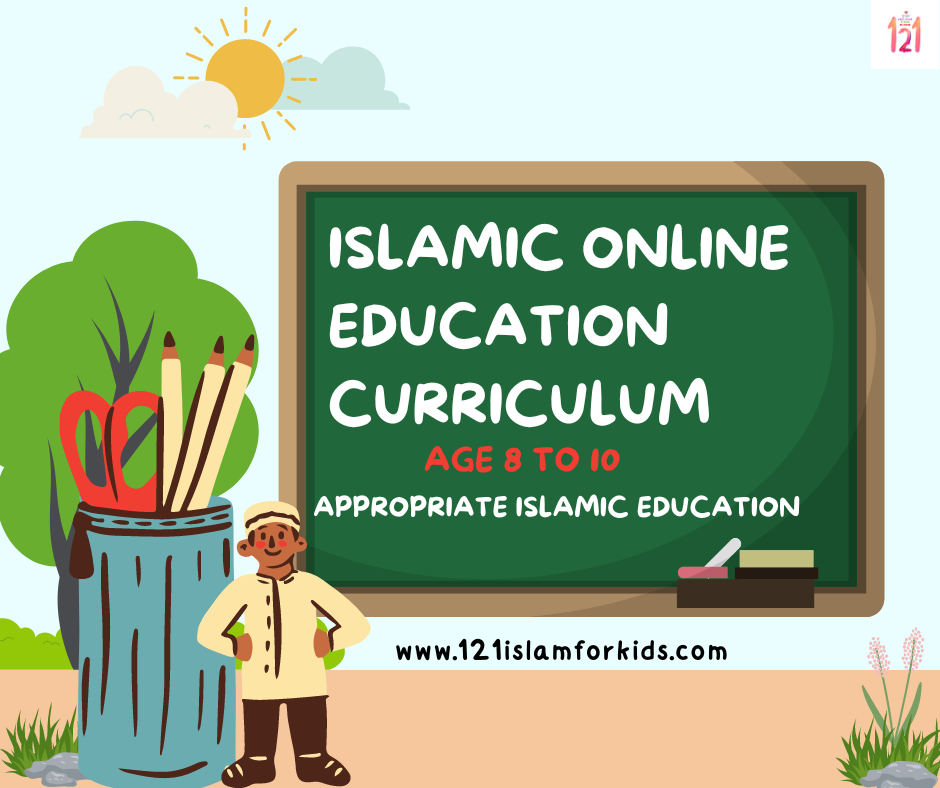
Islamic Online Education Curriculum for Children Aged 8 to 10: Building Strong Foundations for 21st-Century Muslims Introduction: The 121 Islam for Kids Online Institute is dedicated to providing comprehensive and age-appropriate Islamic education for Muslim children aged 8 to 10 years old. Our curriculum is designed to instill a strong understanding of core Islamic beliefs, principles, and values while also fostering respect for diversity and promoting good character and manners. With a focus on interactive and engaging methods, our program aims to empower children to become confident, compassionate, and responsible young Muslims. Online Education Curriculum Modules: Module 1: Basic Fiqh Objective: To introduce children to the fundamental principles of Islamic Jurisprudence (Fiqh) and guide them in applying Islamic teachings to their daily lives. 1.1 Five Pillars of Islam: 1.2 Wudu and Salah: Module 2: Core Islamic Beliefs Objective: To provide children with a strong understanding of the foundational beliefs of Islam. 2.1 Oneness of Allah (Tawheed): 2.2 Belief in Angels, Prophets, Scriptures, Books, and Day of Judgment: Module 3: Introduction to Other World Religions Objective: To promote interfaith understanding and respect for diversity while reinforcing the uniqueness of Islamic beliefs. You can read this topic in detail ‘Understanding Religion and Its Role in Our Lives – A Guide for Muslim Kids (8-10)’ 3.1 Comparative Religion: Module 4: Tafseer of Short Surahs Objective: To help children understand the meanings and lessons behind short surahs (chapters) from the Quran. 4.1 Surah Al-Fatiha: 4.2 Surah Al-Asr and Surah Al-Ikhlas: Module 5: Explanation of Hadiths with Stories and Worksheets Objective: To engage children with stories and activities that illustrate the wisdom and guidance found in Hadiths. 5.1 30 short Hadiths: 5.2 Story related to the topic 5.3 Worksheets and Interactive Activities: Module 6: Seerah of Prophet Muhammad (PBUH) and Other Prophets Objective: To introduce children to the life and teachings of Prophet Muhammad (PBUH) and other esteemed prophets. 6.1 Seerah of Prophet Muhammad (PBUH): 6.2 Stories of Other Prophets: Module 7: Islamic Manners and Etiquettes Objective: To instill good manners, etiquette, and the importance of respecting elders and peers. 7.1 Dress Code in Islam: 7.2 Rights of Parents and Elders: 7.3 manners – 121 Islam for Kids: Conclusion: At the 121 Islam for Kids Online Institute, we are dedicated to providing an interactive and all-inclusive curriculum that will help shape young Muslim minds. Our program is designed to focus on fundamental Islamic values, ethics, and manners, which will help to establish a strong foundation in faith and character. We also aim to instill a sense of open-mindedness and respect towards diverse beliefs, thereby encouraging children to actively participate as responsible members of their communities and the world at large. Through our curriculum, we strive to equip the next generation with the knowledge and tools needed to uphold the principles of Islam and make positive contributions to society. How does this guide Islamic online education curricula? Let us know in the Comment box Do you want to add any other module to this list?
How to teach Surah Inshirah step by step?
Comprehensive Surah Inshirah teaching method: word meanings, Tajweed, Tafsir, infographics, videos, mind maps, exercises, revisions & dua learning. Engaging and holistic learning! (We are uploading videos and photos of teaching methods and video lessons of this Surah within a few days, Stay tuned for more) Translation Surah Al-Inshirah (Ash-Sharh) – سورة الإنشراح بِسْمِ اللَّهِ الرَّحْمَٰنِ الرَّحِيمِ (In the name of Allah, the Most Gracious, the Most Merciful) أَلَمْ نَشْرَحْ لَكَ صَدْرَكَ ٨١ (Have We not expanded for you your breast?) – Translation: Provided you with relief and comfort. وَوَضَعْنَا عَنكَ وِزْرَكَ ٨٢ (And We removed from you your burden) – Translation: We relieved you of the heavy burden you were carrying. ٱلَّذِىٓ أَنقَضَ ظَهْرَكَ ٨٣ (Which had weighed upon your back) – Translation: That had caused your back to bend due to the burden. وَرَفَعْنَا لَكَ ذِكْرَكَ ٨٤ (And raised high for you your repute) – Translation: And exalted your mention among the people. فَإِنَّ مَعَ ٱلْعُسْرِ يُسْرًۭا ٨٥ (For indeed, with hardship, there is a relief) – Translation: Verily, along with every difficulty, there is a relief. إِنَّ مَعَ ٱلْعُسْرِ يُسْرًۭا ٨٦ (Indeed, with hardship, there is a relief) – Translation: Truly, with every difficulty, there is a relief. فَإِذَا فَرَغْتَ فَٱنصَبْ ٨٧ (So when you have finished [your duties], then stand up [for worship]) – Translation: So, when you have finished your tasks, devote yourself to worship. وَإِلَىٰ رَبِّكَ فَٱرْغَبْ ٨٨ (And to your, Lord direct your longing) – Translation: And turn your attention and desire towards your Lord. Word-by-word meanings of Surah Al-Inshirah Below are the word-by-word meanings of Surah Al-Inshirah (Ash-Sharh) in both Arabic and English: Surah Al-Inshirah (Ash-Sharh) – سورة الإنشراح بِسْمِ (Bismi) – In the name اللَّهِ (Allahi) – of Allah, الرَّحْمَٰنِ (Ar-Rahmani) – the Most Gracious, الرَّحِيمِ (Ar-Rahimi) – the Most Merciful. أَلَمْ (Alam) – Have We not نَشْرَحْ (Nashrah) – expanded لَكَ (Laka) – for you صَدْرَكَ (Sadrak) – your breast? وَوَضَعْنَا (Wa-wada’na) – And We removed عَنكَ (Anka) – from you وِزْرَكَ (Wizrak) – your burden, ٱلَّذِىٓ (Allathee) – which أَنقَضَ (Anqadha) – had weighed ظَهْرَكَ (Zahrak) – upon your back, وَرَفَعْنَا (Wa-rafa’na) – And raised لَكَ (Laka) – for you ذِكْرَكَ (Thikrak) – your repute. فَإِنَّ (Fa-inna) – For indeed, مَعَ (Ma’a) – with ٱلْعُسْرِ (Al-‘usr) – hardship, يُسْرًۭا (Yusra) – there is relief. إِنَّ (Inna) – Indeed, مَعَ (Ma’a) – with ٱلْعُسْرِ (Al-‘usr) – hardship, يُسْرًۭا (Yusra) – there is relief. فَإِذَا (Fa-idha) – So when فَرَغْتَ (Faraghta) – you have finished فَٱنصَبْ (Fansab) – then stand up وَإِلَىٰ (Wa-ilaa) – and to رَبِّكَ (Rabbika) – your Lord فَٱرْغَبْ (Farghab) – direct your longing. Explanation of Surah Inshirah (Ash-Sharh) based on Ibn Kathir’s Tafsir Here’s a simplified and child-friendly explanation of Surah Al-Inshirah (Ash-Sharh) based on Ibn Kathir’s Tafsir: Surah Al-Inshirah (Ash-Sharh) – سورة الإنشراح In summary, Surah Al-Inshirah teaches us that Allah will always help and support us through difficult times. After every hardship, there will be ease, and we should never forget to turn to Allah and seek His guidance in everything we do. Keep in mind that this is a simplified explanation for children, and the actual Tafsir by Ibn Kathir goes into more detail and covers various aspects of the Surah. For children, it’s essential to present complex concepts in a way that is easy for them to understand and relate to. Mind map OF Surah Al-Inshirah (Ash-Sharh) – سورة الإنشراح Introduction: Surah Al-Inshirah, also known as Surah Ash-Sharh, is the 94th chapter of the Quran. It consists of 8 verses and is a short but profound Surah with a powerful message. The Surah was revealed in Makkah during a time when the Prophet Muhammad (peace be upon him) was facing immense challenges and difficulties in conveying the message of Islam. In this Surah, Allah comforts and consoles the Prophet and provides him with assurance, encouragement, and hope. The mind map highlights the main themes and key points of Surah Al-Inshirah, making it easier to grasp the overall message of the Surah at a glance. Teaching method Surah Al-Inshirah Teaching Surah Al-Inshirah to children can be a wonderful and rewarding experience. To create an effective and comprehensive learning experience, here’s a suggested teaching method that incorporates word meanings translation, Tajweed, Tafsir, infographics, videos, mind maps, exercises, and revisions: These additional activities will add more diversity and excitement to the learning process, ensuring that children have a holistic understanding of Surah Al-Inshirah and its teachings. Learning through interactive and engaging activities helps children internalize the lessons and creates a lifelong love for the Quran. Quizzes for kids: Reflection Questions for kids: These quizzes and reflection questions can help reinforce the understanding of Surah Al-Inshirah and its valuable lessons in patience, gratitude, and reliance on Allah. Frequently Asked Questions (FAQs) about Surah Al-Inshirah: Resources Story for the reflection of Surah InShirah(Written) Story for the reflection of Surah Inshirah (Video) Gallery Video Playlist Books (Shop) My First Quran Picture Book My First Quran Stories Book Islamic education By Molvi Abdula Aziz Grade 6 Free Books (pdf) Our Online Courses Quran classes: We have online quran tajweed, recitation, and Quran Hifz classes for children. One-on-one classes with Qualified teachers. Quran Tafseer classes: Short and Easy-to-understand Quran translation and tafseer will be taught to the young learners. Infographics, mindmaps, work-by-word tajweed and meanings, stories, and duas are included in these classes. Hadith with Stories course consists of 30 short hadith It’s a personality development course for children with interesting stories. 30 short hadiths would be taught with stories. We have worksheets to solve after learning hadiths for implications. Prayer for kids course : A short course to teach about taharat, Gusal, wudu, times of prayers, number and names of prayers, pillars, conditions of prayer, and method of prayer. Kindness to Parents: A 1-week course to teach the rights of parents with practical work. Dua and how to be kind to parents is included in this course. 6 articles on the Muslim faith: Faiths/Muslim beliefs would be taught one by one with
20 short stories of Good Manners for kids
“Short Stories of Quranic Teachings and Manners”: In this collection of stories, we explore 20 narratives that exemplify the moral teachings and manners derived from the Quran. Each story encapsulates a valuable lesson, showcasing the transformative power of embodying Quranic values in our lives. From acts of kindness and resilience to honesty and humility, these stories highlight the virtues of compassion, justice, gratitude, and familial love. The characters in these tales inspire us to reflect on our actions and strive for personal growth, fostering a harmonious and compassionate society. Ultimately, these stories remind us of the timeless wisdom within the Quran and encourage us to embrace its teachings in our pursuit of a better world. 1. The Kind Stranger: Once upon a time, a weary traveler found himself lost in a remote village. His stomach growled with hunger, and darkness began to settle in. Just as despair started to take hold, a kind-hearted stranger approached him. The stranger had noticed the traveler’s plight and invited him into his humble home. Inside, the stranger offered the tired traveler a warm meal, clean clothes, and a comfortable bed for the night. Over dinner, they shared stories and laughter, and the traveler felt a newfound sense of peace and gratitude. In the morning, the kind stranger guided the traveler back on the right path, ensuring he reached his destination safely. As the traveler continued his journey, he couldn’t help but reflect on the stranger’s selfless act of kindness. He realized that the stranger embodied the Quranic teachings of hospitality and compassion, reminding him of the importance of extending a helping hand to those in need. From that day forward, the traveler made a promise to himself to always be mindful of others, ready to offer assistance and kindness wherever he went. Inspired by the stranger’s generosity, he became an advocate for spreading love and compassion, following the Quranic teachings that encouraged believers to treat strangers as friends and to embrace the opportunity to be a source of comfort and support. 2. The Forgiving Friend: In a bustling town, two close friends found themselves entangled in a heated argument. The exchange of harsh words soon escalated into a full-blown fight, leaving both of them wounded emotionally and physically. However, amid their anger, one of them remembered the Quranic teaching about forgiveness and its transformative power. Taking a deep breath, he approached his friend, his voice laced with remorse. He apologized for his actions and acknowledged his part in the dispute. Surprised and moved by this display of humility, the friend paused and reflected on the bond they had shared for years. Realizing that forgiveness was a virtue bestowed upon the strong, he reciprocated with a heartfelt apology. The weight of their anger lifted, replaced by a sense of peace and understanding. They embraced, their friendship rekindled by the power of forgiveness. Their renewed bond became an inspiration to others in the town. Word spread of their ability to rise above their differences and reconcile, highlighting the Quranic teachings of forgiveness and the importance of preserving relationships. Their story served as a reminder that the path to healing and harmony lies in forgiveness and the willingness to let go of grudges. From that day forward, the two friends became advocates for forgiveness, urging others to mend broken relationships and seek reconciliation. Their journey demonstrated the strength and beauty that lay in forgiving one another, echoing the timeless wisdom found within the pages of the Quran. 3. The Honest Merchant: In a bustling marketplace, there was a merchant known for his integrity and honesty. People from far and wide flocked to his store, confident that they would be treated fairly and justly. One day, a customer came to purchase an item worth a substantial amount of money. As the merchant handed the customer the purchased goods, he made an accidental error and gave the customer more change than required. The customer, unaware of the mistake, left the store content with his purchase. The merchant, however, quickly realized the error and recognized the opportunity to demonstrate his commitment to the Quranic teachings of honesty and fairness. Without hesitation, the merchant rushed out of his shop, determined to find the customer and rectify the mistake. After a frantic search, he caught up with the customer and explained the situation, returning the excess change. The customer was taken aback by the merchant’s honesty and was deeply moved by his act of integrity. Word of the merchant’s honorable deed spread throughout the marketplace, earning him a reputation for his unwavering honesty. People admired him for the quality of his products and his steadfast adherence to the Quranic teachings of honesty and fairness. As time went on, the merchant’s business flourished. Customers flocked to his store, knowing they would be treated with respect and fairness. The merchant’s success became a testament to the profound impact that honesty and integrity can have on one’s life and the community at large. 4. The Generous Neighbors: In a small village nestled amidst rolling hills, the harsh winds of famine blew. Food was scarce, and hunger plagued the community. Amongst the villagers, there was a family known for their generous spirit and unwavering compassion. Though their provisions were meager, they shared what little they had with their hungry neighbors. Every day, they would distribute the little food they had, making sure that no one went to bed with an empty stomach. Their acts of kindness and selflessness became a shining example of the Quranic teachings of generosity and caring for others, even in times of great hardship. The village’s spirit of unity and support grew stronger as other families followed suit. Each household contributed whatever it could, pooling its resources to ensure that everyone received sustenance. It wasn’t long before the entire village formed a tight-knit community that weathered the storm of famine together. As the seasons changed and prosperity returned, the village thrived. The bonds forged during that difficult time remained unbreakable, as
Basic Beliefs in Islam: P3 Belief in angels:
This is a series of our course Basic Beliefs in Islam: This is part 3, Belief in Angels: Let’s see what is Muslim belief in Angels. Basic beliefs in Islam: Belief in Angels Mind Map: Main Topic: Islamic Belief in Angel Conclusion: The Islamic belief in angels is a fundamental aspect of faith, affirming the unseen realm and the presence of Allah’s divine order. Angels play various roles, carrying out specific tasks assigned by Allah and serving as messengers between Allah and His creation. They possess unique attributes and characteristics, emphasizing their purity, obedience, and knowledge. Belief in angels reinforces accountability, divine justice, and the importance of a spiritual connection with Allah. References from the Quran and Hadith provide further evidence and guidance on the significance of angels in Islam. Definition and Nature of Angels Angels are special beings created by Allah from pure light. They obey Allah perfectly and have no choice but to follow His commands. Angels are messengers between Allah and people. The angel Jibril (Gabriel) brought the Qur’an to Prophet Muhammad, and other angels have different jobs like protecting people and recording our deeds. There are many angels, but we cannot count them. They watch over us, protect us, and help keep everything in the universe organized. Muslims should respect and honor angels by making duaa (prayers). However, we should only worship Allah, not the angels. Believing in angels is very important in Islam. The Qur’an and Hadith tell us many stories about angels and what they do. Muslims confirm their belief in angels in various ways: By understanding these beliefs, Muslims grow closer to Allah and appreciate His perfect plan. Names of some angels and their role Different types of angels have different roles and names mentioned in Islamic tradition. Each one has an important job in Allah’s creation. Teaching Method Islamic Belief in Angels to Children: Introduction: Definition and Nature of Angels: Purpose and Role of Angels: Belief in Specific Angels: Attributes and Characteristics of Angels: Interactions with Humans: Importance and Significance in Islam: References from the Quran and Hadith: Different angels have different jobs. Some bring messages from Allah to the prophets, some record what we do, and some manage the weather. Each angel’s job is important and helps keep everything in the universe working perfectly. Duties of Angels in Islam We don’t know exactly how many angels exist. Allah created so many angels that no human can count them. Each person has angels with them to protect and watch over them. How Many Angels are There in Islam? Yes! Believing in angels is a very important part of being Muslim. The Qur’an and Hadith teach us that angels are real and they help Allah’s creation in many ways. Do Muslims Believe in Angels? Conclusion: When teaching children about angels, use simple words, stories, and fun activities. This helps them understand and love learning about the unseen world and Allah’s perfect creation. This article is a series of our 6 articles in Islam course. Other articles on this course. A short course on 6 Articles of Faith in Islam: Article 1: Who is Allah? Towheed, first Article of Muslim Faith What is Monotheism? The largest monotheism Religions:
The best story of the reflection of Surah Al-Adiyat
The Power and Gratitude of Surah Adiyat” Brave horses” is a series of Quranic stories. We are sharing Stories of short surahs of the Quran to explain surah to the kids and beginners. A short Quranic story ”Brave horses” Once upon a time, in a faraway kingdom, there lived a wise king who possessed a magnificent army with powerful and noble horses. These horses were renowned for their strength, speed, and unwavering bravery. The kingdom flourished under their protection and guidance. One fine day, the king decided to showcase the remarkable abilities of his horses to the people of the kingdom. He invited everyone to witness this grand event, where the field was filled with excitement and anticipation. The chargers, as the horses were called, stood tall and proud, ready to demonstrate their extraordinary skills. At the signal from the king, they began to gallop with great speed, their hooves striking the ground with power. The impact of their hooves created sparks that dazzled the onlookers. As the chargers raced across the field, it seemed as though they were soaring through the air. With their incredible speed, they could launch a surprise raid on the enemy at the first light of dawn, catching them off guard. Dust clouds rose as the horses charged forward, a spectacular sight that spoke of their strength and might. Fearlessly, the chargers penetrated the enemy ranks, disrupting their formations and sowing confusion among their adversaries. Their presence alone struck fear into the hearts of the enemies, and their unwavering bravery inspired awe and admiration among all who witnessed their prowess. The spectators watched in amazement, marveling at the extraordinary abilities of the chargers. It reminded them of the power and strength bestowed upon these noble creatures by Allah, their Creator. After the breathtaking display, the king gathered the people and began to reflect upon the significance of these remarkable horses. He said, “Just as these horses display their power and bravery, we must also remember to be grateful to Allah for all the blessings He has bestowed upon us.” The king spoke about how sometimes people become ungrateful and forget to express their gratitude to Allah for the countless blessings in their lives. He emphasized that true strength lies not only in physical might but also in recognizing and appreciating the blessings bestowed upon them. With deep wisdom, the king continued, “Allah is our Lord, and He is always watching over us. He knows our actions, whether we are grateful or ungrateful. We should strive to be grateful and show our appreciation for His countless favors.” The people of the kingdom listened attentively, realizing the profound lesson being imparted. They understood that gratitude is a fundamental virtue that brings happiness and contentment. They made a sincere commitment to cultivating gratitude in their hearts and minds, recognizing that material possessions are temporary, but gratitude to Allah is an eternal source of joy. From that day forward, the people of the kingdom embraced gratitude as a way of life. They understood that true strength comes not just from physical power but from being thankful to Allah, their Creator, and recognizing His blessings in every aspect of their lives. And so, the story of the powerful chargers in the kingdom became a powerful reminder for all. It taught them the importance of gratitude, reminding them of the strength that emanates from being thankful to Allah, their Creator, and the everlasting happiness it brings. Surah Al-Adiyat step-by-step teaching method Video stories More Quranic stories Story Books Islamic Kids Best website |Free books download Quran Tafsir
Surah Al Adiyat: Easy to Understand Learning and Teaching Method
Introduction of Surah adiyat: Surah Adiyat, also known as Al-Adiyat, is the 100th chapter of the Qur’an, the holy book of Islam. It is classified as a Makki surah, meaning it was revealed in Mecca during the early years of Prophet Muhammad’s mission. The surah consists of 11 verses and derives its name from the word “adiyat” in the first verse, which translates to “the chargers” or “the warhorses.” Surah Adiyat is a short but powerful chapter that addresses themes of human ingratitude, materialism, and the Day of Judgment. It vividly portrays a scene of warhorses charging into battle, symbolizing the power, strength, and fervor of those who engage in combat. The surah emphasizes the role of such horses and their riders in the pursuit of worldly gain, highlighting the human tendency to become preoccupied with material possessions and neglectful of their spiritual responsibilities. Through its vivid imagery and strong linguistic style, Surah Adiyat draws attention to the ingratitude of mankind and the importance of recognizing and appreciating the blessings bestowed upon them by Allah. It serves as a reminder of the transitory nature of worldly possessions and the ultimate accountability of humans on the Day of Judgment. Overall, Surah Adiyat invites individuals to reflect on their attitudes, actions, and priorities in life, urging them to be mindful of their responsibilities and to show gratitude to their Creator. Word-by-word Arabic to English translation of Surah Adiyat: بِسْمِ (Bismi) – In (the) name ٱللَّهِ (Allahi) – of Allah, ٱلرَّحْمَـٰنِ (Rahmani) – The Most Gracious, ٱلرَّحِيمِ (Rahimi) – The Most Merciful. وَٱلْعَـٰدِيَـٰتِ (Wal-‘ādiyāti) – By (the) chargers, ضَبْحًۭا (ḍabḥan) – panting, إِنَّ ٱلْإِنسَـٰنَ (Inna al-insāna) – Indeed, mankind, لِرَبِّهِ (li-rabbihi) – to his Lord, لَكَنُودٌۭ (lakanūdun) – is ungrateful. وَإِنَّهُۥ (wa-innahu) – And indeed, he, لِحُبِّ ٱلْخَيْرِ (liḥubbi al-khayr) – for the love of good, لَشَدِيدٌۭ (lashadīdun) – is intense. أَفَلَا يَعْلَمُ (Afalā ya’lamu) – Does he not know, إِذَا بُعْثِرَ (idhā bu’thira) – when the contents of the graves are scattered, مَا فِى ٱلْقُبُورِ (mā fī al-qubūr) – what is in the graves is thrown out? وَحُصِّلَ (waḥuṣṣila) – And that which is in (the) breasts, مَا فِى ٱلصُّدُورِ (mā fī aṣ-ṣudūr) – is exposed. إِنَّ رَبَّهُم بِهِمْ (Inna rabbahum bihim) – Indeed, their Lord, يَوْمَئِذٍۢ (yawma’idhin) – on that Day, لَخَبِيرٌۭ (lakhabeerun) – is All-Aware. Verse-by-verse explanation of Surah Adiyat Here’s a simplified verse-by-verse explanation of Surah Adiyat (Chapter 100) for children, based on the Tafsir Ibn Kathir: (You can see The videos of word by word translation/Explainnation in the video playlist.) Verse 1: “By the galloping horses,” Explanation: This verse talks about fast horses that run swiftly and make a sound while running. It shows us how powerful and energetic they are. Verse 2: “And those that produce sparks [by striking],” Explanation: These horses strike the ground with their hooves and create sparks. It’s like when you rub two stones together and see sparks. It shows how strong and fast they are. Verse 3: “And those that raid at dawn,” Explanation: These horses are used in battles and they charge forward early in the morning to attack the enemy. It shows their bravery and courage. Verse 4: “And stir up thereby [clouds of] dust,” Explanation: As the horses run, they kick up the dust on the ground and create a cloud of dust. It shows how they leave a trail behind them as they move swiftly. Verse 5: “And penetrate thereby into the enemy ranks,” Explanation: These horses charge through the enemy lines with great force and bravery. They break through the enemy’s defenses and create chaos. Verse 6: “Indeed, mankind is ungrateful to his Lord.” Explanation: This verse reminds us that sometimes people forget to be grateful to Allah, who is our Creator and Sustainer. We should always remember to thank Allah for everything He has given us. Verse 7: “And indeed, he is to that a witness.” Explanation: Allah is watching everything we do, and He knows whether we are grateful to Him or not. He is aware of our actions and will reward or punish us accordingly. Verse 8: “And indeed, he is in love of wealth, intense.” Explanation: People often get too attached to their wealth and belongings. They become so obsessed with money and material things that they forget about their spiritual responsibilities. Verse 9: “But does he not know that when the contents of the graves are scattered,” Explanation: This verse is a reminder that one day, when the Day of Judgment comes, all the things that people were attached to in this world will be left behind. Wealth and possessions will not matter anymore. Verse 10: “And that within the breasts is obtained,” Explanation: On the Day of Judgment, everything we have done, said, and felt will be exposed. Allah knows what is hidden in our hearts and will judge us based on our intentions and actions. Verse 11: “Indeed, their Lord, with them that Day, is [fully] Acquainted.” Explanation: This verse tells us that on the Day of Judgment, Allah will be fully aware of everything we have done. He will judge us based on our deeds, and we will be held accountable for our actions. This explanation aims to simplify the verses of Surah Adiyat for children, focusing on the key messages conveyed by Tafsir Ibn Kathir. Surah Adiyat Mind Map: The mind map of Suraha adiyat is also added in to our Video playlist. Click the playlist down This mind map provides an overview of Surah Adiyat according to the Tafsir Ibn Kathir, highlighting the key themes and messages of the surah. Excellency of Adiyat The excellence of Surah Al-‘Adiyat lies in its powerful and thought-provoking message. It serves as a reminder to reflect on our priorities, detach ourselves from worldly distractions, and focus on our spiritual well-being. It teaches us the importance of gratitude, humility, and the inevitability of being held accountable for our actions. As with every chapter of the Quran, the true value and benefit
Who is Allah? Towheed, first Article of Muslim Faith
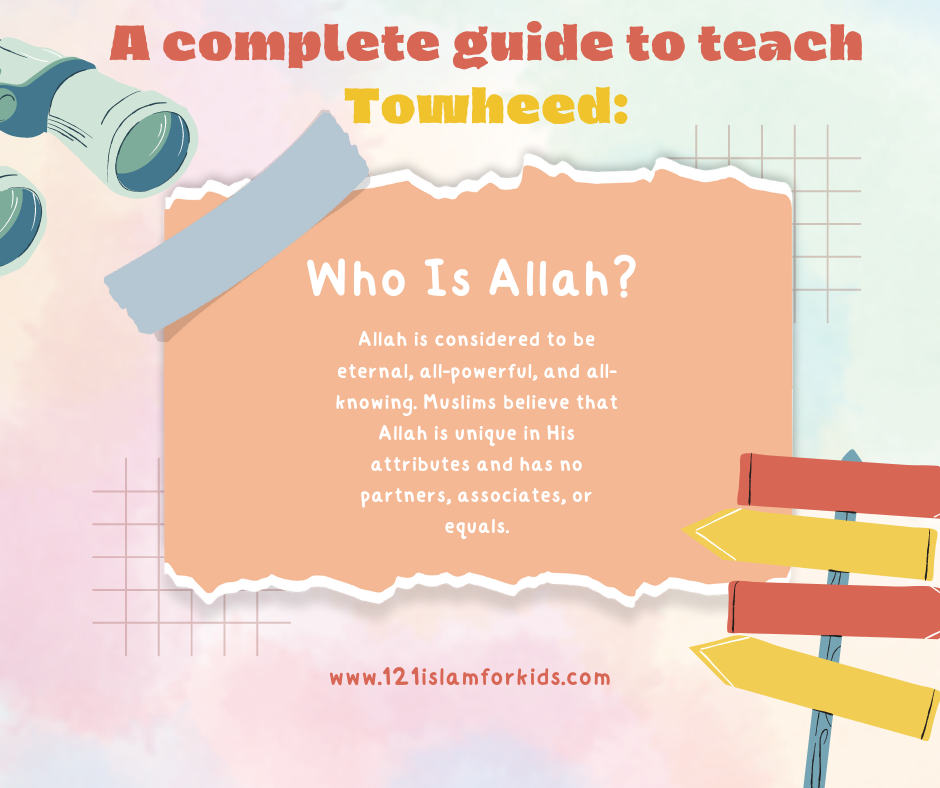
Who is the Allah? Allah is the Arabic term for God in Islam. Muslims believe that Allah is the one and only true God, the creator and sustainer of the universe. Allah is considered to be eternal, all-powerful, and all-knowing. Muslims believe that Allah is unique in His attributes and has no partners, associates, or equals. Allah is described in the Quran, which Muslims believe to be the direct word of God as revealed to Prophet Muhammad. The Quran emphasizes Allah’s divine attributes, including His mercy, wisdom, justice, and love. Allah is seen as the source of guidance, the ultimate judge, and the one who responds to the prayers and needs of His creation. Muslim believe in Allah Muslims believe that Allah has revealed His will and guidance to humanity through prophets and scriptures, including the Quran. They strive to worship and obey Allah, seeking His pleasure and following the teachings and example of Prophet Muhammad. Allah is seen as a compassionate and forgiving God, and Muslims are encouraged to develop a personal and intimate relationship with Him through acts of worship, prayer, supplication, and remembrance. Tawheed: The Oneness of Allah – A Fundamental Belief in Islam Tawheed is an Arabic term that refers to the concept of the oneness of Allah in Islamic belief. It is derived from the root word “Wahid,” which means “one.” Tawheed encompasses the belief in the absolute unity and uniqueness of Allah, recognizing Him as the one and only true God, with no partners, associates, or equals. Tawheed is the foundation of Islamic monotheism, highlighting the core belief that Allah is the sole creator, sustainer, and controller of the universe. Muslims firmly affirm that there is no deity worthy of worship except Allah. It involves acknowledging and accepting Allah’s divine attributes, such as His knowledge, power, mercy, and justice. The concept of Tawheed is based on the teachings of the Quran, which repeatedly emphasizes the oneness of Allah and rejects any form of polytheism or association of partners with Him. It is also supported by the Hadiths (sayings and actions of Prophet Muhammad), where the Prophet emphasized the importance of pure monotheism. Tawheed: three aspects: By understanding and affirming Tawheed, Muslims establish a deep connection with Allah, recognizing His supreme authority and surrendering themselves to His will. It brings about unity, clarity of purpose, and a strong sense of devotion, guiding Muslims in their worship, moral conduct, and relationship with Allah and His creation. Tawheed is a fundamental principle in Islam, shaping the faith and practice of Muslims worldwide. Conclusion: Tawheed, the oneness of Allah, forms the bedrock of Islamic belief. Muslims affirm the uniqueness, sovereignty, and perfection of Allah, worshiping Him alone and rejecting any partners or rivals. The Quranic verses, Hadiths, and teachings of the prophets emphasize the centrality of Tawheed in the Islamic faith. Understanding and embracing Tawheed brings unity, trust, and a profound sense of purpose to the lives of Muslims, as they submit themselves wholly to the worship and service of Allah, the one and only true God. How we will teach Towheed (Who is Allah) to our students? Teaching children about the concept of tawhid (the oneness of Allah) and introducing them to the concept of Allah can be done in several ways. Here are some suggestions for teaching children about Allah and fostering their understanding of tawhid: Common questions children might ask Children may ask a wide range of questions about Allah as they begin to explore and understand the concept of God. Here are some common questions children might ask: It’s important to approach these questions with patience, age-appropriate explanations, and a willingness to explore and learn together. Encouraging children to seek knowledge and providing them with simple, understandable answers will help them develop a better understanding of Allah and their faith. Remember, teaching children about Allah and tawhid is a gradual process. It is important to be consistent, and patient, and create an environment where they feel comfortable asking questions and learning about their faith Online class activity: After Reading the stories of creations and Introduction of Allah from Surah Ikhlaas.We know about Allah’s creation.The first Man.Al-Aleem Allah’s attribution.Allah has created man ( Story of His creation was told, Allah gathers the soil of all kinds and made a man and then gave him life.Then Allah gifted his eyes to see, ears to listen, heart to feel, and mind to think)So Allah Knows what is best for mankind.Allah knows,How to live?He guided us through his book Al-QuranHow to talk?What is bad and good?What food and drink is better for us?All other creatures were created and forced to do what Allah wanted them to do.But Mankind is free to choose.Allah Gave him the mind to think what is good and bad..If we will be thankful to Allah , He will increase His blessings.see the answers given by the kids in the Last picture. 6 Articles of Muslim Faith Resources: Books free books – 121 Islam for Kids Pinterest Videos Courses – 121 Islam for Kids How is this article? Do you like my teaching method? Enroll your children in our Online class Email or sign up here.
How to Teach and Learn Surah At-Tin? Step-by-Step
Surah At Tin (95) has been taught step-by-step with a complete guide, various activities, and a lot of free resources for students and teachers. Introduction of Surah At-Tin: Surah At-Tin is the 95th chapter of the Quran, consisting of 8 verses. It is named after the word “At-Tin” (fig) mentioned in the first verse. This Surah emphasizes the greatness of Allah’s creation and His ability to bring about different stages of human life. It begins by mentioning the fig and olive trees, symbolizing the blessings and provisions provided by Allah. Mount Sinai is also mentioned, highlighting the significance of divine revelation. The Surah then reflects on the creation of human beings, emphasizing that they have been created in the best form and shape. However, despite these blessings, humans can deviate from the right path and fall into arrogance and heedlessness. The Surah concludes by emphasizing that true success lies in having faith in Allah and performing righteous deeds. Those who believe and act righteously will receive an uninterrupted and everlasting reward. Overall, Surah At-Tin serves as a reminder of the importance of gratitude, humility, and righteousness in the sight of Allah. It encourages believers to reflect on the signs of Allah’s creation and strive for spiritual growth and moral excellence. Surah Tu-Tin Words -meanings Here are the word-to-word meanings of Surah At-Tin from Arabic to English: verse-by-verse Tafsir Here is the verse-by-verse tafsir (exegesis) of Surah At-Tin according to Ibn Kathir and Ibn Abbas: Verse 1: “By the fig” Verse 2: “And [by] Mount Sinai” Verse34: “And [by] this secure city [Makkah]“ Verse 4: “We have certainly created man in the best of stature” Verse 5: “Then We return him to the lowest of the low,” Verse 6: “Except for those who believe and do righteous deeds, for they will have a reward uninterrupted.” Verse 7: “Except for those who believe and do righteous deeds, for they will have a reward uninterrupted.” Verse 8: It’s important to note that the interpretations of Ibn Kathir and Ibn Abbas are highly respected but not the only interpretations available. Different scholars may have varying perspectives on the tafsir of Surah At-Tin. Oath Meaning and Purpose The use of oaths at the beginning of certain Surahs (chapters) in the Quran serves several purposes. When Allah begins a Surah with an oath, it adds emphasis and draws attention to the subject matter being discussed. Oaths are a rhetorical device used to captivate the listener’s or reader’s attention, to emphasize the truthfulness and importance of the message being conveyed. In the case of Surah At-Tin, Allah starts with oaths by mentioning the fig, olive, Mount Sinai, and the secure city (Makkah). By swearing these creations and locations, Allah emphasizes their significance and draws attention to the subsequent message contained in the Surah. Oaths are also used to evoke a sense of wonder, awe, and contemplation within the audience. By swearing elements of creation, Allah highlights His power, creativity, and authority over all things. It reminds the listeners or readers of the magnificence and order present in the world and encourages them to reflect upon the signs of Allah’s creation. Moreover, starting Surahs with oaths grabs the attention of the listeners or readers, compelling them to pay closer attention to the message that follows. It establishes the seriousness and importance of the subject matter being discussed, inviting individuals to contemplate and reflect on the message being conveyed. In summary, the use of oaths at the beginning of Surahs serves to emphasize the truthfulness and significance of the message, evoke contemplation and reflection, and capture the attention of the audience. It is a rhetorical device employed by Allah to deliver His message in a powerful and impactful manner. Surah AT-Tin explanation: This surah of eight verses was revealed in Makkah and takes itstitle from the first word lat-Teenl which means fig.By The fig and the olive and Mount Sinai and this Safe Land11Al lah swears by these four things and says that He created manin the finest mold. The fig and the olive are well-known fruits. The figand the olive offer an example of wholesome health-giving fruits.Mount Sinai is the place where Allah spoke to Prophet Musa, and the safe Landi is Makkah, where the Qur’an was first revealed. Al lah then says that He created man in the best image andform. He then reduced him to the lowest of the low; that is, Hellfire.After this attractiveness and beauty, the destination of those who disobeyed Allah will be Hellfire. However, those who believe in Allahand follow His guidance will not be among them; rather, they willhave a reward without end. Some scholars said that the lowest ofthe low also means old age.This surah ends by asking about that which causes people todeny the Final Judgement.It is a fact that many of the worst criminals are not caught orpunished in this life. Likewise, many God-fearing people who do theirbest in this life are not rewarded. Al lah will surely hand out exact justice to His creatures in the end!Is Al-lah not the Best of judges? This means Allah the Almighty isindeed the best of judges Who does not do any injustice to anyone.It is in absolute Justice that He will establish the Day of Judgement,and He will then reward the good people and punish the evil ones. Outline/Mindmap for Surah At-Tin: Please watch a video of the mindmap or See the picture in the Gallery of this mindmap to understand it well. Here is a short outline of Surah AT TIN I. Introduction A. Mention of oaths 1. Fig 2. Olive 3. Mount Sinai 4. Secure city (Makkah) II. The Creation of Man A. Man created in the best form and shape B. Reflection on the excellence of human abilities III. Transience of Human Existence A. The return to a state of weakness and helplessness B. Reminder of the temporary nature of life IV. Exception for the Believers A. Those who have faith in Allah B. Those who
“Enlighten the spirituality of your kids: Online Islamic Summer Camp”
121 Islam for Kids: Unlocking the Wonders of Islam at Our Spectacular Online Islamic Summer Camp! Introduction Islamic Summer Camp: Welcome to a world of inspiration, discovery, and spiritual growth! This summer, 121 Islam for Kids is thrilled to present our highly anticipated Online Islamic Classes Summer Camp. Designed exclusively for young minds, our camp is a transformative journey that will ignite a passion for Islam, foster strong faith, and cultivate a deep understanding of our beautiful religion. With engaging virtual sessions, expert instructors, interactive activities, and a nurturing community, we invite children from all corners of the globe to join us on an incredible adventure that will leave an indelible mark on their hearts and minds. Section 1:Embrace the Digital Frontier of Islamic Education: In today’s digital age, online learning has revolutionized the way knowledge is shared and accessed. At 121 Islam for Kids, we embrace this innovative approach, harnessing the power of technology to provide an immersive and enriching educational experience. Our Online Islamic Classes Summer Camp leverages cutting-edge virtual platforms, allowing children to delve into the world of Islam from the comfort and safety of their own homes. Through real-time video conferencing, interactive presentations, multimedia resources, and collaborative exercises, we create a vibrant virtual environment that connects young learners with the beauty of Islamic teachings. Section 2:Expert Instructors: Guiding Young Hearts and Minds: At the heart of our summer camp are our exceptional instructors—esteemed scholars, educators, and role models who are passionate about nurturing young minds. Our instructors possess deep knowledge of Islamic teachings and pedagogical expertise, ensuring that each session is engaging, age-appropriate, and captivating. With their compassionate guidance and wealth of experience, our instructors create a supportive learning environment where children can grow intellectually, emotionally, and spiritually. Section 3:An Unforgettable Curriculum: A Voyage into Islamic Knowledge: Our Online Islamic Classes Summer Camp features a meticulously crafted curriculum that spans a multitude of captivating topics. We believe in presenting Islam in a holistic manner, empowering children with a comprehensive understanding of their faith. From Quranic studies and stories of the Prophets to Islamic history, character development, and the pillars of Islam, our curriculum covers a vast array of subjects. Each session is carefully designed to stimulate curiosity, ignite a love for learning, and inspire children to live as devoted Muslims. Section 4:Interactive Activities: Engaging Minds and Nurturing Hearts At 121 Islam for Kids, we understand the importance of interactive and immersive experiences in capturing children’s imaginations. Our summer camp offers a wide range of activities that cater to diverse learning styles, ensuring an enriching experience for every child. From virtual group projects, Islamic quizzes, creative arts and crafts, and storytelling sessions, to guided discussions, our activities encourage critical thinking, self-expression, and the application of Islamic values in daily life. These interactive endeavors foster meaningful connections among young campers, creating a vibrant community united in their pursuit of knowledge and faith. Section 5:Flexibility and Convenience: Empowering Young Learners We recognize the demands of a busy summer schedule. Hence, our Online Islamic Classes Summer Camp is designed to be flexible, allowing children to participate at their convenience. With scheduled sessions and recorded replays available, children can engage with the curriculum at a time that suits their individual needs. Whether your child is joining from home or during travels, our virtual platform ensures a seamless experience, empowering young learners to balance their commitments while embracing the joys of Islamic education. Section 6: A Supportive Community: Building Lifelong Connections At 121 Islam for Kids, we prioritize building a warm and inclusive community. Our online summer camp offers a unique opportunity for children to connect with peers from diverse backgrounds, fostering lasting friendships rooted in faith. We provide a safe space where children can engage in discussions, share experiences, and learn from one another, guided by the values of respect, empathy, and unity. Our dedicated instructors and staff are always available to offer support, ensuring that every child feels valued and encouraged throughout their summer camp journey. Course Details: (Click on the link for course detail) Course: Quran Tajweed: Master the art of reciting the Quran with precision and beauty in our Quran Tajweed course. Our experienced instructors will guide you through the rules of Tajweed, ensuring accurate pronunciation, proper intonation, and an enchanting rhythm. By honing your recitation skills, you will develop a profound appreciation for the divine words of Allah. Course: Quran Tafsir: Dive into the depths of the Quran with our Quran Tafsir course. Led by knowledgeable scholars, this course unravels the meanings and interpretations of the Quranic verses, providing valuable insights into the profound wisdom and guidance contained within. Through interactive discussions and in-depth analysis, you will gain a deeper understanding of the teachings of the Quran. Course: Hadith with Stories: Immerse yourself in the rich heritage of Hadith with stories in our course dedicated to this noble tradition. Discover the wisdom and lessons found in the sayings and actions of the Prophet Muhammad (peace be upon him), and learn how they can be applied in your daily life. Engage in thought-provoking discussions and strengthen your connection with the timeless teachings of the Prophet. Course: Islamic Beliefs: Gain a comprehensive understanding of the core principles and foundations of Islam in our course on Islamic beliefs. Explore the fundamental beliefs that form the bedrock of your faith. Engage in thought-provoking discussions, examine the pieces of evidence, and strengthen your conviction in the principles that define your identity as a Muslim. Course: Rights of Parents in Islam: Discover the importance of honoring and respecting one’s parents in our course on the rights of parents in Islam. Explore the teachings of Islam regarding filial piety and the obligations towards parents. This course provides practical guidance on how to fulfill these duties and foster harmonious relationships within the family. Course: Islamic Dress Code: Uncover the significance of the Islamic dress code in our course on modesty and attire. Explore the principles and guidelines of Islamic dress, understanding the deeper meanings
Islamic Studies Online for Children in CA. Nurturing Faith
Islamic Studies Online for Children in CA by 121 Islam for Kids: Nurturing Faith and Knowledge Introduction: In today’s fast-paced world, it is crucial to provide children with a solid foundation in Islamic education. Recognizing this need, 121 Islam for Kids offers comprehensive and interactive online Islamic studies courses specifically designed for children in California / all over Canada. With a focus on nurturing faith and knowledge, these courses provide a unique opportunity for children to learn about Islam conveniently and engagingly. Features of Islamic studies online : Tailored Curriculum: The online Islamic studies courses offered by 121 Islam for Kids are carefully curated to meet the specific needs of children in California/Canada. The curriculum covers a wide range of topics, including Quranic studies, Prophetic stories, Islamic manners and etiquette, and the lives of the companions. The courses are structured progressively, allowing children to build a strong foundation in their understanding of Islam. Engaging and Interactive Learning: 121 Islam for Kids understands the importance of engaging children in their learning journey. The online courses employ interactive teaching methods such as storytelling, multimedia presentations, quizzes, and activities to capture the attention and interest of young learners. This ensures that children actively participate in their learning and retain knowledge effectively. Qualified and Dedicated Instructors: The courses are led by qualified and dedicated instructors who have expertise in teaching Islamic studies to children. These instructors have a deep understanding of Islamic principles and values and are skilled at delivering the content in an age-appropriate manner. They create a supportive and nurturing environment where children feel comfortable asking questions and actively engaging in discussions. Flexibility and Convenience: One of the key advantages of online Islamic studies courses is the flexibility and convenience they offer. Parents can easily enroll their children in the courses without the need for travel or fixed schedules. The courses are accessible from the comfort of home, allowing children to learn at their own pace and at a time that suits their schedule. Fostering Faith and Character Development: Beyond imparting knowledge, the courses offered by 121 Islam for Kids aim to foster faith and character development in children. Through lessons on Islamic values, ethics, and moral teachings, children are encouraged to develop strong faith, empathy, kindness, and good manners. The courses instill a sense of responsibility, community engagement, and respect for others, nurturing well-rounded individuals. Conclusion: In a multicultural society like California and Canada, providing children with a solid Islamic education is essential for their spiritual growth and identity formation. 121 Islam for Kids offers a valuable opportunity for children to learn about Islam in a convenient, engaging, and interactive online setting. With tailored courses, qualified instructors, and a focus on faith and character development, these courses empower children to build a strong connection with their faith and navigate their lives as confident and morally upright individuals. Enrolling your child in the online Islamic studies courses by 121 Islam for Kids is a step towards nurturing their faith and knowledge, providing them with a strong foundation for a meaningful and fulfilling life. Courses: Quran classes: We have online quran tajweed, recitation, and Quran Hifz classes for children. One-on-one classes with Qualified teachers. Quran Tafseer classes: Short and Easy to understand Quran translation and tafseer will be taught to the young learners. Infographics, mindmaps, work-by-word tajweed and meanings, stories, and duas are included in these classes. Hadith with Stories course consists of 30 short hadith It’s a personality development course for children with interesting stories. 30 short hadiths would be taught with stories. We have worksheets to solve after learning hadiths for implications. Prayer for kids course : A short course to teach about taharat, Gusal, wudu, times of prayers, number and names of prayers, pillars, conditions of prayer, and method of prayer. Kindness to Parents: A 1-week course to teach the rights of parents with practical work. Dua and how to be kind to parents is included in this course. 6 articles on the Muslim faith: Faiths/Muslim beliefs would be taught one by one with the help of mind maps and stories in the Quran. Islamic dress code: Islamic rules of dressing, Aurah/covering body rules, and modesty dressing will be included in this one-week course. Ramzan Boost course: 1 month before Ramzan we start this course. Everything about fasting rules and supplication with the Ramzan checklist and daily to-do list is included in this course. Faith boosts course in December to say NO MARYY CHRISTMAS: Stories of faith by the Quran will be added in this course with basic articles of faith in this course. Enrolments Available All courses Are available to start as in one on one classes. Please have a look at our group courses continued here. Email
“The Divine Promise:-A Tale of Surah At-Tin”
“The Divine Promise: The Story of Surah At-Tin” It is a series of Quranic Stories presented by 121 Islam for kids-A tale from the Quran “The Fruitful Journey” is a divine message for children from Surah At-Tin: Once upon a time, in a small village nestled between mountains, there lived a young boy named Adam. Adam was known for his kind heart and inquisitive nature. One sunny day, as he sat under a fig tree near his house, he noticed the beautiful fruits hanging from its branches. He plucked a fig and marveled at its sweetness. Little did Adam know that this fig would become a symbol of an important lesson he was about to learn. As Adam grew older, he developed a deep love for nature. He spent hours exploring the olive groves that surrounded his village, fascinated by the resilience and beauty of the olive trees. He would often climb the trees and admire their lush green leaves and the golden olives they bore. The olives became a reminder for him of the bounties and blessings bestowed upon him by Allah. One day, Adam’s father took him on a journey to a nearby mountain known as Mount Sinai. As they ascended, Adam was captivated by the breathtaking scenery surrounding him. Upon reaching the peak, his father shared the story of Prophet Musa (Moses) and how Allah had revealed the Torah to him on that very mountain. Adam felt a sense of awe and realized the significance of the mountain as a symbol of divine revelation. Years passed, and Adam embarked on a pilgrimage to the holy city of Makkah. As he stood in the sacred precincts, he felt a profound sense of security and peace enveloping him. The city’s ancient walls whispered stories of the Prophet Ibrahim (Abraham) and the journey of faith he embarked upon. Adam understood that Makkah symbolized the haven and sanctuary provided by Allah to believers. As Adam grew older, he began to ponder the stages of human life. He realized that Allah had created mankind in the best form and shape, with unique abilities and intellect. Reflecting on this, he recognized the responsibility that came with being human. He understood the need to appreciate the blessings bestowed upon him and utilize his abilities for the greater good. As time went on, Adam experienced the inevitable cycle of life. He witnessed loved ones growing old and eventually returning to a state of weakness and helplessness. This humbling reality reminded him of the temporary nature of worldly existence. It made him realize the importance of humility, gratitude, and seeking Allah’s pleasure throughout life’s journey. In the later stages of his life, Adam found solace in his unwavering faith and his commitment to righteous deeds. He understood that true success lies in believing in Allah and acting righteously. This understanding became a guiding light for him, as he sought to leave a lasting impact on the world through acts of kindness and compassion. As Adam reached the end of his life, he was comforted by the knowledge that those who believe and do righteous deeds will be rewarded with an uninterrupted and eternal reward from Allah. He passed away peacefully, leaving behind a legacy of faith and good deeds that inspired generations to come. And so, the story of Adam and his journey through the stages of human life, guided by the lessons of Surah At-Tin, continued to be shared and cherished. It served as a reminder for people to appreciate the blessings around them, reflect on the temporary nature of life, and strive for faith and righteous actions in the pursuit of eternal rewards. Surah At-Tin’s step-by-step teaching method Video stories More Quranic stories Story Books Islamic Kids Best website |Free books download Quran Tafsir
What is Monotheism? The largest monotheism Religions:
Islam and largest monotheism religions in the world: Unveiling the truth and difference between Islam and other religions and beliefs. What is Monotheism? Monotheism is the belief in the existence of a single supreme deity or God. It holds that there is only one God who is all-powerful, all-knowing, and the creator of the universe. Monotheistic religions reject the idea of multiple gods or polytheism. In Islam, monotheism is a fundamental concept known as “Tawhid,” which is emphasized throughout the Quran and the teachings of the Prophet Muhammad. Monotheism in Quran: The Quran contains numerous verses that affirm the oneness of Allah and warn against associating partners with Him. For example, in Surah Al-Ikhlas (Chapter 112), it states: “Say, ‘He is Allah, the One, Allah, the Eternal Refuge. He neither begets nor is born, nor is there to Him any equivalent.’” (Quran 112:1-4) This verse emphasizes the uniqueness and absolute oneness of Allah, rejecting any notion of partners or equals. Additionally, the Prophet Muhammad emphasized the importance of monotheism in his teachings. In a hadith, he said: “The best words are: La ilaha illallah لا إله إلا الله(There is no god but Allah).” This statement affirms the belief in the oneness of Allah as the central tenet of Islam. While Islam places a strong emphasis on monotheism, it differs in certain beliefs from other religions that also adhere to monotheistic principles. Here are some other religions based on monotheism but with differences from Islam: What is polytheism? Polytheism is a religious belief system that recognizes and worships multiple deities or gods. In polytheistic religions, there is a belief in the existence of many gods, each with its own distinct powers, attributes, and roles. These gods are often associated with specific aspects of nature, such as the sun, moon, earth, water, or other natural forces. Polytheistic belief systems can be found in various cultures throughout history, including ancient Greek and Roman religions, Norse mythology, Hinduism, Shintoism, and some African and Native American traditional religions. Each of these polytheistic traditions may have a different pantheon of gods, with certain deities holding greater importance or prominence. In polytheism, followers may worship and offer prayers, rituals, and sacrifices to different gods based on their specific needs or desires. It is not uncommon for individuals to have a preferred deity or personal connection with a particular god, while still acknowledging the existence and significance of other deities within the pantheon. It’s important to note that polytheism differs from monotheism, which is the belief in a single, all-powerful deity, and from atheism, which is the absence of belief in any deities. Other Monotheism Religions Compared to Islam: Christianity: Christianity is a monotheistic religion that believes in the Trinity, which states that God is one being existing in three distinct persons: the Father, the Son (Jesus Christ), and the Holy Spirit. Islam rejects the concept of the Trinity and considers it a form of polytheism. Judaism: Judaism is one of the oldest monotheistic religions and forms the foundation for the Abrahamic faiths. It emphasizes the covenant between God and the Jewish people. While Islam shares the belief in monotheism with Judaism, there are differences in theological interpretations and practices. Sikhism: Sikhism is a monotheistic religion that emerged in South Asia in the 15th century. It believes in the oneness of God, referred to as Ik Onkar. Sikhism incorporates elements from both Islam and Hinduism but has distinct beliefs and practices. Bahá’í Faith: The Bahá’í Faith is a relatively newer monotheistic religion that originated in the 19th century. It emphasizes the unity of all religions and the belief in the oneness of God. While sharing a belief in monotheism, the Bahá’í Faith differs in its teachings about the succession of prophets and the unity of religions. These are just a few examples of monotheistic religions with differences in beliefs and practices compared to Islam. It is important to recognize that while monotheism is a common thread among these religions, the specific understandings and interpretations of monotheism may vary, resulting in distinct theological systems and religious practices. Other religious beliefs and philosophical perspectives Besides polytheism and monotheism, there are several other religious beliefs and philosophical perspectives that exist worldwide. Here are a few examples: These are just a few examples of the diverse range of beliefs that exist beyond polytheism and monotheism. It’s important to recognize that there are numerous religious, spiritual, and philosophical perspectives worldwide, each with its own unique characteristics and interpretations of the nature of the divine and the universe. Conclusion: In conclusion, polytheism is a religious belief system that recognizes and worships multiple deities, while monotheism is the belief in a single, all-powerful deity. Polytheistic religions have pantheons with multiple gods, each with distinct attributes and roles, while monotheistic religions emphasize the existence of one supreme God. Beyond polytheism and monotheism, there are various other belief systems, such as pantheism, panentheism, animism, atheism, agnosticism, and deism. These beliefs offer alternative perspectives on the nature of the divine, the universe, and the relationship between humans and the divine. It’s important to respect and understand the diversity of religious and philosophical beliefs that exist, as they contribute to the richness of human culture and worldview. If this article was helpful for you? Leave your thought. Other links about Monotheism: Noble Quran | Surah Ikhlas 11 Steps easy Tafsir. A short course on 6 Articles of Faith in Islam: What is Sufism? 4 Principles of spiritual development? Email Story Books Gallery Facebook. Youtube Urdu Channel Youtube English Channel