Surah Al-Falaq An-Naas study method provides comprehensive learning techniques for these two protective chapters of the Quran. This interactive guide includes detailed verse-by-verse explanations, word meanings, translations, and educational activities for understanding Surah Al-Falaq and Surah An-Naas.Surah.
Surah Surah Al-Falaq An-Naas Study Method: Understanding the Chapter of Dawn (سورة الفلق)Surah Al-Falaq (سورة الفلق)
These Surah Al-Falaq An-Naas teachings guide us to seek Allah’s protection from all types of evil.This Surah teaches us to seek Allah’s protection from all types of evil.
Verse 1:
Arabic:
قُلْ أَعُوذُ بِرَبِّ الْفَلَقِ
English Translation:
“Say: I seek refuge in the Lord of the dawn.”
Word Meanings:
- قُلْ (Qul) – Say
- أَعُوذُ (A’udhu) – I seek refuge
- بِرَبِّ (bi-Rabbi) – In the Lord
- الْفَلَقِ (al-Falaq) – The dawn or the daybreak
Explanation:
In this verse, we are told to seek protection from Allah, the One who causes the dawn to break through the darkness. The “dawn” symbolizes light, hope, and the power to overcome darkness and evil.
Verse 2:
Arabic:
مِن شَرِّ مَا خَلَقَ
English Translation:
“From the evil of what He has created.”
Word Meanings:
- مِن شَرِّ (min sharri) – From the evil
- مَا (ma) – What
- خَلَقَ (khalaqa) – He has created
Explanation:
This verse asks for protection from any harmful or evil things in Allah’s creation. While Allah’s creation is good, some things or beings may cause harm, so we ask Allah to protect us from any possible danger.
Verse 3:
Arabic:
وَمِن شَرِّ غَاسِقٍ إِذَا وَقَبَ
English Translation:
“And from the evil of the night when it grows dark.”
Word Meanings:
- غَاسِقٍ (ghasiqin) – Darkness
- إِذَا (idha) – When
- وَقَبَ (waqab) – It settles
Explanation:
This verse seeks protection from the dangers of the night, when darkness falls, and we cannot see clearly. The night can bring fear and unknown dangers, but Allah can protect us.
Verse 4:
Arabic:
وَمِن شَرِّ النَّفَّاثَاتِ فِي الْعُقَدِ
English Translation:
“And from the evil of those who blow on knots.”
Word Meanings:
- النَّفَّاثَاتِ (an-naffathat) – Those who blow
- فِي الْعُقَدِ (fi-l-‘uqad) – On knots
Explanation:
This verse refers to the evil of those who practice magic or sorcery by tying knots and blowing on them. It’s a form of evil behavior that people may use to harm others. We seek Allah’s protection from such harmful acts.
Verse 5:
Arabic:
وَمِن شَرِّ حَاسِدٍ إِذَا حَسَدَ
English Translation:
“And from the evil of the envious one when he envies.”
Word Meanings:
- حَاسِدٍ (hasid) – The envious one
- حَسَدَ (hasada) – He envies
Explanation:
This verse seeks protection from those who feel jealous and wish harm upon others. When someone envies another person, they might desire bad things to happen to them. We ask Allah to protect us from such jealousy.
Surah An-Naas (سورة الناس)
This Surah teaches us to seek protection from the evil whispers of Shaytan (Satan) and all harmful influences.
Verse 1:
Arabic:
قُلْ أَعُوذُ بِرَبِّ النَّاسِ
English Translation:
“Say: I seek refuge in the Lord of mankind.”
Word Meanings:
- قُلْ (Qul) – Say
- أَعُوذُ (A’udhu) – I seek refuge
- بِرَبِّ (bi-Rabbi) – In the Lord
- النَّاسِ (an-Naas) – Of mankind
Explanation:
In this verse, we are instructed to seek refuge in Allah, the Lord of all people. This reminds us that Allah is the Creator and Protector of every human being.
Verse 2:
Arabic:
مَلِكِ النَّاسِ
English Translation:
“The King of mankind.”
Word Meanings:
- مَلِكِ (Malik) – King
- النَّاسِ (an-Naas) – Of mankind
Explanation:
Here, we acknowledge that Allah is the King of all people. He is in charge of everything, and no one has power or authority over Him. He alone controls and protects us.
Verse 3:
Arabic:
إِلَٰهِ النَّاسِ
English Translation:
“The God of mankind.”
Word Meanings:
- إِلَٰهِ (Ilah) – God
- النَّاسِ (an-Naas) – Of mankind
Explanation:
This verse reminds us that Allah is the only God of all humans. He is the One we worship and rely on. By stating that Allah is our God, we confirm our belief in His power to protect us from harm.
Verse 4:
Arabic:
مِن شَرِّ الْوَسْوَاسِ الْخَنَّاسِ
English Translation:
“From the evil of the whisperer who withdraws.”
Word Meanings:
- شَرِّ (sharri) – Evil
- الْوَسْوَاسِ (waswas) – Whisperer
- الْخَنَّاسِ (khannas) – Who withdraws
Explanation:
This verse asks for protection from the whisperer, meaning Shaytan, who quietly puts evil thoughts into our minds and then hides. Shaytan tries to make us do bad things, but we seek Allah’s protection to avoid falling into these traps.
Verse 5:
Arabic:
الَّذِي يُوَسْوِسُ فِي صُدُورِ النَّاسِ
English Translation:
“Who whispers in the hearts of mankind.”
Word Meanings:
- يُوَسْوِسُ (yuwaswisu) – Whispers
- فِي (fi) – In
- صُدُورِ (sudoor) – Hearts
- النَّاسِ (an-Naas) – Of mankind
Explanation:
Shaytan tries to enter people’s hearts and minds to make them think bad things. He whispers evil ideas into our hearts to lead us away from the right path, but Allah can protect us from these whispers.
Verse 6:
Arabic:
مِنَ الْجِنَّةِ وَالنَّاسِ
English Translation:
“From among jinn and among mankind.”
Word Meanings:
- الْجِنَّةِ (al-jinnah) – The jinn (invisible beings)
- النَّاسِ (an-Naas) – Mankind
Explanation:
This verse tells us that evil whispers can come from both jinn (invisible beings) and humans. Some people or beings might try to lead us astray, but by seeking Allah’s protection, we can stay safe from all types of evil influences.
Summary of Both Surah Al-Falaq An-Naas
- Surah Al-Falaq protects us from the dangers of the outside world—whether they come from people, jealousy, or magic.
- Surah An-Naas protects us from the dangers within—whispers and evil thoughts that try to lead us away from the right path.
Reciting both Surah Al-Falaq An-Naas reminds us that Allah is our ultimate protector from all forms of evil, and we should always turn to Him in times of fear or difficulty.Reciting these Surahs reminds us that Allah is our ultimate protector from all forms of evil, and we should always turn to Him in times of fear or difficulty.
Additional Information:
- These Surahs should be recited in the morning and evening as part of Azkar (remembrance of Allah) to seek protection from all harm throughout the day and night.
- It’s also recommended to recite them before sleeping, to seek Allah’s protection from evil during the night.
Quiz: Surah Al-Falaq & Surah An-Naas
Here’s a fun and educational quiz for kids based on the key facts and explanations of Surah Al-Falaq and Surah An-Naas.
Multiple Choice Questions (MCQs):
- Who do we ask for protection in Surah Al-Falaq?
- A) The sun
- B) The moon
- C) The Lord of the dawn
- D) The stars Answer: C) The Lord of the dawn
- In Surah Al-Falaq, we ask Allah to protect us from the evil of:
- A) Animals
- B) Darkness, jealousy, and magic
- C) Angels
- D) Trees Answer: B) Darkness, jealousy, and magic
- What does “Al-Falaq” mean?
- A) Night
- B) Darkness
- C) Daybreak/Dawn
- D) Stars Answer: C) Daybreak/Dawn
- In Surah An-Naas, who is the King of mankind?
- A) A Prophet
- B) Allah
- C) Angels
- D) Shaytan Answer: B) Allah
- Who tries to whisper bad thoughts in our hearts?
- A) Shaytan
- B) Angels
- C) Prophets
- D) Friends Answer: A) Shaytan
- What does “An-Naas” mean in Surah An-Naas?
- A) People
- B) Angels
- C) Shaytan
- D) Jinn Answer: A) People
- How many verses (ayahs) are in Surah Al-Falaq?
- A) 3
- B) 5
- C) 7
- D) 6 Answer: B) 5
- How many verses (ayahs) are in Surah An-Naas?
- A) 6
- B) 4
- C) 3
- D) 7 Answer: A) 6
- When is it recommended to recite Surah Al-Falaq and Surah An-Naas?
- A) Only during Ramadan
- B) During morning and evening
- C) After every meal
- D) Before sleeping only
Answer: B) During morning and evening
- Why do we recite Surah Al-Falaq and Surah An-Naas in the morning and evening?
- A) To protect ourselves from hunger
- B) To ask for Allah’s protection from all kinds of evil throughout the day and night
- C) To bring rain
- D) To avoid studying
Answer: B) To ask for Allah’s protection from all kinds of evil throughout the day and night
Short Answer Questions:
- What is the main theme of Surah Al-Falaq?
- Answer: The main theme is seeking Allah’s protection from external evils, such as darkness, jealousy, and magic.
- What is the main theme of Surah An-Naas?
- Answer: The main theme is seeking Allah’s protection from the evil whispers of Shaytan and evil thoughts.
- From which two types of beings can evil whispers come, according to Surah An-Naas?
- Answer: Evil whispers can come from both jinn and humans.
- Why are Surah Al-Falaq and Surah An-Naas called “Al-Mu’awwidhatayn”?
- Answer: They are called Al-Mu’awwidhatayn because they are the two Surahs of seeking protection from Allah.
- What was the occasion for the revelation of these two Surahs?
- Answer: These Surahs were revealed when Prophet Muhammad (peace be upon him) was affected by magic, and Allah revealed these Surahs to protect him from harm.
- Why are these two Surahs recited together often?
- Answer: These Surahs are recited together because both provide protection from external and internal evils, making them powerful for seeking Allah’s protection.
True/False Questions:
- Surah Al-Falaq protects us from the evil whispers of Shaytan.
- Answer: False (It’s Surah An-Naas that protects from evil whispers of Shaytan).
- Surah An-Naas teaches us to seek refuge in Allah, who is the Lord, King, and God of mankind.
- The word “Falaq” means darkness.
- Answer: False (It means dawn or daybreak).
- Surah Al-Falaq has 6 verses.
- Answer: False (It has 5 verses).
- Both Surah Al-Falaq and Surah An-Naas were revealed to help protect the Prophet Muhammad (peace be upon him) from the effects of magic.
This quiz can help children review the key facts and concepts from Surah Al-Falaq An-Naas in a fun and engaging way!This quiz can help children review the key facts and concepts from the two Surahs in a fun and engaging way!
Study method
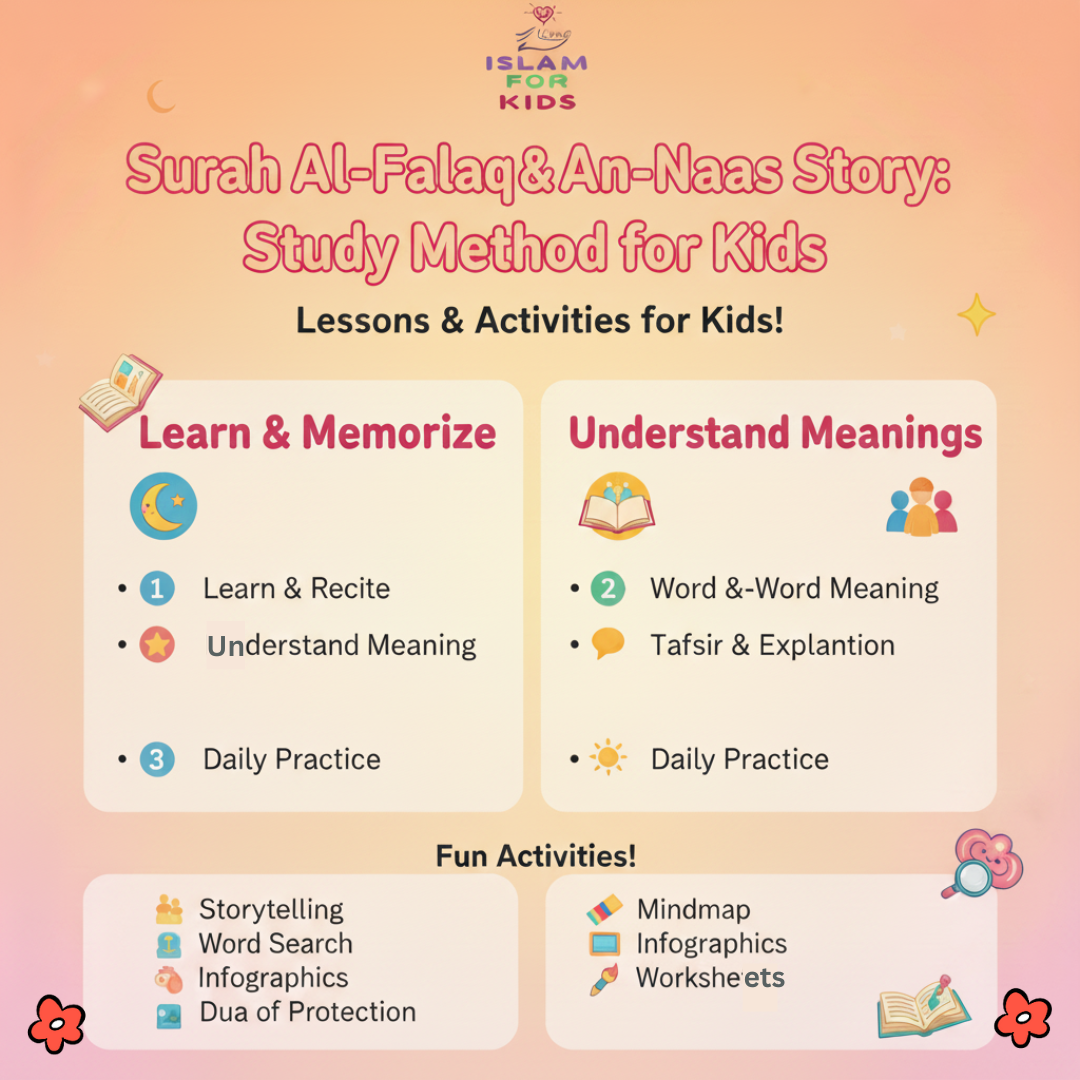
In our online classes, we use an engaging and comprehensive study method to teach Surah Al-Falaq and Surah An-Naas. Our goal is to ensure students not only learn to recite and memorize these Surahs but also understand their meanings through creative and interactive learning tools. Here’s how we do it, with links to detailed resources for each step:
1. Recitation (تلاوت)
Objective:
We begin by focusing on the correct recitation of the Surahs. Using videos of expert reciters, students follow along to perfect their pronunciation. Each verse is practiced until fluency is achieved.
Click here for our recitation videos.
2. Tajweed (تجوید)
Objective:
We introduce the essential rules of Tajweed so students can recite the Quran correctly. We pay special attention to proper articulation of Arabic sounds and apply these rules in real-time recitation practice.
Explore our Tajweed lessons with videos and guides.
3. Memorization (حفظ)
Objective:
Memorization is made easy with the help of videos that guide students step-by-step. The process is broken into small sections, and each is repeated multiple times to ensure retention.
Learn more about our Hifz videos and memorization techniques.
4. Words Meaning and Translation
Objective:
We teach word meanings and translations using the “My First Quran with Pictures” book, making it easy for students to grasp the Arabic words along with their English meanings. This method makes learning engaging and fun.
See how we use “My First Quran with Pictures” in our lessons.
5. Tafsir (تفسیر) Surah Al-Falaq An-Naas
Objective:
We explain the meanings and lessons of the Surahs through the Islamic Education Book. Each verse is discussed in a simple and age-appropriate way, helping students understand the significance of seeking Allah’s protection.
Explore our Tafsir lessons and resources.
6. Infographics Surah Al-Falaq An-Naas
Objective:
Infographics are used to simplify the Surahs’ key themes. We either use visuals from “My First Quran with Pictures” or encourage students to create their own. This visual learning helps students retain the key messages of each verse.
Check out our infographic tools and creative projects.
7. Storytelling
Objective:
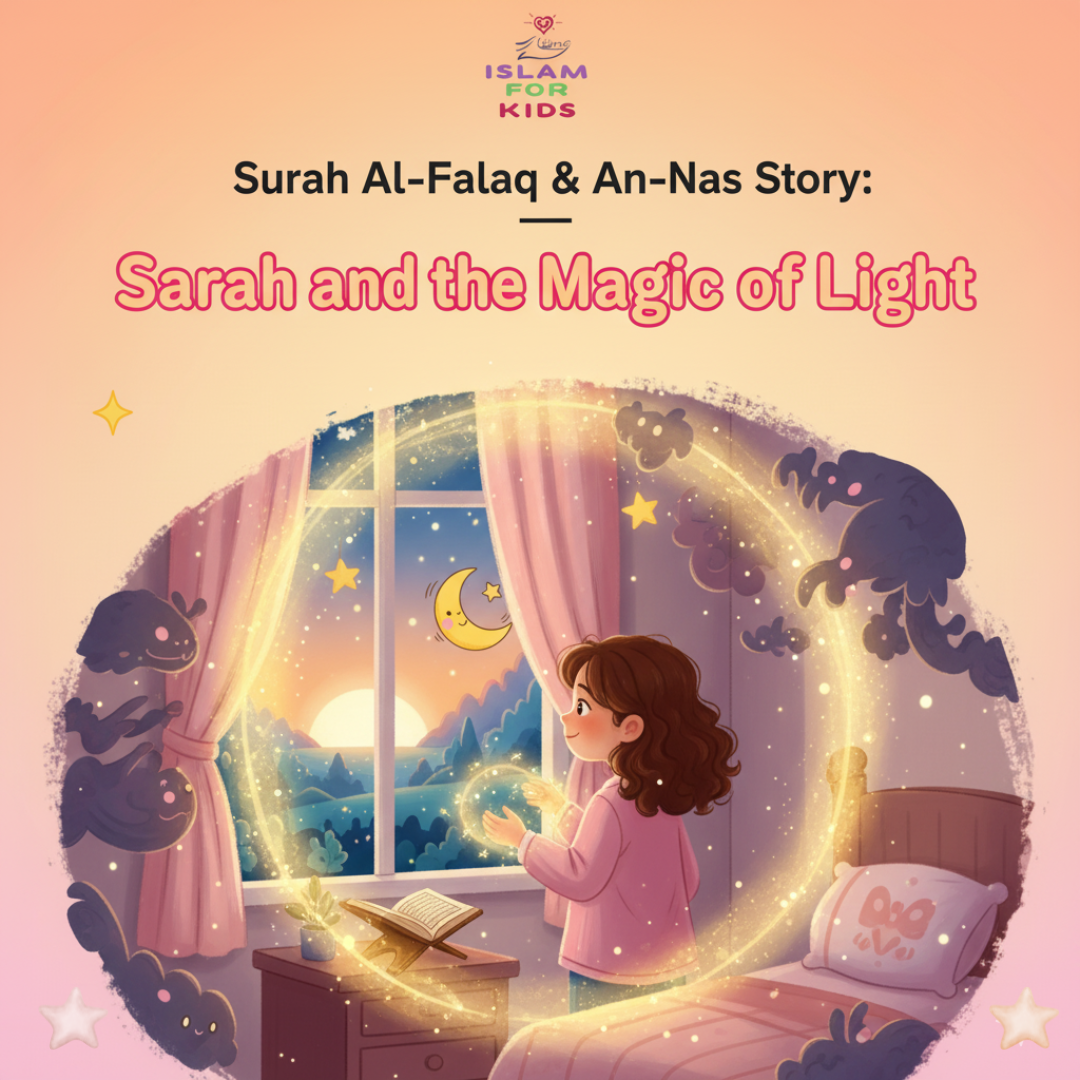
We enhance understanding through storytelling in class and with video animations. Stories like “Sarah and the Magic of Light” bring the Surahs’ meanings to life, making them more relatable for children.
Watch our storytelling videos and animations.
8. Mind Mapping
Objective:
We teach mind mapping using pre-designed images and videos to help students visually organize the lessons from the Surahs. These mind maps make it easier to understand and remember the concepts.
Discover our mind mapping resources and videos.
9. Exercises and Revisions (نظرثانی)
Objective:
We conduct regular revisions to ensure long-term retention. For assessments, we use interactive quizzes and exercises that test the students’ understanding and memorization of the Surahs.
Check out our revision quizzes and exercises.
Our method combines the power of visual aids, videos, books, and interactive tools to make learning Surah Al-Falaq and Surah An-Naas both fun and effective.
Visit the links below for our resources and activities:
Explore our resources and enroll today!