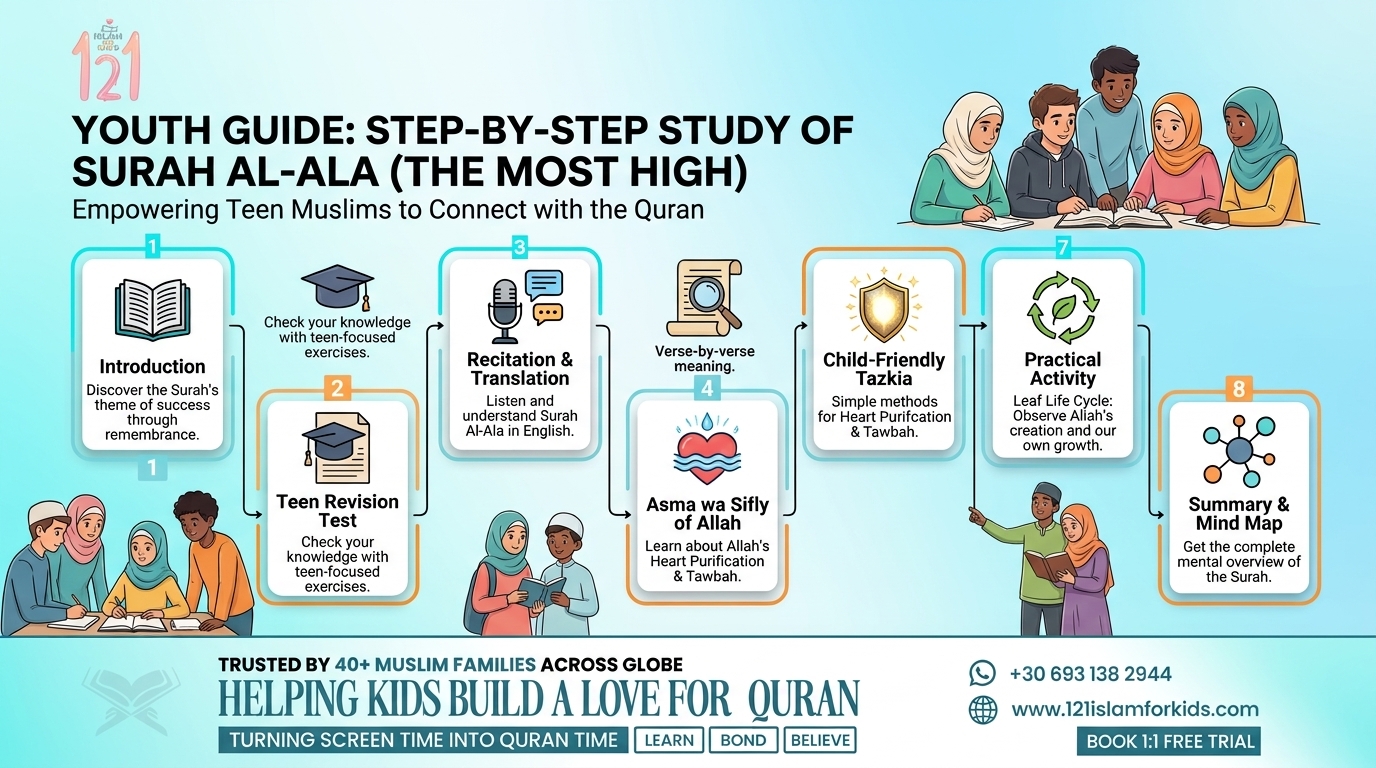
Welcome to the ultimate Step-by-Step Surah Al-Ala Study for Teens. This comprehensive guide is designed to help you not only recite chapter 87 of the Quran but to deeply understand its powerful message, its context from Tafseer Ibn Kathir, and how its ancient wisdom relates directly to your life as a modern teenager. Whether you are studying for Islamic school, wanting to improve your prayer, or seeking spiritual growth, this guide will walk you through everything you need to know.
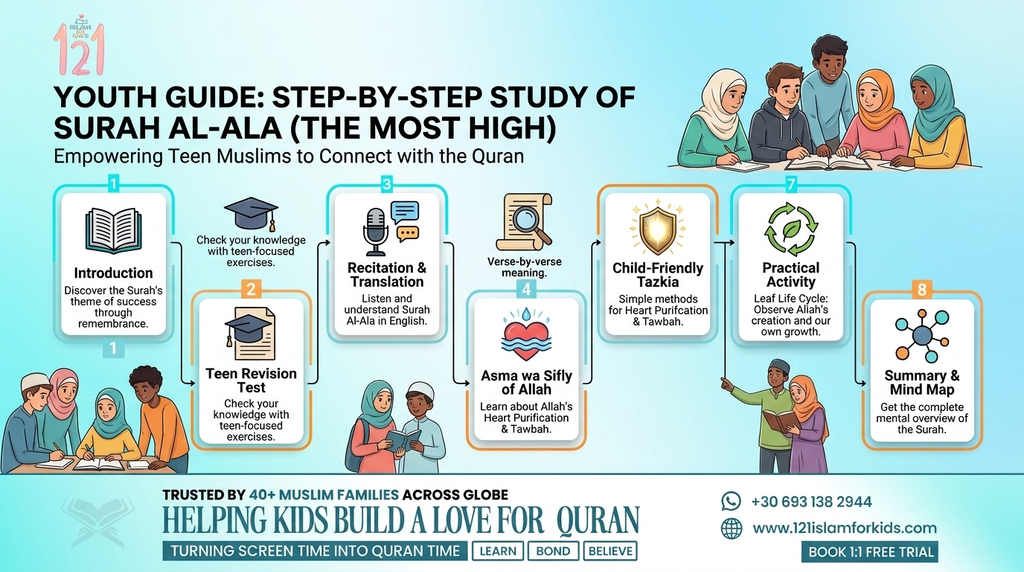
To start our Step-by-Step Surah Al-Ala Study for Teens, we must understand what makes this Surah unique.
This Surah holds a special place in Islamic practice. The Prophet Muhammad (ﷺ) loved Surah Al-Ala. He frequently recited it during the first unit (rak’ah) of the most important weekly and yearly prayers: Friday (Jumu’ah) prayers, Eid prayers, and Witr prayers after Isha.
When Verse 1 was revealed—“Glorify the Name of your Lord, the Most High”—the Prophet (ﷺ) instructed Muslims to say “Subhana Rabbiyal A’la” (Glory be to my Lord, the Most High) during prostration (Sujood). Studying Surah Al-Ala directly improves your Salah by helping you understand the very words you say every day.
The core of any surah study is the recitation and basic meaning.
| Verse | Arabic Text | English Translation |
| 1 | سَبِّحِ اسْمَ رَبِّكَ الْأَعْلَى | Glorify the name of your Lord, the Most High, |
| 2 | الَّذِي خَلَقَ فَسَوَّىٰ | The One Who creates and completes (all things), |
| 3 | وَالَّذِي قَدَّرَ فَهَدَىٰ | And Who determines (how long they exist) and directs (them to their end), |
| 4 | وَالَّذِي أَخْرَجَ الْمَرْعَىٰ | And Who brings out the lush green pastures, |
| 5 | فَجَعَلَهُ غُثَاءً أَحْوَىٰ | And then reduces them to dry stalks (dry chaff). |
| 6 | سَنُقْرِئُكَ فَلَا تَنسَىٰ | We will teach you to recite, so you won’t forget anything, |
| 7 | إِلَّا مَا شَاءَ اللَّهُ ۚ إِنَّهُ يَعْلَمُ الْجَهْرَ وَمَا يَخْفَىٰ | Unless Allah wants; for He knows what is out in the open as well as what’s hidden away. |
| 8 | وَنُيَسِّرُكَ لِلْيُسْرَىٰ | We’ll soon make your path towards peace of mind an easy one. |
| 9 | فَذَكِّرْ إِن نَّفَعَتِ الذِّكْرَىٰ | So remind (people), for it may be to their benefit. |
| 10 | سَيَذَّكَّرُ مَن يَخْشَىٰ | Whoever is afraid (of making his Lord angry) will take this reminder, |
| 11 | وَيَتَجَنَّبُهَا الْأَشْقَى | While the wretched (bad people) will ignore it. |
| 12 | الَّذِي يَصْلَى النَّارَ الْكُبْرَىٰ | That kind of person is the one who will enter the blazing Fire, |
| 13 | ثُمَّ لَا يَمُوتُ فِيهَا وَلَا يَحْيَىٰ | And there is no living or dying in there! |
| 14 | قَدْ أَفْلَحَ مَن تَزَكَّىٰ | And so it is that the one who tries to improve himself (purifies himself) shall prosper, |
| 15 | وَذَكَرَ اسْمَ رَبِّهِ فَصَلَّىٰ | He remembers the name of his Lord and prays. |
| 16 | بَلْ تُؤْثِرُونَ الْحَيَاةَ الدُّنْيَا | But no! It seems that (most of) you still prefer the life of this world, |
| 17 | وَالْآخِرَةُ خَيْرٌ وَأَبْقَىٰ | Even though the next life is better and more lasting. |
| 18 | إِنَّ هَٰذَا لَفِي الصُّحُفِ الْأُولَىٰ | Yet, these truths were revealed in ancient scrolls before— |
| 19 | صُحُفِ إِبْرَاهِيمَ وَمُوسَىٰ | In the scrolls of Abraham and of Moses. |
Here, we dive into the core of our Step-by-Step Surah Al-Ala Study for Teens, using Tafseer Ibn Kathir to clarify the deeper meanings.
1.Part 1: Allah’s Greatness & Power (Verses 1–5):Focus on Creation and Natural Laws.
Allah begins by commanding us to glorify His Name above everything. Ibn Kathir explains that Allah created everything in perfect proportions (Khalaqa Fa-Sawwa). He predetermined destinies and guided every creature to what it needs to survive (Qaddara Fa-Hada). Allah also brings forth green plants, allows them to flourish, and eventually causes them to turn into dry, dark stubble. This natural cycle reminds us that this world is temporary.
2.Part 2: Divine Comfort to the Prophet (ﷺ) (Verses 6–8): Focus on Quran Preservation & Ease.
When revelation first began, Prophet Muhammad (ﷺ) worried he might forget the words brought by Angel Jibreel. Allah comforted him by promising that He would make him recite and retain the Quran effortlessly. Allah knows both the apparent and hidden things, and He facilitates the easiest path for those who follow His guidance.
3. Part 3: Two Types of People (Verses 9–13): Focus on Response to Guidance.
The Prophet (ﷺ) is commanded to spread the message. People respond in two ways:
4.Part 4: Success vs. Worldly Deception (Verses 14–17): Focus on True Prosperity.
True success (Falah) belongs to those who purify their hearts, remember Allah’s Name, and keep up their prayers. However, human nature often prioritizes immediate worldly gains (Dunya) over the eternal rewards of the Next World (Akhirah).
5.Part 5: The Timeless Message (Verses 18–19):Focus on Continuity of Revelation.
The core spiritual principles in Surah Al-A’la are not new; they were also recorded in the ancient scriptures revealed to Prophet Ibrahim (Abraham) and Prophet Musa (Moses).
A vital step in any surah study for teenagers is identifying the names and attributes of Allah. Based on Verses 1–7, we learn several key Attributes:
Teenagers need practical tools for spiritual growth. The Quran emphasizes Tazkia (purification) and Tawbah (repentance). Below are simple steps designed for teens to practice what Surah Al-A’la encourages.
“Truly, Allah loves those who turn to Him and loves those who purify themselves.” (Quran 2:222)
Step 1: Regret the Sin
Step 2: Stop the Sin, Now!
Step 3: Intend to Never Go Back, Never!
Step 4: Seek Forgiveness of Allah, Repent
Step 5: Follow the Bad with Good
Step 6: Do Not Delay Tawbah!
This Is It!
A dynamic part of our Step-by-Step Surah Al-Ala Study for Teens connects verses of the Quran to science.
Objective: Connect Verses 4–5—“Who brings out the lush green pastures, and then reduces them to dry stalks”—to real-world biology and spiritual reflection.
Visualizing the Cycle:
  [Stage 1: Spring/Summer]        [Stage 2: Autumn]             [Stage 3: Dry Chaff]
  Lush Green Leaf           --->  Fading/Yellowing Leaf   --->  Crumbled Brown Stalk
  (Creation & Provision)          (Time & Transition)           (Temporary Nature of Dunya)
Student Activity Instructions:
This activity is not just about observing nature; it is about recognizing the Khalia (Creator), Al-Aleem (the All-Knowing), and Al-Qadir (the All-Powerful) behind it.
The foundational concept for this activity is found explicitly in the Quran, reinforcing Allah’s total awareness:
“And with Him are the keys of the unseen; none knows them except Him. And He knows what is on the land and in the sea. Not a leaf falls but He knows it. And there is no grain in the darkness of the earth and no moist or dry thing but that it is written in a clear record.” (Quran 6:59)
To summarize our complete surah study, we present a thematic overview and a visual mind map.
                         SURAH AL-A'LA (19 Verses)
                                     |
       +-----------------------------+-----------------------------+
       |                             |                             |
[Verses 1-5]                  [Verses 6-8]                  [Verses 9-13]
Allah's Power &               Divine Comfort &              Two Types of People:
Creation Cycle                Memorization Guard            1. Fearing / Mindful
(Greenery -> Dry Chaff)       (Quran made easy)             2. Wretched / Stubborn
       |                             |                             |
       +-----------------------------+-----------------------------+
                                     |
                       +-------------+-------------+
                       |                           |
                 [Verses 14-17]              [Verses 18-19]
                 True Prosperity             Ancient Scrolls
                 (Tazkiyah, Dhikr,           (Scrolls of Ibrahim
                  Salah vs. Dunya)            and Musa)
| Theme | Key Verses | Main Takeaway for Teenagers |
| Praising Allah | 1–5 | Allah created everything with balance; praise Him in daily prayer (Sujood). |
| Ease in Learning | 6–8 | Trust Allah when studying the Quran; He makes learning easy for sincere hearts. |
| Choice of Attitude | 9–13 | Be open to reminders and advice; do not let pride make you heedless. |
| Purification & Success | 14–17 | Real success is cleaning your heart, remembering Allah, and prioritizing the Akhirah. |
| Universal Message | 18–19 | Truth is consistent throughout history across all prophets. |
The final step in your Step-by-Step Surah Al-Ala Study for Teens is testing your knowledge.
This structured Surah Al-Ala guide represents the level of detailed study we conduct in our Global Weekend Online Group Classes. These classes focus on Surah analysis, Tazkia (self-purification), and practical application, bringing together Muslim teens from around the world to learn and grow in an interactive environment.
If you are a parent interested in enrolling your child in our global weekend classes, we invite you to reach out to us:
We encourage you to visit the Gallery section on our website. There, you will find images and downloadable PDF worksheets showcasing our past activities, detailed diagrams like the leaf life cycle chart, and student projects.
This is our class lesson overview. We have online Islamic education classes for children of all ages. Our group classes meet every weekend, and we also offer short, one-on-one courses. Visit our course page for more details.