Tag: islamic worksheets for kids

  • More Than a Story: How to teach Children the Divine Console of Al-Isra’ wal-Mi’raj

    More Than a Story: How to teach Children the Divine Console of Al-Isra’ wal-Mi’raj

    More Than a Story: Teaching Our Children the Divine Console of Al-Isra’ wal-Mi’raj

    As parents, we strive to equip our children with faith that is not only robust but also deeply personal. Few events in Islamic history offer a more profound foundation for this than the miraculous Night Journey and Ascension of Prophet Muhammad (peace and blessings be upon him): Al-Isra’ wal-Mi’raj.

    This isn’t just a tale of travel; it is a demonstration of Divine love, reassurance, and the immense honor bestowed upon our Prophet during his darkest hour. Teaching it correctly provides children (ages 9-14) with essential lessons in perseverance, reliance on Allah, and the status of the salah (prayer).

    Al-Isra’ wal-Mi’raj free story for kids

    The Context: When Faith Was Faltering

    Before diving into the miracle, it’s vital that children understand the human side of the Prophet’s journey. This event took place during the ‘Am al-Huzn’ (The Year of Sorrow), following the devastating losses of his beloved wife Khadijah and his protector, uncle Abu Talib.

    When teaching this: Emphasize the human struggle. This shows our children that even the greatest people face immense hardship. Allah planned this journey specifically to console His Messenger and show him that his struggles were seen and honored. This frames the entire miracle not as a show of power, but as an act of profound mercy.

    Core Lessons: Highlights for Your Child

    To make this story stick, focus on the following key narrative highlights:

    1. The Lightning Steed and the Assembly of Prophets

    • The Buraq: Introduce the magnificent creature, Al-Buraq, whose name means ‘lightning.’ This instantly captures a child’s imagination.
    • The Imam of Prophets: The Prophet’s first stop was Al-Masjid Al-Aqsa in Jerusalem, where he led all the previous Prophets—from Adam to Isa—in prayer. This moment officially confirmed his status as the leader of all mankind, validating the entirety of his mission to every other prophet’s mission.

    2. Jibril’s True Form and the Limit of Creation

    • The Angel’s Appearance: On the journey, the Prophet witnessed Angel Jibril in his true, magnificent form—an angel with six hundred wings, spanning the horizon. This reveals the unbelievable scope of creation that exists beyond our world.
    • Sidrat-ul-Muntaha: When they reached the Lote Tree of the Utmost Boundary, Jibril stopped, stating that he could not advance further without being annihilated by the Divine Light. The Prophet continued alone. This highlights the unique honor and closeness the Prophet attained with Allah (SWT).

    3. The Mercy of the Five Daily Prayers

    This is the single greatest gift of the Mi’raj. Allah initially commanded fifty prayers daily. Through the advice of Prophet Musa (Moses), the Prophet repeatedly sought mercy until the number was reduced to five. Allah declared: “They are five (in number) but fifty (in reward).”

    Teaching Point: Explain that we perform five acts of prayer, but receive the reward for fifty. This illustrates Allah’s unparalleled mercy and establishes the salah as our direct, personal connection to the Divine, a true gift from the Heavens.

    How We Approach Miracles in 1-to-1 Online Teaching

    At our 1-to-1 Islam for Kids Institute, we believe foundational stories must be taught through personalized, interactive methods. Simply reading the facts is not enough.

    Our success in online education is built on:

    • Contextualization: We link the events of Al-Isra’ wal-Mi’raj directly to the seerah (Prophet’s biography), helping children understand why the miracle happened when it did.
    • Visual Engagement: We utilize digital illustrations and guided discussions (perfect for a one-on-one setting) to help students visualize Al-Buraq, the Seven Heavens, and the Sidrat-ul-Muntaha.
    • Application: We use activities and personalized worksheets to help students connect the story to their own salah practice and their efforts to avoid Shirk (associating partners with Allah)—two of the core gifts received during the Mi’raj.

    This one-on-one attention ensures the learning is not passive, leading to high performance in both knowledge retention and practical application of Islamic values.

    Your Invitation: Bring This Story to Life

    We encourage you to read the full, amazing narrative of Al-Isra’ wal-Mi’raj to your children tonight. It is a story of hope, resilience, and reward.

    To help you turn this narrative into a memorable educational experience, we invite you to join our FREE Storytelling Session on the Night Journey!

    We’ll provide interactive activities, engaging discussion prompts, and custom-designed worksheets you can use at home.

    Click the link below to join our WhatsApp community and secure your free spot:

    WhatsApp: +30 693 138 2944

    Let us work together to give our children a deep, loving appreciation for the wonders of Islam.
  • How to teach 5 Rights of Parents in Islam? Online Islamic Courses

    How to teach 5 Rights of Parents in Islam? Online Islamic Courses

    The Rights of Parents in Islam: A Comprehensive Understanding through Online Islamic Courses.

    online islamic courses

    Introduction online course Rights of Parents:

    Islam places great emphasis on the rights and respect due to parents. The Quran, hadiths (sayings of Prophet Muhammad, peace be upon him), and scholarly opinions provide a comprehensive framework for understanding and fulfilling these rights. Let us delve into the various aspects of the rights of parents in Islam, supported by references from the Quran, hadiths, and notable quotes.

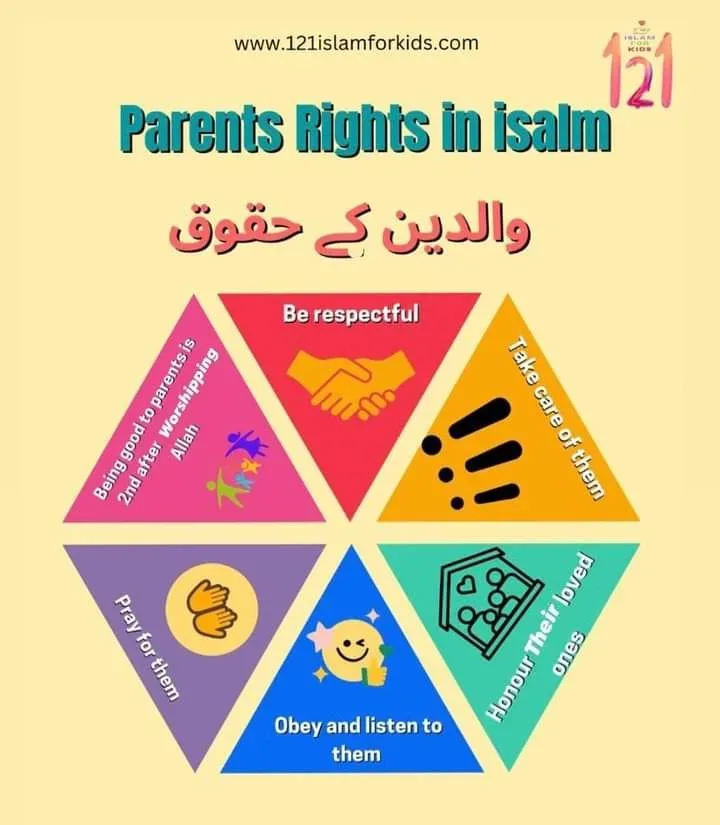
    Kindness and Respect:

    The foundation of parental rights lies in showing kindness and respect to parents. Allah commands in the Quran: “And your Lord has decreed that you not worship except Him, and to parents, good treatment. Whether one or both of them reach old age [while] with you, say not to them [so much as], ‘uff,’ and do not repel them but speak to them a noble word” (Quran 17:23).

    Prophet Muhammad (pbuh) further emphasized this in a hadith: “Paradise lies beneath the feet of mothers.” This highlights the elevated status of mothers and emphasizes the importance of respecting and caring for them.

    Obedience and Compliance:

    Islam emphasizes obedience to parents unless they command something against Islamic teachings. The Quran states: “But if they (both) strive with you to make you join in worship with Me others of which you have no knowledge, then obey them not” (Quran 29:8). This verse highlights the exception to obedience when it comes to matters of shirk (associating partners with Allah).

    Prophet Muhammad (pbuh) affirmed the significance of obedience to parents in a hadith: “The pleasure of Allah is in the pleasure of the parents, and the anger of Allah is in the anger of the parents.” This underscores the importance of seeking parental satisfaction as a means to earn Allah’s pleasure.

    Financial Support:

    Children have a responsibility to provide financial support to their parents when needed. Allah says in the Quran: “And do well to parents, and near of kin, and orphans, and the needy, and the neighbor from among your own people” (Quran 2:83). This verse emphasizes the duty to support parents alongside other obligations.

    Dua and Prayers for Parents:

    Islam encourages children to make dua (supplication) and pray for the well-being, forgiveness, and guidance of their parents. The Quran mentions: “And lower to them the wing of humility out of mercy and say, ‘My Lord, have mercy upon them as they brought me up [when I was] small’” (Quran 17:24).

    Honor their loved Ones:

    In Islam, honoring the relatives of parents is highly encouraged. Muslims are urged to maintain good relations with their extended family, treating them with kindness, respect, and support. Visiting and assisting relatives, especially after the passing of parents, is considered a virtuous act.

    Prophet Muhammad (pbuh) affirmed the significance of praying for parents in a hadith: “When a person dies, all their deeds come to an end except three: Sadaqah Jariyah (ongoing charity), beneficial knowledge, or a righteous child who prays for them.”

    Conclusion:

    The rights of parents in Islam encompass various aspects such as kindness, respect, obedience, financial support, and prayers. The Quran, hadiths, and Islamic scholars provide guidance on fulfilling these rights, emphasizing the importance of cherishing and honoring parents.

    As Muslims, it is our duty to understand and fulfill these rights, recognizing that the love and care we receive from our parents is a blessing from Allah. By upholding these rights, we contribute to building strong family bonds, fostering a harmonious society, and earning the pleasure of Allah.

    In the words of Imam Ahmad ibn Hanbal, a renowned Islamic scholar, “The best of deeds after the obligatory acts are those done to please one’s parents.”

    May Allah bless us all with the ability to fulfill the rights of our parents and strengthen the ties of kinship.

    Teaching Methods for Online Islamic Courses.

    Exploring the kindness towards Parents in Islam to Children, including Duas and Activities:

    Introduction to Parental Rights

    Dua: Begin each session with a dua seeking Allah’s blessings and guidance to understand parental rights.

    Activity: Discuss real-life scenarios where children can identify examples of fulfilling parental rights.

    Assessment: Ask children to write or draw about a time when they showed kindness and respect to their parents.

    Understanding Parental Responsibilities

    Dua: Teach children specific duas for seeking Allah’s forgiveness for any shortcomings towards their parents.

    Activity: Have children create a “Parental Responsibilities” chart listing tasks they can help their parents with.

    Assessment: Ask children to write a short paragraph on why it is important to obey and respect parents.

    Practicing Kindness and Respect

    Dua: Teach children duas for seeking Allah’s blessings on their parents and seeking forgiveness for any mistakes.

    Activity: Role-play scenarios demonstrating acts of kindness, respect, and helpfulness towards parents.

    Assessment: Ask children to create a poster illustrating ways to show kindness and respect to parents.

    Communication and Appreciation

    Dua: Teach children duas for seeking Allah’s blessings on their parents’ health, happiness, and wellbeing.

    Activity: Guide children in writing thank-you letters or cards expressing gratitude to their parents.

    Assessment: Have children share a story or personal experience where they communicated effectively with their parents.

    Seeking Parents’ Guidance

    Dua: Teach children duas for seeking Allah’s guidance and wisdom to understand and follow their parents’ advice.

    Activity: Engage children in a discussion about seeking parents’ opinions and advice in decision-making.

    Assessment: Ask children to create a collage or drawing representing a valuable lesson learned from their parents.

    Honoring Parents in All Circumstances

    Hadith: Teach them one short hadith about the father and one about Mother.

    Activity: Tell them a story about the rights of the Father and mother in stories. (Two hadiths are included in our hadith course)

    Assessment: Have children write a reflective journal entry about a time when they overcame a challenging situation by honoring their parents. (We have worksheets on it)

    Dua for Parents

    Dua: Teach children a special dua for their parents’ well-being, forgiveness, and success.

    Activity: Have children create personalized dua cards for their parents, expressing love and prayers for them.

    Assessment: Ask children to share a dua they made for their parents and explain why they chose those specific words.

    Conclusion and Recap

    Dua: End the course with a dua seeking Allah’s blessings for parents and their children.

    Activity: Encourage children to reflect on the lessons learned and set goals for applying them.

    Assessment: Ask children to create a “Rights of Parents” pledge, committing to fulfill their parents’ rights.

    By incorporating duas and engaging activities, children will develop a deeper understanding of the rights of parents in Islam and actively apply them in their lives. These methods will instill a sense of gratitude, respect, and love for parents, fostering a strong bond within the family.

    Enrol now for this course or get a PDF of this Course Here

    Hadith about Mothers’ Respect in Islam with a story and a worksheet.

    Hadith about fathers’ respect in Islam with a story and a worksheet

    Have a look at online Islamic courses

    The book used in this Course, Islamic Studies Grade 05

    Free Books

    Videos