Tag: Islamic studies for children

  • Surah Al-Falaq – An-Naas Study Method: Understanding the Chapter of Dawn (سورة الفلق)Surah Al-Falaq (سورة الفلق)

    Surah Al-Falaq – An-Naas Study Method: Understanding the Chapter of Dawn (سورة الفلق)Surah Al-Falaq (سورة الفلق)

    Surah Al-Falaq An-Naas study method provides comprehensive learning techniques for these two protective chapters of the Quran. This interactive guide includes detailed verse-by-verse explanations, word meanings, translations, and educational activities for understanding Surah Al-Falaq and Surah An-Naas.Surah.
    Surah Al-Falaq An-Naas study method comprehensive guide with interactive learning techniques for children


    Surah Surah Al-Falaq An-Naas Study Method: Understanding the Chapter of Dawn (سورة الفلق)Surah Al-Falaq (سورة الفلق)

    These Surah Al-Falaq An-Naas teachings guide us to seek Allah’s protection from all types of evil.This Surah teaches us to seek Allah’s protection from all types of evil.

    Verse 1:

    Arabic:
    قُلْ أَعُوذُ بِرَبِّ الْفَلَقِ

    English Translation:
    “Say: I seek refuge in the Lord of the dawn.”

    Word Meanings:

    • قُلْ (Qul) – Say
    • أَعُوذُ (A’udhu) – I seek refuge
    • بِرَبِّ (bi-Rabbi) – In the Lord
    • الْفَلَقِ (al-Falaq) – The dawn or the daybreak

    Explanation:
    In this verse, we are told to seek protection from Allah, the One who causes the dawn to break through the darkness. The “dawn” symbolizes light, hope, and the power to overcome darkness and evil.


    Verse 2:

    Arabic:
    مِن شَرِّ مَا خَلَقَ

    English Translation:
    “From the evil of what He has created.”

    Word Meanings:

    • مِن شَرِّ (min sharri) – From the evil
    • مَا (ma) – What
    • خَلَقَ (khalaqa) – He has created

    Explanation:
    This verse asks for protection from any harmful or evil things in Allah’s creation. While Allah’s creation is good, some things or beings may cause harm, so we ask Allah to protect us from any possible danger.


    Verse 3:

    Arabic:
    وَمِن شَرِّ غَاسِقٍ إِذَا وَقَبَ

    English Translation:
    “And from the evil of the night when it grows dark.”

    Word Meanings:

    • غَاسِقٍ (ghasiqin) – Darkness
    • إِذَا (idha) – When
    • وَقَبَ (waqab) – It settles

    Explanation:
    This verse seeks protection from the dangers of the night, when darkness falls, and we cannot see clearly. The night can bring fear and unknown dangers, but Allah can protect us.


    Verse 4:

    Arabic:
    وَمِن شَرِّ النَّفَّاثَاتِ فِي الْعُقَدِ

    English Translation:
    “And from the evil of those who blow on knots.”

    Word Meanings:

    • النَّفَّاثَاتِ (an-naffathat) – Those who blow
    • فِي الْعُقَدِ (fi-l-‘uqad) – On knots

    Explanation:
    This verse refers to the evil of those who practice magic or sorcery by tying knots and blowing on them. It’s a form of evil behavior that people may use to harm others. We seek Allah’s protection from such harmful acts.


    Verse 5:

    Arabic:
    وَمِن شَرِّ حَاسِدٍ إِذَا حَسَدَ

    English Translation:
    “And from the evil of the envious one when he envies.”

    Word Meanings:

    • حَاسِدٍ (hasid) – The envious one
    • حَسَدَ (hasada) – He envies

    Explanation:
    This verse seeks protection from those who feel jealous and wish harm upon others. When someone envies another person, they might desire bad things to happen to them. We ask Allah to protect us from such jealousy.


    Surah An-Naas (سورة الناس)

    This Surah teaches us to seek protection from the evil whispers of Shaytan (Satan) and all harmful influences.

    Verse 1:

    Arabic:
    قُلْ أَعُوذُ بِرَبِّ النَّاسِ

    English Translation:
    “Say: I seek refuge in the Lord of mankind.”

    Word Meanings:

    • قُلْ (Qul) – Say
    • أَعُوذُ (A’udhu) – I seek refuge
    • بِرَبِّ (bi-Rabbi) – In the Lord
    • النَّاسِ (an-Naas) – Of mankind

    Explanation:
    In this verse, we are instructed to seek refuge in Allah, the Lord of all people. This reminds us that Allah is the Creator and Protector of every human being.


    Verse 2:

    Arabic:
    مَلِكِ النَّاسِ

    English Translation:
    “The King of mankind.”

    Word Meanings:

    • مَلِكِ (Malik) – King
    • النَّاسِ (an-Naas) – Of mankind

    Explanation:
    Here, we acknowledge that Allah is the King of all people. He is in charge of everything, and no one has power or authority over Him. He alone controls and protects us.


    Verse 3:

    Arabic:
    إِلَٰهِ النَّاسِ

    English Translation:
    “The God of mankind.”

    Word Meanings:

    • إِلَٰهِ (Ilah) – God
    • النَّاسِ (an-Naas) – Of mankind

    Explanation:
    This verse reminds us that Allah is the only God of all humans. He is the One we worship and rely on. By stating that Allah is our God, we confirm our belief in His power to protect us from harm.


    Verse 4:

    Arabic:
    مِن شَرِّ الْوَسْوَاسِ الْخَنَّاسِ

    English Translation:
    “From the evil of the whisperer who withdraws.”

    Word Meanings:

    • شَرِّ (sharri) – Evil
    • الْوَسْوَاسِ (waswas) – Whisperer
    • الْخَنَّاسِ (khannas) – Who withdraws

    Explanation:
    This verse asks for protection from the whisperer, meaning Shaytan, who quietly puts evil thoughts into our minds and then hides. Shaytan tries to make us do bad things, but we seek Allah’s protection to avoid falling into these traps.


    Verse 5:

    Arabic:
    الَّذِي يُوَسْوِسُ فِي صُدُورِ النَّاسِ

    English Translation:
    “Who whispers in the hearts of mankind.”

    Word Meanings:

    • يُوَسْوِسُ (yuwaswisu) – Whispers
    • فِي (fi) – In
    • صُدُورِ (sudoor) – Hearts
    • النَّاسِ (an-Naas) – Of mankind

    Explanation:
    Shaytan tries to enter people’s hearts and minds to make them think bad things. He whispers evil ideas into our hearts to lead us away from the right path, but Allah can protect us from these whispers.


    Verse 6:

    Arabic:
    مِنَ الْجِنَّةِ وَالنَّاسِ

    English Translation:
    “From among jinn and among mankind.”

    Word Meanings:

    • الْجِنَّةِ (al-jinnah) – The jinn (invisible beings)
    • النَّاسِ (an-Naas) – Mankind

    Explanation:
    This verse tells us that evil whispers can come from both jinn (invisible beings) and humans. Some people or beings might try to lead us astray, but by seeking Allah’s protection, we can stay safe from all types of evil influences.


    Summary of Both Surah Al-Falaq An-Naas

    • Surah Al-Falaq protects us from the dangers of the outside world—whether they come from people, jealousy, or magic.
    • Surah An-Naas protects us from the dangers within—whispers and evil thoughts that try to lead us away from the right path.

    Reciting both Surah Al-Falaq An-Naas reminds us that Allah is our ultimate protector from all forms of evil, and we should always turn to Him in times of fear or difficulty.Reciting these Surahs reminds us that Allah is our ultimate protector from all forms of evil, and we should always turn to Him in times of fear or difficulty.

    Additional Information:

    • These Surahs should be recited in the morning and evening as part of Azkar (remembrance of Allah) to seek protection from all harm throughout the day and night.
    • It’s also recommended to recite them before sleeping, to seek Allah’s protection from evil during the night.

    Quiz: Surah Al-Falaq & Surah An-Naas

    Here’s a fun and educational quiz for kids based on the key facts and explanations of Surah Al-Falaq and Surah An-Naas.


    Multiple Choice Questions (MCQs):

    1. Who do we ask for protection in Surah Al-Falaq?
    • A) The sun
    • B) The moon
    • C) The Lord of the dawn
    • D) The stars Answer: C) The Lord of the dawn

    1. In Surah Al-Falaq, we ask Allah to protect us from the evil of:
    • A) Animals
    • B) Darkness, jealousy, and magic
    • C) Angels
    • D) Trees Answer: B) Darkness, jealousy, and magic

    1. What does “Al-Falaq” mean?
    • A) Night
    • B) Darkness
    • C) Daybreak/Dawn
    • D) Stars Answer: C) Daybreak/Dawn

    1. In Surah An-Naas, who is the King of mankind?
    • A) A Prophet
    • B) Allah
    • C) Angels
    • D) Shaytan Answer: B) Allah

    1. Who tries to whisper bad thoughts in our hearts?
    • A) Shaytan
    • B) Angels
    • C) Prophets
    • D) Friends Answer: A) Shaytan

    1. What does “An-Naas” mean in Surah An-Naas?
    • A) People
    • B) Angels
    • C) Shaytan
    • D) Jinn Answer: A) People

    1. How many verses (ayahs) are in Surah Al-Falaq?
    • A) 3
    • B) 5
    • C) 7
    • D) 6 Answer: B) 5

    1. How many verses (ayahs) are in Surah An-Naas?
    • A) 6
    • B) 4
    • C) 3
    • D) 7 Answer: A) 6
    1. When is it recommended to recite Surah Al-Falaq and Surah An-Naas?
      • A) Only during Ramadan
      • B) During morning and evening
      • C) After every meal
      • D) Before sleeping only
      Answer: B) During morning and evening

    1. Why do we recite Surah Al-Falaq and Surah An-Naas in the morning and evening?
    • A) To protect ourselves from hunger
    • B) To ask for Allah’s protection from all kinds of evil throughout the day and night
    • C) To bring rain
    • D) To avoid studying

    Answer: B) To ask for Allah’s protection from all kinds of evil throughout the day and night


    Short Answer Questions:

    1. What is the main theme of Surah Al-Falaq?
    • Answer: The main theme is seeking Allah’s protection from external evils, such as darkness, jealousy, and magic.

    1. What is the main theme of Surah An-Naas?
    • Answer: The main theme is seeking Allah’s protection from the evil whispers of Shaytan and evil thoughts.

    1. From which two types of beings can evil whispers come, according to Surah An-Naas?
    • Answer: Evil whispers can come from both jinn and humans.

    1. Why are Surah Al-Falaq and Surah An-Naas called “Al-Mu’awwidhatayn”?
    • Answer: They are called Al-Mu’awwidhatayn because they are the two Surahs of seeking protection from Allah.

    1. What was the occasion for the revelation of these two Surahs?
    • Answer: These Surahs were revealed when Prophet Muhammad (peace be upon him) was affected by magic, and Allah revealed these Surahs to protect him from harm.

    1. Why are these two Surahs recited together often?
    • Answer: These Surahs are recited together because both provide protection from external and internal evils, making them powerful for seeking Allah’s protection.

    True/False Questions:

    1. Surah Al-Falaq protects us from the evil whispers of Shaytan.
    • Answer: False (It’s Surah An-Naas that protects from evil whispers of Shaytan).

    1. Surah An-Naas teaches us to seek refuge in Allah, who is the Lord, King, and God of mankind.
    • Answer: True

    1. The word “Falaq” means darkness.
    • Answer: False (It means dawn or daybreak).

    1. Surah Al-Falaq has 6 verses.
    • Answer: False (It has 5 verses).

    1. Both Surah Al-Falaq and Surah An-Naas were revealed to help protect the Prophet Muhammad (peace be upon him) from the effects of magic.
    • Answer: True

    This quiz can help children review the key facts and concepts from Surah Al-Falaq An-Naas in a fun and engaging way!This quiz can help children review the key facts and concepts from the two Surahs in a fun and engaging way!

    Study method

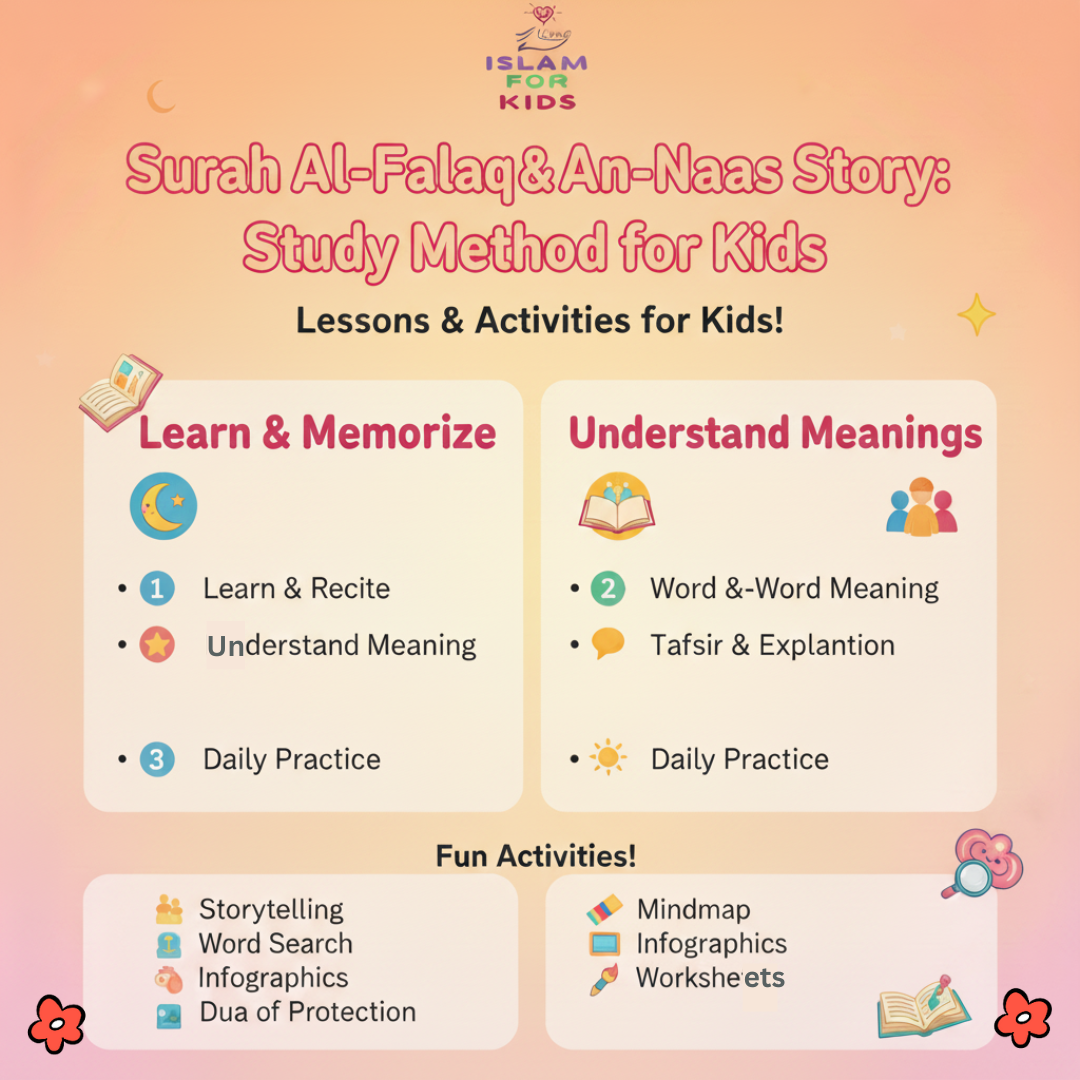
    In our online classes, we use an engaging and comprehensive study method to teach Surah Al-Falaq and Surah An-Naas. Our goal is to ensure students not only learn to recite and memorize these Surahs but also understand their meanings through creative and interactive learning tools. Here’s how we do it, with links to detailed resources for each step:


    1. Recitation (تلاوت)

    Objective:
    We begin by focusing on the correct recitation of the Surahs. Using videos of expert reciters, students follow along to perfect their pronunciation. Each verse is practiced until fluency is achieved.
    Click here for our recitation videos.


    2. Tajweed (تجوید)

    Objective:
    We introduce the essential rules of Tajweed so students can recite the Quran correctly. We pay special attention to proper articulation of Arabic sounds and apply these rules in real-time recitation practice.
    Explore our Tajweed lessons with videos and guides.


    3. Memorization (حفظ)

    Objective:
    Memorization is made easy with the help of videos that guide students step-by-step. The process is broken into small sections, and each is repeated multiple times to ensure retention.
    Learn more about our Hifz videos and memorization techniques.


    4. Words Meaning and Translation

    Objective:
    We teach word meanings and translations using the “My First Quran with Pictures” book, making it easy for students to grasp the Arabic words along with their English meanings. This method makes learning engaging and fun.
    See how we use “My First Quran with Pictures” in our lessons.


    5. Tafsir (تفسیر) Surah Al-Falaq An-Naas

    Objective:
    We explain the meanings and lessons of the Surahs through the Islamic Education Book. Each verse is discussed in a simple and age-appropriate way, helping students understand the significance of seeking Allah’s protection.
    Explore our Tafsir lessons and resources.


    6. Infographics Surah Al-Falaq An-Naas

    Objective:
    Infographics are used to simplify the Surahs’ key themes. We either use visuals from “My First Quran with Pictures” or encourage students to create their own. This visual learning helps students retain the key messages of each verse.
    Check out our infographic tools and creative projects.


    7. Storytelling

    Objective:
    We enhance understanding through storytelling in class and with video animations. Stories like “Sarah and the Magic of Light” bring the Surahs’ meanings to life, making them more relatable for children.
    Watch our storytelling videos and animations.


    8. Mind Mapping

    Objective:
    We teach mind mapping using pre-designed images and videos to help students visually organize the lessons from the Surahs. These mind maps make it easier to understand and remember the concepts.
    Discover our mind mapping resources and videos.


    9. Exercises and Revisions (نظرثانی)

    Objective:
    We conduct regular revisions to ensure long-term retention. For assessments, we use interactive quizzes and exercises that test the students’ understanding and memorization of the Surahs.
    Check out our revision quizzes and exercises.


    Our method combines the power of visual aids, videos, books, and interactive tools to make learning Surah Al-Falaq and Surah An-Naas both fun and effective.
    Visit the links below for our resources and activities:

    Explore our resources and enroll today!

  • How to teach 5 Rights of Parents in Islam? Online Islamic Courses

    How to teach 5 Rights of Parents in Islam? Online Islamic Courses

    The Rights of Parents in Islam: A Comprehensive Understanding through Online Islamic Courses.

    online islamic courses

    Introduction online course Rights of Parents:

    Islam places great emphasis on the rights and respect due to parents. The Quran, hadiths (sayings of Prophet Muhammad, peace be upon him), and scholarly opinions provide a comprehensive framework for understanding and fulfilling these rights. Let us delve into the various aspects of the rights of parents in Islam, supported by references from the Quran, hadiths, and notable quotes.

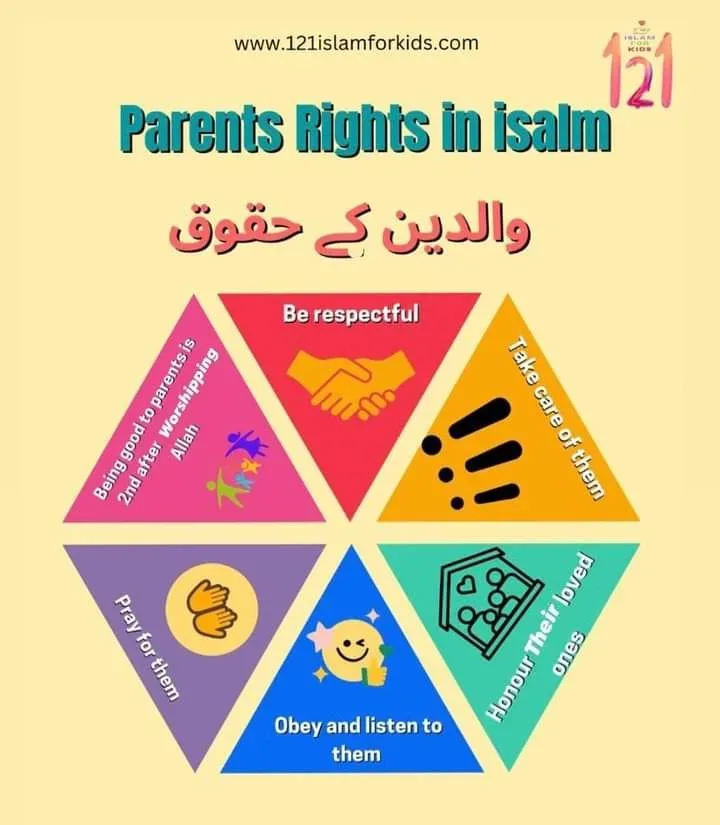
    Kindness and Respect:

    The foundation of parental rights lies in showing kindness and respect to parents. Allah commands in the Quran: “And your Lord has decreed that you not worship except Him, and to parents, good treatment. Whether one or both of them reach old age [while] with you, say not to them [so much as], ‘uff,’ and do not repel them but speak to them a noble word” (Quran 17:23).

    Prophet Muhammad (pbuh) further emphasized this in a hadith: “Paradise lies beneath the feet of mothers.” This highlights the elevated status of mothers and emphasizes the importance of respecting and caring for them.

    Obedience and Compliance:

    Islam emphasizes obedience to parents unless they command something against Islamic teachings. The Quran states: “But if they (both) strive with you to make you join in worship with Me others of which you have no knowledge, then obey them not” (Quran 29:8). This verse highlights the exception to obedience when it comes to matters of shirk (associating partners with Allah).

    Prophet Muhammad (pbuh) affirmed the significance of obedience to parents in a hadith: “The pleasure of Allah is in the pleasure of the parents, and the anger of Allah is in the anger of the parents.” This underscores the importance of seeking parental satisfaction as a means to earn Allah’s pleasure.

    Financial Support:

    Children have a responsibility to provide financial support to their parents when needed. Allah says in the Quran: “And do well to parents, and near of kin, and orphans, and the needy, and the neighbor from among your own people” (Quran 2:83). This verse emphasizes the duty to support parents alongside other obligations.

    Dua and Prayers for Parents:

    Islam encourages children to make dua (supplication) and pray for the well-being, forgiveness, and guidance of their parents. The Quran mentions: “And lower to them the wing of humility out of mercy and say, ‘My Lord, have mercy upon them as they brought me up [when I was] small’” (Quran 17:24).

    Honor their loved Ones:

    In Islam, honoring the relatives of parents is highly encouraged. Muslims are urged to maintain good relations with their extended family, treating them with kindness, respect, and support. Visiting and assisting relatives, especially after the passing of parents, is considered a virtuous act.

    Prophet Muhammad (pbuh) affirmed the significance of praying for parents in a hadith: “When a person dies, all their deeds come to an end except three: Sadaqah Jariyah (ongoing charity), beneficial knowledge, or a righteous child who prays for them.”

    Conclusion:

    The rights of parents in Islam encompass various aspects such as kindness, respect, obedience, financial support, and prayers. The Quran, hadiths, and Islamic scholars provide guidance on fulfilling these rights, emphasizing the importance of cherishing and honoring parents.

    As Muslims, it is our duty to understand and fulfill these rights, recognizing that the love and care we receive from our parents is a blessing from Allah. By upholding these rights, we contribute to building strong family bonds, fostering a harmonious society, and earning the pleasure of Allah.

    In the words of Imam Ahmad ibn Hanbal, a renowned Islamic scholar, “The best of deeds after the obligatory acts are those done to please one’s parents.”

    May Allah bless us all with the ability to fulfill the rights of our parents and strengthen the ties of kinship.

    Teaching Methods for Online Islamic Courses.

    Exploring the kindness towards Parents in Islam to Children, including Duas and Activities:

    Introduction to Parental Rights

    Dua: Begin each session with a dua seeking Allah’s blessings and guidance to understand parental rights.

    Activity: Discuss real-life scenarios where children can identify examples of fulfilling parental rights.

    Assessment: Ask children to write or draw about a time when they showed kindness and respect to their parents.

    Understanding Parental Responsibilities

    Dua: Teach children specific duas for seeking Allah’s forgiveness for any shortcomings towards their parents.

    Activity: Have children create a “Parental Responsibilities” chart listing tasks they can help their parents with.

    Assessment: Ask children to write a short paragraph on why it is important to obey and respect parents.

    Practicing Kindness and Respect

    Dua: Teach children duas for seeking Allah’s blessings on their parents and seeking forgiveness for any mistakes.

    Activity: Role-play scenarios demonstrating acts of kindness, respect, and helpfulness towards parents.

    Assessment: Ask children to create a poster illustrating ways to show kindness and respect to parents.

    Communication and Appreciation

    Dua: Teach children duas for seeking Allah’s blessings on their parents’ health, happiness, and wellbeing.

    Activity: Guide children in writing thank-you letters or cards expressing gratitude to their parents.

    Assessment: Have children share a story or personal experience where they communicated effectively with their parents.

    Seeking Parents’ Guidance

    Dua: Teach children duas for seeking Allah’s guidance and wisdom to understand and follow their parents’ advice.

    Activity: Engage children in a discussion about seeking parents’ opinions and advice in decision-making.

    Assessment: Ask children to create a collage or drawing representing a valuable lesson learned from their parents.

    Honoring Parents in All Circumstances

    Hadith: Teach them one short hadith about the father and one about Mother.

    Activity: Tell them a story about the rights of the Father and mother in stories. (Two hadiths are included in our hadith course)

    Assessment: Have children write a reflective journal entry about a time when they overcame a challenging situation by honoring their parents. (We have worksheets on it)

    Dua for Parents

    Dua: Teach children a special dua for their parents’ well-being, forgiveness, and success.

    Activity: Have children create personalized dua cards for their parents, expressing love and prayers for them.

    Assessment: Ask children to share a dua they made for their parents and explain why they chose those specific words.

    Conclusion and Recap

    Dua: End the course with a dua seeking Allah’s blessings for parents and their children.

    Activity: Encourage children to reflect on the lessons learned and set goals for applying them.

    Assessment: Ask children to create a “Rights of Parents” pledge, committing to fulfill their parents’ rights.

    By incorporating duas and engaging activities, children will develop a deeper understanding of the rights of parents in Islam and actively apply them in their lives. These methods will instill a sense of gratitude, respect, and love for parents, fostering a strong bond within the family.

    Enrol now for this course or get a PDF of this Course Here

    Hadith about Mothers’ Respect in Islam with a story and a worksheet.

    Hadith about fathers’ respect in Islam with a story and a worksheet

    Have a look at online Islamic courses

    The book used in this Course, Islamic Studies Grade 05

    Free Books

    Videos

  • Surah-tu-Lahab |Great story of the uncle of Prophet SAW

    Surah-tu-Lahab |Great story of the uncle of Prophet SAW

    Surah-tu-Lahab:111 Surah in Quran (The flame)

    Surah-tu-Lahab

    Some words about the Surah Al-Masad – 1-5 – Quran.com

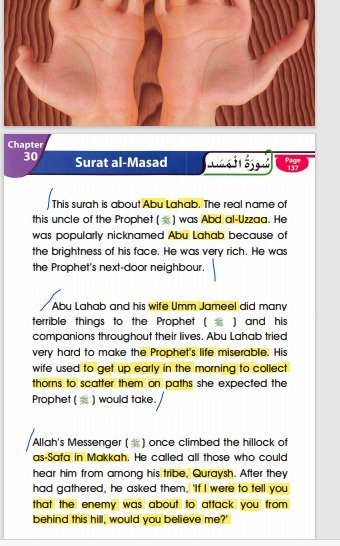
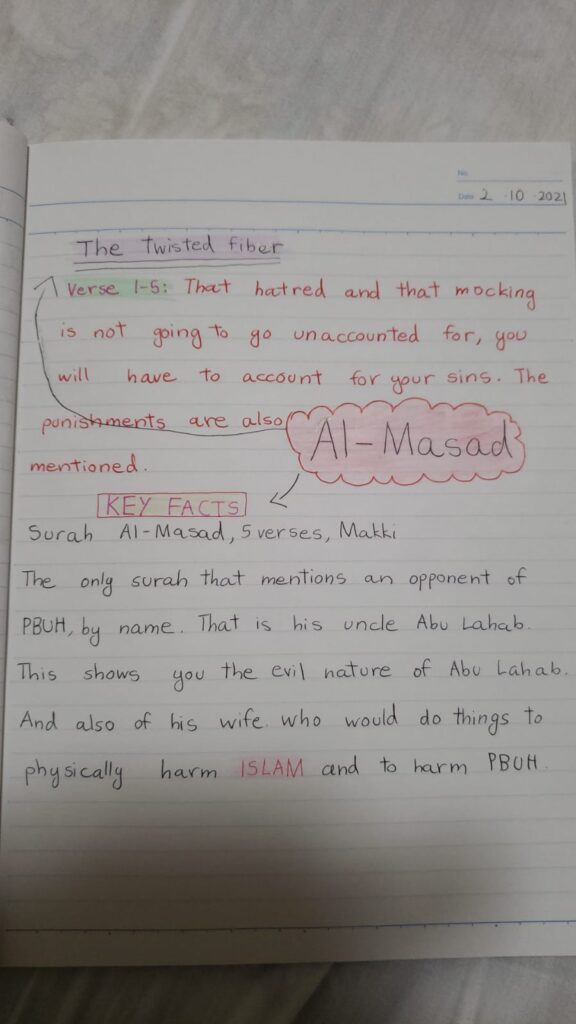
    Surah-tu-Masad or Surahtu-Lahab is about uncle of Prophet Muhammad SAW, Abu lahab and his wife. They are cursed in this Surah-tu-Lahab by name But Why? He was happy when his nephew was born. He loved the son of his dead brother. He knew his nephew very closely. But his love turned to hate.

    Method of Teaching

    Surah-tu-Lahab Our method of teaching. This is how we taught and learned this surah in Many steps.

    Step 1 : Introduction of Surah-tu-Lahab

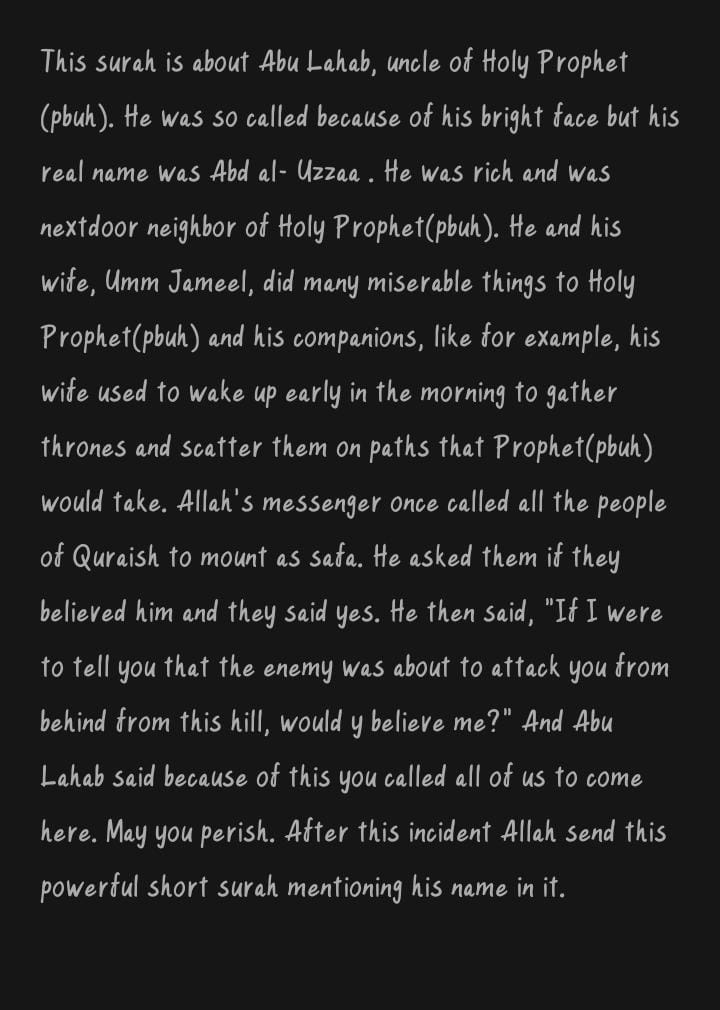
    Abu Lahab showed enmity with Holy prophet SAW Just because the teachings were against His fake gods. He was Rich. He had many children .He was proud was proud. So in his pride, he misbehaved. He dusted his hands to look down him. He is the only person in Quran who is cursed with his name in this way. And his wife as well because His wife was partner of his mission.

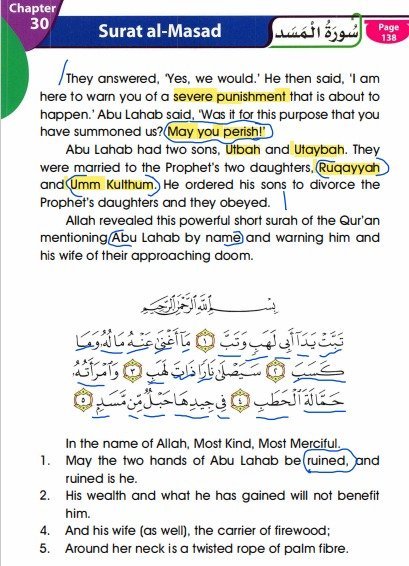
    So Allah promised that both will be punished.1. His hands would be ruined.2. He and his wife would be ruined.3. They would be blazing fire.4. Fibber rope would be in their neck. And his pride, his wealth and sons will not help him……. it is the saddest moment

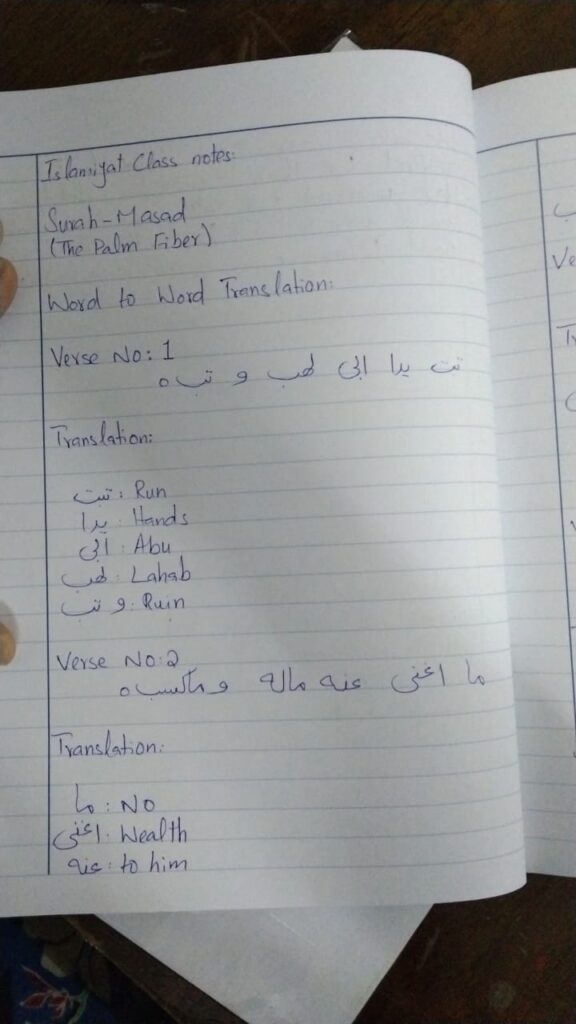
    Step2 : Word to word Translation

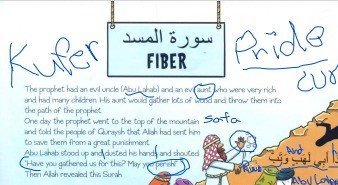
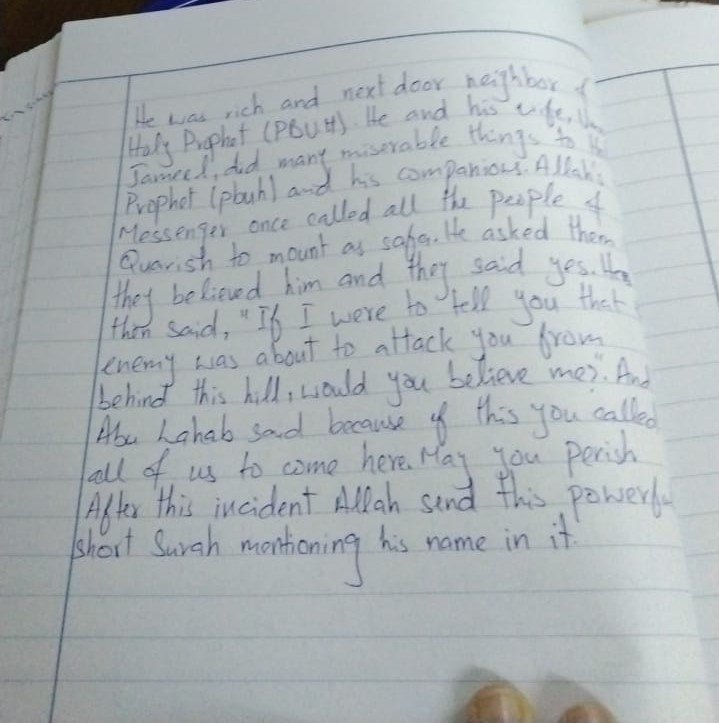
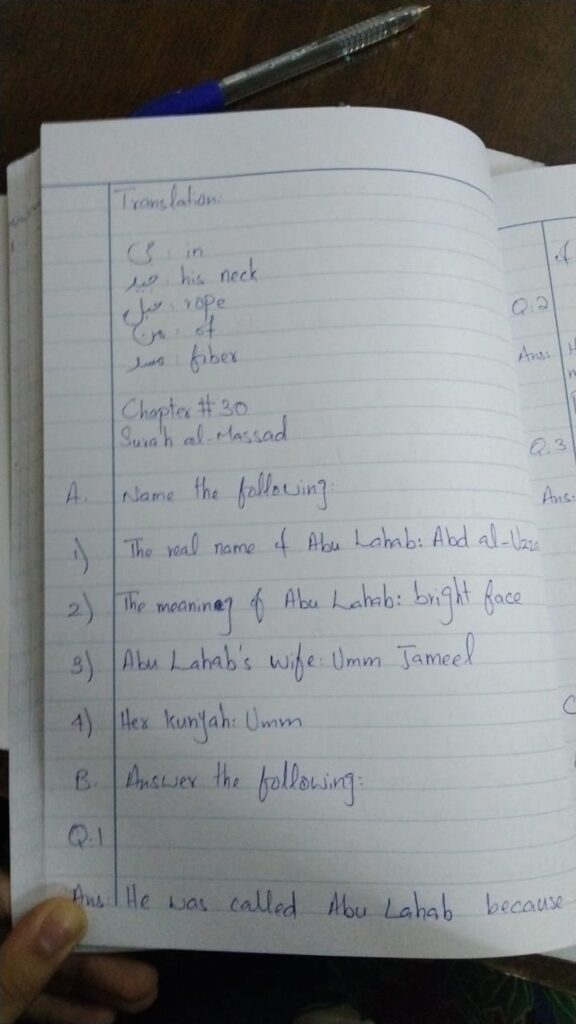
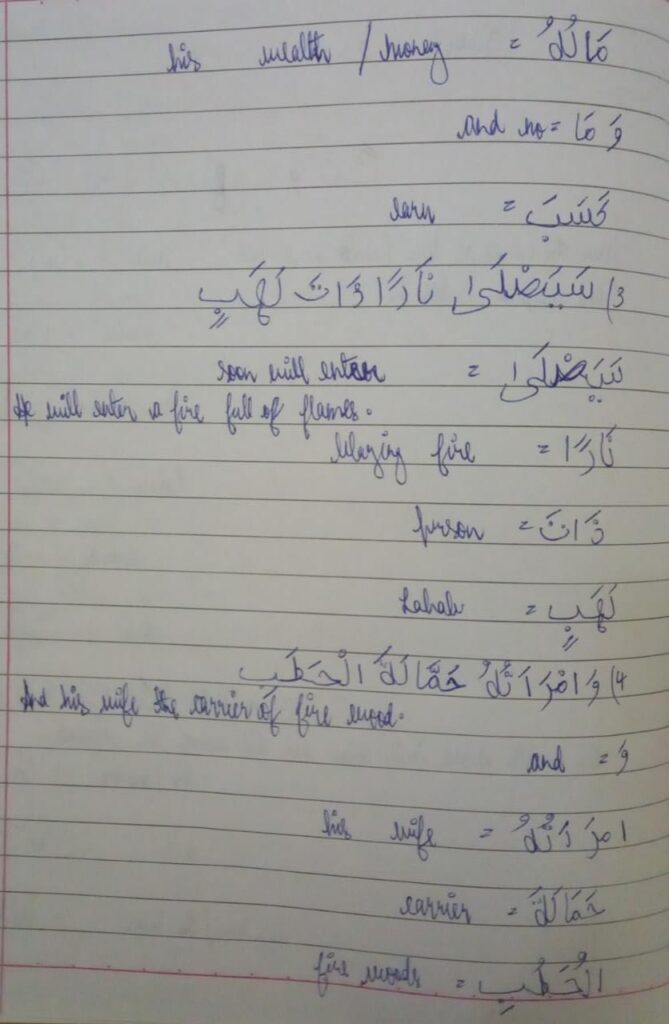
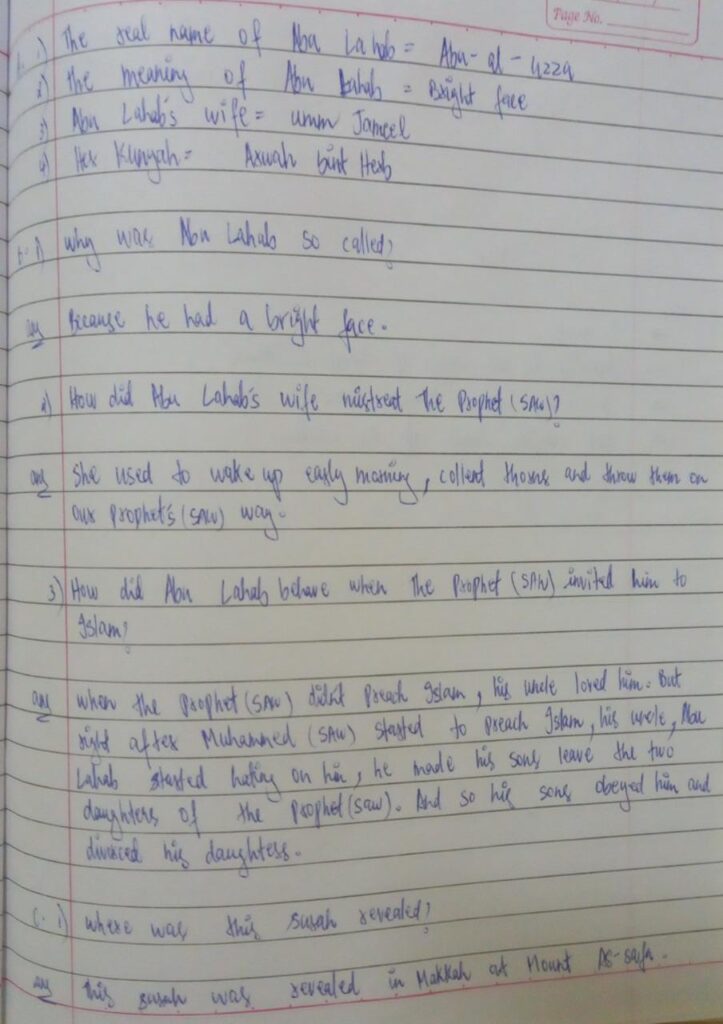
    From Book ;My first Quran picture book; we do word to word Translation. For word to word translation we also use ms word. So that children can note and memorize the meanings of every word. In the pictures below you can see the class work done by students as well.

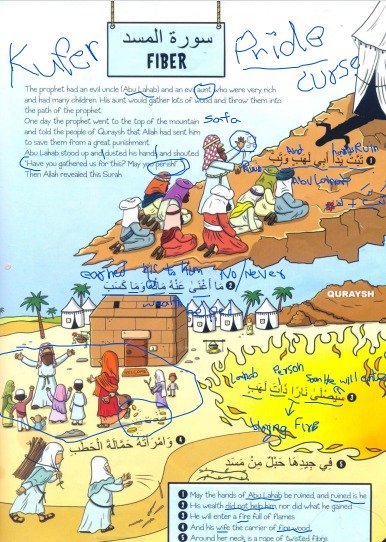
    Step 3 : Translation and discussion of Surah-tu-Lahab

    In this step, we do a full translation of every verse with the help of the pictures in the book. It’s very easy for students to understand the verses with the help of pictures. I really admire the author of this book. When we do a discussion on every verse we discuss some incidents from our life.

    We also discuss the do’s and don’t according to the them and lessons we draw from the verses. For example, Abu Lahab dusted his hand in pride. He had many children and was very rich. So for students, it was time to ponder the value of powers. He had men’s power and wealth power. But nothing helped him. So Allah SWT says, whatever a man earns could not help him.

    Step4 : Tafseer of Surah-tu-Lahab

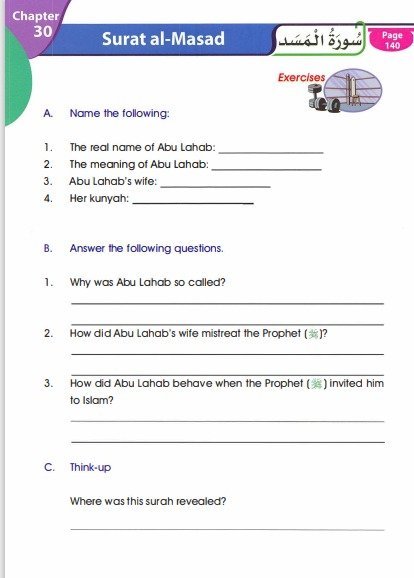
    We had a deep study on the story and surah from Islamic studies book chapter 30.. Here are some key points noted from the book. Surah-tu-Lahab is a Makki Surah. It has 5 verses. It was revealed after misbehaved of Abu Lahab on mount AS-Safa. When Allah SWT order his PromembersAW to call his family/Tribe member toward Islam. Abue Lahab and his wife left no stone to make the life of Prophet miserable. Hence he ordered his two sons to divorce their wives the daughters of Prophet Muhammad SAW.

    Step 5 Storytelling

    Surah-tu-Lahab is a story of pride of Abue Lhaba. A story of two brothers (Habil and Qabil) from ‘My first Quran story book’ was told about pride/jealousy and hate. This story is about the sons of Adam AS, Habeel and Qabeel. So the result was same. Severe punishment was for Qabeel who was the son of a prophet as well as for Abue Lhab who was the uncle of Holy Prophet. No one can escape from the punishment of doing wrong. The examples of the Sons of Noah AS and Loot As and Father of Ibraheem is also narrated in Quran. My students learned big lessons from the stories.

    Abu lahab was a symbol of pride. He was proud to be wealthy and he had many sons , so he was also pride on his men power. As well as his status was also reason of his pride. So here is a story, which is also according to our topic.

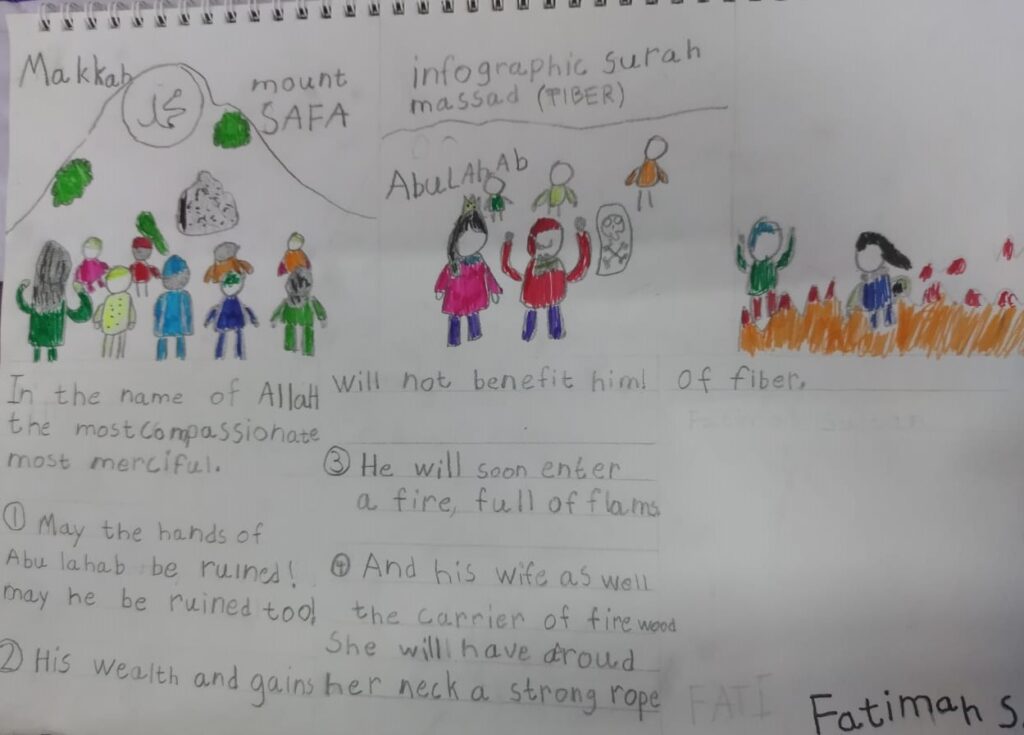
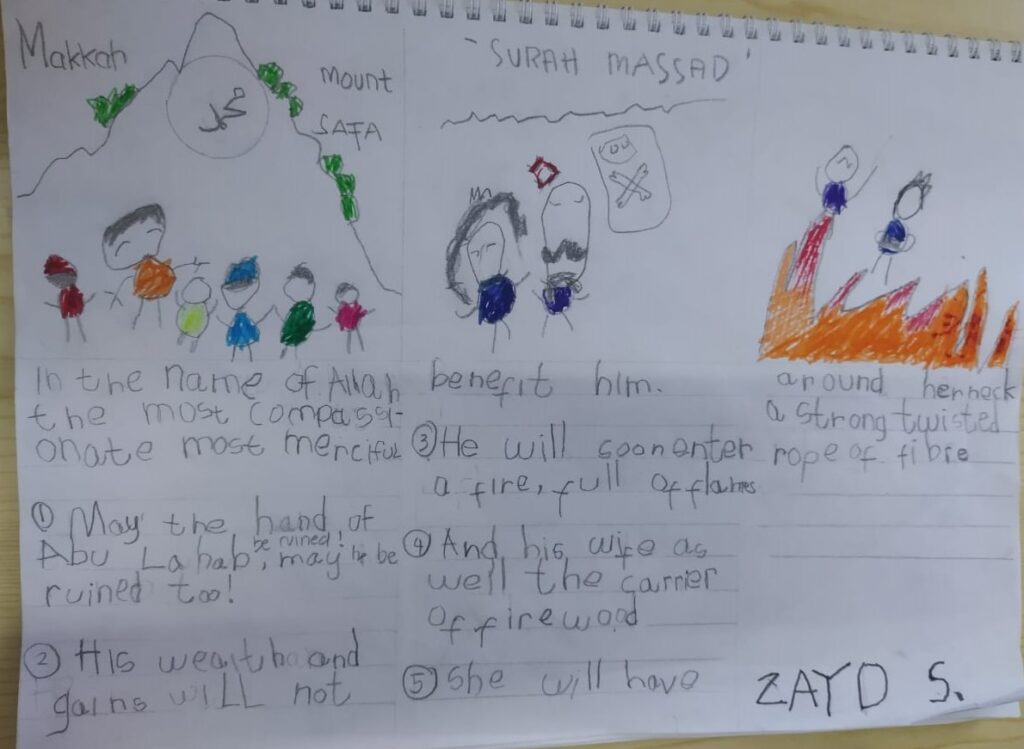
    Step 5 Infographic of Surah-tu-Lahab

    Infographic helps in memorizing translation and its also good for long-term memory. With the help of drawings, children draw images of the Qur’an in their hands but hearts and minds. Which is the favorite activity of the children.

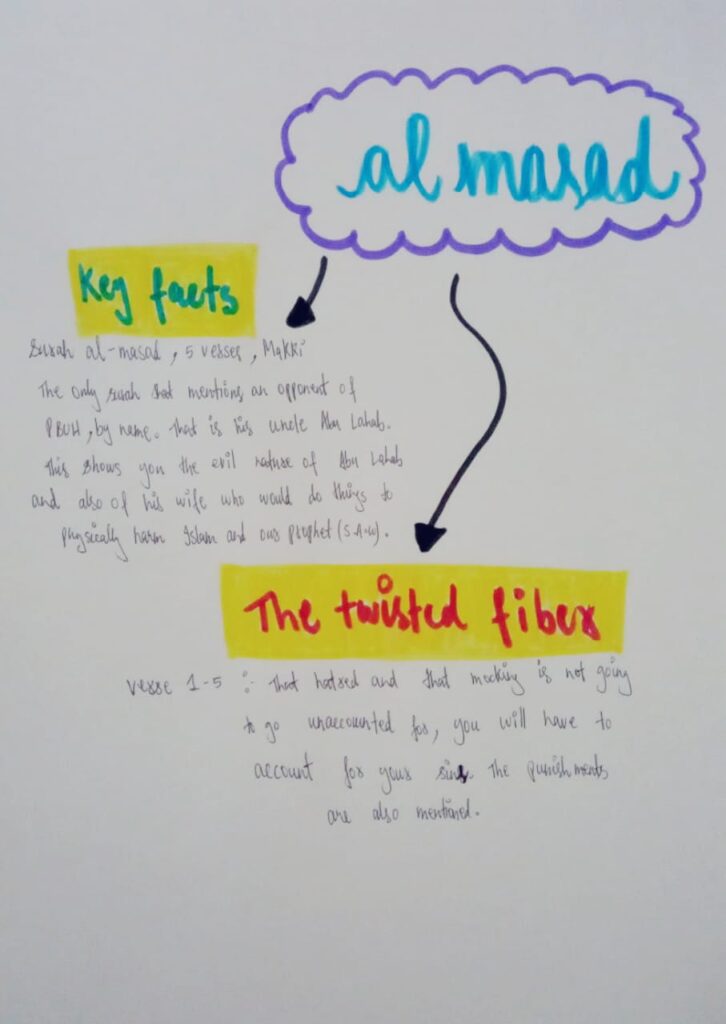
    Step 6 Mind map of Surah-tu-Lahab

    So we do mind map after completing the Surah. We collect our information and points from the Surah to make mind map. We also do use mind maps from LiveIslam.org here are some points from the mind map.

    Surah-tu-Lahab is makki surah. It has 5 verses. Its theme is pride, jealousy and sever punishment for wrong doors. So cursed people are also mentioned in the Quran.

    Step 7 Exercise/revision of Surah-tu-Laha

    Exercise from the Islamic studies book was done . Final worksheet like a lap book was also done. The translation was revised and listened by students. Memorisation Task of this surah was also completed During these classes. done.

    Alhamdolilah, children learned new Arabic words, Learned lessons from the life of Habeel and Qabeel and from the Seerah stories about Abu lehab and About our Prophet’s teaching style when He SAW called his peoples from Al-Sufa Mountain.

    Tafseer for other Surahs

    Other courses we have

    • Online Quran classes for all levels.
    • We havenEasy Tafseer for kids with exciting stories you can see that course in my hadith course tab.
    • Prayer for kids course is a short course to teach about taharat, Gusal, wudu, times of prayers, number and names of prayers, pillars and conditions of prayer, and method of prayer. Search as Prayer for kids course on the search bar.
    • Ramzan boost course we do start 2 weeks before Ramzan.
    • Faith boos course In December to say No To Marry Christmas.
    • Kindness to Parents

    If you want to start this course with me then leave a comment, Email me or enroll your child here.

    Enrolments Available

    Information for this class Quran Tafseer class is

    1. Age Under 8 and up to 9yrs
    2. Classes available in Urdu and English
    3. Classes are available for all time zones
    4. Two groups weekly (weekdays and weekends)
    5. Demo videos are available.
    6. The fee is very low
    7. 2 hrs weekly
    8. All lessons will be done with various activities
    9. Books and worksheets will be provided by the Teacher
    .
    email: bhallitaha@gmail.com

    Facebook.

    You tube Urdu Channel

    You tube English Channel

    or leave a comment.