Tag: Quran for kids

  • Surah Al-Balad for kids

    Surah Al-Balad for kids

    Surah Al-Balad for kids:

    Surah Al balad is one of the most inspiring chapters of the Quran for young learners. We will learn this surah step by step:

    Here are the detailed word meanings of Surah Al-Balad, for kids.

    Verse by verse words meaning of Surah Al-Balad for kids:

    1. لَاۤ اُقْسِمُ بِهٰذَا الْبَلَدِ

    • لَاۤ (Laa) – No, (or “Indeed” for emphasis)
    • اُقْسِمُ (Uqsimu) – I swear
    • بِهٰذَا (Bihaadha) – By this
    • الْبَلَدِ (Al-Balad) – The city

    2. وَ اَنۡتَ حِلٌّۢ بِهٰذَا الْبَلَدِ

    • وَ (Wa) – And
    • اَنۡتَ (Anta) – You
    • حِلٌّۢ (Hillun) – Free (or permitted)
    • بِهٰذَا (Bihaadha) – In this
    • الْبَلَدِ (Al-Balad) – The city

    3. وَ وَالِدٍ وَّ مَا وَلَدَ

    • وَ (Wa) – And
    • وَالِدٍ (Waalid) – A father
    • وَّ (Wa) – And
    • مَا (Maa) – What (or who)
    • وَلَدَ (Walad) – He fathered (or gave birth to)

    4. لَقَدْ خَلَقْنَا الْاِنْسَانَ فِيْ كَبَدٍ

    • لَقَدْ (Laqad) – Certainly
    • خَلَقْنَا (Khalaqnaa) – We created
    • الْاِنْسَانَ (Al-Insaan) – The human being (or mankind)
    • فِيْ (Fee) – In
    • كَبَدٍ (Kabad) – Hardship (or struggle)

    5. اَيَحْسَبُ اَنْ لَّنْ يَّقْدِرَ عَلَيْهِ اَحَدٌ

    • اَيَحْسَبُ (A-Yahsabu) – Does he think
    • اَنْ (An) – That
    • لَّنْ (Lan) – Not
    • يَّقْدِرَ (Yaqdira) – Anyone can have power
    • عَلَيْهِ (Alayhi) – Over him
    • اَحَدٌ (Ahad) – Anyone

    6. يَقُوْلُ اَهْلَكْتُ مَالًا لُّبَدًا

    • يَقُوْلُ (Yaqoolu) – He says
    • اَهْلَكْتُ (Ahlaktu) – I have spent (or destroyed)
    • مَالًا (Maalan) – Wealth
    • لُّبَدًا (Lubadan) – In abundance

    7. اَيَحْسَبُ اَنْ لَّمْ يَرَهٗۤ اَحَدٌ

    • اَيَحْسَبُ (A-Yahsabu) – Does he think
    • اَنْ (An) – That
    • لَّمْ (Lam) – Not
    • يَرَهٗۤ (Yarahu) – He is seen
    • اَحَدٌ (Ahad) – By anyone

    8. اَلَمْ نَجْعَلْ لَهٗ عَيْنَيْنِ

    • اَلَمْ (Alam) – Have We not
    • نَجْعَلْ (Naj’al) – Made
    • لَهٗ (Lahu) – For him
    • عَيْنَيْنِ (Aynayn) – Two eyes

    9. وَلِسَانًا وَّ شَفَتَيْنِ

    • وَ (Wa) – And
    • لِسَانًا (Lisaanan) – A tongue
    • وَّ (Wa) – And
    • شَفَتَيْنِ (Shafatayn) – Two lips

    10. وَهَدَيْنَاهُ النَّجْدَيْنِ

    • وَ (Wa) – And
    • هَدَيْنَاهُ (Hadaynaahu) – We showed him
    • النَّجْدَيْنِ (An-Najdayn) – The two paths (the good and bad ways)

    11. فَلَا اقْتَحَمَ الْعَقَبَةَ

    • فَلَا (Falaa) – But he has not
    • اقْتَحَمَ (IqtaHama) – Attempted (or crossed)
    • الْعَقَبَةَ (Al-Aqabah) – The difficult pass (obstacle)

    12. وَمَاۤ اَدْرٰىكَ مَا الْعَقَبَةُ

    • وَمَاۤ (Wa Maa) – And what
    • اَدْرٰىكَ (Adraaka) – Will make you know
    • مَا (Maa) – What is
    • الْعَقَبَةُ (Al-Aqabah) – The difficult pass

    13. فَكُّ رَقَبَةٍ

    • فَكُّ (Fakku) – The freeing
    • رَقَبَةٍ (Raqabah) – Of a slave (or a neck)

    14. اَوْ اِطْعَامٌ فِيْ يَوْمٍ ذِيْ مَسْغَبَةٍ

    • اَوْ (Aw) – Or
    • اِطْعَامٌ (Itaa’am) – Feeding
    • فِيْ (Fee) – On
    • يَوْمٍ (Yawmin) – A day
    • ذِيْ (Dhee) – Of
    • مَسْغَبَةٍ (Masghabah) – Severe hunger

    15. یَتِیْمًا ذَا مَقْرَبَةٍ

    • یَتِیْمًا (Yateeman) – An orphan
    • ذَا (Dhaa) – Of
    • مَقْرَبَةٍ (Maqrabah) – Near relationship (relative)

    16. اَوْ مِسْكِينًا ذَا مَتْرَبَةٍ

    • اَوْ (Aw) – Or
    • مِسْكِينًا (Miskeenan) – A needy person
    • ذَا (Dhaa) – Of
    • مَتْرَبَةٍ (Matrabah) – Misery (or covered with dust)

    17. ثُمَّ كَانَ مِنَ الَّذِينَ اٰمَنُوْا وَ تَوَاصَوْا بِالصَّبْرِ وَ تَوَاصَوْا بِالْمَرْحَمَةِ

    • ثُمَّ (Thumma) – Then
    • كَانَ (Kaana) – He was
    • مِنَ (Mina) – Among
    • الَّذِينَ (Alladheena) – Those who
    • اٰمَنُوْا (Aamanu) – Believed
    • وَ تَوَاصَوْا (Wa Tawaasaw) – And advised one another
    • بِالصَّبْرِ (Bis-Sabr) – To patience
    • وَ تَوَاصَوْا (Wa Tawaasaw) – And advised one another
    • بِالْمَرْحَمَةِ (Bil-Marhamah) – To compassion (or mercy)

    18. اُولٰۤىٕكَ اَصْحٰبُ الْمَيْمَنَةِ

    • اُولٰۤىٕكَ (Ulaa’ika) – Those are
    • اَصْحٰبُ (As-haabu) – The companions (or people)
    • الْمَيْمَنَةِ (Al-Maymanah) – Of the right hand (good people)

    19. وَ الَّذِیْنَ كَفَرُوْا بِاٰیَاتِنَا هُمْ اَصْحٰبُ الْمَشْئَمَةِ

    • وَ (Wa) – And
    • الَّذِیْنَ (Alladheena) – Those who
    • كَفَرُوْا (Kafaroo) – Disbelieved
    • بِاٰیَاتِنَا (Bi-Aayaatinaa) – In Our signs
    • هُمْ (Hum) – They
    • اَصْحٰبُ (As-haabu) – Are the companions (or people)
    • الْمَشْئَمَةِ (Al-Mash’amah) – Of the left hand (bad people)

    **20. عَلَیْهِمْ نَارٌ مُّؤ

    ْصَدَةٌ**

    • عَلَیْهِمْ (Alayhim) – Upon them
    • نَارٌ (Naarun) – Is fire
    • مُّؤْصَدَةٌ (Mu’sadah) – Closed in (sealed)

    This breakdown helps students understand the meaning of each word in Surah Al-Balad and supports their comprehension of the surah’s overall message.

    Full Translation (in English) of Surah Al-Balad for kids

    In the name of Allah, the Most Merciful, the Most Compassionate

    1. I swear by this city (Makkah),
    2. And you, [O Muhammad], are free of restriction in this city –
    3. And [by] the father and what he fathered,
    4. We have certainly created man into hardship.
    5. Does he think that no one has power over him?
    6. He says, “I have spent wealth in abundance.”
    7. Does he think that no one has seen him?
    8. Have We not made for him two eyes?
    9. And a tongue and two lips?
    10. And have shown him the two ways?
    11. But he has not broken through the difficult pass.
    12. And what can make you know what is [breaking through] the difficult pass?
    13. It is the freeing of a slave,
    14. Or feeding on a day of severe hunger
    15. An orphan of near relationship,
    16. Or a needy person in misery.
    17. And then being among those who believed and advised one another to patience and advised one another to compassion.
    18. Those are the companions of the right.
    19. But they who disbelieved in Our signs – those are the companions of the left.
    20. Over them will be fire closed in.

    Story and Explanation of Surah Al-Balad

    Hey kids! Today, we will learn about a very special chapter from the Quran called Surah Al-Balad. It’s a story full of lessons that will help us understand life better and how we should live it.

    1. The Sacred City of Makkah (Verses 1-2)

    The surah starts with Allah swearing by a special city, Makkah. This city is where the Kaaba is located, which Muslims face when they pray. Makkah is also the place where our Prophet Muhammad (PBUH) was born. By swearing by Makkah, Allah is showing us how important this city is.

    But that’s not all! Allah also mentions that the Prophet Muhammad (PBUH) is living in this city, and this makes the city even more special. Allah is reminding us of the great honour and responsibility that comes with living in such a blessed place.

    2. The Father and His Child (Verse 3)

    Then, Allah swears by the father and his child. This is to remind us of the strong bond between parents and their children. Parents work hard and make many sacrifices for their children, just like how Allah created us and takes care of us with so much love and mercy.

    3. Life is Full of Challenges (Verse 4)

    Allah tells us that life is full of challenges and difficulties. Every person goes through tough times, whether it’s in school, at home, or with friends. But these challenges are a part of life. They help us grow stronger, just like how exercise makes our muscles stronger.

    4. The Arrogance of Some People (Verses 5-7)

    Some people, when they become rich or powerful, start to think that no one can control them. They might say, “I’ve spent so much money” as if they can do anything they want. But Allah reminds us that He sees everything. No matter how rich or powerful someone is, they can never escape Allah’s watchful eye.

    5. The Gifts from Allah (Verses 8-9)

    Allah reminds us of the gifts He has given us, like our eyes, tongue, and lips. These gifts help us see, speak, and communicate. But with these gifts comes responsibility. We should use our eyes to see good things, our tongues to speak kind words, and our lips to spread smiles and happiness.

    6. The Two Paths (Verse 10)

    Allah has shown us two paths in life: one path leads to goodness and the other to badness. It’s like standing at a crossroads with a choice to make. The good path might be harder, but it leads to Allah’s pleasure and paradise. The bad path might seem easy, but it leads to trouble and sorrow.

    7. The Difficult Pass (Verses 11-12)

    Allah talks about a “difficult pass” – imagine a steep mountain that’s hard to climb. This represents the challenges we face when trying to do good deeds. Climbing this mountain might be tough, but the reward at the top is worth it!

    8. What is the Difficult Pass? (Verses 13-16)

    So, what is this difficult pass? Allah explains that it involves doing good deeds, like:

    • Freeing a slave: In the old days, many people were enslaved, and freeing them was one of the greatest acts of kindness.
    • Feeding the hungry: Imagine how good it feels to give food to someone who is starving.
    • Helping an orphan: An orphan is someone who has lost their parents. Helping them is a big act of kindness.
    • Supporting someone in need: Many people are struggling and need our help.

    These are the good deeds that help us climb the difficult pass in life.

    9. The Right-Handed and Left-Handed People (Verses 17-20)

    Finally, Allah talks about two groups of people:

    The Right-Handed People (Companions of the Right):
    These are the people who do good deeds, believe in Allah, and help others. They advise each other to be patient and kind. On the Day of Judgment, they will receive their book of deeds in their right hand as a sign of success. These people will go to paradise, a place of happiness and peace.

    The Left-Handed People (Companions of the Left):
    These are the people who ignore Allah’s guidance and do bad deeds. They don’t care about others and live only for themselves. On the Day of Judgment, they will receive their book of deeds in their left hand, which is a sign of failure. These people will face severe punishment in the hereafter.

    Conclusion

    Surah Al-Balad teaches us that life is full of challenges, but by choosing the right path and doing good deeds, we can succeed in this life and the next. Allah has given us all the tools we need, like our eyes, tongue, and mind, to make the right choices. We should always try to be among the “right-handed” people who will find success and happiness with Allah.

    So remember, the next time you face a challenge, think of it as a mountain you need to climb. It might be tough, but with patience, kindness, and faith, you can reach the top!

    Here are some short Q/A questions about Surah Al-Balad, designed for kids, including facts and lessons:

    Q/A for Surah Al-Balad for kids

    1. What is Surah Al-Balad about?

    Answer: Surah Al-Balad talks about the challenges of life, the importance of doing good deeds, and the choice between following the right path or the wrong path. It also highlights the significance of Makkah and the qualities of those who are successful in the eyes of Allah.

    2. How many verses are there in Surah Al-Balad?

    Answer: Surah Al-Balad has 20 verses.

    3. What does the surah begin with?

    Answer: The surah begins with an oath by the city of Makkah, emphasizing its importance and the fact that the Prophet Muhammad (PBUH) is living there.

    4. What does Allah swear by in the first verse?

    Answer: Allah swears by the city of Makkah.

    5. Who are the “right-handed” people mentioned in the surah?

    Answer: The “right-handed” people are those who do good deeds, believe in Allah, and help others. They are patient, compassionate, and will be rewarded with paradise.

    6. Who are the “left-handed” people?

    Answer: The “left-handed” people are those who disbelieve in Allah’s signs and do not follow His guidance. They will face punishment in the hereafter.

    7. What does the surah say about the difficult pass (al-‘Aqabah)?

    Answer: The surah describes the difficult past as the challenge of doing good deeds, such as freeing a slave, feeding the hungry, helping orphans, and being patient and compassionate. It’s a hard path but very rewarding.

    8. What are some examples of good deeds mentioned in Surah Al-Balad?

    Answer: Examples include freeing a slave, feeding people on a day of severe hunger, helping an orphan, and supporting those in need.

    9. Why is Makkah special in Surah Al-Balad?

    Answer: Makkah is special because it is a sacred city where the Kaaba is located, and it is the birthplace of Prophet Muhammad (PBUH). The surah begins by swearing an oath by Makkah to emphasize its importance.

    10. What lesson does Surah Al-Balad teach us about hardship?

    Answer: The surah teaches us that life is full of hardships and challenges, but by striving to do good deeds and following the right path, we can overcome these challenges and achieve success.

    11. When was Surah Al-Balad revealed?

    Answer: Surah Al-Balad was revealed in Makkah during the early part of Prophet Muhammad’s (PBUH) prophethood. It is considered a Makki surah.

    12. What does the surah say about the gifts Allah has given us?

    Answer: The surah mentions that Allah has given us eyes, a tongue, and lips, which are blessings to help us see, speak, and communicate. We should use these gifts wisely to follow the right path and do good deeds.

    13. How can we use the lessons from Surah Al-Balad in our daily lives?

    Answer: We can use the lessons by being kind and helping others, staying patient during tough times, making good choices, and striving to do good deeds. This will lead us to be among those who are successful and rewarded by Allah.

    14. What is the meaning of “right-handed” in the context of Surah Al-Balad?

    Answer: In the context of the surah, “right-handed” refers to people who will receive their book of deeds in their right hand on the Day of Judgment, signifying they have lived a good life and will be rewarded with paradise.

    15. What will happen to the “left-handed” people?

    Answer: The “left-handed” people will receive their book of deeds in their left hand and will face punishment in the hereafter because they did not follow Allah’s guidance and disbelieved in His signs.

    These questions and answers are designed to help kids understand and remember the key messages and facts of Surah Al-Balad in a fun and engaging way.

    Here are some multiple-choice questions (MCQs) about Surah Al-Balad with answers provided at the end:


    MCQs of Surah Al-Balad for kids

    1. What is the number of Surah Al-Balad in the Quran?
    • a) 80
    • b) 90
    • c) 100
    1. How many verses are there in Surah Al-Balad?
    • a) 10
    • b) 15
    • c) 20
    1. Where was Surah Al-Balad revealed?
    • a) Makkah
    • b) Madinah
    • c) Jerusalem
    1. What does “Al-Balad” mean?
    • a) The Mountain
    • b) The City
    • c) The River
    1. What is the “City” referred to in Surah Al-Balad?
    • a) Madinah
    • b) Makkah
    • c) Taif
    1. The main theme of Surah Al-Balad is about the:
    • a) Importance of wealth
    • b) Struggles of life and perseverance
    • c) Laws of inheritance
    1. Surah Al-Balad teaches us to help:
    • a) The wealthy
    • b) The needy and orphans
    • c) The rulers
    1. Who are the “Right-handed” people mentioned in Surah Al-Balad?
    • a) The sinners
    • b) The righteous
    • c) The wealthy
    1. Surah Al-Balad encourages us to follow the path of:
    • a) Greed
    • b) Kindness and patience
    • c) Anger
    1. Which challenge is mentioned in Surah Al-Balad as a “steep path”?
      • a) Climbing a mountain
      • b) Feeding the hungry
      • c) Walking through a desert
    2. In Surah Al-Balad, those who reject the steep path are known as:
      • a) The Left-handed
      • b) The Righteous
      • c) The Prophets
    3. What lesson does Surah Al-Balad give about wealth?
      • a) To spend it selfishly
      • b) To share it with the needy
      • c) To hide it

    Answers:

    1. b) 90
    2. c) 20
    3. a) Makkah
    4. b) The City
    5. b) Makkah
    6. b) Struggles of life and perseverance
    7. b) The needy and orphans
    8. b) The righteous
    9. b) Kindness and patience
    10. b) Feeding the hungry
    11. a) The Left-handed
    12. b) To share it with the needy

    step-by-step study method for teaching Surah Al-Balad

    Here’s a step-by-step study method for teaching Surah Al-Balad that includes your original steps, as well as some extra details to make the process easier for others to follow:

    1. Tajweed (Pronunciation of the Letters and Rules of Recitation)

    • Objective: Ensure students pronounce each letter correctly and apply the rules of tajweed.
    • Method:
    • Teach the proper pronunciation of difficult letters in Surah Al-Balad.
    • Explain important tajweed rules like Ikhfa, Idgham, and Ghunna that apply in the surah.
    • Have students repeat after you and correct any mistakes.
    • Make it interactive by asking students to point out tajweed rules as they recite.

    2. Recitation (Tilawah) and Memorization (Hifz)

    • Objective: Help students recite the surah fluently and memorize it.
    • Method:
    • Begin by reciting the entire surah slowly while students listen.
    • Divide the surah into small parts (ayah by ayah or in pairs of verses).
    • Recite each part multiple times, and then ask the students to repeat after you.
    • Encourage them to memorize the divided sections gradually.
    • Check their memorization after each session and ensure revision of previously memorized sections.

    3. Word Meanings and Translation

    • Objective: Teach students the meaning of each word and the overall translation.
    • Method:
    • Go verse by verse and explain the meaning of each word.
    • Use visual aids, flashcards, or even a whiteboard for writing the words and their meanings.
    • After discussing the words, provide the full translation of the verse in English.
    • Ask students to recite the verse, followed by saying the translation, so they can link the words to their meaning.

    4. Calligraphy or LEGO Activity

    • Objective: Engage students creatively and reinforce the surah’s message through art or construction.
    • Method:
    • Calligraphy: Teach students how to write selected ayahs in Arabic calligraphy or let them design their Arabic art related to the surah.
    • LEGO: Alternatively, use LEGO bricks to create scenes or symbols that represent the surah’s themes (like building a city to represent the opening verses about Makkah).
    • This method helps in connecting hands-on learning with Quranic studies.

    5. Storytelling (Tafsir Explanation)

    • Objective: Help students understand the message and lessons of the surah through a story format.
    • Method:
    • Using the tafsir provided earlier, explain the surah step by step as a story.
    • Bring in real-life examples that resonate with children (e.g., challenges in life, choices between right and wrong, helping others).
    • Ask students questions to keep them engaged, like “What do you think it means to help an orphan or a needy person?”

    6. Mind Map

    • Objective: Visually organize the main themes and ideas of the surah.
    • Method:
    • Create a mind map with the surah’s key points (e.g., Makkah, challenges in life, right and left-handed people).
    • Use different colors or drawings to highlight the major ideas.
    • Encourage students to create their mind map, summarizing what they have learned.

    7. Exercise and Worksheets of surah al balad

    • Objective: Review the surah and reinforce understanding through practical exercises.
    • Method:
    • Provide worksheets with questions based on the surah’s translation and tafsir.
    • Create fill-in-the-blank activities using verses of Surah Al-Balad
    • Ask students to match Arabic words with their English meanings.
    • You can also include multiple-choice questions about the story and lessons.

    8. Revisions

    • Objective: Strengthen retention through regular review.
    • Method:
    • At the start of each class, spend a few minutes revising what was learned in the previous session.
    • Conduct quick memorization checks of the verses they have already learned.
    • Ask students to retell the story of Surah Al-Balad and what lessons they took from it.
    • Incorporate fun revision techniques like quizzes, competitions, or group recitations.

    Final Thoughts

    By following these steps, students will gain a deep understanding of Surah Al-Balad, not only through memorization but also by applying its teachings in their lives. This step-by-step approach balances traditional Islamic learning with creative, interactive methods to keep students engaged and help them internalize the surah’s meaning. Check our More short surahs for kids collection to expand your Quranic knowledge!

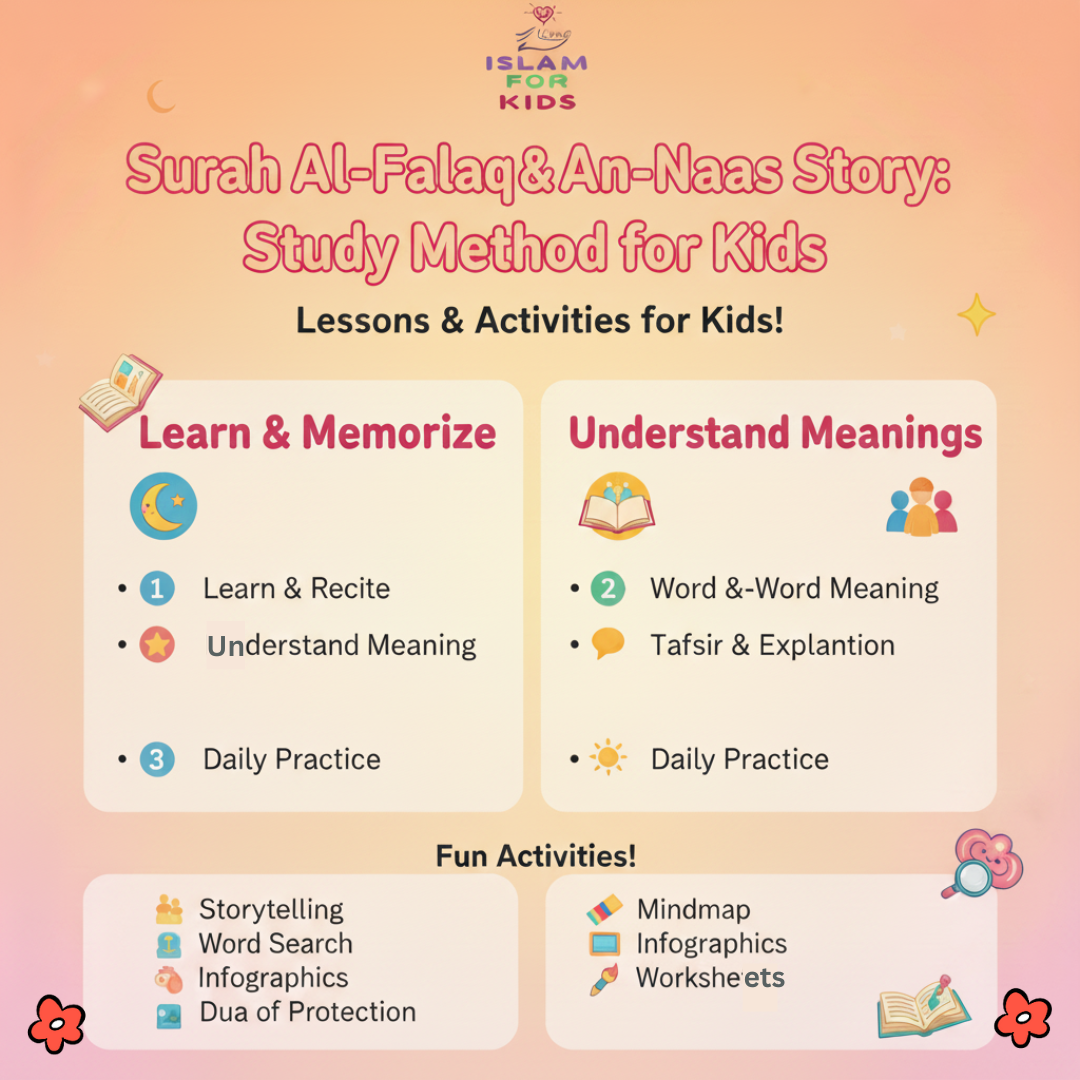
    Our method combines the power of visual aids, videos, books, and interactive tools to make learning Surah Al-Falaq and Surah An-Naas both fun and effective.

    Visit the links below for our resources and activities:

    Explore our resources and enroll today!
    Tafsir of Short surahs for children

  • Surah Al-Falaq – An-Naas Study Method: Understanding the Chapter of Dawn (سورة الفلق)Surah Al-Falaq (سورة الفلق)

    Surah Al-Falaq – An-Naas Study Method: Understanding the Chapter of Dawn (سورة الفلق)Surah Al-Falaq (سورة الفلق)

    Surah Al-Falaq An-Naas study method provides comprehensive learning techniques for these two protective chapters of the Quran. This interactive guide includes detailed verse-by-verse explanations, word meanings, translations, and educational activities for understanding Surah Al-Falaq and Surah An-Naas.Surah.

    Surah Al-Falaq An-Naas study method comprehensive guide with interactive learning techniques for children


    Surah Surah Al-Falaq An-Naas Study Method: Understanding the Chapter of Dawn (سورة الفلق)Surah Al-Falaq (سورة الفلق)

    These Surah Al-Falaq An-Naas teachings guide us to seek Allah’s protection from all types of evil.This Surah teaches us to seek Allah’s protection from all types of evil.

    Verse 1:

    Arabic:
    قُلْ أَعُوذُ بِرَبِّ الْفَلَقِ

    English Translation:
    “Say: I seek refuge in the Lord of the dawn.”

    Word Meanings:

    • قُلْ (Qul) – Say
    • أَعُوذُ (A’udhu) – I seek refuge
    • بِرَبِّ (bi-Rabbi) – In the Lord
    • الْفَلَقِ (al-Falaq) – The dawn or the daybreak

    Explanation:
    In this verse, we are told to seek protection from Allah, the One who causes the dawn to break through the darkness. The “dawn” symbolizes light, hope, and the power to overcome darkness and evil.


    Verse 2:

    Arabic:
    مِن شَرِّ مَا خَلَقَ

    English Translation:
    “From the evil of what He has created.”

    Word Meanings:

    • مِن شَرِّ (min sharri) – From the evil
    • مَا (ma) – What
    • خَلَقَ (khalaqa) – He has created

    Explanation:
    This verse asks for protection from any harmful or evil things in Allah’s creation. While Allah’s creation is good, some things or beings may cause harm, so we ask Allah to protect us from any possible danger.


    Verse 3:

    Arabic:
    وَمِن شَرِّ غَاسِقٍ إِذَا وَقَبَ

    English Translation:
    “And from the evil of the night when it grows dark.”

    Word Meanings:

    • غَاسِقٍ (ghasiqin) – Darkness
    • إِذَا (idha) – When
    • وَقَبَ (waqab) – It settles

    Explanation:
    This verse seeks protection from the dangers of the night, when darkness falls, and we cannot see clearly. The night can bring fear and unknown dangers, but Allah can protect us.


    Verse 4:

    Arabic:
    وَمِن شَرِّ النَّفَّاثَاتِ فِي الْعُقَدِ

    English Translation:
    “And from the evil of those who blow on knots.”

    Word Meanings:

    • النَّفَّاثَاتِ (an-naffathat) – Those who blow
    • فِي الْعُقَدِ (fi-l-‘uqad) – On knots

    Explanation:
    This verse refers to the evil of those who practice magic or sorcery by tying knots and blowing on them. It’s a form of evil behavior that people may use to harm others. We seek Allah’s protection from such harmful acts.


    Verse 5:

    Arabic:
    وَمِن شَرِّ حَاسِدٍ إِذَا حَسَدَ

    English Translation:
    “And from the evil of the envious one when he envies.”

    Word Meanings:

    • حَاسِدٍ (hasid) – The envious one
    • حَسَدَ (hasada) – He envies

    Explanation:
    This verse seeks protection from those who feel jealous and wish harm upon others. When someone envies another person, they might desire bad things to happen to them. We ask Allah to protect us from such jealousy.


    Surah An-Naas (سورة الناس)

    This Surah teaches us to seek protection from the evil whispers of Shaytan (Satan) and all harmful influences.

    Verse 1:

    Arabic:
    قُلْ أَعُوذُ بِرَبِّ النَّاسِ

    English Translation:
    “Say: I seek refuge in the Lord of mankind.”

    Word Meanings:

    • قُلْ (Qul) – Say
    • أَعُوذُ (A’udhu) – I seek refuge
    • بِرَبِّ (bi-Rabbi) – In the Lord
    • النَّاسِ (an-Naas) – Of mankind

    Explanation:
    In this verse, we are instructed to seek refuge in Allah, the Lord of all people. This reminds us that Allah is the Creator and Protector of every human being.


    Verse 2:

    Arabic:
    مَلِكِ النَّاسِ

    English Translation:
    “The King of mankind.”

    Word Meanings:

    • مَلِكِ (Malik) – King
    • النَّاسِ (an-Naas) – Of mankind

    Explanation:
    Here, we acknowledge that Allah is the King of all people. He is in charge of everything, and no one has power or authority over Him. He alone controls and protects us.


    Verse 3:

    Arabic:
    إِلَٰهِ النَّاسِ

    English Translation:
    “The God of mankind.”

    Word Meanings:

    • إِلَٰهِ (Ilah) – God
    • النَّاسِ (an-Naas) – Of mankind

    Explanation:
    This verse reminds us that Allah is the only God of all humans. He is the One we worship and rely on. By stating that Allah is our God, we confirm our belief in His power to protect us from harm.


    Verse 4:

    Arabic:
    مِن شَرِّ الْوَسْوَاسِ الْخَنَّاسِ

    English Translation:
    “From the evil of the whisperer who withdraws.”

    Word Meanings:

    • شَرِّ (sharri) – Evil
    • الْوَسْوَاسِ (waswas) – Whisperer
    • الْخَنَّاسِ (khannas) – Who withdraws

    Explanation:
    This verse asks for protection from the whisperer, meaning Shaytan, who quietly puts evil thoughts into our minds and then hides. Shaytan tries to make us do bad things, but we seek Allah’s protection to avoid falling into these traps.


    Verse 5:

    Arabic:
    الَّذِي يُوَسْوِسُ فِي صُدُورِ النَّاسِ

    English Translation:
    “Who whispers in the hearts of mankind.”

    Word Meanings:

    • يُوَسْوِسُ (yuwaswisu) – Whispers
    • فِي (fi) – In
    • صُدُورِ (sudoor) – Hearts
    • النَّاسِ (an-Naas) – Of mankind

    Explanation:
    Shaytan tries to enter people’s hearts and minds to make them think bad things. He whispers evil ideas into our hearts to lead us away from the right path, but Allah can protect us from these whispers.


    Verse 6:

    Arabic:
    مِنَ الْجِنَّةِ وَالنَّاسِ

    English Translation:
    “From among jinn and among mankind.”

    Word Meanings:

    • الْجِنَّةِ (al-jinnah) – The jinn (invisible beings)
    • النَّاسِ (an-Naas) – Mankind

    Explanation:
    This verse tells us that evil whispers can come from both jinn (invisible beings) and humans. Some people or beings might try to lead us astray, but by seeking Allah’s protection, we can stay safe from all types of evil influences.


    Summary of Both Surah Al-Falaq An-Naas

    • Surah Al-Falaq protects us from the dangers of the outside world—whether they come from people, jealousy, or magic.
    • Surah An-Naas protects us from the dangers within—whispers and evil thoughts that try to lead us away from the right path.

    Reciting both Surah Al-Falaq An-Naas reminds us that Allah is our ultimate protector from all forms of evil, and we should always turn to Him in times of fear or difficulty.Reciting these Surahs reminds us that Allah is our ultimate protector from all forms of evil, and we should always turn to Him in times of fear or difficulty.

    Additional Information:

    • These Surahs should be recited in the morning and evening as part of Azkar (remembrance of Allah) to seek protection from all harm throughout the day and night.
    • It’s also recommended to recite them before sleeping, to seek Allah’s protection from evil during the night.

    Quiz: Surah Al-Falaq & Surah An-Naas

    Here’s a fun and educational quiz for kids based on the key facts and explanations of Surah Al-Falaq and Surah An-Naas.


    Multiple Choice Questions (MCQs):

    1. Who do we ask for protection in Surah Al-Falaq?
    • A) The sun
    • B) The moon
    • C) The Lord of the dawn
    • D) The stars Answer: C) The Lord of the dawn

    1. In Surah Al-Falaq, we ask Allah to protect us from the evil of:
    • A) Animals
    • B) Darkness, jealousy, and magic
    • C) Angels
    • D) Trees Answer: B) Darkness, jealousy, and magic

    1. What does “Al-Falaq” mean?
    • A) Night
    • B) Darkness
    • C) Daybreak/Dawn
    • D) Stars Answer: C) Daybreak/Dawn

    1. In Surah An-Naas, who is the King of mankind?
    • A) A Prophet
    • B) Allah
    • C) Angels
    • D) Shaytan Answer: B) Allah

    1. Who tries to whisper bad thoughts in our hearts?
    • A) Shaytan
    • B) Angels
    • C) Prophets
    • D) Friends Answer: A) Shaytan

    1. What does “An-Naas” mean in Surah An-Naas?
    • A) People
    • B) Angels
    • C) Shaytan
    • D) Jinn Answer: A) People

    1. How many verses (ayahs) are in Surah Al-Falaq?
    • A) 3
    • B) 5
    • C) 7
    • D) 6 Answer: B) 5

    1. How many verses (ayahs) are in Surah An-Naas?
    • A) 6
    • B) 4
    • C) 3
    • D) 7 Answer: A) 6
    1. When is it recommended to recite Surah Al-Falaq and Surah An-Naas?
      • A) Only during Ramadan
      • B) During morning and evening
      • C) After every meal
      • D) Before sleeping only
      Answer: B) During morning and evening

    1. Why do we recite Surah Al-Falaq and Surah An-Naas in the morning and evening?
    • A) To protect ourselves from hunger
    • B) To ask for Allah’s protection from all kinds of evil throughout the day and night
    • C) To bring rain
    • D) To avoid studying

    Answer: B) To ask for Allah’s protection from all kinds of evil throughout the day and night


    Short Answer Questions:

    1. What is the main theme of Surah Al-Falaq?
    • Answer: The main theme is seeking Allah’s protection from external evils, such as darkness, jealousy, and magic.

    1. What is the main theme of Surah An-Naas?
    • Answer: The main theme is seeking Allah’s protection from the evil whispers of Shaytan and evil thoughts.

    1. From which two types of beings can evil whispers come, according to Surah An-Naas?
    • Answer: Evil whispers can come from both jinn and humans.

    1. Why are Surah Al-Falaq and Surah An-Naas called “Al-Mu’awwidhatayn”?
    • Answer: They are called Al-Mu’awwidhatayn because they are the two Surahs of seeking protection from Allah.

    1. What was the occasion for the revelation of these two Surahs?
    • Answer: These Surahs were revealed when Prophet Muhammad (peace be upon him) was affected by magic, and Allah revealed these Surahs to protect him from harm.

    1. Why are these two Surahs recited together often?
    • Answer: These Surahs are recited together because both provide protection from external and internal evils, making them powerful for seeking Allah’s protection.

    True/False Questions:

    1. Surah Al-Falaq protects us from the evil whispers of Shaytan.
    • Answer: False (It’s Surah An-Naas that protects from evil whispers of Shaytan).

    1. Surah An-Naas teaches us to seek refuge in Allah, who is the Lord, King, and God of mankind.
    • Answer: True

    1. The word “Falaq” means darkness.
    • Answer: False (It means dawn or daybreak).

    1. Surah Al-Falaq has 6 verses.
    • Answer: False (It has 5 verses).

    1. Both Surah Al-Falaq and Surah An-Naas were revealed to help protect the Prophet Muhammad (peace be upon him) from the effects of magic.
    • Answer: True

    This quiz can help children review the key facts and concepts from Surah Al-Falaq An-Naas in a fun and engaging way!This quiz can help children review the key facts and concepts from the two Surahs in a fun and engaging way!

    Study method

    In our online classes, we use an engaging and comprehensive study method to teach Surah Al-Falaq and Surah An-Naas. Our goal is to ensure students not only learn to recite and memorize these Surahs but also understand their meanings through creative and interactive learning tools. Here’s how we do it, with links to detailed resources for each step:


    1. Recitation (تلاوت)

    Objective:
    We begin by focusing on the correct recitation of the Surahs. Using videos of expert reciters, students follow along to perfect their pronunciation. Each verse is practiced until fluency is achieved.
    Click here for our recitation videos.


    2. Tajweed (تجوید)

    Objective:
    We introduce the essential rules of Tajweed so students can recite the Quran correctly. We pay special attention to proper articulation of Arabic sounds and apply these rules in real-time recitation practice.
    Explore our Tajweed lessons with videos and guides.


    3. Memorization (حفظ)

    Objective:
    Memorization is made easy with the help of videos that guide students step-by-step. The process is broken into small sections, and each is repeated multiple times to ensure retention.
    Learn more about our Hifz videos and memorization techniques.


    4. Words Meaning and Translation

    Objective:
    We teach word meanings and translations using the “My First Quran with Pictures” book, making it easy for students to grasp the Arabic words along with their English meanings. This method makes learning engaging and fun.
    See how we use “My First Quran with Pictures” in our lessons.


    5. Tafsir (تفسیر) Surah Al-Falaq An-Naas

    Objective:
    We explain the meanings and lessons of the Surahs through the Islamic Education Book. Each verse is discussed in a simple and age-appropriate way, helping students understand the significance of seeking Allah’s protection.
    Explore our Tafsir lessons and resources.


    6. Infographics Surah Al-Falaq An-Naas

    Objective:
    Infographics are used to simplify the Surahs’ key themes. We either use visuals from “My First Quran with Pictures” or encourage students to create their own. This visual learning helps students retain the key messages of each verse.
    Check out our infographic tools and creative projects.


    7. Storytelling

    Objective:
    We enhance understanding through storytelling in class and with video animations. Stories like “Sarah and the Magic of Light” bring the Surahs’ meanings to life, making them more relatable for children.
    Watch our storytelling videos and animations.


    8. Mind Mapping

    Objective:
    We teach mind mapping using pre-designed images and videos to help students visually organize the lessons from the Surahs. These mind maps make it easier to understand and remember the concepts.
    Discover our mind mapping resources and videos.


    9. Exercises and Revisions (نظرثانی)

    Objective:
    We conduct regular revisions to ensure long-term retention. For assessments, we use interactive quizzes and exercises that test the students’ understanding and memorization of the Surahs.
    Check out our revision quizzes and exercises.


    Our method combines the power of visual aids, videos, books, and interactive tools to make learning Surah Al-Falaq and Surah An-Naas both fun and effective.

    Visit the links below for our resources and activities:

    Explore our resources and enroll today!
  • Step-by-Step deep study of Surah Al-Humazah (Chapter 104)

    Step-by-Step deep study of Surah Al-Humazah (Chapter 104)

    Surah Humazah (Chapter 104) of the Quran in Arabic along with English translation and word-to-word meanings and various activities:

    surah humazah

    Surah Humazah (Chapter 104)

    Arabic:

    بِسْمِ اللَّهِ الرَّحْمَٰنِ الرَّحِيمِ

    وَيْلٌ لِكُلِّ هُمَزَةٍ لُمَزَةٍ

    الَّذِي جَمَعَ مَالًا وَعَدَّدَهُ

    يَحْسَبُ أَنَّ مَالَهُ أَخْلَدَهُ

    كَلَّا ۖ لَيُنبَذَنَّ فِي الْحُطَمَةِ

    وَمَا أَدْرَاكَ مَا الْحُطَمَةُ

    نَارُ اللَّهِ الْمُوقَدَةُ

    الَّتِي تَطَّلِعُ عَلَى الْأَفْئِدَةِ

    إِنَّهَا عَلَيْهِم مُّؤْصَدَةٌ فِي عَمَدٍ مُّمَدَّدَةٍ

    English Translation:

    1. Woe to every scorner and mocker
    2. Who collects wealth and [continuously] counts it.
    3. He thinks that his wealth will make him immortal.
    4. No! He will surely be thrown into the Crusher.
    5. And what can make you know what is the Crusher?
    6. It is the fire of Allah, [eternally] fueled,
    7. Which mounts directed at the hearts.
    8. Indeed, it [i.e., Hellfire] will be closed down upon them
    9. In extended columns.

    Step-by-Step teaching method

    Teaching Surah Al-Humazah (Chapter 104) comprehensively can be done through a structured step-by-step approach that incorporates various methods to engage learners. Here’s a suggested plan:

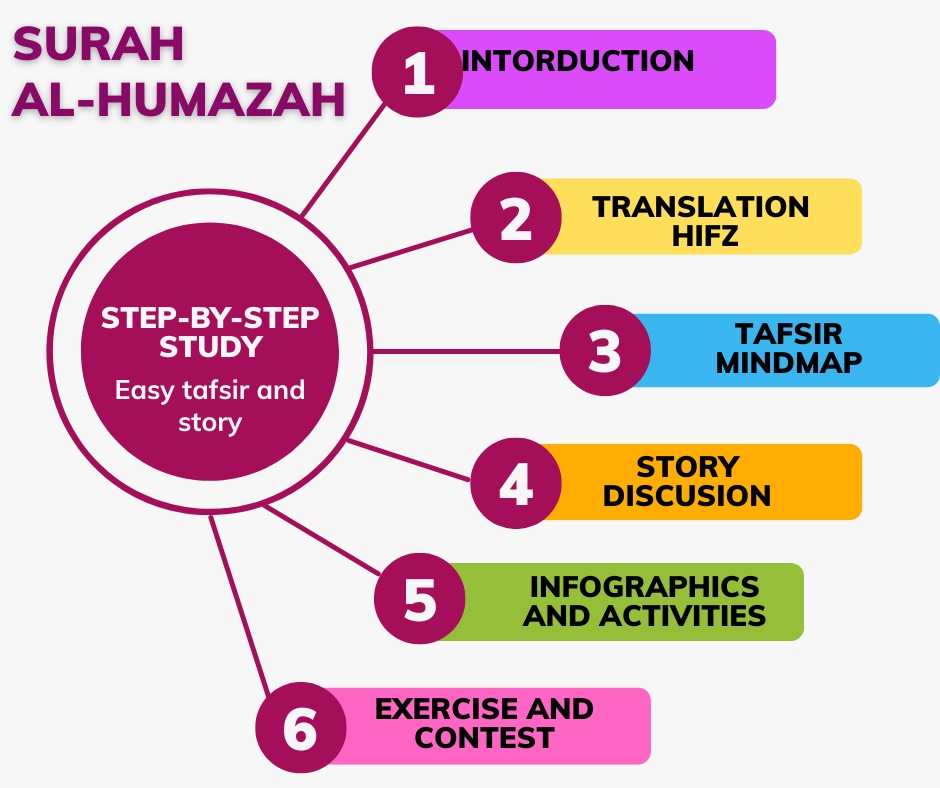
    1. Introduction:

    • Begin by introducing the Surah’s name, Al-Humazah, and its significance.
    • Discuss the theme of the Surah, which focuses on the consequences of backbiting, slander, and arrogance.

    2. Word Meaning and Tafsir:

    • Break down each verse, explaining the meanings of keywords and phrases.
    • Use resources like Ibn Kathir’s Tafsir to provide deeper insights into the context and interpretation of the Surah.
    • Encourage students to ask questions and engage in discussions to enhance their understanding.

    3. Memorization:

    • Provide techniques for memorizing the Surah, such as repetition, visualization, and listening to recitations.
    • Break the Surah into smaller sections for easier memorization.
    • Encourage regular practice and revision to reinforce memorization.

    4. Infographics and Mindmaps:

    • Create visually appealing infographics that summarize the key themes and messages of each verse.
    • Use mind maps to organize the main ideas and connections within the Surah, aiding in comprehension and retention.

    5. Storytelling:

    • Narrate stories or anecdotes related to the theme of the Surah to make it more relatable and memorable.
    • Highlight examples from the life of Prophet Muhammad (peace be upon him) or other historical incidents that illustrate the consequences of backbiting and arrogance.

    6. Activities:

    • Role-playing: Divide students into groups and assign roles to act out scenarios involving backbiting and its consequences, followed by discussions on alternative positive behaviors.
    • Art/crafts projects: Have students create artwork or posters depicting the Surah’s message using symbols and imagery. Like making a heart with wounds and stitching it or bandaging it.
    • Writing exercises: Ask students to write reflections or journal entries on how they feel when they get bad remarks. make a list of the sentences or words, you never like to hear for you.

    7. Quiz and Exercises:

    • Create quizzes or worksheets to assess students’ understanding of the Surah’s content, including its meanings and lessons.
    • Incorporate interactive exercises such as fill-in-the-blank, matching, or true/false questions.
    • Provide feedback and review any areas where students may need clarification or additional support.

    By following this structured approach, learners can gain a comprehensive understanding of Surah Al-Humazah while also developing their memorization skills, critical thinking abilities, and moral awareness.

    Let’s start Surah Al-Humazah Step-by-step study

    1.Intorduction

    Surah Al-Humazah was revealed in Makkah during the early period of Prophet Muhammad’s mission. Its revelation came as a response to the widespread mockery, slander, and arrogance prevalent among the Quraysh, particularly towards the Prophet and his followers.

    According to Tafsir and Seerah books, some of the prominent figures in Makkah who were known for their mockery and slander against the Prophet and the early Muslims included:

    1. Abu Lahab: He was the uncle of Prophet Muhammad and one of his staunchest opponents. Abu Lahab and his wife Umm Jamil were notorious for their hostility towards Islam and their relentless persecution of the Prophet and his followers.
    2. Abu Jahl (Amr ibn Hisham): He was one of the leaders of the Quraysh and a fierce enemy of Islam. Abu Jahl was known for his arrogance, hostility, and relentless opposition to the Prophet and his message.
    3. Muhammad ibn Ishaaq said: We continue to hear that this surah was revealed about Umayyah ibn Khalaf: He was a wealthy and influential figure in Makkah who openly opposed Islam and mistreated the early Muslims. Umayyah was known for his cruelty and disdain towards the Prophet and his followers.
    4. ‘Ata and Al-Kalbi said: This surah was revealed about Al-Akhnas ibn Shariq, who used to criticize people and gossip about them, especially the Messenger of Allah.
    5. Muqatil said: This surah was revealed about Al-Walid ibn Al-Mughira, who used to gossip about the Messenger of Allah in his absence and mock him to his face.
    6. Ibn Ashour said: This surah encompasses all polytheists who engaged in this act, whether their names are known or not.”

    These individuals, along with others from the Quraysh tribe, actively engaged in mocking, ridiculing, and slandering the Prophet and his followers, seeking to discredit Islam and undermine its message. The Prophet Muhammad (peace be upon him) continued his mission undeterred, guided by the light of truth and compassion, while those who had opposed him were left to face the consequences of their deeds in the Hereafter Surah Al-Humazah was revealed to condemn their behavior and warn them of the consequences of their actions in the Hereafter.

    2. Word-by-Word meaning and translation

    بِسْمِ اللَّهِ الرَّحْمَٰنِ الرَّحِيمِ

    In the name of Allah, the Entirely Merciful, the Especially Merciful.

    Verse 1:

    Arabic: وَيْلٌ لِكُلِّ هُمَزَةٍ لُمَزَةٍ

    English: Woe to every scorner and mocker

    • يْلٌ (Woe)
    • لِكُلِّ (to every)
    • هُمَزَةٍ (scorner)
    • لُمَزَةٍ (mocker)

    Verse 2:

    Arabic: الَّذِي جَمَعَ مَالًا وَعَدَّدَهُ

    English: Who collects wealth and [continuously] counts it.

    • الَّذِي (Who)
    • جَمَعَ (collects)
    • مَالًا (wealth)
    • وَعَدَّدَهُ (and [continuously] counts it)

    Verse 3:

    Arabic: يَحْسَبُ أَنَّ مَالَهُ أَخْلَدَهُ

    English: He thinks that his wealth will make him immortal.

    • يَحْسَبُ (He thinks)
    • أَنَّ (that)
    • مَالَهُ (his wealth)
    • أَخْلَدَهُ (will make him immortal)

    Verse 4:

    Arabic: كَلَّا ۖ لَيُنبَذَنَّ فِي الْحُطَمَةِ

    English: No! He will surely be thrown into the Crusher.

    • كَلَّا (No!)
    • لَيُنبَذَنَّ (He will surely be thrown)
    • فِي (into)
    • الْحُطَمَةِ (the Crusher)

    Verse 5:

    Arabic: وَمَا أَدْرَاكَ مَا الْحُطَمَةُ

    English: And what can make you know what is the Crusher?

    • وَمَا (And what)
    • أَدْرَاكَ (can make you know)
    • مَا (what)
    • الْحُطَمَةُ (is the Crusher)

    Verse 6:

    Arabic: نَارُ اللَّهِ الْمُوقَدَةُ

    English: It is the fire of Allah, [eternally] fueled,

    • نَارُ (fire of)
    • اللَّهِ (Allah)
    • الْمُوقَدَةُ (eternally fueled)

    Verse 7:

    Arabic: الَّتِي تَطَّلِعُ عَلَى الْأَفْئِدَةِ

    English: Which mounts directed at the hearts.

    • الَّتِي (Which)
    • تَطَّلِعُ (mounts directed)
    • عَلَى (at)
    • الْأَفْئِدَةِ (the hearts)

    Verse 8:

    Arabic: إِنَّهَا عَلَيْهِم مُّؤْصَدَةٌ

    English: Indeed, it [i.e., Hellfire] will be closed down upon them

    • إِنَّهَا (Indeed, it)
    • عَلَيْهِم (upon them)
    • مُّؤْصَدَةٌ (will be closed down)

    Verse 9:

    Arabic: فِي عَمَدٍ مُّمَدَّدَةٍ

    English: In extended columns.

    • فِي (in)
    • عَمَدٍ (columns)
    • مُّمَدَّدَةٍ (extended)

    3. Easy Tafsir of surah humazah

    You’re correct, the Bismillah is not included in Surah Al-Humazah (Chapter 104) of the Quran. Here’s a detailed Tafsir of Surah Al-Humazah according to Ibn Kathir’s interpretation:

    Verse 1: The word “Woe” is a severe warning from Allah to those who habitually engage in backbiting and slander. They are constantly looking for faults in others to mock and ridicule them.

    “Woe” is a warning of punishment for those who habitually ridicule and mock others. This indicates that mocking and making fun of people is a serious offense in the sight of Allah. Imagine if you worked hard on a drawing and someone laughed at it. That’s not nice, right?

    Verse 2: Allah describes the habit of such people, who amass wealth through any means possible and constantly count and hoard it as if their entire existence revolves around their wealth.

    Verse 3: These individuals have the false belief that their wealth will grant them eternal life and happiness as if they will never face any consequences for their actions.

    This verse talks about people who love to collect money and keep counting it all the time, thinking it’s the most important thing. It’s like someone who collects a lot of toys but never shares them with their friends.

    Verse 4: Allah refutes this false belief with a resolute “No!” They will not live forever in luxury; rather, they will be cast into the Crusher, a place of severe punishment in the Hereafter.

    Such a person believes that their wealth will make them immortal, showing their arrogance and false sense of security in their riches. But that’s not true because life is about more than just money. Even if you have lots of toys, you still need friends to play with.

    Verse 5: The severity of this punishment is emphasized, prompting reflection on its terrifying nature.

    This false belief is shattered by the reality of death and the Hereafter. They will be thrown into a crushing punishment Keep in mind, punishment is not just because of a lot of money or more toys. But it’s because of your arrogant behavior and showing off and denying to share it with others. It’s like when you build a sandcastle at the beach and then a big wave comes and washes it away.

    Just suppose you have a variety of dishes to eat. And someone in your neighbor is very hungry. The aroma of food is spread. But instead of sharing food, you are being rude to him. How would you feel if it happened to you?

    Verse 6: The Crusher is described as a fire kindled by Allah Himself, symbolizing the intense and unrelenting nature of the punishment awaiting the wrongdoers.

    Verse 7: This fire will leap onto the hearts of the offenders, causing them unbearable agony and distress.

    This fire burns so hot that it reaches right into people’s hearts, causing them pain and sadness. As they cause pain and sadness in the worldly life.

    Verse 8: They will be trapped in this torment, unable to escape or find any relief from its heat and pain.

    Verse 9: They will be confined in long columns in Hell, indicating the severity and permanence of their punishment, with no hope of reprieve.

    Once they’re in this place, there’s no escaping it. It’s like being stuck in a room with no doors or windows. They will be stuck there in long lines, waiting and unable to leave. It’s like waiting in line for a ride at an amusement park, but this ride never ends, and it’s not fun at all.

    In summary, Surah Al-Humazah serves as a stern warning against the sins of backbiting, slander, and arrogance, highlighting the severe consequences they entail in the Hereafter. It reminds believers to be mindful of their words and actions and to avoid harming others with their tongues or through their pursuit of worldly wealth.

    4. Infographics/ Hifz(Memorization)

    After covering two or three verses. children would be asked to make infographics of the verses. My first Quran with pictures has good infographics. Children can copy them or add their creativity and explain the theme of the verse with the help of drawing objects. (Please visit gallary to see the pictures made by our students.) During this children will start to memorise the verses by heart. We have verse-by-verse tajweed recitation videos. Children will practice and memorize with the help of these videos. (visit the youtube playlist for Tajweed recitation videos)

    5. Mindmap

    Here is a mindmap of the Surah Humazah

    Surah Al-Humaza

    Meaning

    The mockers

    Mindmap

    KEY FACTS!!

    Surah Al-Humazah

    It is in juzz 30

    It has 9 verses. 

    It is Makki Surah.. 

    Three topics have been discussed in this Surah 

       Warning to mockers

       Vanity of wealth

       Punishments of Jahanam

    V. 1 warning to mockers.

    Woe to the one woe goal is to speak about other people.

    ONE OF THE ETTIQUETTES OF ISLAM IS TO MIND YOUR BUN BASINESS. QURAN CRITICISES THE ONE WHO IS ALWAYS GOSSIPING

    Verse 2-5 

    Vanity of wealth

    He, who counts his own money and he thinks that his money will cause him to live forever.

    THE PEOPLE WHO THINK LIFE IS PURELY TO A MALS HEALTH THEY DON’T THINK ABOUT DEATH

    Verse 4-9:

    Punishment of Jahanam.

    That person will be thrown into the crushing fire.

    Points to remember:. 

    Never look down on anyone..

    Mocking is not allowed by anyone. 

    Keep a balance between earning and spending money. 

    Do not count money with greed. 

    Remember it!!!

    If we will mock others and hurt others, hellfire will burn our hearts, as we were hurting others by mocking. 

    Let’s make an intention. 

    No Mocking

    No gossips 

    No greed for more

    We need to pray to seek the protection of Allah

    Let’s pray.

    Dua for evil and protection from shaitan

    أَعُوذُ بِكَلِمَاتِ اللهِ التَّامَّةِ مِنْ شَرِّ مَا خَلَقَ

    Transliteration
    The dua is transliterated as A’udhu bi kalimat-illah il-tammati min sharri ma khalaq.

    Meaning in English
    The meaning of the dua for protection from the evil eye is I seek refuge in the perfect words of Allah from the evil of that which He has created.

    6. Story of surah humazah:

    There are two stories to explain this surah. The first story is the revelation story of the surah. This story can help students, why this surah was revealed. And how mocking and slandering and greedy habits of disbelievers of the Makkah were answered.

    2nd story is crafted for children. The theme of the story is How mocking and greed of more can leave us alone. You can read this story at our site or watch the video of the story. The Link is down in resources.

    Exercise based on Surah Al-Humazah:

    Quiz:

    1. What is the theme of Surah Al-Humazah?
      a) Mercy and forgiveness
      b) Backbiting and slander
      c) Gratitude and generosity
    2. What does “Woe” in verse 2 signify?
      a) Happiness
      b) Warning
      c) Comfort
    3. In verse 3, what do people mentioned collect excessively?
      a) Toys
      b) Wealth
      c) Knowledge
    4. What false belief do the wrongdoers have in verse 4?
      a) Their wealth will make them immortal
      b) Their friends will protect them
      c) They will never face consequences
    5. What is the Crusher mentioned in verse 5?
      a) A tool for building
      b) A punishment in the Hereafter
      c) A type of food

    Exercise:

    1. Memorize the Arabic text of Surah Al-Humazah.
    2. Write a summary of the Surah’s message in your own words.
    3. Reflect on a time when you may have engaged in backbiting or gossip. Write about how you felt afterward and what you learned from the experience.
    4. Create an infographic or poster illustrating the consequences of backbiting and slander mentioned in the Surah.
    5. Role-play a scenario where someone is being mocked or ridiculed. Discuss alternative ways the situation could have been handled with kindness and respect.
    6. Write a short story or poem inspired by the theme of Surah Al-Humazah.
    7. Discuss with a friend or family member how you can apply the lessons from Surah Al-Humazah in your daily life to avoid backbiting and arrogance.

    (FAQs) about Surah Al-Humazah along with short answers:

    1. What is the main theme of Surah Al-Humazah?

    • The main theme is the consequences of backbiting, slander, and arrogance.

    2. What does “Woe” signify in verse 2?

    • “Woe” signifies a severe warning or impending punishment from Allah.

    3. What do people mentioned in verse 3 collect excessively?

    • They collect wealth excessively and count it repeatedly.

    4. What false belief do the wrongdoers have in verse 4?

    • They believe that their wealth will make them immortal and protect them from any harm.

    5. What is the “Crusher” mentioned in verse 5?

    • The Crusher refers to a severe punishment in the Hereafter for those who engage in wrongdoing.

    6. What is the punishment described in verse 7?

    • The punishment described is like a fire kindled by Allah Himself, symbolizing intense and relentless torment.

    7. How can we apply the lessons from Surah Al-Humazah in our daily lives?

    • We can avoid backbiting, slander, and arrogance, and instead strive to be kind, respectful, and considerate towards others.

    Story of Surah Humazah Video

    Gallery

    Video Playlist English

    Video Playlist Urdu

    Books (Shop)

    My First Quran Picture Book

    My First Quran Stories Book

    Islamic education By Molvi Abdula Aziz Grade7

    Free Books (pdf)

  • How to teach Surah Inshirah step by step?

    How to teach Surah Inshirah step by step?

    Comprehensive Surah Inshirah teaching method: word meanings, Tajweed, Tafsir, infographics, videos, mind maps, exercises, revisions & dua learning. Engaging and holistic learning! (We are uploading videos and photos of teaching methods and video lessons of this Surah within a few days, Stay tuned for more)

    surah inshirah

    Translation Surah Al-Inshirah (Ash-Sharh) – سورة الإنشراح

    بِسْمِ اللَّهِ الرَّحْمَٰنِ الرَّحِيمِ (In the name of Allah, the Most Gracious, the Most Merciful)

    أَلَمْ نَشْرَحْ لَكَ صَدْرَكَ ٨١ (Have We not expanded for you your breast?) – Translation: Provided you with relief and comfort.

    وَوَضَعْنَا عَنكَ وِزْرَكَ ٨٢ (And We removed from you your burden) – Translation: We relieved you of the heavy burden you were carrying.

    ٱلَّذِىٓ أَنقَضَ ظَهْرَكَ ٨٣ (Which had weighed upon your back) – Translation: That had caused your back to bend due to the burden.

    وَرَفَعْنَا لَكَ ذِكْرَكَ ٨٤ (And raised high for you your repute) – Translation: And exalted your mention among the people.

    فَإِنَّ مَعَ ٱلْعُسْرِ يُسْرًۭا ٨٥ (For indeed, with hardship, there is a relief) – Translation: Verily, along with every difficulty, there is a relief.

    إِنَّ مَعَ ٱلْعُسْرِ يُسْرًۭا ٨٦ (Indeed, with hardship, there is a relief) – Translation: Truly, with every difficulty, there is a relief.

    فَإِذَا فَرَغْتَ فَٱنصَبْ ٨٧ (So when you have finished [your duties], then stand up [for worship]) – Translation: So, when you have finished your tasks, devote yourself to worship.

    وَإِلَىٰ رَبِّكَ فَٱرْغَبْ ٨٨ (And to your, Lord direct your longing) – Translation: And turn your attention and desire towards your Lord.

    Word-by-word meanings of Surah Al-Inshirah

    Below are the word-by-word meanings of Surah Al-Inshirah (Ash-Sharh) in both Arabic and English:

    Surah Al-Inshirah (Ash-Sharh) – سورة الإنشراح

    بِسْمِ (Bismi) – In the name

    اللَّهِ (Allahi) – of Allah,

    الرَّحْمَٰنِ (Ar-Rahmani) – the Most Gracious,

    الرَّحِيمِ (Ar-Rahimi) – the Most Merciful.

    أَلَمْ (Alam) – Have We not

    نَشْرَحْ (Nashrah) – expanded

    لَكَ (Laka) – for you

    صَدْرَكَ (Sadrak) – your breast?

    وَوَضَعْنَا (Wa-wada’na) – And We removed

    عَنكَ (Anka) – from you

    وِزْرَكَ (Wizrak) – your burden,

    ٱلَّذِىٓ (Allathee) – which

    أَنقَضَ (Anqadha) – had weighed

    ظَهْرَكَ (Zahrak) – upon your back,

    وَرَفَعْنَا (Wa-rafa’na) – And raised

    لَكَ (Laka) – for you

    ذِكْرَكَ (Thikrak) – your repute.

    فَإِنَّ (Fa-inna) – For indeed,

    مَعَ (Ma’a) – with

    ٱلْعُسْرِ (Al-‘usr) – hardship,

    يُسْرًۭا (Yusra) – there is relief.

    إِنَّ (Inna) – Indeed,

    مَعَ (Ma’a) – with

    ٱلْعُسْرِ (Al-‘usr) – hardship,

    يُسْرًۭا (Yusra) – there is relief.

    فَإِذَا (Fa-idha) – So when

    فَرَغْتَ (Faraghta) – you have finished

    فَٱنصَبْ (Fansab) – then stand up

    وَإِلَىٰ (Wa-ilaa) – and to

    رَبِّكَ (Rabbika) – your Lord

    فَٱرْغَبْ (Farghab) – direct your longing.

    Explanation of Surah Inshirah (Ash-Sharh) based on Ibn Kathir’s Tafsir

    Here’s a simplified and child-friendly explanation of Surah Al-Inshirah (Ash-Sharh) based on Ibn Kathir’s Tafsir:

    Surah Al-Inshirah (Ash-Sharh) – سورة الإنشراح

    1. Did Allah Help You? In the name of Allah, the Most Gracious, the Most Merciful. Allah asks the Prophet Muhammad (peace be upon him) if He has not made things easier for him and given him comfort.
    2. Your Burden is Lifted: Allah says that He removed the burden from the Prophet’s back. This burden could mean worries, hardships, or heavy responsibilities.
    3. Raised Your Reputation: Allah raised the Prophet’s mention and status among the people, so everyone respected and admired him.
    4. With Hardship Comes Ease: Allah assures the Prophet Muhammad (peace be upon him) that after every difficulty, there will be relief and ease. So, he should not worry because Allah will make things better.
    5. Remembering Allah: Allah repeats the message to emphasize that there is always ease with every hardship.
    6. Complete Your Duties and Worship: After you have finished your tasks and responsibilities, turn your attention to Allah and worship Him with devotion.
    7. Desire Allah’s Pleasure: Always remember to seek Allah’s pleasure and guidance in everything you do.

    In summary, Surah Al-Inshirah teaches us that Allah will always help and support us through difficult times. After every hardship, there will be ease, and we should never forget to turn to Allah and seek His guidance in everything we do.

    Keep in mind that this is a simplified explanation for children, and the actual Tafsir by Ibn Kathir goes into more detail and covers various aspects of the Surah. For children, it’s essential to present complex concepts in a way that is easy for them to understand and relate to.

    Mind map OF Surah Al-Inshirah (Ash-Sharh) – سورة الإنشراح

    Introduction:

    Surah Al-Inshirah, also known as Surah Ash-Sharh, is the 94th chapter of the Quran. It consists of 8 verses and is a short but profound Surah with a powerful message. The Surah was revealed in Makkah during a time when the Prophet Muhammad (peace be upon him) was facing immense challenges and difficulties in conveying the message of Islam. In this Surah, Allah comforts and consoles the Prophet and provides him with assurance, encouragement, and hope.

    1. Allah’s Comfort and Help
      • Allah’s mercy and kindness
      • Allah eased Prophet Muhammad’s (peace be upon him) burden
    2. Allah Elevated His Reputation
      • The Prophet’s respect and admiration increased
      • People looked up to him and followed his teachings
    3. Ease After Hardship
      • Allah’s promise of relief after difficulty
      • Every hardship is followed by ease
    4. Remembering Allah’s Blessings
      • Allah repeats the message of ease after hardship
      • Encouragement to be patient and grateful
    5. Fulfilling Duties and Worship
      • Completing responsibilities and tasks
      • Devoting time to worship Allah
    6. Seeking Allah’s Pleasure
      • Turning to Allah for guidance and help
      • Desiring Allah’s love and approval

    The mind map highlights the main themes and key points of Surah Al-Inshirah, making it easier to grasp the overall message of the Surah at a glance.

    Teaching method Surah Al-Inshirah

    Teaching Surah Al-Inshirah to children can be a wonderful and rewarding experience. To create an effective and comprehensive learning experience, here’s a suggested teaching method that incorporates word meanings translation, Tajweed, Tafsir, infographics, videos, mind maps, exercises, and revisions:

    1. Introduction to Surah Al-Inshirah: Begin the lesson by introducing Surah Al-Inshirah to the children. Provide them with the background information about when and why this Surah was revealed. Emphasize its significance in comforting the Prophet Muhammad (peace be upon him) during challenging times.
    2. Word Meanings Translation: Start by teaching the children the word-by-word meanings of Surah Al-Inshirah. Break down each verse, explaining the meanings of Arabic words in simple terms. This will help them understand the Surah’s message in a language they can comprehend.
    3. Tajweed Learning: Teach the children the proper rules of Tajweed to recite Surah Al-Inshirah correctly. Demonstrate the pronunciation of letters and sounds, and encourage them to practice along with you. Use audio or video resources to reinforce the correct recitation.
    4. Tafsir Insights: Share age-appropriate insights from Tafsir Ibn Kathir or other reputable sources regarding the context, meaning, and lessons of Surah Al-Inshirah. Focus on the Surah’s message of hope, ease after hardship, and reliance on Allah.
    5. Infographics and Visual Aids: Utilize infographics and visual aids to make learning engaging and fun. Create colorful posters or digital images that summarize key themes, lessons, and benefits of memorizing Surah Al-Inshirah.
    6. Educational Videos: Incorporate animated or interactive videos that visually present the Surah’s content and reinforce its meanings. These videos can be a valuable tool to capture children’s attention and facilitate better understanding.
    7. Mind Maps: Create a mind map of Surah Al-Inshirah with key concepts, themes, and related verses. Mind maps help children organize information and see the connections between different elements of the Surah.
    8. Exercises and Quizzes: Prepare exercises and quizzes to assess the children’s understanding of Surah Al-Inshirah. These can include fill-in-the-blanks, true/false, and multiple-choice questions.
    9. Revisions and Memorization: Encourage the children to memorize Surah Al-Inshirah verse by verse. Help them with memorization techniques, and regularly revise the Surah with them to reinforce memorization.
    10. Arts and Crafts: Engage the children in arts and crafts projects related to Surah Al-Inshirah. They can create posters, bookmarks, or greeting cards featuring verses from the Surah, along with their artistic interpretations.
    11. Quran Journal: Encourage children to maintain a Quran journal where they can write reflections and personal insights about Surah Al-Inshirah. This activity helps develop their critical thinking and emotional connection with the Quran.
    12. Group Recitation Circle: Organize a group recitation circle where children can take turns reciting Surah Al-Inshirah in a supportive and encouraging environment. This will boost their confidence in Tajweed and memorization.
    13. Storytelling: Narrate stories from the life of the Prophet Muhammad (peace be upon him) that relate to the themes of Surah Al-Inshirah. Children can learn valuable lessons from the Prophet’s experiences and how he found solace in the Quran.
    14. Application in Daily Life: Emphasize the practical application of Surah Al-Inshirah’s lessons in their daily lives. Encourage them to seek comfort and strength from this Surah during challenging times and to be grateful to Allah during times of ease.
    15. Dua Memorization: Introduce children to the dua (supplication) derived from Surah Al-Inshirah: “رَبِّ اشْرَحْ لِي صَدْرِي وَيَسِّرْ لِي أَمْرِي” (Rabbi shrah li sadri wa yassir li amri). Help them memorize this beautiful dua and explain its meaning in simple terms.

    These additional activities will add more diversity and excitement to the learning process, ensuring that children have a holistic understanding of Surah Al-Inshirah and its teachings. Learning through interactive and engaging activities helps children internalize the lessons and creates a lifelong love for the Quran.

    Quizzes for kids:

    1. Multiple Choice Quiz:
      • Question 1: What is another name for Surah Al-Inshirah?
        • A) The Earthquake
        • B) The Night
        • C) The Relief
        • D) The Cow
      • Question 2: How many verses are there in Surah Al-Inshirah?
        • A) 5
        • B) 7
        • C) 8
        • D) 10
      • Question 3: Where was Surah Al-Inshirah revealed?
        • A) Madinah
        • B) Jerusalem
        • C) Makkah
        • D) Egypt
      • Question 4: What is the main theme of Surah Al-Inshirah?
        • A) Stories of Prophets
        • B) Patience and Gratitude
        • C) Rules of Fasting
        • D) Life of the Prophet Muhammad (peace be upon him)
    2. True or False Quiz:
      • Statement 1: Surah Al-Inshirah was revealed in Madinah. (True/False)
      • Statement 2: The Surah teaches that ease follows hardship. (True/False)
      • Statement 3: Surah Al-Inshirah has 5 verses. (True/False)
      • Statement 4: The Surah encourages patience during tough times. (True/False)

    Reflection Questions for kids:

    1. What message do you think Surah Al-Inshirah conveys about facing challenges in life?
    2. Can you share a personal experience where you felt relief or ease after a difficult situation? How did you respond?
    3. How can you apply the teachings of Surah Al-Inshirah in your daily life to remain patient and grateful?
    4. Surah Al-Inshirah mentions seeking Allah’s help and guidance. In what ways can you seek Allah’s closeness in your life?
    5. Share an example of a time when you helped someone during a challenging situation. How did it make you feel?

    These quizzes and reflection questions can help reinforce the understanding of Surah Al-Inshirah and its valuable lessons in patience, gratitude, and reliance on Allah.

    Frequently Asked Questions (FAQs) about Surah Al-Inshirah:

    1. What is the meaning of “Al-Inshirah”? “Al-Inshirah” translates to “The Relief” or “The Expansion” in English. It signifies the ease and comfort that follow after times of hardship.
    2. How many verses are in Surah Al-Inshirah? Surah Al-Inshirah consists of 8 verses.
    3. When and where was Surah Al-Inshirah revealed? Surah Al-Inshirah was revealed in Makkah during the early years of Prophet Muhammad’s (peace be upon him) prophethood.
    4. What is the main theme of Surah Al-Inshirah? The main theme is the promise of relief, ease, and comfort from Allah after facing difficulties. It emphasizes patience, gratitude, and reliance on Allah during challenging times.
    5. How does Surah Al-Inshirah provide comfort? The Surah reassures that hardships are temporary and ease is inevitable. It reminds believers of Allah’s mercy, guiding them to seek solace in His presence.
    6. How does Surah Al-Inshirah relate to daily life? The Surah teaches valuable life lessons, encouraging believers to have patience during tough times and gratitude during prosperous moments.
    7. What lessons can we learn from Surah Al-Inshirah? Surah Al-Inshirah teaches the cyclical nature of challenges and the importance of turning to Allah in prayer, and finding strength in His words.
    8. Can Surah Al-Inshirah be memorized easily? Yes, due to its short length and rhythmic flow, Surah Al-Inshirah is often one of the first Surahs memorized by children and new learners.
    9. What is the significance of memorizing and reciting this Surah? Memorizing and reciting Surah Al-Inshirah can bring a sense of peace, hope, and connection with Allah, especially during tough times.
    10. How can I teach Surah Al-Inshirah to children effectively? Employ interactive methods like word meanings, Tajweed, Tafsir, infographics, videos, and mind maps to engage children and help them grasp the Surah’s message easily.

    Resources

    Story for the reflection of Surah InShirah(Written)

    Story for the reflection of Surah Inshirah (Video)

    Video Playlist

    Books (Shop)

    My First Quran Picture Book

    My First Quran Stories Book

    Islamic education By Molvi Abdula Aziz Grade 6

    Free Books (pdf)

    Our Online Courses

    Quran classes:

    We have online quran tajweed, recitation, and Quran Hifz classes for children. One-on-one classes with Qualified teachers.

    Quran Tafseer classes:

    Short and Easy-to-understand Quran translation and tafseer will be taught to the young learners. Infographics, mindmaps, work-by-word tajweed and meanings, stories, and duas are included in these classes.

    Hadith with Stories course consists of 30 short hadith 

    It’s a personality development course for children with interesting stories. 30 short hadiths would be taught with stories. We have worksheets to solve after learning hadiths for implications.

    Prayer for kids course :

    A short course to teach about taharat, Gusal, wudu, times of prayers, number and names of prayers, pillars, conditions of prayer, and method of prayer.

    Kindness to Parents:

    A 1-week course to teach the rights of parents with practical work. Dua and how to be kind to parents is included in this course.

    6 articles on the Muslim faith:

    Faiths/Muslim beliefs would be taught one by one with the help of mind maps and stories in the Quran.

    Islamic dress code:

    Islamic rules of dressing, Aurah/covering body rules, and modesty dressing will be included in this one-week course.

    Ramzan Boost course:

    1 month before Ramzan we start this course. Everything about fasting rules and supplication with the Ramzan checklist and daily to-do list is included in this course.

    Faith boosts course in December to say NO MARYY CHRISTMAS:

    Stories of faith by the Quran will be added in this course with basic articles of faith in this course.

    Enrolments Available

    All courses Are available to start as on one classes. Please have a look at our group courses continued here.

    Email
    Facebook.
    Youtube Urdu Channel
    Youtube English Channel
    If this teaching method is helpful for you? leave a comment.
  • The first surah revealed by Prophet Muhammad: Surah ALAlaq

    The first surah revealed by Prophet Muhammad: Surah ALAlaq

    _

    The first Surah reveald in Makkah on Prophet Muhammad SAW when he was 40 yrs old. This is a very important surah which was revealed in two parts. Both parts have different thems.

    Surah Alaq can be taught step by step using an approach that encompasses understanding the meaning of the verses and memorizing the surah. Here is a suggested teaching method for Surah Alaq:

    Step 1: Introduction and Background

    • Introduction: The first surah revealed, Surah Alaq is the 96th chapter (surah) of the Quran and is also known as “Iqra,” which means “Read” or “Recite.” It holds great importance as one of the earliest revelations received by the Prophet Muhammad (peace be upon him) during the early years of his prophethood.
    • This chapter marks a pivotal moment in the revelation of the Quran, introducing profound concepts and messages that continue to guide Muslims to this day.
    • Background: Surah Alaq was revealed in Makkah, prior to the migration (Hijrah) of the Prophet Muhammad (peace be upon him) to Madinah. Verse 1 to 5 is the first revelation. During this period, the Prophet was meditating in the cave of Hira, contemplating the social and spiritual challenges of his community. It was during one such occasion in the month of Ramadan that the angel Jibril (Gabriel) descended upon him and commanded him to “Read” (Iqra).
    • The Prophet, who was unlettered and had not received any formal education, was initially taken aback by the command. However, he humbly responded,
    • “I am not able to read.”
    • The angel Jibril then embraced him tightly, and after releasing him, repeated the command to read. This interaction, believed to have occurred several times, resulted in the revelation of the first verses of Surah Alaq.
    • The revelation of Surah Alaq not only marked the beginning of the Prophet Muhammad’s (peace be upon him) prophethood but also emphasized the importance of seeking knowledge and the pursuit of education.
    • It instilled in the Muslim community a profound appreciation for learning, literacy, and the acquisition of wisdom.
    • The background of Surah Alaq verse 9 to 19 was revealed later. These verses are about Abu Jahal. It reflects the challenges faced by the Prophet during the early stages of his mission.
    • The pagan society of Makkah, deeply rooted in idolatry and unaware of the monotheistic teachings of Islam, presented significant obstacles to the spreading of the message.
    • However, the revelation of Surah Alaq and subsequent revelations served as a source of guidance, encouragement, and fortitude for the Prophet and his followers.
    • Understanding the introduction and background of Surah Alaq helps to contextualize the significance of this chapter and the transformative impact it had on the early Muslim community. It emphasizes the themes of seeking knowledge, the importance of literacy, and the profound spiritual journey that began with the command to “Read” (Iqra).

    Step 2: Recitation and Listening

    • We encourage students to listen to a recitation of Surah Alaq to familiarize themselves with the Correct Tajweed.
    • We Emphasize correct pronunciation and Tajweed rules during the recitation.
    • We provide word-by-word Tajweed and Recitation videos with word meanings

    Step 3: Translation and Tafsir (Exegesis)

    • We Break down the meaning of each verse, explaining the concepts and ideas conveyed in Surah Alaq. For this purpose, we Read the book ‘My first quran with Pictures’. This book has beautiful infographics that help students understand every verse’s theme.
    • We translate the surah into the student’s easy English, ensuring they understand the message being conveyed.
    • We Use Tafsir resources or explanations by scholars to provide deeper insights into the context and interpretations of the verses. Islamic education books by Molvi Abdul Aziz have excellent short tafsir for children, which is very easy to read and understand.

    Step 4: Reflection and Discussion

    • We encourage students to reflect on the lessons and guidance offered in Surah Alaq. For this purpose, we do some practical work. For example, to teach them the importance of creation, we did an activity of seeding. So a been in a glass jar was grown by children. As humans were created by a clot.
    • We Facilitate a discussion about the significance of seeking knowledge, the consequences of arrogance, and the importance of humility in their lives. The example is clear, Animals and other creatures have very small knowledge so they can’t change their life. But humans are learning and making big changes in this world just because they have knowledge given by Allah.

    Step 5: Memorization

    • We Break down Surah Alaq into manageable segments or verses for memorization. We have 2 classes every week. So 1 or 2 verses would be memorized every day. Children get much time to memorise surah during other activities.
    • We Teach the memorization of the surah using repetition, recitation practice through videos , and memorization techniques.
    • We Emphasize the importance of understanding the meaning of the verses while memorizing them to foster a deeper connection with the surah.

    Step 6: Application and Integration

    • We encourage students to apply the teachings of Surah Alaq in their daily lives.
    • We Discuss practical ways to seek knowledge, practice humility, and avoid arrogance.
    • We encourage them to reflect on the lessons of Surah Alaq in their interactions with others, their studies, and their pursuit of personal growth.

    Step 7: Revision and Assessment

    • We Conduct regular revision sessions to reinforce the memorization of Surah Alaq.
    • We Assess students’ understanding of the surah through quizzes, discussions, or written assignments.
    • We Provide opportunities for students to recite Surah Alaq in class one by one. Every student gets a chance to recite and participate in reading word meanings and discussions to build confidence in their recitation and memorization skills.

    Step 8: Mindmap and Infographic

    • We encourage our students to write word meaning with infographics. It helps to remember meanings as image memory power.
    • After completing the surah, we also help students to mindmap the theme and lessons of the surah with keywords.

    Step 9: Activities.

    • We include various activities during our lessons.
    • We encourage students to do crafting, drawing, and practicals according to the lessons
    • For Surah Alaq we did an activity to grow a seed. It helped students how Allah has created everything.
    • Another activity was About making a list of Skills and knowledge of this world.
    • We also had an activity about picking all the nouns from the surah and making drawings of nouns, like pen, human, Alaq.

    Step 10: Story

    • Storytelling is a basic part of our teaching style.
    • We have the story Story: “From Arrogance to Humility” to read in our class.
    • We collect stories of the creations,
    • Stories of Seerat tu Nbi SAW

    By following this step-by-step teaching method, students can develop a comprehensive understanding of Surah Alaq, memorize its verses, and internalize its timeless teachings, allowing them to apply its wisdom in their lives.

    Resources

    My First Quran Picture Book

    My First Quran Stories Book

    Islamic education By Molvi Abdula Aziz Grade 6

    Lectures videos in English

    Lectures videos in Urdu

    Courses

    Quran classes:

    We have online quran tajweed, recitation, and Quran Hifz classes for children. One-on-one classes with Qualified teachers.

    Quran Tafseer classes:

    Short and Easy to understand Quran translation and tafseer will be taught to the young learners. Infographics, mindmaps, work-by-word tajweed and meanings, stories, and duas are included in these classes.

    Hadith with Stories course consists of 30 short hadith 

    It’s a personality development course for children with interesting stories. 30 short hadiths would be taught with stories. We have worksheets to solve after learning hadiths for implications.

    Prayer for kids course :

    A short course to teach about taharat, Gusal, wudu, times of prayers, number and names of prayers, pillars, conditions of prayer, and method of prayer.

    Kindness to Parents:

    A 1-week course to teach the rights of parents with practical work. Dua and how to be kind to parents is included in this course.

    6 articles on the Muslim faith:

    Faiths/Muslim beliefs would be taught one by one with the help of mind maps and stories in the Quran.

    Islamic dress code:

    Islamic rules of dressing, Aurah/covering body rules, and modesty dressing will be included in this one-week course.

    Ramzan Boost course:

    1 month before Ramzan we start this course. Everything about fasting rules and supplication with the Ramzan checklist and daily to-do list is included in this course.

    Faith boosts course in December to say NO MARYY CHRISTMAS:

    Stories of faith by the Quran will be added in this course with basic articles of faith in this course.

    Enrolments Available

    All courses Are available to start as in one on one classes. Please have a look at our group courses continued here.

    Email
    Facebook.
    Youtube Urdu Channel
    Youtube English Channel
    If this teaching method is helpful for you? leave a comment.