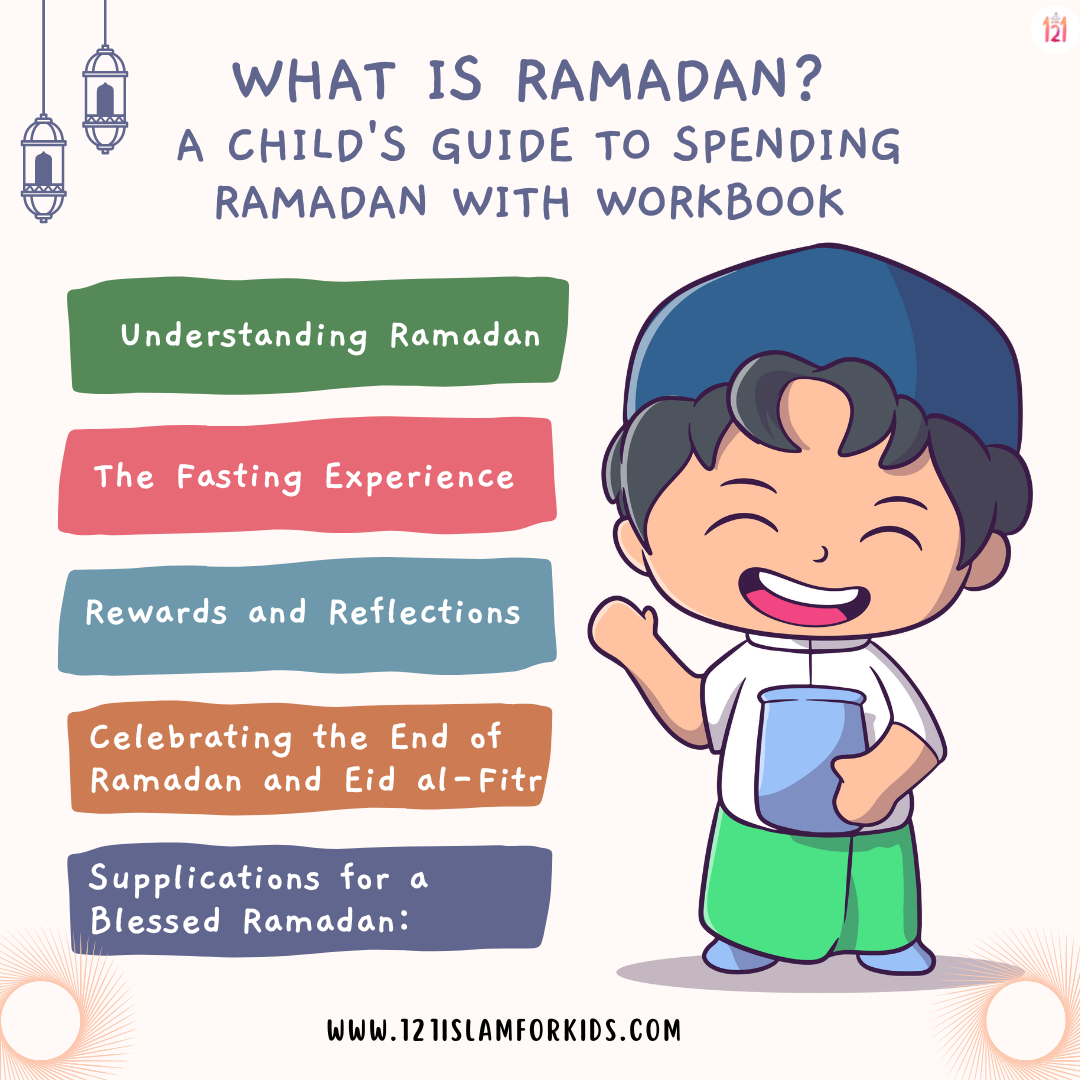
What is Ramadan: A Guide for Young Hearts with Worksheets. Children will learn the importance and rules of fasting and supplication. Ramzan Diary-based activities. This is a short course designed for kids.
This is an activity-based work. Our activity book/Ramzan diary will help your child to books in Ramzan. I hope it will help you alot.
Table of Contents
Outline of the Course
- Briefly introduce Ramadan as the ninth month of the Islamic lunar calendar.
- Explain its significance as a month of fasting, reflection, and spiritual growth.
Section 1: Understanding Ramadan
- What is Ramadan?
- Definition and historical context.
- The importance of Ramadan in Islam.
- Fasting: More than Abstaining from Food
- Explain the concept of fasting beyond abstaining from food and drink.
- The order of fasting in the Quran.
- Purpose of Fasting
- Highlight the spiritual, self-discipline, and empathy-building aspects.
Section 2: Preparing for Ramadan
- Excitement in the Air: Preparations and Decorations
- Encourage the anticipation of Ramadan through decorations and preparations.
- Create a festive atmosphere.
- Prepare Ramzan’s Diary and Planner
- Set Ibada goals
- Prepare your daily check list
- Prepare your dua list and posters
- Dos and Don’ts During Ramadan
- Guide on etiquettes and behaviors during the month.
Section 3: The Fasting Experience
- All Organs Fasting: A Holistic Approach
- Explain how fasting involves the entire body, not just abstaining from food.
- A Child’s Guide to Spending Ramadan
- Practical tips for children to make the most of the month.
- Different Supplications and Ibada
- Include age-appropriate supplications and acts of worship.
Section 4: Suhur and Iftar
- Rules and Benefits of Suhoor and Iftar
- Explain the significance of pre-dawn and sunset meals.
- Benefits for physical and spiritual health.
Section 5: Spiritual and Health Benefits
- Fasting: A Blessing for Mind and Body
- Elaborate on the health benefits of fasting.
- The connection between spiritual and physical well-being.
Section 6: Acts of Charity
- Understanding Sadqa for Children
- Define Sadqa and present various types suitable for children.
Section 7: Quranic Reflections
- Quran Revelation and Recitation Detail
- Share stories of the Quran’s revelation and encourage recitation.
Section 8: Special Nights and Moments
- Lailatul Qadr: The Night of Power
- Explain the significance and encourage special prayers during this night.
Section 9: Rewards and Reflections
- The Reward of Worship in Ramadan
- Highlight the special blessings and rewards during this month.
Conclusion
- Summarize the key points.
- Encourage children to approach Ramadan with enthusiasm and dedication.
Section 1: Understanding Ramadan
What is Ramadan?
Ramadan is a sacred month, a time when the Quran, the holy book of Islam, was revealed to Prophet Muhammad (peace be upon him). It’s not just a regular month; it’s like a friend who brings us blessings and joy.
Allah says in the Quran,
“The month of Ramadan [is that] in which was revealed the Quran, a guidance for the people and clear proofs of guidance and criterion.” (2:185)
The significance of Ramadan is immense. It’s a month when Muslims all over the world fast from dawn to sunset, refraining not only from food and drink but also from negative actions and thoughts. Prophet Muhammad (peace be upon him) said,
“When the month of Ramadan starts, the gates of the heaven are opened, and the gates of Hell are closed, and the devils are chained.” (Sahih al-Bukhari)
Fasting:
More than Abstaining from FoodFasting during Ramadan is a complete experience that involves more than just saying no to meals. It’s a holistic approach where our hearts, minds, and actions are tuned towards goodness. Allah instructs in the Quran,
“O you who have believed, decreed upon you is fasting as it was decreed upon those before you that you may become righteous.” (2:183)
Fasting is not just about feeling hungry; it’s about developing self-discipline and understanding the struggles of those who are less fortunate. Prophet Muhammad (peace be upon him) emphasized the broader purpose of fasting, saying,
“Fasting is not [just abstaining] from eating and drinking. Fasting is [also] from vain speech and foul language.” (Sahih Bukhari)
Purpose of Fasting
The purpose of fasting extends beyond the physical act. It’s a journey of the soul, an opportunity for spiritual growth, and a means of enhancing empathy for others. Allah beautifully describes the essence of fasting,
“O you who have believed, decreed upon you is fasting as it was decreed upon those before you that you may become righteous.” (2:183)
During Ramadan, we strive to be kinder, more patient, and grateful for the blessings around us. The act of fasting is a powerful tool for self-reflection and self-improvement. Prophet Muhammad (peace be upon him) said,
“The one who fasts experiences two joys: the joy of breaking his fast and the joy of meeting his Lord.” (Sahih Muslim)
As young hearts embark on the journey of Ramadan, they learn that fasting is a beautiful tapestry of spiritual development, self-control, and a deepened connection with Allah. The month becomes a school of character-building and a pathway to becoming better individuals.
Section 2: Preparing for Ramadan
Excitement in the Air: Preparations and Decorations
Before Ramadan arrives, there’s a buzz of excitement in the air. It’s like getting ready for a wonderful celebration. Prophet Muhammad (peace be upon him) said, “When the first night of Ramadan comes, the devils and rebellious jinn are chained, the gates of Hell are closed, and not one gate of it is opened. The gates of Paradise are opened, and not one gate of it is closed.” (Sahih al-Bukhari)
To enhance this festive atmosphere, families decorate their homes. This isn’t just about making things look pretty; it’s about creating an environment filled with joy and anticipation. Verses from the Quran, like “Say, ‘In the bounty of Allah and in His mercy – in that let them rejoice; it is better than what they accumulate.’” (10:58), remind us to be grateful and celebrate the blessings Allah has bestowed upon us.
Why Keeping a Ramadan Diary and Checklist is Cool for Kids:
- Track Your Wins: Use your Ramadan diary to mark off the days you fast, pray, and do good deeds. It feels awesome to see how much you’ve achieved!
- Be a Goal Getter: Make a checklist of things you want to do during Ramadan, like fasting a few days, reading Quran, or being kind to others. Checking off your goals is super satisfying!
- Write Your Story: Your diary is like your own special book where you can write about your days in Ramadan. Share how you feel, what you learn, and the cool stuff you do!
- Be a Ramadan Rockstar: Keeping a diary and checklist helps you be responsible and stick to your plans. It’s all about being awesome and growing every day!
- Memories Galore: Your Ramadan diary is a treasure chest of memories! You can look back on it later and remember all the fun and special moments you had during Ramadan.
Your Ramadan Diary and Checklist:
- Fast-o-Meter: Tick off the days you fast and give yourself a high-five for each successful fast!
- Prayer Power: Keep track of your prayers every day. Don’t forget to pray on time and with your heart!
- Kindness Counts: Write down the nice things you do for others, like sharing, helping, or saying kind words.
- Quran Quest: Record the verses you read or memorize from the Quran. Try to finish a part of the Quran by the end of Ramadan!
- Feelings Flashback: Use your diary to talk about your feelings, what you’re thankful for, and the fun stuff you did each day.
Your Ramadan Plan for Super Ibadah and Prayer:
- Dream Big: Think about what you want to achieve during Ramadan. Set small goals that you can reach step by step!
- Make a Schedule: Plan your day with time for suhoor, prayers, Quran time, and iftar. Stick to your schedule and make every moment count!
- Family Fun: Do Ramadan stuff with your family, like praying together, reading Quran, and helping others. It’s even more fun when you do it together!
- Get Ready: Get cool books, apps, and stuff that helps you learn more about Ramadan and Islam. The more you know, the more awesome you’ll be!
- Check Your Progress: Look at your diary and checklist regularly to see how far you’ve come. Celebrate your wins and keep going strong!
With your Ramadan diary, checklist, and plan for worship and prayer, you’ll have an amazing time, grow closer to Allah, and make this Ramadan the best one yet!
Dos and Don’ts During Ramadan
As we prepare for Ramadan, it’s important to understand the dos and don’ts – the etiquette and behaviors that make this month special. Prophet Muhammad (peace be upon him) taught us, “If someone does not give up false speech and act upon it, Allah does not need for him to give up his food and drink.” (Sahih al-Bukhari)
Dos include being extra kind, patient, and grateful. It’s a time to share with others and lend a helping hand. The Quran advises, “And speak to people good [words] and establish prayer and give zakah.” (2:83)
Don’ts involve avoiding negative behaviors such as lying, gossiping, and arguments. Allah reminds us, “O you who have believed, avoid much [negative] assumption. Indeed, some assumption is sin.” (49:12)
Guided by these teachings, young hearts learn that Ramadan is not just about refraining from food but also about nourishing their souls with goodness and positive actions. It’s a time to cultivate a spirit of kindness and patience.
Section 3: The Fasting Experience
When child will start Fasting?
In Islam, the obligation to fast during the month of Ramadan begins once a child reaches the age of puberty. However, parents are encouraged to gradually introduce their children to the practice of fasting before reaching puberty to familiarize them with its rituals and importance.
Typically, children are encouraged to start fasting intermittently from around the age of seven. This practice helps them build resilience, discipline, and a sense of devotion to their faith. Parents may encourage children to fast for a few hours during the day, gradually increasing the duration as they grow older and become more accustomed to fasting.
Parents need to be supportive and understanding during this process, taking into account the child’s physical and emotional capabilities. Children should never be forced to fast, and their well-being should always be prioritized. If a child finds fasting too difficult or experiences any adverse effects, parents should encourage them to break their fast and make up for it later.
When a child are not fasting, they should still actively participate in the spirit of Ramadan by engaging in acts of worship, such as performing the five daily prayers, reciting the Quran, and engaging in acts of charity and kindness. Additionally, parents can encourage children to learn about the significance of Ramadan, its rituals, and the importance of empathy and compassion towards others.
Overall, the process of introducing children to fasting should be gradual, supportive, and tailored to their individual needs and capabilities. By instilling a love for Ramadan and its practices from a young age, parents can help nurture a strong connection to faith and foster a sense of belonging within the Muslim community.
All Organs Fasting: A Holistic Approach
During Ramadan, our fasting isn’t limited to keeping our stomachs empty. Prophet Muhammad (peace be upon him) said, “Fasting is a shield; so when one of you is fasting, he should neither indulge in obscene language nor raise his voice in anger. If someone attacks him or insults him, let him say: I am fasting!” (Sahih Muslim)
This holistic approach means our eyes fast from seeing inappropriate things, our ears from hearing harmful words, and our tongues from speaking unkindly. We aim to purify our thoughts and actions, understanding that true fasting goes beyond the physical act.
A Child’s Guide to Spending Ramadan
For young hearts, Ramadan is an adventure. They can make special du’as (supplications) like the one Prophet Muhammad (peace be upon him) taught: “O Allah, I ask You for guidance, piety, safety, and well-being, and contentment and sufficiency.” (Sahih Muslim)
Children can read children-friendly stories from the Quran, learning from the wisdom of prophets like Prophet Yusuf (Joseph) and his patience or Prophet Musa (Moses) and his bravery. It’s a time to be little superheroes of kindness, sharing, and caring for others.
Different Supplications and Ibada
Children can engage in simple acts of worship or ibada. For instance, before starting any activity, they can say “Bismillah” (In the name of Allah). Expressing gratitude with phrases like “Alhamdulillah” (All praise is due to Allah) and asking for Allah’s help with “Hasbiyallahu la ilaha illa Huwa” (Allah is Sufficient for me; there is no deity except Him) become part of their daily routine.
As young hearts actively participate in these supplications and acts of worship, they develop a sense of closeness to Allah and a deeper understanding of the spiritual significance of Ramadan.
Section 4: Suhur and Iftar
Rules and Benefits of Suhoor and Iftar
Ramadan brings with it two special meals – Suhoor and Iftar. Before the sun rises, we have Suhoor, a pre-dawn meal to prepare us for the day of fasting. Allah’s Messenger (peace be upon him) encouraged us to have Suhoor, saying, “Eat Suhoor, for in Suhoor there is a blessing.” (Sahih Bukhari)
As the sun sets, it’s time for Iftar, the meal to break our fast. The Prophet Muhammad (peace be upon him) taught us to break our fast with dates and water, saying, “When one of you is fasting, he should break his fast with dates; but if he cannot get any, even water is sufficient.” (Abu Dawood)
The significance of these meals goes beyond nourishing our bodies. They are moments of connection – with our families, our communities, and with Allah. In the Quran, Allah says, “And eat and drink until the white thread of dawn becomes distinct to you from the black thread [of night].” (2:187)
Benefits for physical and spiritual health: Suhoor provides the energy needed for the day, and Iftar is a time of gratitude and reflection. Fasting teaches us self-discipline and helps us appreciate the blessings of food and water. The Prophet (peace be upon him) emphasized the spiritual benefits, “Fasting is not merely abstaining from eating and drinking. Rather, it is also abstaining from ignorant and indecent speech. If someone fights him or insults him, let him say: ‘I am fasting.’” (Sahih al-Bukhari)
As young hearts experience the rhythm of Suhoor and Iftar, they understand that these moments are not just about filling their tummies. They are opportunities for gratitude, connection, and self-discipline – all essential aspects of the Ramadan journey.
Section 5: Spiritual and Health Benefits
Fasting: A Blessing for Mind and Body
Fasting during Ramadan is not only a spiritual journey but also a gift for our minds and bodies. As we refrain from eating and drinking, our bodies undergo a form of detoxification. The Prophet Muhammad (peace be upon him) stated, “Fast, and you will be healthy.” (Ibn Majah)
The connection between spiritual and physical well-being:
The Quran acknowledges the dual impact of fasting, stating, “O you who have believed, decreed upon you is fasting as it was decreed upon those before you that you may become righteous.” (2:183) This righteousness encompasses both spiritual and physical well-being.
Developing self-control:
Fasting teaches us self-control, a skill that extends beyond the month of Ramadan. The Prophet (peace be upon him) emphasized the importance of controlling our actions, stating, “When any one of you is observing Saum (fasting) on a day, he should neither indulge in obscene language nor should he raise his voice; and if anyone reviles him or tries to quarrel with him, he should say: ‘I am observing fast.’” (Sahih Muslim)
Health benefits of fasting:
Research suggests that fasting can have various health benefits, including improved metabolism, better digestion, and even mental clarity. The Prophet’s guidance aligns with these findings, affirming the wisdom behind the practice.
Spiritual awareness and mindfulness:
Fasting enhances spiritual awareness and mindfulness. As we feel the physical effects of hunger, we become more conscious of our actions and intentions. Allah says in the Quran, “And He found you lost and guided [you].” (93:7) Fasting guides us back to our true selves, fostering a connection with Allah and a deeper understanding of our purpose.
Young hearts, as they experience the physical and spiritual dimensions of fasting, begin to appreciate the interconnectedness of their minds, bodies, and souls. The health benefits of fasting are not just a coincidence but a manifestation of Allah’s wisdom in prescribing this beautiful act of worship.
Section 6: Acts of Charity for Young Hearts
Understanding Sadqa for Children
In Ramadan, when the air is filled with kindness and joy, we learn about Sadqa – a magical way to share our love and blessings with others. Sadqa is like a treasure chest of good deeds that brings smiles and happiness to those around us.
Define Sadqa and present various types suitable for children:
1. Sharing Toys and Belongings:
Imagine sharing your favorite toys or books with friends who might not have as many. The Prophet Muhammad (peace be upon him) said, “Allah is in the aid of the servant as long as the servant is in the aid of his brother.” (Sahih Muslim) Sharing is like a special kind of Sadqa that makes our hearts happy.
2. Acts of Kindness:
Little acts of kindness are like tiny superpowers. Helping a friend, being polite, or cheering up someone who’s feeling sad – these are all acts of Sadqa. The Prophet (peace be upon him) said, “Every act of kindness is a charity.” (Sahih Muslim) So, let’s sprinkle kindness like confetti!
3. Feeding the Hungry:
Ramadan is a time to think about those who might be hungry. We can help by preparing or sharing meals. Prophet Muhammad (peace be upon him) said,
“He is not a believer whose stomach is filled while the neighbor to his side goes hungry.” (Ibn Majah) Sharing food is like sharing love! Feeding birds and animals is also a good act of charity. especially our leftover food should not be in bins. Children can collect the leftover food and put it in gardens or backyards for birds.
4. Saving Water and Resources:
Our planet is a gift from Allah, and we can take care of it as an act of Sadqa too. The Prophet (peace be upon him) said, “Do not waste water, even if you perform your ablution on the banks of an abundantly-flowing river.” (Ibn Majah) Every drop saved is a drop of kindness to our Earth.
5. Sharing skills and Ideas:
Children can teach skills they know to others. They can also teach them good words and hadiths or verses to others if they know. Children can also share awesome ideas, or recommend them to spend Ramzan and other days on good things.
6. Help
helping parents with house chores is also sadqa. And when a child helps his/her sibling in many ways, Allah gives reward to I’m for being kind to younger.
Understanding Sadqa helps us become superheroes of kindness. It’s not about how much we have; it’s about how much we can give. In Ramadan, our hearts become bigger, and our hands become helpers. Let’s spread joy and love, making the world brighter for everyone around us!
Section 7: Quranic Reflections for Young Hearts
Quran Revelation and Recitation Detail
In the magical month of Ramadan, we get to know about the Quran, a special book that guides our hearts. It’s not just a storybook; it’s like a treasure map leading us to goodness. Let’s explore the wonders of the Quran together!
Share stories of the Quran’s revelation and encourage recitation:
1. The Night of Power:
The Quran wasn’t sent to us all at once but during a very special night called Lailatul Qadr, better than a thousand months! Allah says, “Indeed, We sent the Qur’an down during the Night of Decree.” (97:1) This night is like a surprise gift, and we can find it in the last ten nights of Ramadan. Let’s make a special dua (supplication) to find it!
2. Encourage Recitation:
Ramadan is the best time to recite the Quran. The Prophet Muhammad (peace be upon him) used to recite extra during this month, like a beautiful melody. Aisha (may Allah be pleased with her) said,
“The Messenger of Allah (peace be upon him) was the most generous of people concerning goodness, and he used to be more generous in Ramadan when Gabriel visited him.” (Sahih al-Bukhari) So, let’s try to read a little bit every day, like a special secret adventure with Allah’s words.
Highlight the significance of reflection:
The Quran is not just a book; it’s a guide full of amazing stories and lessons. Allah asks us to think and reflect on the words. “Do they not reflect upon themselves? Allah created the heavens and the earth and everything between them in True and Just Proportions and for an appointed term.” (30:8) It’s like a magical mirror that helps us see how special we are.
Encourage children to recite and reflect:
Let’s make our special dua, asking Allah to make the Quran our best friend. “Allahumma, make the Quran the spring of our hearts, the light of our chests, the removal of our sadness, and the relief of our distress.” This supplication is like a magical spell that connects our hearts to the Quran.
As young hearts, let’s dive into the world of the Quran, like explorers on a fantastic journey. Every word is like a star guiding us, and every story is a treasure waiting to be discovered. In Ramadan, let’s make the Quran our special friend; together, we’ll uncover its beautiful secrets!
Section 8: Special Nights and Moments for Young Hearts
Lailatul Qadr: The Night of Power
In the enchanting month of Ramadan, there’s a night so special, so powerful, it’s like catching shooting stars of goodness! This night is called Lailatul Qadr, and it’s like finding a hidden treasure in the last ten nights of Ramadan.
Explain the significance and encourage special prayers during this night:
1. Better than a thousand months:
Allah says, “The Night of Decree is better than a thousand months.” (97:3) Imagine doing something good on this night – it’s like doing it for more than 83 years! So, let’s stay up late, pray, and make lots of special wishes.
2. Special prayers and duas: On Lailatul Qadr, we can pray special prayers like Qiyamul Layl (Night Prayer) and make many heartfelt duas. The Prophet Muhammad (peace be upon him) said, “Whoever stands in prayer on the Night of Qadr with sincere faith and hope for reward, his previous sins will be forgiven.” (Sahih al-Bukhari) It’s like a magical night where our prayers can reach the sky!
Make it fun for children:
1. Searching for the Night: Imagine Lailatul Qadr as a hidden treasure. We don’t know the exact night, but it’s in the last ten nights. So, let’s make a special calendar, do extra good deeds, and every night, we can pretend we’re on a treasure hunt, looking for the Night of Power!
2. Special Wishes/prayers: On this magical night, let’s make special wishes to Allah. We can wish for our family, friends, and even for the whole world to be happy and safe. It’s like writing a letter to Allah, and He listens to every word.
As young hearts, let’s make Lailatul Qadr a night to remember. It’s like having a sleepover with the angels, praying for goodness, and feeling the magic in the air. Every second of this night is like a precious gem. So, let’s stay up, pray, and dream big because Lailatul Qadr is a night full of power and miracles!
Section 9: Rewards and Reflections for Young Hearts
The Reward of Worship in Ramadan
In the special month of Ramadan, some rewards and blessings make our hearts sparkle with joy. Let’s discover the magical gifts that Allah has in store for us!
Highlight the special blessings and rewards during this month:
1. Gates of Paradise are Open, Gates of Hell Closed:
The Prophet Muhammad (peace be upon him) said, “When the month of Ramadan starts, the gates of the heaven are opened, and the gates of Hell are closed, and the devils are chained.” (Sahih al-Bukhari) It’s like a special invitation from Allah – the doors to goodness are wide open, and the doors to bad things are firmly closed!
2. Every Good Deed is Multiplied:
Allah loves the good things we do during Ramadan even more. The Prophet (peace be upon him) said, “The one who fasts experiences two joys: the joy of breaking his fast and the joy of meeting his Lord.” (Sahih Muslim) It’s like getting double stickers for every good deed!
Encourage gratitude and reflections:
1. Thanking Allah for Blessings:
In Ramadan, we count our blessings and say, “Alhamdulillah” (All praise is due to Allah) for all the good things. Allah loves when we’re grateful. The Prophet (peace be upon him) said, “He who does not thank people, does not thank Allah.” (Sahih Ahmad) Gratitude is like a secret key that opens doors to even more goodness.
2. Reflecting on Our Actions:
Ramadan is a time to look at our actions and think about how we can become even better. Allah says, “Do they not reflect upon themselves? Allah created the heavens and the earth and everything between them in True and Just Proportions and for an appointed term.” (30:8) It’s like taking a mirror and looking at the kindness in our hearts.
Section 10: Celebrating the End of Ramadan and Eid al-Fitr
The Joyful Conclusion: Eid al-Fitr
As Ramadan bids us farewell, a celebration awaits – it’s time for Eid al-Fitr, a festival of joy, gratitude, and togetherness. Let’s discover the magic of Eid and the happiness it brings to our hearts!
Reflecting on Ramadan’s Achievements:
1. Thanking Allah for the Journey: Before Eid, let’s take a moment to thank Allah for guiding us through Ramadan. Reflect on the lessons learned, the kindness shared, and the moments of closeness to Allah. We say, “Allahumma innaka ‘afuwwun tuhibbul ‘afwa fa’fu ‘anni” (O Allah, You are the Most Forgiving, and You love forgiveness, so forgive me). It’s like asking for a clean slate filled with goodness.
2. Sharing in the Joy of Eid: Prophet Muhammad (peace be upon him) encouraged us to share the joy of Eid with everyone, including those who may not have enough to celebrate. It’s like spreading happiness! He said, “The fast remains suspended between Heaven and Earth until the Sadaqat al-Fitr are paid.” (Sahih Ibn Khuzaymah) Sadaqat al-Fitr is like a special gift we give to those who need it, making their Eid brighter too.
Preparing for Eid:
1. Special Prayers: On the morning of Eid, we gather for a special prayer called Salat al-Eid. It’s like a big family reunion with our fellow Muslims, and we say Takbir –
“Allahu Akbar, Allahu Akbar, La ilaha illallah, Allahu Akbar, Allahu Akbar, wa lillahi al-hamd” (Allah is the Greatest, Allah is the Greatest, there is no deity but Allah, Allah is the Greatest, Allah is the Greatest, and to Allah belongs all praise). It’s like telling the whole world about the greatness of Allah!
2. Spreading Love and Happiness: Eid is a time for giving and receiving gifts, visiting family and friends, and sharing delicious meals. We dress in our best clothes and greet each other by saying, “Eid Mubarak!” – wishing each other a blessed Eid.
Gratitude and Generosity on Eid:
1. Thanking Allah for the Blessings: During Eid, we express gratitude for the blessings and happiness Allah has granted us. We say, “Allahumma taqabbal minna innaka antas Samee’ul Aleem” (O Allah, accept from us, indeed, You are the Hearing, the Knowing). It’s like telling Allah how thankful we are.
2. Acts of Charity: Before going for Eid prayers, we give a special charity called Zakat al-Fitr. This act ensures that everyone, regardless of their circumstances, can join in the festivities. It’s like spreading love and making sure everyone feels the warmth of Eid.
As young hearts, let’s welcome Eid with open arms, joyous smiles, and a heart full of gratitude. Eid al-Fitr is a time to celebrate our achievements during Ramadan, to share love with those around us, and to express gratitude for the blessings that make our lives beautiful. May every Eid be filled with happiness, laughter, and the sweet moments that stay in our hearts forever! Eid Mubarak!
Supplications for a Blessed Ramadan:
(These Supplication are added in our Ramzan Diary)
Dua for Blessings:
As we start Ramadan, let’s say, “Allahumma barik lana fi Rajab wa Sha’ban wa ballighna Ramadan” (O Allah, bless us in Rajab and Sha’ban and allow us to reach Ramadan). It’s like asking Allah to shower our days with extra goodness.
Dua for a Grateful Heart:
We can also say, “Allahumma a’inna ala dhikrika wa shukrika wa husni ibadatika” (O Allah, help us to remember You, be grateful to You, and worship You in the best way). This supplication is like a special request for a heart filled with goodness.
As young hearts, let’s welcome the blessings of Ramadan with big smiles and open hearts. Every good deed is like a treasure, and every moment is an opportunity to feel closer to Allah. May this Ramadan be full of joy, gratitude, and beautiful reflections for us all”
Supplication for the Sighting of the Ramadan Moon:
Arabic:
اللهم أهله علينا بالأمن والإيمان، والسلامة والإسلام، ربي وربك الله،
Transliteration:
“Allahumma ahillahu ‘alayna bil-amni wal-iman, was-salamati wal-Islam, Rabbi wa Rabbukallah,
O Allah, let this month (Ramadan) pass over us with blessings, safety, faith, and in peace and Islam. You are our Lord and the Lord of all.”
1. Dua for blessings (First Section):
Arabic:
رَبِّ اغْفِرْ وَارْحَمْ إِنَّكَ أَنْتَ خَيْرُ الرَّاحِمِينَ
Transliteration:
Rabighfir warham innaka anta khairur rahimeen.
Translation:
“O my Lord, forgive and have mercy, for You are the Best of the Merciful.”
2. Dua for Seeking Forgiveness (Second Section):
Arabic: أَسْتَغْفِرُ اللهَ الّذِي لَا إِلَـهَ إِلَّا هُوَ الْحَيُّ الْقَيُّومُ وَأَتُوبُ إِلَيْهِ
Transliteration: Astaghfirullahal-lazi la ilaha illa Huwal-Haiyul-Qayyumu wa atubu ilaih.
Translation: “I seek forgiveness from Allah, the One who is truly worthy of worship, the Ever-Living, the Sustainer of existence, and I turn to Him in repentance.”
3. Dua for Forgiveness (Third Section):
Arabic: اللّهُمَّ إِنَّكَ عَفُوٌّ تُحِبُّ الْعَفْوَ فَاعْفُ عَنِّي
Transliteration: “Allahumma innaka ‘afuwwun tuhibbul ‘afwa fa’fu ‘anni.”
Translation: “O Allah, You are the Most Forgiving, and You love forgiveness, so forgive me.”
Dua for Lail tu Qader and Ramzan
Arabic:
اللَّهُمَّ أَجِرْنِي مِنَ النَّارِ
Transliteration:
Allahumma Ajirni Minan Naar |
Translation:
O Allah, save me from the fire (Jahannam).
Supplication for Eid al-Fitr:
Arabic:
الله أكبر، الله أكبر، لا إله إلا الله، الله أكبر، الله أكبر، ولله الحمد. اللهم إنك عفو تحب العفو فاعف عني.
Transliteration:
“Allahu Akbar, Allahu Akbar, La ilaha illallah, Allahu Akbar, Allahu Akbar, wa lillahi al-hamd. Allahumma innaka ‘afuwwun tuhibbul ‘afwa fa’fu ‘anni.”
These duas are tailored to fit the specific themes of each section during Ramadan, focusing on seeking blessings, asking for forgiveness, and seeking Allah’s pardon.