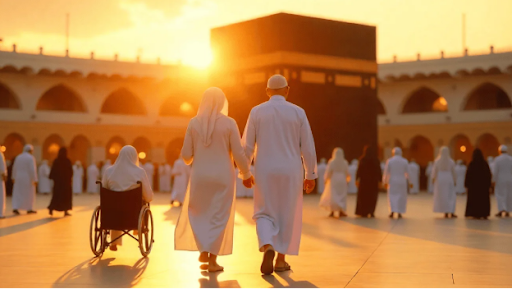
For many Muslim parents, the idea of taking their children to Umrah feels deeply special. It is more than a trip. It is a chance to introduce them to the Haram, to teach them love for sacred places, and to let them experience a journey centred around faith, remembrance, and family. Yet anyone who has travelled seriously with children knows that a spiritually meaningful journey can also be physically demanding, emotionally unpredictable, and logistically complex.
That is especially true for Umrah.
Adults often imagine Umrah through the lens of worship, focus, patience, and devotion. Children experience it through heat, hunger, waiting, walking, noise, disrupted sleep, unfamiliar surroundings, and overstimulation. The difference matters. Families who perform Umrah well are usually not the ones who force adult expectations onto small children. They are the ones who adjust their pace, prepare intelligently, and treat the journey as a family pilgrimage rather than an idealised spiritual retreat.
When approached properly, Umrah with children can be one of the most beautiful journeys a family ever takes together. It can also be one of the hardest if parents underestimate the realities. The key is not perfection. The key is preparation, flexibility, and the willingness to value peace over pressure.
Parents sometimes make the mistake of planning family Umrah as though it were simply a normal Umrah trip with extra luggage. In reality, the entire experience changes when children are involved.
A child may become tired exactly when the parents want to perform Tawaf. A toddler may need food, a diaper change, or comforting while the family is trying to move between locations. A baby may not sleep well in a hotel room. An older child may become frustrated by the crowds, the walking, the long waits, or the sudden changes to routine.
None of this means the trip is going badly. It simply means the family is experiencing Umrah honestly.
The sooner parents accept that this journey must be approached differently, the better the trip usually becomes. With children, success should not be measured by how much was completed in a single day or how closely the trip resembled an adult-only pilgrimage. Success should be measured by whether the family remained safe, emotionally settled, spiritually connected, and physically manageable.
The emotional tone of the trip often depends on expectations set before departure.
If parents expect uninterrupted worship, seamless rituals, and highly structured days, they are likely to feel disappointed. If they expect some chaos, some tiredness, and some changes of plan, they usually cope much better.
Children cry. Children resist. Children get tired. Children become overwhelmed. Sacred travel does not cancel normal childhood behaviour. In fact, a journey of this kind can intensify it, because children are removed from their usual rhythms and placed into highly stimulating environments.
One of the healthiest things a parent can do before family Umrah is redefine what a “good trip” looks like. A good trip is not necessarily one where every intention was fulfilled in the way originally imagined. It is one where the family worshipped sincerely, managed the practical side wisely, and protected one another from unnecessary hardship.
A child-friendly Umrah begins long before departure. It begins with the booking.
Families often focus mainly on headline price, but for Umrah with children, the real value of a package is often found in convenience rather than cost alone. A slightly cheaper deal can become far more difficult if it involves long airport layovers, poorly timed arrivals, hotels far from the Haram, or transport arrangements that are tiring even for adults.
This is one reason many parents prefer to research Umrah packages with children specifically, rather than choosing a standard option and hoping it works for family travel. A package that might suit a couple or a group of adults may not be the best choice for parents travelling with babies, toddlers, or younger children.
Hotel location is especially important. Families generally benefit from being as close as reasonably possible to the Haram. That does not simply save time. It reduces exhaustion, makes it easier to return quickly for naps or breaks, and gives parents more flexibility if a child becomes overwhelmed. Proximity is not just a comfort feature for families; it is a practical support system.
Many parents wait until they arrive to explain the meaning of Umrah to children. That is usually a missed opportunity.
Children often respond much better when they are prepared in advance. Tell them where they are going. Show them pictures of the Kaaba. Explain that this is a special journey to worship Allah. Older children can be introduced to the stories of Prophet Ibrahim, Sayyidah Hajar, and Prophet Ismail. Younger children can simply be taught that they are going to a place loved by Muslims all over the world.
This preparation helps in two ways. First, it gives children emotional context. Second, it makes the journey feel meaningful rather than confusing. Even if they do not fully understand every ritual, they begin to connect the trip with something important and beautiful.
Some parents find it helpful to involve children practically as well. They may make a small dua list with them, prepare a simple travel activity journal, or create a child-friendly checklist of what they will see and do. These small steps help children feel that they are participants in the journey, not just passengers being dragged through it.
A spiritual journey does not become more rewarding because a child is exhausted, hungry, or unwell. One of the biggest parenting mistakes on Umrah is treating physical needs as secondary to the “real purpose” of the trip. In reality, taking care of those needs is part of managing the trip properly.
Children should be well hydrated, appropriately dressed, and allowed enough rest. Parents should think carefully about familiar snacks, comfortable shoes, medication, wipes, weather, sun exposure, and sleep routines. If a child has allergies, asthma, sensory sensitivities, or particular medical needs, that planning becomes even more important.
Families also need to account for the fact that routine disruption affects children differently. A child who normally sleeps at a fixed time may become extremely unsettled if sleep is delayed repeatedly. A child who eats selectively may not adapt easily to unfamiliar food. A toddler who manages well at home may become much more clingy in crowded settings.
Good family Umrah planning means anticipating these realities, not pretending they will not happen.
Travel days are often the most stressful part of the journey. Parents may already be thinking about passports, check-in, luggage, timing, ihram, and arrival logistics. Children pick up on stress quickly, so disorganisation on the travel day often creates emotional spillover.
The solution is to simplify as much as possible.
Keep essentials easily accessible. Separate medications, snacks, wipes, water, and a change of clothes from the main luggage. Do not bury important items inside a large suitcase. If two parents are travelling together, divide responsibilities in advance. One person may handle documents while the other focuses on the children during transitions.
Children are far more likely to stay calm when the adults around them appear calm. This is one of those areas where small preparation prevents large problems.
For many families, Tawaf is where expectations collide most sharply with reality.
Parents imagine a serene ritual but often encounter tired children, crowded movement, emotional stress, and physical strain. The mistake is trying to complete Tawaf at the pace or intensity of adults travelling alone.
With children, slower is usually wiser. Steadier is better than faster. Parents should not feel pressured to rush, push through dense crowds, or maintain an unrealistic tempo. If a child needs to be comforted, carried, repositioned, or settled, that is part of the journey.
Some children may walk part of the way, though many will tire quickly. Some families prefer carriers. Others use strollers when circumstances allow. Some parents take turns focusing on the child while the other concentrates on maintaining calm and direction.
The main objective is not to look efficient. It is to complete the act safely and with composure.
Interestingly, many parents find Sa’i easier to manage than Tawaf because the movement is more straightforward and less circularly congested in experience. It can also become one of the most meaningful moments for children if framed properly.
The story of Sayyidah Hajar searching between Safa and Marwah is deeply powerful. It teaches effort, faith, desperation, love, and trust in Allah. Children often connect strongly to stories, and Sa’i becomes more bearable when they understand that it is not “just more walking” but part of a story that has shaped the memory of the Ummah for centuries.
This is one of the unique gifts of performing Umrah with children. Adults often focus on completion and devotion. Children often connect through story, emotion, and memory. If they leave the journey remembering courage, trust, and love for sacred places, that is already something very valuable.
No honest discussion of Umrah with children should pretend that everything will always feel peaceful.
Children may cry during key moments. They may become overstimulated. They may refuse cooperation at the most inconvenient times. Parents may feel embarrassed, especially in sacred places where they had hoped everything would be spiritually elevated.
This is where emotional maturity matters most.
Parents should resist the urge to treat these moments as signs of failure. Sometimes the best decision is to step away and calm the child. Sometimes it is better to rest than force another outing. Sometimes one parent continues while the other handles the child. Sometimes the original plan simply needs to change.
That is not a ruined Umrah. That is a real one.
Family pilgrimage requires parents to understand that mercy is not separate from worship. How one handles frustration, tiredness, noise, and pressure may in fact become one of the most spiritually revealing parts of the trip.
Another common mistake is trying to do too much.
Families often arrive with long mental lists: every prayer in the Haram, every ziyarat stop, shopping, family visits, extra worship, and idealised plans for each day. In theory this feels noble. In practice it often creates exhaustion and tension.
Children benefit far more from a calmer, more manageable trip than from an overloaded one. Rest time is not wasted time. A slower day is not a failed day. Parents should build margin into the schedule and allow for recovery.
A peaceful trip with fewer completed extras is almost always better than a chaotic trip full of avoidable stress.
Parents sometimes worry that children are too young to fully understand Umrah or that they will not remember the rituals in detail. That concern is understandable, but it misses something important.
Children often remember atmosphere more than detail.
They remember how the journey felt. They remember whether their parents were gentle or stressed. They remember stories, comfort, kindness, and moments of awe. They remember whether sacred places felt loving and meaningful or tense and overwhelming.
That means the emotional climate parents create matters enormously. A child may not remember every step of Tawaf years later, but they may remember seeing the Kaaba for the first time. They may remember making dua with their parents. They may remember feeling part of something special.
Performing Umrah with children is not the easiest way to travel, but it may be one of the most rewarding. It teaches parents to slow down, to lead with mercy, and to balance spiritual aims with human realities. It reminds families that worship is not only found in uninterrupted moments of devotion, but also in patience, gentleness, care, and restraint.
The most successful family Umrah is rarely the one that looks perfect from the outside. It is the one that is approached wisely, paced realistically, and carried out with sincerity.
For families beginning their planning, it can help to explore trusted resources on HajjGuider to better understand package options, preparation, and what kind of arrangements may suit a family’s specific needs.
A peaceful family Umrah, even if imperfect, is far better than a pressured one. And for many children, it may become one of the earliest and most lasting memories of faith they ever carry.