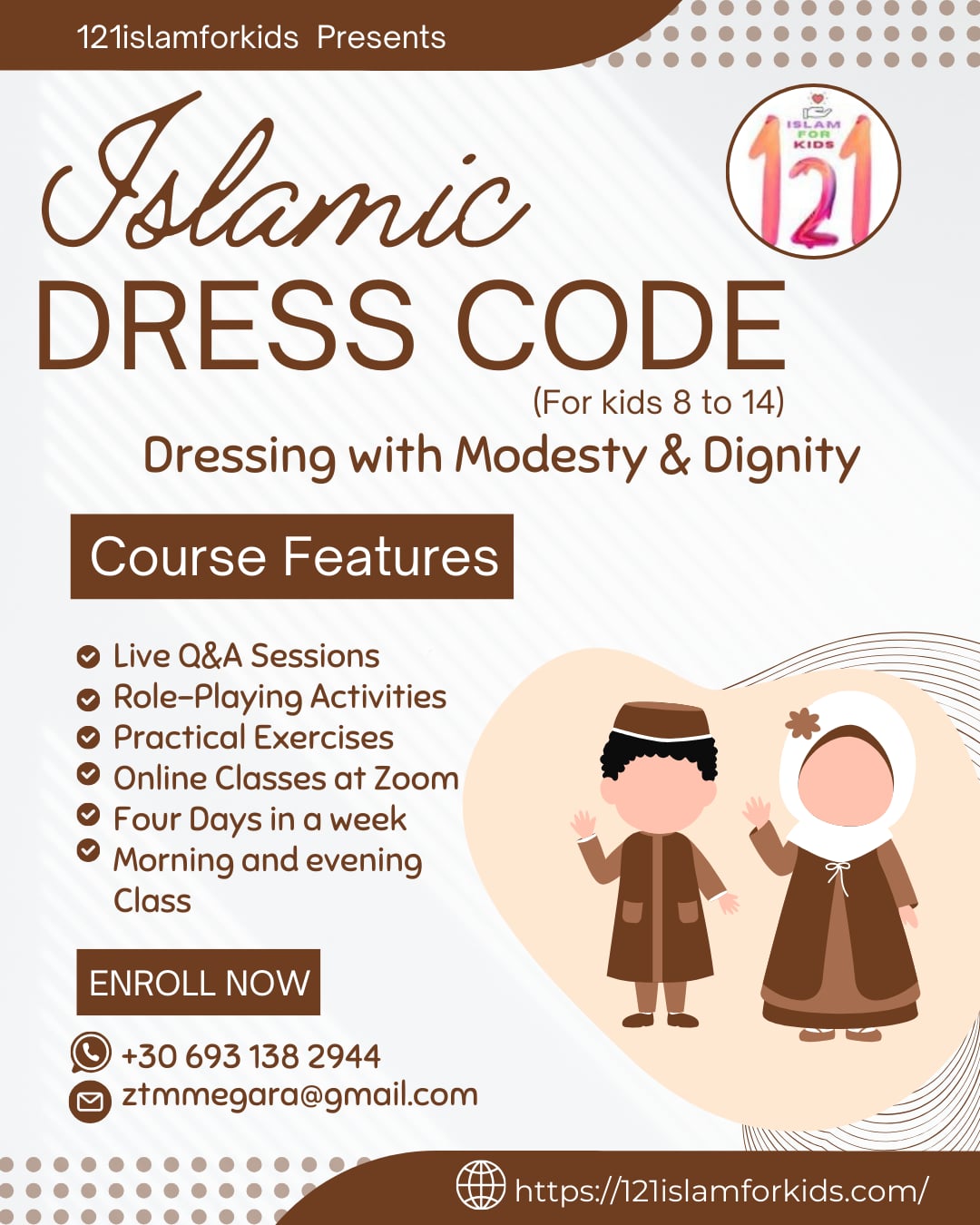
Aurah in Islam refers to the parts of the body that should be covered in modesty. It encompasses both physical and behavioral aspects, emphasizing the importance of maintaining modesty in appearance and conduct. We proudly present a course on the Islamic dress code in Quran. Islamic Dress Rules for Men: Islamic Dress Rules for Women: It is important to note that interpretations of Islamic dress rules may vary among different scholars and cultures. While these guidelines provide a general understanding, individuals may consult their local scholars for specific rulings or variations based on their circumstances and cultural practices. The ultimate purpose of Islamic dress rules is to promote modesty, decency, and the preservation of dignity for both men and women. It is an expression of faith and a means of upholding Islamic values in personal appearance and conduct. Quranic verses and hadiths Certainly! Here are some Quranic verses and hadiths that discuss the concept of Islamic dress and the covering of the body: Quranic Verses: Hadiths: These verses and hadiths emphasize the importance of modesty and covering the body, particularly for women. They highlight the obligation to guard one’s private parts, dress in a manner that is not revealing, and use clothing as a means of righteousness and adornment. The specific details of Islamic dress may vary based on cultural customs and interpretations. Still, the underlying principle remains consistent – to dress in a manner that preserves modesty, dignity, and obedience to the commandments of Allah and the teachings of the Prophet Muhammad (peace be upon him). Teaching Methods Islamic dress code in Islam Modesty, and Covering the Body: Introduction to Modesty and Islamic Dress: Provide an overview of the importance of modesty in Islam and the significance of dressing in accordance with Islamic guidelines. Share Quranic verses and hadiths that emphasize the concept of modesty and the importance of covering the body. Understanding the Concept of Aurah: Explain the concept of aurah and its significance in Islamic teachings. Use visual aids, such as diagrams or illustrations, to depict the body areas that should be covered according to Islamic dress guidelines. Engage in class discussions to clarify any questions or misconceptions about aurah. Quranic Verses and Hadiths on Dressing Modestly: Provide a list of Quranic verses and hadiths that explicitly mention the importance of dressing modestly and covering the body. Discuss the context and implications of these verses and hadiths to deepen the student’s understanding. Exploring Different Styles of Islamic Dress: Introduce various styles of Islamic dress, such as hijab, abaya, niqab, and modest clothing from different cultures. Show visual examples of these styles and discuss their significance and variations across different regions. Practical Tips for Dressing Modestly: Offer helpful guidance on how to incorporate modesty in everyday attire. Provide suggestions for finding modest clothing that is fashionable, comfortable, and aligns with Islamic guidelines. Share tips on combining different clothing items to achieve modesty while maintaining personal style. The Importance of Intention: Emphasize the significance of intention in dressing modestly and adhering to Islamic guidelines. Encourage students to reflect on their intentions and develop a sincere desire to please Allah in their choice of clothing. Addressing Challenges and Misconceptions: Discuss common challenges and misconceptions related to Islamic dress, such as societal pressures, cultural influences, and stereotypes. Provide practical advice on how to overcome these challenges and navigate through them while maintaining one’s commitment to Islamic values. Promoting Positive Body Image and Self-Esteem: Highlight the positive aspects of modesty, such as promoting self-respect, dignity, and a healthy body image. Conduct activities and discussions that encourage students to appreciate their bodies as a gift from Allah and embrace their unique qualities. Role Models and Inspirational Stories: Share stories of exemplary Muslim individuals who embody modesty and adhere to Islamic dress guidelines. Discuss the impact of these role models on society and the importance of following their examples. Practical Application: Assign practical tasks, such as creating modest outfit ensembles, designing modest clothing sketches, or conducting a research project on modest fashion trends. Encourage students to reflect on their personal journey towards modesty and share their experiences with the class. Q&A Sessions and Discussions: Allocate time for Q&A sessions to address any specific questions or concerns raised by the students. Facilitate class discussions to encourage students to share their perspectives, experiences, and challenges related to Islamic dress and modesty. Conclusion and Recap: Summarize the key points covered in the course and reinforce the importance of adhering to Islamic dress guidelines. Provide additional resources, such as recommended readings or online platforms, for further exploration of the topic. By incorporating these teaching methods, students will develop a comprehensive understanding of Islamic dress, modesty, and the significance of covering the body. These methods will not only provide knowledge but also foster a sense of appreciation for the values and principles underlying Islamic dress. Resources and Activities: Course Sign up Other Courses Leave your thoughts about this course in the comment box
A short course on 6 Articles of Faith in Islam:
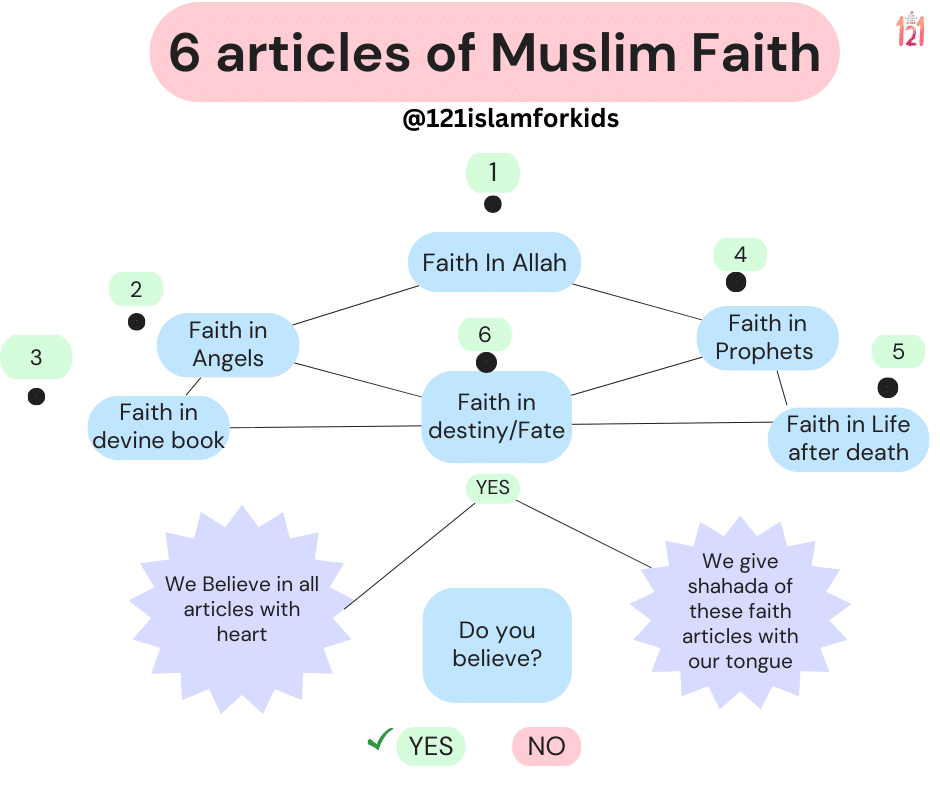
Title: Exploring the 6 Articles of Faith in Islam: Online Course for Children The six articles of faith, also known as the pillars of iman, are the foundational beliefs that Muslims hold. Here is a detailed explanation of each article: Belief in Allah (God): Muslims believe in the oneness of Allah, that there is only one God. Allah is eternal, all-powerful, and the creator of the universe. Muslims believe in Allah’s divine attributes, such as His mercy, knowledge, and justice. They believe in worshipping and obeying Allah alone and recognizing Him as the ultimate authority. Read More Belief in Angels: Muslims believe in the existence of angels, who are spiritual beings created by Allah. Angels have no physical form and are invisible to humans. They carry out specific tasks assigned by Allah, such as delivering messages, recording deeds, and protecting individuals. Muslims believe in the archangel Jibril (Gabriel), who brought revelations from Allah to the prophets. Read more Belief in Prophets: Muslims believe in the prophets and messengers sent by Allah to guide humanity. They include well-known figures like Prophet Muhammad, Jesus, Moses, Abraham, and others. Prophets were chosen by Allah and were entrusted with delivering His message to people. Muslims believe that Prophet Muhammad is the final messenger and that his teachings and example (Sunnah) are to be followed. Belief in Divine Books: Muslims believe that Allah revealed divine books to guide humanity. The Quran is the central and final book of Islam, believed to be the direct word of Allah as revealed to Prophet Muhammad. Muslims also believe in the original scriptures sent to earlier prophets, such as the Torah revealed to Moses and the Injeel (Gospel) revealed to Jesus. The Quran is considered the most authentic and complete book, providing guidance for all aspects of life. Read more about this faith here. Belief in the Day of Judgment: Muslims believe in the Day of Judgment, also known as the Last Day or the Day of Resurrection. On this day, Allah will resurrect all individuals from their graves to be held accountable for their deeds. Muslims believe in the balance of justice, where each person’s good and bad deeds will be weighed. The righteous will be rewarded with Paradise (Jannah), while the wicked will face punishment in Hellfire (Jahannam). Belief in Divine Decree (Qadr): Muslims believe in Allah’s divine decree and predestination. They believe that everything happens according to Allah’s will and knowledge. This belief includes accepting that Allah has knowledge of all things past, present, and future. Muslims understand that while humans have free will, Allah’s ultimate plan and decree are always in effect. These six articles of faith form the foundation of Islamic belief. They guide Muslims in understanding the purpose of life, the relationship with Allah, and the principles and values that shape their actions and interactions with others. By adhering to these beliefs, Muslims strive to lead a righteous life, seeking Allah’s pleasure and aiming for eternal happiness in the Hereafter. Course Outline: Introduction to Islam Understanding the basics of Islam as a comprehensive way of life. Introducing the concept of the Seven Articles of Islam. Tawhid: Oneness of Allah Explaining the belief in the Oneness of Allah. Discussing the attributes of Allah and His role as the Creator. Engaging children through stories and interactive activities. Prophethood: Belief in Prophets and Messengers Introducing the concept of Prophets and Messengers in Islam. Highlighting the importance of Prophet Muhammad (PBUH) as the final Messenger. Learning about other Prophets and their significant contributions. Divine Books: Belief in Revealed Scriptures Understanding the importance of Divine Books in Islam. Discussing the Quran as the final and preserved revelation. Exploring the stories and lessons from various Prophets and scriptures. Angels: Belief in Angelic Beings Exploring the world of angels and their role in Islamic beliefs. Learning about popular angels like Jibril (Gabriel) and Mika’il (Michael). Understanding the concept of guardian angels and their presence in our lives. Day of Judgment: Belief in the Afterlife Discussing the belief in the Day of Judgment and life after death. Exploring the concept of accountability and the scale of deeds. Engaging children through thought-provoking discussions on the significance of righteous actions. Qadar: Belief in Divine Decree and Destiny Understanding the concept of Qadar, the divine decree. Discussing the balance between free will and predestination. Encouraging children to trust in Allah’s wisdom and guidance. Conclusion and Recap Summarizing the key teachings and principles of the Seven Articles of Islam. Providing an opportunity for children to ask questions and seek clarification. Encouraging reflection and application of the learned knowledge in daily life. Mind Map: Seven Articles of Islam | ————————————— | | | | | Tawhid Prophethood Divine Angels Day of Judgment Books | Qadar By following this course outline and utilizing engaging teaching methods, interactive discussions, stories, and activities, children will develop a solid understanding of the Seven Articles of Islam in a fun and interactive online learning environment. Teaching Method of 6 Articles of Islam Crafts, Activities, and Assessments for Exploring the Seven Articles of Islam: Introduction to Islam Craft: Create an Islamic art collage using cut-out shapes and patterns. Activity: Share personal stories of how Islam is practiced in daily life. Assessment: Conduct a group discussion to assess children’s prior knowledge about Islam. Tawhid: Oneness of Allah Craft: Design and decorate “Allah is One” posters. Activity: Play a game where children identify and match attributes of Allah. Assessment: Ask children to draw or write about how they practice Tawhid in their lives. Prophethood: Belief in Prophets and Messengers Craft: Make paper puppets of Prophets and act out their stories. Activity: Create a timeline of major Prophets and their key messages. Assessment: Have children narrate a Prophet’s story and explain its moral lesson. Divine Books: Belief in Revealed Scriptures Craft: Decorate mini Quran bookmarks with Islamic calligraphy. Activity: Organize a “Quran Challenge” where children find verses related to specific topics. Assessment: Ask children to present their favorite Quranic verse and explain its meaning.
Islamic Relief USA: The largest Muslim charitable organization
Islamic Relief USA (IRUSA) is a humanitarian organization that is part of the Islamic Relief Worldwide (IRW) network. It is one of the largest Muslim charitable organizations in the United States, dedicated to providing assistance and support to those in need, regardless of their race, religion, or nationality. Here is some detailed information about Islamic Relief USA: It’s important to note that the information provided is based on the knowledge available up until September 2021. For the most up-to-date and accurate information on Islamic Relief USA, I recommend visiting their official website at www.irusa.org. Here is a list of Islamic relief organizations in the United States: Please note that this is not an exhaustive list, and there may be other local and regional Islamic relief organizations in the United States. It’s always advisable to research and verify the credibility and activities of any organization before making donations or getting involved. People Also read this What are the 4 obligatory acts of Wudu? How to perform Wudu? Story 25 Eng| Taqwa is the Fear of Allah: Umer R.A and the Widow woman
What are the 4 obligatory acts of Wudu? How to perform Wudu?
In this article, we will cover the Fard of wudu, the Sunnah of wudu, and the Complete wudu method. What is fard of Wudu? Wudu, also known as ablution, holds significant importance in Islam as it is a ritual purification process that Muslims perform before certain acts of worship. It involves specific actions and intentions aimed at purifying the body and mind. Understanding the method and obligatory aspects of wudu, known as fard, is crucial for practicing Muslims. This brief note will explore the concept of wudu, the method of performing it, and the fard obligations associated with it. Wudu is an integral part of the Islamic faith and is performed by Muslims to purify themselves before engaging in acts of worship, such as the five daily prayers (Salah), recitation of the Quran, and other religious rituals. It symbolizes spiritual and physical cleanliness, and by performing wudu, Muslims aim to attain a state of purity to establish a deeper connection with Allah. Method of fard Wudu The method of performing wudu consists of several sequential steps that must be followed in order. The process typically begins by making a clear intention in the heart to perform wudu solely for the sake of worship and to seek purification. Then, the individual begins by washing their hands up to the wrists three times, ensuring that water reaches every part of the hand, including the fingers. The next step involves rinsing the mouth and nose three times, using a small amount of water. This includes taking water into the mouth, swishing it around, and spitting it out, as well as inhaling water slightly into the nostrils and then expelling it. It is recommended to use the right hand for these actions. After that, the face is washed three times, from the hairline to the chin and from ear to ear, ensuring that water reaches all parts of the face. This step is followed by washing the right arm up to the elbow three times, starting with the right hand, and then repeating the same process for the left arm. Next, the individual wipes their head with wet hands, moving them from the front of the head to the back, and then bringing them back to the front. It is recommended to use the index fingers to wipe the inner edges of the ears, and the thumbs to wipe the back of the ears. Lastly, the person washes their feet, starting with the right foot and ensuring that water reaches all parts, including between the toes, up to the ankles. This is done three times, and the same process is repeated for the left foot. During the entire wudu process, it is essential to maintain the proper order and ensure that each part is washed or wiped the required number of times. It is also recommended to begin each action with the right side of the body. When it comes to the fard obligations of wudu, there are four main aspects that must be fulfilled for the wudu to be considered valid. These fard elements are washing the face, washing the arms up to the elbows, wiping a quarter of the head, and washing the feet up to the ankles. These actions must be performed in the specified manner and in the correct order. Neglecting any of these obligations or performing them incorrectly can invalidate the wudu. It is important to note that while wudu is obligatory for certain acts of worship, such as Salah, it is also highly recommended to perform wudu at other times to maintain a state of cleanliness and spiritual readiness. Muslims may perform wudu before reciting the Quran, entering the mosque, or engaging in supplications. The fard obligations of Wudu The fard obligations of wudu refer to the essential components that must be fulfilled for wudu to be considered valid. These obligations are necessary and cannot be omitted or neglected. Here are the fard elements of wudu: These fardh obligations are essential and must be performed in the proper sequence and manner for wudu to be considered valid. Neglecting any of these obligations or performing them incorrectly can invalidate the wudu. It is important to note that each obligation should be fulfilled in its entirety, ensuring that water reaches all required areas. By fulfilling the fardh obligations of wudu, Muslims fulfill the basic requirements of this ritual purification, ensuring cleanliness and readiness for acts of worship. These obligations serve as a reminder of the importance of physical and spiritual purity in Islamic practice, establishing a sense of discipline and reverence in the performance of wudu. The Sunnah of Wudu: Cleanliness The sunnah of wudu refers to the recommended actions and practices that Prophet Muhammad (peace be upon him) performed while performing ablution. While not obligatory, adhering to the Sunnah acts of wudu holds great merit and rewards in Islamic tradition. These acts provide additional blessings and spiritual benefits to the individual performing them. Here are some examples of the Sunnah practices of wudu: Conclusion In conclusion, wudu is an essential ritual of purification in Islam, serving as a means to achieve physical and spiritual cleanliness. The method of performing wudu involves a specific sequence of actions, each with its own purpose and significance. The fard obligations of wudu must be fulfilled for it to be valid. By observing the practice of wudu, Muslims strive to attain a state of purity and readiness for acts of worship, enhancing their spiritual connection with Allah. Wudu serves as a reminder of the importance of cleanliness and the need to approach worship with a purified body and mind. It is a beautiful and symbolic practice that reflects the meticulousness and devotion of Muslims in their pursuit of spiritual growth and closeness to the Divine. By adhering to the method and fulfilling the fard obligations of wudu, Muslims uphold a fundamental aspect of their faith, fostering a sense of discipline, humility, and reverence in their worship. Read More here The method of Five
Story 25 Eng| Taqwa is the Fear of Allah: Umer R.A and the Widow woman
This is a hadith with stories series for kids. Today hadith is about Taqwa from Tirmidhi 1987 with the story of Umer R.A Hadith about Taqwa Assalamualaikum Warahmatullahi wabarakatuhMy dear students, Today we are going to learn a beautiful hadith about Taqwa and a very interesting story. May Allah accept it from us and help us act upon it. AmeenAllah is Ar-Rahman(Most Gracious) and Ar-Raheem(Most Merciful). Allah is Al-Aleem, He is everywhere and He knows everything. Remember my dear children, the angels over our shoulders are always writing ALL of our good and bad actions. If you happen to do a bad action, ask Allah to forgive you as HE is Al-Ghaffar(Most forgiving). My dear children, always tell your parents about all your actions, good or bad, they will be able to help and ask for forgiveness for you as well. Story of Umer R.A about Tqwa and the widow woman A young girl selling milk there was a very honest young girl, she had a fear of Allah and always tried to do good things. In those days, Hazrat Umer Farooq was the caliph of the city where she lived. The caliph ordered that no one should mix milk with water. So one day, the mother of that girl asked her to mix some water into milk so that they may earn more money as they were very poor. However, the girl said, ‘’No Mother,I will not do it as the Caliph forbade us and we have to obey his order.”The mother said, ”I know but the Caliph is not here to see it.” The girl said, ”He might not be here but Allah is watching us all the time.” At the same time, the caliph who was patrolling the city, stopped outside their house and heard their conversation. He knocked on the door and entered the house. He praised the girl and told her how happy he was with her and then the mother was regretful over her greedy actions. Later on, the caliph married his son Abdullah bin Umer with the girl and this was the reward for her honesty and fear of Allah. The lesson we learned from this story is that bad actions are bad, whether we are doing it openly or in secret. We should not obey anyone in doing bad deeds as Allah is the lord and we should always have fear of Allah, In sha AllahWrite down the hadith into your hadith book and keep sharing them with your parents and friends.Assalamualaikum warahmatullahi wabarakatuh This story has been written for our Hadith with stories course designed for kids in English and Urdu. We also have prepared worksheets for kids. Visit the following links to read more about the course. 30 short hadith with stories course Introduction Read This hadith with the introduction and explanation in Urdu and English Read This story in Urdu Buy our hadith workbook Video of this story Worksheet for This hadith
Story 25 Urdu | Is Taqwa Fear of Allah? اللہ کاڈراور تقویٰ
Taqwa is Fear of Allah: Hadith with story for kids السلام وعلیکم ورحمتہ اللہ وبرکاتہ میرے پیارے طلباء! آج ہم ایک خوبصورت حدیث اور ایک بہت ہی دلچسپ کہانی سیکھنے جارہے ہیں۔اللہ اسے ہماری طرف سے قبول فرمائے اور اس پر عمل کرنے میں ہماری مدد فرمائے۔ آمین Hadith about Taqwa: حدیث اتَّقِ اللَّهِ حَيْثُمَا كُنْتَ جہاں بھی رہو اللہ سے ڈرو اللہ الرحمٰن اور الرحیم یعنی بہت رحم کرنے والا ہے۔اللہ العلیم ہے ، وہ ہر جگہ ہے اور وہ سب کچھ جانتا ہے۔ابوذر نے بیان کیا: اللہ کے رسول صلی اللہ علیہ وآلہ وسلم نے فرمایا ، “اللہ سے ڈرو جہاں بھی ہو ، کسی اچھے کام کے ساتھ برے کام کی پیروی کرو اور وہ اسے مٹا دے گا ، اور لوگوں کے ساتھ اچھے طریقے سے پیش آو۔” ماخذ: سنن الترمذی1987 ہمارے نبی محمد صلی اللہ علیہ وسلم نے ہمیں اللہ سے ڈرنے اور تقویٰ اختیار کرنے کا حکم دیا۔ اللہ سے ڈرنا کیوں ضروری ہے؟ میرے پیارے طلباء ، یہ اس وجہ سے ہے کہ جب شیطان ہمیں برا عمل کرنے کی طرف راغب کرے تو ہمیں یہ یاد رکھنا چاہئے کہ اللہ سبحانہ و تعالی ہمیں دیکھ رہے ہیں۔ یہ یقین رکھتے ہوئے کہ اللہ ہر چیز پر قدرت رکھتا ہے ، ہماری خوبیاں بڑھانے میں ہماری مدد کرے گا۔ میرے پیارے بچوں یاد رکھیں، ہمارے کندھوں پر فرشتے ہمیشہ ہمارے اچھے اور بُرے کاموں کو لکھتے رہتے ہیں۔ اگر آپ سے کوئی برا فعل ہوتا ہے تو اللہ سے دعا کریں کہ وہ آپ کو معاف کردے کیونکہ وہ الغفار یعنی سب سے زیادہ معاف کرنے والا ہے۔ میرے پیارے بچوں ، ہمیشہ اپنے والدین کو اپنے تمام اعمال کے بارے میں بتائیں ، اچھے یا برے ، وہ اس میں آپ کی مدد کریں گے ۔ Story: حضرت عمر فاروق رضی اللہ عنہ اور بیوہ عورت ایک نوجوان لڑکی دودھ بیچ رہی ہے ایک بہت ہی ایماندار نوجوان لڑکی تھی ، اسے اللہ کا خوف تھا اور ہمیشہ اچھے کام کرنے کی کوشش کرتی تھی۔ انہی دنوں میں ، حضرت عمر فاروق رضی اللہ عنہ اسی شہر کے خلیفہ تھے جہاں وہ رہتی تھی۔ خلیفہ نے حکم دیا کہ کوئی بھی دودھ میں پانی نہیں ملائے۔ ایک دن اس بچی کی والدہ نے اس سے دودھ میں کچھ پانی ملانے کو کہا تاکہ وہ زیادہ سے زیادہ رقم کمائیں کیونکہ وہ بہت زیادہ غریب تھے ۔ لڑکی نے کہا ، ’’ نہیں ماں ، میں یہ نہیں کروں گی کیونکہ خلیفہ نے ہمیں منع کیا ہے اور ہمیں اس کے حکم کی تعمیل کرنی ہوگی۔ والدہ نے کہا ، “مجھے معلوم ہے لیکن خلیفہ اسے دیکھنے کے لئے یہاں نہیں ہیں۔” لڑکی نے کہا ، “شاید وہ یہاں نہ ہو لیکن اللہ ہر وقت ہم پر نگاہ رکھتا ہے ۔” اسی دوران ، خلیفہ جو شہر میں گشت کر رہے تھے ، اس عورت کے گھر کے باہر روکے اور ان کی گفتگو سنی۔ حضرت عمر فاروق رضی اللہ عنہ نے دروازہ کھٹکھٹایا اور گھر میں داخل ہوۓ اور اس نے بچی کی تعریف کی اور بتایا کہ وہ اس لڑ کی سےکتنے خوش ہیں اور پھر ماں کو اس کی لالچی حرکت پر پچھتاوا ہوا۔ بعد میں ، خلیفہ نے اس لڑکی کے ساتھ اپنے بیٹے عبداللہ بن عمر کی شادی کی اور یہ اس کی ایمانداری اور اللہ کے خوف کا بدلہ تھا۔ اس کہانی سے ہم نے جو سبق حاصل کیا وہ یہ ہے کہ برا عمل برا ہے ، چاہے ہم اسے کھلے عام کر رہے ہو یا خفیہ۔ ہمیں برے کام کرنے میں کسی کی اطاعت نہیں کرنی چاہئے کیونکہ اللہ ہمارا رب ہے اور ہمیں ہمیشہ اللہ سے ڈرنا چاہئے ، ان شاء اللہ اس حدیث کو اپنی حدیث کی کتاب میں لکھیں اور اپنے والدین اور دوستوں کے ساتھ بانٹتے رہیں۔ السلام وعلیکم ورحمتہ اللہ وبرکاتہ This story has been written for our Hadith with stories course designed for kids in English and Urdu. We also have prepared worksheets for kids. Visit the following links to read more about the course. 30 short hadith with stories course Introduction Read This hadith with the introduction and explanation in Urdu and English Read This story in Urdu Buy our hadith workbook Video of this story Worksheet for This hadith
What is the meaning of Mubarak? Similar words for Mubarak
The Meaning of “Mubarak” (مُبَارَك) The Arabic word “Mubarak” (مُبَارَك) is an adjective that holds a positive connotation and is often used as a term for blessings and well-wishes in the Islamic context. The term derives from the root word “baraka” (بَرَكَة), which means blessing, goodness, or divine Favor. So the meaning of Mubarak is for congratulations or sending blessings. When “Mubarak” (مُبَارَك) Term is used? The term “Mubarak” is commonly associated with special occasions and joyful events in the Muslim community. It is used to express congratulations, good wishes, and prayers for blessings and prosperity. For example, “Eid Mubarak” is a greeting exchanged during the Islamic festival of Eid, which signifies “Blessed Eid” or “Have a blessed Eid.” Similarly, “Ramadan Mubarak” is used to convey well wishes and blessings during the holy month of Ramadan. In a broader sense, “Mubarak” can also refer to something that is considered blessed, fortunate, or filled with divine favor. It is often used to describe people, places, or things that are believed to possess spiritual or sacred qualities. Overall, the term “Mubarak” encapsulates the concept of blessings and carries the sentiment of wishing goodness, prosperity, and divine favor upon oneself and others. It reflects the Islamic belief in seeking and acknowledging the abundant blessings and grace of Allah (God) in various aspects of life. In addition to “Mubarak,” there are several other terms and phrases that are commonly used in Islam to convey blessings, well-wishes, and congratulations. Here are a few examples: Phrases that are commonly used convey blessings. Tabarak Allah: Tabarak Allah: This phrase means “Blessed is Allah.” It is used to acknowledge and affirm the blessings and greatness of Allah. Barakallahu feek: Barakallahu feek: It translates to “May Allah bless you.” This phrase is often used to express blessings and good wishes to someone. Tahaani: Tahaani: This term refers to congratulations or felicitations. It can be used to offer congratulations on various occasions, such as weddings, births, or achievements. Naseeb: Naseeb: Naseeb refers to one’s destiny or portion. It is often used to convey the idea of wishing someone good fortune or a blessed future. Tawfiq: Tawfiq: Tawfiq is the divine assistance and guidance provided by Allah. It is used to express the wish for someone to be granted success and enablement in their endeavours. Rahma: Rahma: Rahma means mercy or compassion. It can be used to express blessings and prayers for someone to be encompassed by the mercy and blessings of Allah. Safiya: Safiya: Safiya refers to purity or serenity. It can be used to convey well wishes for someone to experience peace, tranquillity, and purity in their lives. Huda: Huda: Huda means guidance. It can be used to express prayers and blessings for someone to be guided by Allah’s divine guidance and wisdom. Rida: Rida: Rida signifies contentment or satisfaction. It can be used to convey the wish for someone to experience contentment and satisfaction in their life. Khair: Khair: Khair means goodness. It is often used to express well-wishes and blessings for someone to have goodness and blessings in various aspects of their life. These terms and phrases are used in different contexts to convey blessings, well wishes, and prayers for others in the Islamic tradition. They reflect the emphasis on invoking Allah’s blessings and seeking His Favor for oneself and others. Other terms Islamic faith There are several other Islamic terms that hold special significance within the Islamic faith. Here are some examples: Insha’Allah: Insha’Allah: This phrase translates to “if Allah wills” or “God willing.” It is used to express the belief that the outcome of an action is ultimately dependent on the will of Allah. SubhanAllah: SubhanAllah: It means “glory be to Allah” or “exalted is Allah.” Muslims often use this phrase to acknowledge the greatness and majesty of Allah. Allahu Akbar: Allahu Akbar: Translating to “Allah is the greatest,” this phrase is frequently uttered by Muslims to declare the supreme greatness and sovereignty of Allah over all things. Alhamdulillah: Alhamdulillah: It means “praise be to Allah” or “thanks to Allah.” Muslims use this phrase to express gratitude and acknowledge that all blessings and goodness come from Allah. Astaghfirullah: Astaghfirullah: This phrase is a supplication for seeking forgiveness from Allah. It translates to “I seek forgiveness from Allah” or “I seek Allah’s forgiveness.” JazakAllah Khair: JazakAllah Khair: It is an expression of gratitude meaning “may Allah reward you with goodness.” Muslims often use this phrase to thank someone for their kindness or help. Taqwa: Taqwa: It refers to the concept of mindfulness and God-consciousness. Taqwa entails being aware of Allah’s presence, fearing His displeasure, and striving to live a righteous life. Hadith: Hadith: Referring to the sayings, actions, and approvals of Prophet Muhammad, hadiths are important sources of guidance and teachings in Islam. Sunnah: Sunnah: Sunnah refers to the way of life, actions, and teachings of Prophet Muhammad. It encompasses both his words and deeds, serving as a model for Muslims to follow. Zakat: Zakat: Zakat is a mandatory form of charity in Islam. It involves giving a portion of one’s wealth to the less fortunate, purifying one’s wealth and benefiting the community. These are just a few examples of Islamic terms that are commonly used and hold significance in the Islamic faith. Each term carries a deeper meaning and reflects various aspects of Islamic belief, practice, and spirituality. These terms and phrases are used in different contexts to convey blessings, well wishes, and prayers for others in the Islamic tradition. They reflect the emphasis on invoking Allah’s blessings and seeking His Favor for oneself and others. 100-Eid-ul-Adha-Eid-e-Qurban-Crafts-Activites
3In Islamic Thought, “aql” Is Considered A Gift From Allah
What is AQL? “Aql” is an Arabic term (Arabic: عقل) that is commonly translated as “intellect” or “reason” in English. In Islamic theology and philosophy, “aql” refers to the faculty of rationality and intellectual capacity that distinguishes human beings from other creatures. It encompasses the ability to think, understand, discern, and make judgments. In Islamic thought, “aql” is considered a gift from Allah and is highly valued as a means of comprehending and reflecting upon the world, acquiring knowledge, and making sound decisions. It is seen as a tool to seek truth, understand religious teachings, and fulfill one’s moral and ethical obligations. “Aql” plays a significant role in various aspects of Islamic discourse, including theology, law, ethics, and philosophy. It is regarded as a source of guidance alongside revelation (Quran) and prophetic teachings (Hadith). Islamic scholars thought Islamic scholars emphasize the importance of utilizing one’s intellect to understand and interpret religious teachings in a rational and logical manner. In Islamic philosophy, philosophers like Ibn Sina (Avicenna) and Al-Farabi further developed the concept of “aql” and explored its relationship with other faculties of the human soul, such as the “nafs” (self) and “ruh” (spirit). They delved into topics like the nature of knowledge, the limits of reason, and the role of intellect in understanding metaphysical concepts. It is worth noting that while “aql” is highly regarded in Islam, it is seen as complementary to revelation rather than superior to it. Islamic teachings emphasize the balance between reason and faith, with the understanding that certain matters may transcend human intellect and require reliance on divine guidance. Conclusion Overall, “aql” represents the capacity for rationality and intellectual discernment in Islam. It is valued as a means of acquiring knowledge, understanding religious teachings, and making informed decisions in accordance with Islamic principles and ethics. The connection between Wisdom, intellect, and knowledge concepts Wisdom, intellect, and knowledge are interconnected concepts, each playing a significant role in personal growth and understanding. Here’s an overview of their connection: Knowledge: Knowledge refers to the information, facts, and understanding that one acquires through learning, observation, study, and experience. It involves the accumulation of facts, data, theories, and concepts in various domains. Knowledge serves as the foundation upon which wisdom and intellect are built. Intellect: Intellect is the capacity for reasoning, critical thinking, and logical analysis. It involves the ability to process and comprehend information, make connections, solve problems, and engage in abstract thinking. Intellect enables individuals to use their cognitive abilities effectively to understand and interpret knowledge. Wisdom: Wisdom goes beyond knowledge and intellect. It involves the application of knowledge and the ability to make sound judgments, discernment, and practical understanding. Wisdom incorporates insight, experience, intuition, and moral or ethical considerations. It is the ability to use knowledge and intellect in a way that promotes understanding, empathy, and virtuous action. In this interconnected relationship, knowledge provides the raw material, intellect processes and interprets that knowledge and wisdom applies that knowledge and intellect to make wise decisions and choices. Wisdom involves understanding the deeper implications and consequences of knowledge and utilizing intellect to discern what is most beneficial and virtuous in a given situation. In summary, knowledge is the acquisition of information, intellect is the cognitive capacity to process and understand that information, and wisdom is the wise and practical application of knowledge and intellect to navigate life’s challenges and make morally sound decisions. They work together to enhance personal growth, decision-making, and overall understanding of the world. Some Islamic quotes about wisdom or intellect These quotes highlight the importance of wisdom, intellect, and self-awareness in Islam. They emphasize the significance of having good character, controlling one’s emotions, seeking knowledge, and understanding oneself as a means of attaining true wisdom and spiritual growth. Quotes emphasize the importance of knowledge These quotes emphasize the importance of knowledge, learning, and intellectual pursuits in Islam. They highlight the value of acquiring knowledge, using intellect (aql) to discern right from wrong, and the significance of scholars in guiding and benefiting society. My Blog Quran short surah tafseer Islamic stories for children
Is Muslim a Religion? Exploring the Diversity of Islam
Religion Islam Introduction Do you have this question, Is Muslim a religion? The answer is here Yes, Islam is considered a religion. Islam is one of the world’s major religions, along with Christianity, Judaism, Hinduism, and Buddhism, among others. It is estimated that there are over 1.8 billion Muslims in the world today, making Islam the second-largest religion in the world after Christianity. Islam is a monotheistic religion that was founded in the 7th century by the Prophet Muhammad in what is now Saudi Arabia. The core belief of Islam is the belief in one God, who is known as Allah in Arabic. Muslims believe that Allah is the only deity worthy of worship and the creator of the universe and everything in it. Islam is based on the teachings of the Quran, which Muslims believe was revealed to the Prophet Muhammad by Allah through the angel Gabriel. The Quran is considered to be the ultimate authority in Islam and is used as a guide for Muslims in all aspects of their lives. In addition to the Quran, Muslims also follow the Hadith, which are collections of sayings and actions of the Prophet Muhammad, and the Sunnah, which is the body of Islamic law and practice. Islam is a way of life for Muslims, and it is not just a set of beliefs and rituals. Muslims are taught to follow the principles of Islam in all aspects of their lives, including their relationships with their family, friends, and community, as well as their interactions with the larger society. Islam is a comprehensive religion that covers all aspects of life, including politics, economics, law, and social relations. One of the central practices of Islam is prayer, which is considered to be a form of worship and a way of connecting with Allah. Muslims are required to perform five daily prayers, which are considered to be a way of demonstrating their devotion to Allah. During these prayers, Muslims recite verses from the Quran and perform physical actions, such as bowing and prostrating, as a way of demonstrating their submission to Allah. Islam also places a strong emphasis on charity and helping others. Muslims are required to give a portion of their wealth to those in need, and they are encouraged to participate in acts of charity and to help those who are less fortunate. This is reflected in the Islamic practice of Zakat, which is an annual donation that Muslims must make to those in need. Islam also places a strong emphasis on the importance of community and social responsibility. Muslims are encouraged to participate in community activities and to work together for the betterment of society. This is reflected in the Islamic practice of Friday prayers, held in mosques and attended by large numbers of Muslims, who come together to pray and participate in community activities. Islam also has a solid moral code, which is reflected in the Five Pillars of Islam. These pillars include the declaration of faith (Shahada), prayer (Salat), fasting (Sawm), charity (Zakat), and pilgrimage to Mecca (Hajj). These pillars are considered to be the foundation of the Islamic faith and are mandatory for all Muslims. In conclusion, Islam is considered a religion because it is a comprehensive way of life that covers all aspects of life, including beliefs, practices, and social relationships. It is based on the belief in one God, known as Allah, and the teachings of the Quran, the Hadith, and the Sunnah. Muslims follow the principles of Islam in all aspects of their lives and are encouraged to participate in acts of charity and community service. Islam is not just a set of beliefs and rituals but is a comprehensive religion that covers all aspects of life and provides guidance for Muslims in their interactions with others and with the larger society. FAQ’S What is Islam? Who is Allah in Islam? Who is the Prophet Muhammad in Islam? What is the Quran in Islam? What are the Five Pillars of Islam? What is the role of women in Islam? What is the role of prayer in Islam? What is Ramadan in Islam? What is the Hajj in Islam? What is the role of community in Islam? Community is an important aspect of the Islamic way of life. Muslims are encouraged to be active members of their community and to contribute to the betterment of society as a whole. This is reflected in the obligation to give charity, as well as the importance of social and community service. Muslims are also encouraged to participate in the political and social affairs of their community and to strive for justice and equality for all. More blogs to read A short biography and life of Prophet Muhammad SAW
Why Homeschooling is More Affordable Than You Think: A Global Perspective
Title: Is homeschooling expensive? A Global Comparison Introduction: It is an educational option where parents or guardians take on the responsibility of teaching their children at home, is becoming increasingly popular worldwide. One common concern for families considering homeschooling is the potential financial impact. This brief essay compares the costs associated with homeschooling and explores factors that can influence expenses. Factors Affecting Costs: Global Comparison of Costs: Considerations and Cost-saving Measures: Conclusion: The cost of homeschooling can vary globally, influenced by factors such as curriculum choices, supplementary resources, extracurricular activities, and local regulations. While homeschooling may involve some financial investment, it is possible to find cost-saving measures by utilizing secondhand resources, online materials, community support, and effective budgeting. Families considering homeschooling should assess their financial situation, explore available resources, and make informed decisions that align with their educational goals and budgetary considerations. Book about Parenting 10 Inspiring Homeschool Blogs You Need to Follow
10 Inspiring Homeschool Blogs You Need to Follow
Title: Journey of Learning: Inspiring Homeschool Blogs “Home Adventures: Exploring the World Through Homeschooling” Join our family as we embark on exciting learning adventures around the globe. Discover how we bring the world into our homeschool, from virtual field trips to cultural celebrations, and ignite a passion for learning in our children. “Creating Magic Moments: Homeschooling with Joy and Creativity” Dive into the enchanting world of homeschooling as we infuse our curriculum with magic and creativity. From imaginative storytelling to hands-on projects, we’ll show you how to make every day a magical learning experience for your children. “Homeschooling on a Shoestring: Thrifty Tips for Resourceful Families” Follow us on our thrifty homeschooling journey where we share creative ideas to maximize learning while minimizing costs. From DIY materials to budget-friendly field trips, we’ll prove that you don’t need a big budget to provide a quality homeschool education. “Nature’s Classroom: Learning Beyond Four Walls” Step into our homeschooling adventure immersed in the beauty of nature. Discover how we utilize the great outdoors as our classroom, fostering a deep connection with the environment and inspiring a lifelong love for nature in our children. “Passionate Learning: Igniting Curiosity in Homeschool” Unleash the power of curiosity in your homeschool with our tips and strategies. Join us as we explore child-led learning, project-based activities, and unconventional approaches that ignite a passion for knowledge and empower our children to become lifelong learners. “Adventures in STEM: Nurturing Young Scientists at Home” Embark on thrilling STEM adventures alongside our family as we dive into the world of science, technology, engineering, and mathematics. Discover hands-on experiments, engineering challenges, and engaging resources that make learning STEM subjects exciting and accessible. “The Artful Homeschooler: Nurturing Creativity Through Homeschooling” Delve into the artistic side of homeschooling as we celebrate creativity in every subject. From exploring various art mediums to integrating artistic expression into history and literature studies, we’ll inspire you to foster your child’s creative talents through homeschooling. “Homeschooling Through High School: Paving the Path to Success” Join us as we navigate the world of homeschooling through the high school years. From college preparation to independent study skills, we’ll share valuable insights, resources, and success stories to ensure a well-rounded education and a smooth transition to higher education. “Homeschooling and Special Needs: Unlocking Every Child’s Potential” Discover our journey of homeschooling children with special needs and learn about effective strategies, tailored resources, and inclusive approaches that empower every child to thrive academically, emotionally, and socially within the homeschooling environment. “Life Skills Homeschooling: Preparing for the Real World” Explore our unique approach to homeschooling, focused on equipping our children with essential life skills for a successful future. From financial literacy to cooking, from problem-solving to time management, we’ll show you how to integrate practical skills into your homeschool curriculum. Remember, each blog should provide valuable content, personal anecdotes, practical tips, and a genuine voice to engage and inspire your readers in their homeschooling journey. Highly regarded homeschool blogs that you can explore: Please note that the availability and content of these blogs may vary over time, so it’s recommended to visit their websites to explore the most recent articles and resources. Additionally, conducting a search for “homeschool blogs” will yield a broader range of options for you to discover and choose from. “Educating the mind without educating the heart is no education at all.” -Aristotle1 “Education is not the filling of a pail, but the lighting of a fire.” -William Butler Yeats1 “The best education does not happen at a desk, but rather engaged in everyday living – hands-on, exploring, in active relationship with life.” -Vince Gowman1 “Homeschooling allows you the freedom to step off the highway of learning and take a more scenic route along a dirt road.” -Tamara L. Chilver1 “Children learn from anything and everything they see. They learn wherever they are, not just in special learning places.” -John Holt2 “When one teaches, two learn.” -Robert Heinlein2 Read more articles
What is Sufism? 4 Principles of spiritual development?
Meaning of Sufism: Sufism, also known as Islamic mysticism, is a branch of Islam that focuses on the inner dimension of the faith and the spiritual development of the individual. It is based on the belief that the ultimate goal of life is to attain closeness to Allah and to experience the divine presence in one’s life. Sufism emphasizes the importance of the heart and the spiritual connection between the individual and Allah and is often associated with practices such as meditation, self-reflection, and the pursuit of inner peace and spiritual growth. Positive aspects: One of the positive aspects of Sufism is its emphasis on the inner dimension of the faith. By focusing on the spiritual development of the individual, Sufism helps Muslims to deepen their relationship with God and to experience a greater sense of peace and fulfillment in their lives. This can lead to greater self-awareness and personal growth, and can also help to bring greater harmony and understanding to communities and societies. Another positive aspect of Sufism is its promotion of peace and love. Sufism emphasizes the importance of compassion, kindness, and love for others, and encourages individuals to reach out to others in a spirit of generosity and understanding. This can help to foster greater unity and cooperation within communities and can also help to promote greater social harmony and peace. Sufism also emphasizes the importance of tolerance and understanding. By encouraging individuals to respect the beliefs and opinions of others, Sufism helps to promote greater understanding and acceptance between different cultures and religions. This can help to reduce conflicts and promote greater peace and stability in the world. Negative aspects Despite its many positive aspects, Sufism also has some negative aspects that should be considered. One of these is the potential for extremism and fanaticism. Some individuals who become involved in Sufism may become so focused on their spiritual pursuits that they become isolated from the rest of society and may begin to embrace extremist ideologies. This can lead to conflicts and violence and can also damage the reputation of Sufism as a whole. Another negative aspect of Sufism is its potential for exploitation and manipulation. Some individuals and organizations may use Sufism for their own personal gain, exploiting vulnerable individuals for financial or political purposes. This can lead to significant harm and can also undermine the credibility of Sufism as a legitimate spiritual tradition. Sufism also faces criticism from some traditionalists who believe that it deviates from the traditional teachings of Islam. These critics argue that Sufism is not based on the Quranic and prophetic teachings and that it is not recognized by Islamic law. They also argue that the practices associated with Sufism, such as meditation and self-reflection, are not Islamic and are instead based on Hindu or Buddhist teachings. Despite these criticisms, It remains a significant and influential part of the Islamic tradition. It is practiced by millions of people around the world and is widely respected for its positive impact on the spiritual and emotional well-being of individuals. In conclusion, It is a complex and multifaceted aspect of the Islamic tradition that offers many positive benefits for those who practice it. However, it also has its negative aspects, including the potential for extremism and manipulation, which must be considered when evaluating the impact of Sufism on individuals and society. Overall, Sufism is an important and valuable part of the Islamic tradition, and its impact on the lives of individuals and communities should be recognized and appreciated. What are the 4 principles of Sufism? Sufism, also known as Islamic mysticism, encompasses a rich tradition with various interpretations and practices. While there are different schools and approaches within Sufism, four key principles commonly associated with Sufi teachings are: 1. Tawhid Tawhid (Oneness): Tawhid refers to the fundamental concept of the unity and oneness of God. Sufis emphasize the idea that the ultimate reality is a singular divine presence, and the goal of their spiritual journey is to experience a profound union with the Divine. This principle underscores the importance of recognizing and seeking the underlying unity in all things. 2. Ihsan Ihsan (Excellence in Worship): Ihsan denotes the pursuit of spiritual excellence and the perfection of one’s relationship with God. It involves sincere devotion, piety, and the cultivation of a deep inner awareness of God’s presence in all aspects of life. Sufis strive to elevate their worship to a state of perfection, not only through outward rituals but also through inward purification of the heart and a constant remembrance of God. 3. Tazkiah-al-nafs Tazkiyah al-Nafs (Purification of the Soul): Tazkiyah al-Nafs is the process of purifying and refining one’s inner self or soul. Sufis believe that the human soul possesses both lower and higher qualities, and the lower self (nafs) is prone to negative traits such as ego, greed, and attachment to worldly desires. Through various spiritual practices like self-discipline, self-reflection, and remembrance of God, Sufis seek to purify the soul and attain spiritual enlightenment. 4. Irfan Irfan (Gnosis): Irfan refers to the intuitive knowledge or mystical insight that arises from a direct personal experience of the Divine. Sufis emphasize the importance of experiential knowledge over mere intellectual understanding. They strive to attain deeper levels of awareness and spiritual insight that go beyond the limitations of conventional knowledge. Irfan involves unveiling the hidden mysteries of existence, perceiving the divine realities, and achieving a profound inner transformation. Famous Sufis in Islam There have been numerous influential Sufis throughout Islamic history who have made significant contributions to the development and dissemination of Sufi teachings. Here are some of the well-known Sufis: Rumi (1207-1273): Jalal ad-Din Muhammad Rumi, commonly known as Rumi, was a Persian poet, jurist, and theologian. His works, particularly the Mathnawi, have had a profound impact on Sufism. Rumi’s poetry beautifully expresses themes of love, spirituality, and the longing for union with the Divine. Ibn Arabi (1165-1240): Muhyiddin Ibn Arabi, also known as Ibn al-Arabi, was a Spanish-Arab mystic, philosopher, and poet.