Online Quran Classes for Kids: The Communication Problem in Traditional LearningThe problem in the online Quran class. Lack of Parent Communication
Online Quran classes for kids face a major challenge: most providers offer poor parent communication. When searching for the best online Quran teachers or affordable Quran tutors for kids, parents often discover that many programs focus solely on students during interactive Quran learning sessions while neglecting to keep parents informed.
This lack of communication in Islamic studies online creates significant problems—children miss classes, forget homework, and struggle to maintain progress while parents remain unaware of their child’s development in learning Quran at home.
At 121 Islam for Kids, we understand the importance of comprehensive Islamic education that involves the entire family.At 121 Islam for Kids, we understand the importance of comprehensive Islamic education that involves the entire family.Online Quran classes for kids face a major challenge: most providers offer poor parent communication. When searching for the best online Quran teachers or affordable Quran tutors for kids, parents often discover that many programs focus solely on students during interactive Quran learning sessions while neglecting to keep parents informed. This lack of communication in Islamic studies online creates significant problems—children miss classes, forget homework, and struggle to maintain progress while parents remain unaware of their child’s development in learning Quran at home. At 121 Islam for Kids, we understand the importance of comprehensive Islamic education that involves the entire family.Online Quran classes for kids face a major challenge: most providers offer poor parent communication. When searching for the best online Quran teachers or affordable Quran tutors for kids, parents often discover that many programs focus solely on students during interactive Quran learning sessions while neglecting to keep parents informed. This lack of communication in Islamic studies online creates significant problems—children miss classes, forget homework, and struggle to maintain progress while parents remain unaware of their child’s development in learning Quran at home.
Whether you’re seeking Quran lessons for beginners or advanced Islamic education for children, effective parent-teacher communication remains crucial. Many families prefer one-on-one Quran classes for personalized attention, while others choose group sessions for Quran study online.
For quality Islamic education resources, parents often turn to established institutions like Islamic Online University and platforms such as Quran.com for additional Quranic resources. Regardless of the format, most virtual Quran academy for kids providers fail to establish proper communication channels with parents.For quality Islamic education resources, parents often turn to established institutions like Islamic Online University and platforms such as Quran.com for additional Quranic resources. Regardless of the format, most virtual Quran academy for kids providers fail to establish proper communication channels with parents.Whether you’re seeking Quran lessons for beginners or advanced Islamic education for children, effective parent-teacher communication remains crucial. Many families prefer one-on-one Quran classes for personalized attention, while others choose group sessions for Quran study online. For quality Islamic education resources, parents often turn to established institutions like Islamic Online University and platforms such as Quran.com for additional Quranic resources. Regardless of the format, most virtual Quran academy for kids providers fail to establish proper communication channels with parents.Whether you’re seeking Quran lessons for beginners or advanced Islamic education for children, effective parent-teacher communication remains crucial. Many families prefer one-on-one Quran classes for personalized attention, while others choose group sessions for Quran study online. Regardless of the format, most virtual Quran academy for kids providers fail to establish proper communication channels with parents.
One of the most overlooked mistakes in online Qur’an teaching is neglecting regular and clear communication with parents. Many teachers focus only on the student during class time and fail to keep parents informed and engaged.
As a result, children may miss classes, forget to complete homework, and struggle to stay on track—while parents remain unaware of their child’s actual progress. This communication gap affects both Muslim children’s Quran tutoring effectiveness and overall learning outcomes in Islamic education for children.As a result, children may miss classes, forget to complete homework, and struggle to stay on track—while parents remain unaware of their child’s actual progress. This communication gap affects both Muslim children’s Quran tutoring effectiveness and overall learning outcomes in Islamic education for children.One of the most overlooked mistakes in online Qur’an teaching is neglecting regular and clear communication with parents. Many teachers focus only on the student during class time and fail to keep parents informed and engaged. As a result, children may miss classes, forget to complete homework, and struggle to stay on track—while parents remain unaware of their child’s actual progress. This communication gap affects both Muslim children’s Quran tutoring effectiveness and overall learning outcomes in Islamic education for children.One of the most overlooked mistakes in online Qur’an teaching is neglecting regular and clear communication with parents. Many teachers focus only on the student during class time and fail to keep parents informed and engaged. As a result, children may miss classes, forget to complete homework, and struggle to stay on track—while parents remain unaware of their child’s actual progress. This communication gap affects both Muslim children’s Quran tutoring effectiveness and overall learning outcomes in Islamic education for children.One of the most overlooked mistakes in online Qur’an teaching is neglecting regular and clear communication with parents. Many teachers focus only on the student during class time and fail to keep parents informed and engaged. As a result, children may miss classes, forget to complete homework, and struggle to stay on track—while parents remain unaware of their child’s actual progress. This communication gap affects both Muslim children’s Quran tutoring effectiveness and overall learning outcomes in Islamic education for children.Online Quran classes for kids face a major challenge: most providers offer poor parent communication. When searching for the best online Quran teachers or affordable Quran tutors for kids, parents often discover that many programs focus solely on students during interactive Quran learning sessions while neglecting to keep parents informed. This lack of communication in Islamic studies online creates significant problems—children miss classes, forget homework, and struggle to maintain progress while parents remain unaware of their child’s development in learning Quran at home.One of the most overlooked mistakes in online Qur’an teaching is neglecting regular and clear communication with parents. Many teachers focus only on the student during class time and fail to keep parents informed and engaged. As a result, children may miss classes, forget to complete homework, and struggle to stay on track—while parents remain unaware of their child’s actual progress.One of the most overlooked mistakes in online Qur’an teaching is neglecting regular and clear communication with parents. Many teachers focus only on the student during class time and fail to keep parents informed and engaged. As a result, children may miss classes, forget to complete homework, and struggle to stay on track—while parents remain unaware of their child’s actual progress.One of the most overlooked mistakes in online Qur’an teaching is neglecting regular and clear communication with parents. Many teachers focus only on the student during class time and fail to keep parents informed and engaged. As a result, children may miss classes, forget to complete homework, and struggle to stay on track—while parents remain unaware of their child’s actual progress.One of the most overlooked mistakes in online Qur’an teaching is neglecting regular and clear communication with parents. Many teachers focus only on the student during class time and fail to keep the parents informed and engaged. As a result, children may miss classes, forget to complete homework, and struggle to stay on track—while parents remain unaware of their child’s actual progress.
At 121 Islam for Kids, we firmly believe that Qur’an education is not a one-way process between teacher and child. Instead, it’s a triangle of cooperation where the child, teacher, and parent work closely together to build a strong, faith-centered learning journey. That’s why we’ve designed a thoughtful and highly effective communication strategy for every enrolled family.
Our Communication System: How We Keep Parents Informed and Involved
1. Dedicated WhatsApp Group for Every Student We create a private WhatsApp group for every student, which includes the child, their parent or guardian, and the teacher. This group becomes the central hub for all communication—announcements, feedback, reminders, class summaries, and file sharing. Parents never feel disconnected or left out. Everything is documented and organized in one place, creating transparency and mutual trust.
2. Timely Reminders Before Every Class We understand that families have busy schedules, and children often juggle school and other activities. To support regular attendance and punctuality, we send two reminders for every class. The first is sent a day in advance, and the second is sent a few hours before the class begins. This double reminder system helps parents and children prepare mentally and practically—no more missed or forgotten sessions.
3. Early Notification in Case of Emergency or Schedule Changes If, for any reason, a class has to be rescheduled or delayed, we never wait till the last minute. Our team ensures that parents are notified well in advance—usually several hours before class. This respect for parents’ time has helped us build strong, appreciative relationships with families across different time zones.
4. Daily Class Summaries and Progress Sharing At the end of each class, we provide a concise and clear summary of the material covered. This includes the Qur’anic verses covered, key vocabulary, any moral or emotional lessons discussed, and details of in-class activities. Parents appreciate knowing what their child is learning without having to ask. It also helps them reinforce the lesson at home or review it if needed.
5. Clear Homework and Revision Instructions We make sure students and parents know exactly what needs to be revised or prepared before the next class. Homework instructions are sent in the group with due dates and any extra help or notes if needed. Parents can help ensure the work is done on time, and children feel more confident coming to class prepared.
6. Encouraging Feedback and Positive Reinforcement Children thrive when their effort is recognized. After checking each child’s homework or class activity, we send personal responses to appreciate their work. We use kind words, gentle encouragement, and positive phrases that build their self-esteem. This simple yet powerful practice keeps motivation high and builds a positive connection between the child and their teacher.
7. Zoom Class Access Made Simple Our Zoom classes run on a consistent, recurring schedule using the same Zoom link every time. We pin this link at the top of each WhatsApp group so it’s always easy to find. Children don’t waste time searching for links or dealing with last-minute confusion. They log in quickly and confidently, and our classes start on time.
8. Small Group Sizes with Big Benefits We intentionally keep our class groups small. This allows for more personal attention, individual feedback, and a calm, focused learning environment. With fewer students per group, the teacher can manage time better, correct recitation carefully, and address each child’s emotional and educational needs. And despite this quality-focused model, we keep our fees affordable to support more families.
Why Parents Love This Approach
Many of our parents have told us they’ve never seen such consistent and respectful communication from any other online program. They know exactly what their child is learning, what to revise, and how their child is progressing. They feel like true partners in their child’s Islamic education. That’s why they stay committed and encourage their children to do the same.
This system has led to excellent results:
High class attendance and punctuality
Strong parent-teacher relationships
Confident, motivated children
A happy and supportive learning environment
Conclusion
At 121 Islam for Kids, we don’t just teach Qur’an—we build a supportive bridge between child, parent, and teacher. Our communication strategy is thoughtful, respectful, and proven to work. This is one of the key reasons our classes are so successful, and our students and parents are always satisfied, Alhamdulillah.
If you’re looking for a comprehensive virtual Quran academy for kids where your child receives excellent Islamic education for children, we welcome you to join us. Whether you need Quran lessons for beginners, one-on-one Quran classes, or Muslim children’s Quran tutoring, our program combines quality Quran study online with exceptional parent communication—exactly what your family deserves.
If you’re looking for a Qur’an program where your child is loved, guided, and understood—and where you as a parent are included every step of the way—we welcome you to join us.If you’re looking for a Qur’an program where your child is loved, guided, and understood—and where you as a parent are included every step of the way—we welcome you to join us.If you’re looking for a comprehensive virtual Quran academy for kids where your child receives excellent Islamic education for children, we welcome you to join us. Whether you need Quran lessons for beginners, one-on-one Quran classes, or Muslim children’s Quran tutoring, our program combines quality Quran study online with exceptional parent communication—exactly what your family deserves.If you’re looking for a comprehensive virtual Quran academy for kids where your child receives excellent Islamic education for children, we welcome you to join us. Whether you need Quran lessons for beginners, one-on-one Quran classes, or Muslim children’s Quran tutoring, our program combines quality Quran study online with exceptional parent communication—exactly what your family deserves.If you’re looking for a Qur’an program where your child is loved, guided, and understood—and where you as a parent are included every step of the way—we welcome you to join us.
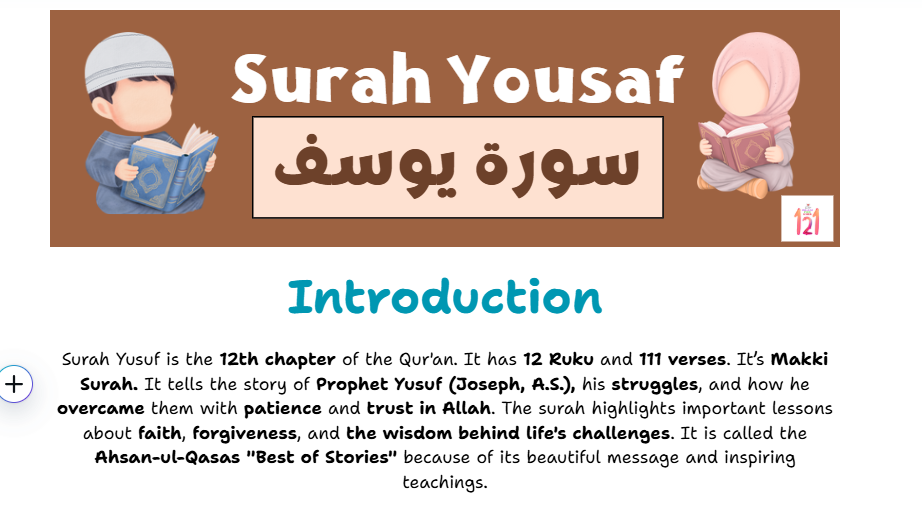
Course Title: Deep Dive into Surah Yusuf (A.S.) – A Journey of Wisdom, Faith & Self-Discovery
Age Group: Teenagers & Young Adults (Ages 13 to 19)
Course Duration: 12 Months (One Ruku per Month – Total of 12 Ruku)
Language of Instruction: English (with Arabic Qur’anic verses and Urdu explanation when needed)
Course Introduction
Surah Yusuf is one of the most detailed and captivating stories in the Qur’an. It is a powerful narrative of hardship, purity, patience, loss, forgiveness, and divine wisdom. Through this course, students will explore each Ruku of the Surah deeply and meaningfully. We do not rush through verses; instead, each month is dedicated to just one Ruku, ensuring the heart of every lesson reaches the soul. Each verse is connected to our students’ lives—whether it’s sibling jealousy, struggling with temptations, emotional pain, or understanding divine plans.
This course provides teens and new adults with a structured, spiritual, and emotionally intelligent journey rooted in Qur’anic values, personal growth, and practical action. It’s not just a Tafsir class—it’s a life training experience.
Our Teaching Methodology
We blend classical Tafsir knowledge with modern pedagogy and emotional intelligence techniques. Our methodology is designed for the teenage mind and heart:
Verse-by-Verse Tafsir – We explain every ayah clearly in English, highlighting Arabic keywords, grammar insights, and contextual meanings with references from classical tafsir.
Relevant Real-Life Application – After understanding the verse, we ask: How does this relate to your life? and What should we learn from this today?
Character-Building Reflections – Activities such as “Who Am I?” sheets, emotion wheels, journaling, and group discussion help build strong Islamic character.
Weekly Worksheets & Journals – Every week includes activities like word mapping, reflection prompts, creative writing, and self-checklists.
Visual Aids & Role Plays – Visual storytelling through slides, animated summaries, and live role plays of emotional moments (like Yusuf in the well, or the palace scene).
Discussion Circles – A safe space for students to talk about their struggles and how the story of Yusuf (A.S.) relates to their pain or choices.
Emotional and Spiritual Anchoring – We focus not just on intellect, but the heart. Discussions about pain, loss, temptation, and family trauma are handled with gentleness and Islamic solutions.
Interactive Tech Tools – Quizzes via Kahoot, Flip activities, Google Jamboard sessions, and story mapping apps are used for fun revision.
Monthly Themes – Each Ruku has a main character trait or life lesson that is discussed throughout the month.
Monthly Ruku Outline (1 Ruku = 1 Month)
Ruku 1: The Beginning of the Story (Verses 1–6)
Introduction to the Surah, Yusuf’s dream, and the concept of divine destiny
Keywords: أحسن القصص, تأويل, أحلام
Focus Theme: Allah has a plan for you
Journaling: My dreams vs Allah’s plans
Ruku 2: Sibling Jealousy & Family Conflict (Verses 7–20)
Activity: “My Inner Strength” worksheet + modesty in today’s world discussion
Ruku 4: Prison, Dreams & Dawah (Verses 36–42)
Yusuf in prison, interpreting dreams, calling inmates to tawheed
Focus Theme: Finding light in hardship
Journal: When did I feel stuck? How did I seek Allah’s help?
Ruku 5: Freedom & Trust (Verses 43–52)
King’s dream, Yusuf’s release, his honesty
Focus Theme: Trust in Allah + Trustworthiness as a character
Project: Yusuf’s CV – Listing his traits that made him respected
Ruku 6: Wisdom in Power (Verses 53–57)
Yusuf’s appointment to high rank
Focus Theme: Leadership, humility, vision
Activity: What makes a good leader? Poster making
Ruku 7: Reunion & Family Secrets (Verses 58–68)
Yusuf meets his brothers, keeps their identity secret
Focus Theme: Forgiveness, patience
Emotional focus: How to deal with people who hurt you
Ruku 8: Tests Continue (Verses 69–76)
Binyamin stays, hidden plans unfold
Focus Theme: Allah’s unseen plan
Reflection: Sometimes your plan doesn’t work—but Allah’s does
Ruku 9: Helplessness & Hope (Verses 77–82)
Brothers return without Binyamin
Focus Theme: Tawakkul and emotional responsibility
Journaling: What do you do when things fall apart?
Ruku 10: The Truth Comes Out (Verses 83–87)
Yaqub’s grief, beautiful patience, and dua
Focus Theme: Emotional faith during loss
Activity: Dua poster for sabr + talk on grief in Islam
Ruku 11: Joy & Reunion (Verses 88–98)
Brothers return, forgiveness, the reunion
Focus Theme: Mercy, apology, healing
Drama Activity: Rewriting apology letters to someone we hurt
Ruku 12: Fulfillment of the Dream (Verses 99–111)
Yusuf’s dream is fulfilled, lessons from the whole story
Focus Theme: Gratitude, legacy, lessons from life
Final Reflection: What Surah Yusuf taught me
Course Benefits
Emotional maturity and Qur’anic guidance hand-in-hand
Students will grow in Sabr, Tawakkul, Shukr, Chastity, Forgiveness, and Integrity
Understand that Islam is a complete way of life, not just rules
Learn Islamic psychology through the Prophet’s emotional responses
Deepen love and understanding of the Qur’an
Real healing and hope for broken families or troubled teens
Build self-confidence and a strong Muslim identity
Practice reflection and journaling for self-awareness
Develop skills of analysis, empathy, and decision-making through Qur’anic stories
Innovative Initiatives
The Yusuf Reflection Journal: Customized reflection journal with prompts for each Ruku
Monthly Review Circles: Students discuss how lessons applied to their real life
‘Ask Yusuf’ Q&A Activity: Write what you would ask Prophet Yusuf (A.S.) and reflect on his possible answer
Forgiveness Tree & Dream Wall: Creative corner to write what you forgave, and what you dream for the future
Peer Support & Mentorship: Teens supporting teens through Islamic reminders
Weekly ‘Tazkiyah Talk’ – 10-minute focus on purifying the soul (from jealousy, anger, despair)
Reflection Videos: Students can record a 2-minute video journal monthly
Wisdom & Lessons from Surah Yusuf (A.S.)
Allah’s plan is greater than your pain
Sibling jealousy is real—but can be healed
Staying away from haram brings barakah, even if it costs you
Holding onto faith in dark times makes you shine later
Leadership is about trust, not title
Forgiveness is a sign of strength, not weakness
Grief and patience go together in Islam
Dreams can come true if they are aligned with Allah’s will
Da’wah is possible even in the hardest places
Family can hurt you, but Islam can heal you
Trust in Allah means not needing every answer today
Real success is in being loved by Allah, not the world
Conclusion
This Surah is not just to be read, but to be lived. Through our unique monthly deep-dive structure, reflective activities, and emotionally safe classroom, every child will leave more connected to Allah, more aware of their emotions, and more inspired to live like Yusuf (A.S.).
It’s more than a course—it’s an awakening.
Included Materials:
12 printable Ruku workbooks
Reflection journals & dua guide
Certificate of Completion
Access to revision games, storytelling sessions, and online portal
Indeed, it [i.e., Hellfire] will be closed down upon them
In extended columns.
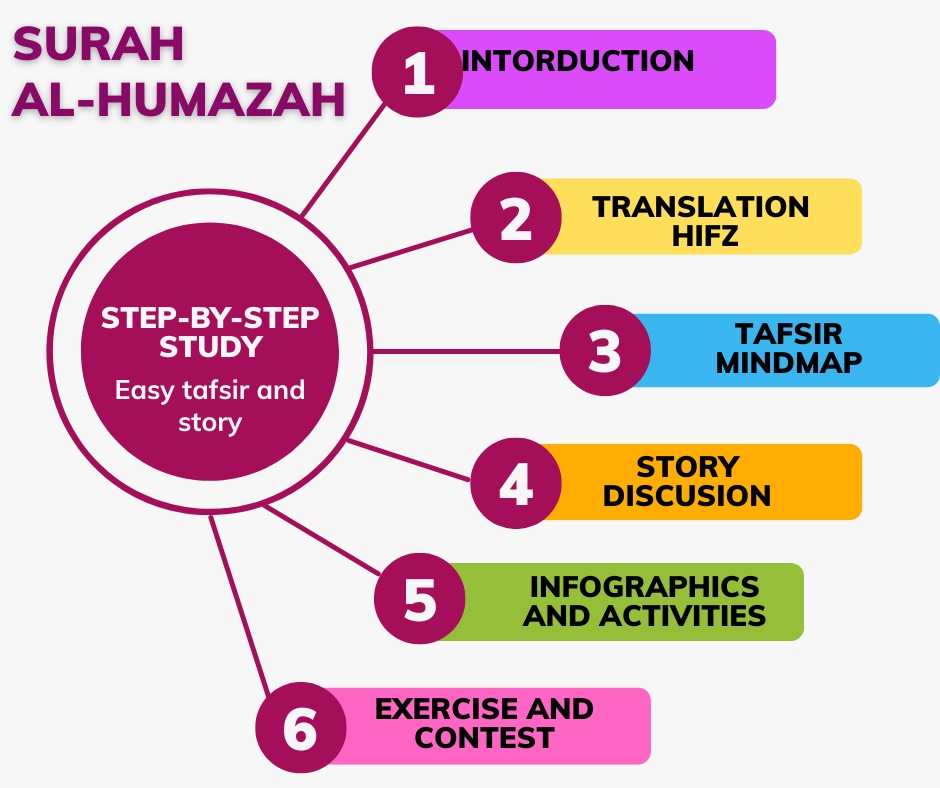
Step-by-Step teaching method
Teaching Surah Al-Humazah (Chapter 104) comprehensively can be done through a structured step-by-step approach that incorporates various methods to engage learners. Here’s a suggested plan:
1. Introduction:
Begin by introducing the Surah’s name, Al-Humazah, and its significance.
Discuss the theme of the Surah, which focuses on the consequences of backbiting, slander, and arrogance.
2. Word Meaning and Tafsir:
Break down each verse, explaining the meanings of keywords and phrases.
Use resources like Ibn Kathir’s Tafsir to provide deeper insights into the context and interpretation of the Surah.
Encourage students to ask questions and engage in discussions to enhance their understanding.
3. Memorization:
Provide techniques for memorizing the Surah, such as repetition, visualization, and listening to recitations.
Break the Surah into smaller sections for easier memorization.
Encourage regular practice and revision to reinforce memorization.
4. Infographics and Mindmaps:
Create visually appealing infographics that summarize the key themes and messages of each verse.
Use mind maps to organize the main ideas and connections within the Surah, aiding in comprehension and retention.
5. Storytelling:
Narrate stories or anecdotes related to the theme of the Surah to make it more relatable and memorable.
Highlight examples from the life of Prophet Muhammad (peace be upon him) or other historical incidents that illustrate the consequences of backbiting and arrogance.
6. Activities:
Role-playing: Divide students into groups and assign roles to act out scenarios involving backbiting and its consequences, followed by discussions on alternative positive behaviors.
Art/crafts projects: Have students create artwork or posters depicting the Surah’s message using symbols and imagery. Like making a heart with wounds and stitching it or bandaging it.
Writing exercises: Ask students to write reflections or journal entries on how they feel when they get bad remarks. make a list of the sentences or words, you never like to hear for you.
7. Quiz and Exercises:
Create quizzes or worksheets to assess students’ understanding of the Surah’s content, including its meanings and lessons.
Incorporate interactive exercises such as fill-in-the-blank, matching, or true/false questions.
Provide feedback and review any areas where students may need clarification or additional support.
By following this structured approach, learners can gain a comprehensive understanding of Surah Al-Humazah while also developing their memorization skills, critical thinking abilities, and moral awareness.
Let’s start Surah Al-Humazah Step-by-step study
1.Intorduction
Surah Al-Humazah was revealed in Makkah during the early period of Prophet Muhammad’s mission. Its revelation came as a response to the widespread mockery, slander, and arrogance prevalent among the Quraysh, particularly towards the Prophet and his followers.
According to Tafsir and Seerah books, some of the prominent figures in Makkah who were known for their mockery and slander against the Prophet and the early Muslims included:
Abu Lahab: He was the uncle of Prophet Muhammad and one of his staunchest opponents. Abu Lahab and his wife Umm Jamil were notorious for their hostility towards Islam and their relentless persecution of the Prophet and his followers.
Abu Jahl (Amr ibn Hisham): He was one of the leaders of the Quraysh and a fierce enemy of Islam. Abu Jahl was known for his arrogance, hostility, and relentless opposition to the Prophet and his message.
Muhammad ibn Ishaaq said: We continue to hear that this surah was revealed about Umayyah ibn Khalaf: He was a wealthy and influential figure in Makkah who openly opposed Islam and mistreated the early Muslims. Umayyah was known for his cruelty and disdain towards the Prophet and his followers.
‘Ata and Al-Kalbi said: This surah was revealed about Al-Akhnas ibn Shariq, who used to criticize people and gossip about them, especially the Messenger of Allah.
Muqatil said: This surah was revealed about Al-Walid ibn Al-Mughira, who used to gossip about the Messenger of Allah in his absence and mock him to his face.
Ibn Ashour said: This surah encompasses all polytheists who engaged in this act, whether their names are known or not.”
These individuals, along with others from the Quraysh tribe, actively engaged in mocking, ridiculing, and slandering the Prophet and his followers, seeking to discredit Islam and undermine its message. The Prophet Muhammad (peace be upon him) continued his mission undeterred, guided by the light of truth and compassion, while those who had opposed him were left to face the consequences of their deeds in the Hereafter Surah Al-Humazah was revealed to condemn their behavior and warn them of the consequences of their actions in the Hereafter.
2. Word-by-Word meaning and translation
بِسْمِ اللَّهِ الرَّحْمَٰنِ الرَّحِيمِ
In the name of Allah, the Entirely Merciful, the Especially Merciful.
Verse 1:
Arabic: وَيْلٌ لِكُلِّ هُمَزَةٍ لُمَزَةٍ
English: Woe to every scorner and mocker
يْلٌ (Woe)
لِكُلِّ (to every)
هُمَزَةٍ (scorner)
لُمَزَةٍ (mocker)
Verse 2:
Arabic: الَّذِي جَمَعَ مَالًا وَعَدَّدَهُ
English: Who collects wealth and [continuously] counts it.
الَّذِي (Who)
جَمَعَ (collects)
مَالًا (wealth)
وَعَدَّدَهُ (and [continuously] counts it)
Verse 3:
Arabic: يَحْسَبُ أَنَّ مَالَهُ أَخْلَدَهُ
English: He thinks that his wealth will make him immortal.
يَحْسَبُ (He thinks)
أَنَّ (that)
مَالَهُ (his wealth)
أَخْلَدَهُ (will make him immortal)
Verse 4:
Arabic: كَلَّا ۖ لَيُنبَذَنَّ فِي الْحُطَمَةِ
English: No! He will surely be thrown into the Crusher.
كَلَّا (No!)
لَيُنبَذَنَّ (He will surely be thrown)
فِي (into)
الْحُطَمَةِ (the Crusher)
Verse 5:
Arabic: وَمَا أَدْرَاكَ مَا الْحُطَمَةُ
English: And what can make you know what is the Crusher?
وَمَا (And what)
أَدْرَاكَ (can make you know)
مَا (what)
الْحُطَمَةُ (is the Crusher)
Verse 6:
Arabic: نَارُ اللَّهِ الْمُوقَدَةُ
English: It is the fire of Allah, [eternally] fueled,
نَارُ (fire of)
اللَّهِ (Allah)
الْمُوقَدَةُ (eternally fueled)
Verse 7:
Arabic: الَّتِي تَطَّلِعُ عَلَى الْأَفْئِدَةِ
English: Which mounts directed at the hearts.
الَّتِي (Which)
تَطَّلِعُ (mounts directed)
عَلَى (at)
الْأَفْئِدَةِ (the hearts)
Verse 8:
Arabic: إِنَّهَا عَلَيْهِم مُّؤْصَدَةٌ
English: Indeed, it [i.e., Hellfire] will be closed down upon them
إِنَّهَا (Indeed, it)
عَلَيْهِم (upon them)
مُّؤْصَدَةٌ (will be closed down)
Verse 9:
Arabic: فِي عَمَدٍ مُّمَدَّدَةٍ
English: In extended columns.
فِي (in)
عَمَدٍ (columns)
مُّمَدَّدَةٍ (extended)
3. Easy Tafsir of surah humazah
You’re correct, the Bismillah is not included in Surah Al-Humazah (Chapter 104) of the Quran. Here’s a detailed Tafsir of Surah Al-Humazah according to Ibn Kathir’s interpretation:
Verse 1: The word “Woe” is a severe warning from Allah to those who habitually engage in backbiting and slander. They are constantly looking for faults in others to mock and ridicule them.
“Woe” is a warning of punishment for those who habitually ridicule and mock others. This indicates that mocking and making fun of people is a serious offense in the sight of Allah. Imagine if you worked hard on a drawing and someone laughed at it. That’s not nice, right?
Verse 2: Allah describes the habit of such people, who amass wealth through any means possible and constantly count and hoard it as if their entire existence revolves around their wealth.
Verse 3: These individuals have the false belief that their wealth will grant them eternal life and happiness as if they will never face any consequences for their actions.
This verse talks about people who love to collect money and keep counting it all the time, thinking it’s the most important thing. It’s like someone who collects a lot of toys but never shares them with their friends.
Verse 4: Allah refutes this false belief with a resolute “No!” They will not live forever in luxury; rather, they will be cast into the Crusher, a place of severe punishment in the Hereafter.
Such a person believes that their wealth will make them immortal, showing their arrogance and false sense of security in their riches. But that’s not true because life is about more than just money. Even if you have lots of toys, you still need friends to play with.
Verse 5: The severity of this punishment is emphasized, prompting reflection on its terrifying nature.
This false belief is shattered by the reality of death and the Hereafter. They will be thrown into a crushing punishment Keep in mind, punishment is not just because of a lot of money or more toys. But it’s because of your arrogant behavior and showing off and denying to share it with others. It’s like when you build a sandcastle at the beach and then a big wave comes and washes it away.
Just suppose you have a variety of dishes to eat. And someone in your neighbor is very hungry. The aroma of food is spread. But instead of sharing food, you are being rude to him. How would you feel if it happened to you?
Verse 6: The Crusher is described as a fire kindled by Allah Himself, symbolizing the intense and unrelenting nature of the punishment awaiting the wrongdoers.
Verse 7: This fire will leap onto the hearts of the offenders, causing them unbearable agony and distress.
This fire burns so hot that it reaches right into people’s hearts, causing them pain and sadness. As they cause pain and sadness in the worldly life.
Verse 8: They will be trapped in this torment, unable to escape or find any relief from its heat and pain.
Verse 9: They will be confined in long columns in Hell, indicating the severity and permanence of their punishment, with no hope of reprieve.
Once they’re in this place, there’s no escaping it. It’s like being stuck in a room with no doors or windows. They will be stuck there in long lines, waiting and unable to leave. It’s like waiting in line for a ride at an amusement park, but this ride never ends, and it’s not fun at all.
In summary, Surah Al-Humazah serves as a stern warning against the sins of backbiting, slander, and arrogance, highlighting the severe consequences they entail in the Hereafter. It reminds believers to be mindful of their words and actions and to avoid harming others with their tongues or through their pursuit of worldly wealth.
4. Infographics/ Hifz(Memorization)
After covering two or three verses. children would be asked to make infographics of the verses. My first Quran with pictures has good infographics. Children can copy them or add their creativity and explain the theme of the verse with the help of drawing objects. (Please visit gallary to see the pictures made by our students.) During this children will start to memorise the verses by heart. We have verse-by-verse tajweed recitation videos. Children will practice and memorize with the help of these videos. (visit the youtube playlist for Tajweed recitation videos)
5. Mindmap
Here is a mindmap of the Surah Humazah
Surah Al-Humaza
Meaning
The mockers
Mindmap
KEY FACTS!!
Surah Al-Humazah
It is in juzz 30
It has 9 verses.
It is Makki Surah..
Three topics have been discussed in this Surah
Warning to mockers
Vanity of wealth
Punishments of Jahanam
V. 1 warning to mockers.
Woe to the one woe goal is to speak about other people.
ONE OF THE ETTIQUETTES OF ISLAM IS TO MIND YOUR BUN BASINESS. QURAN CRITICISES THE ONE WHO IS ALWAYS GOSSIPING
Verse 2-5
Vanity of wealth
He, who counts his own money and he thinks that his money will cause him to live forever.
THE PEOPLE WHO THINK LIFE IS PURELY TO A MALS HEALTH THEY DON’T THINK ABOUT DEATH
Verse 4-9:
Punishment of Jahanam.
That person will be thrown into the crushing fire.
Points to remember:.
Never look down on anyone..
Mocking is not allowed by anyone.
Keep a balance between earning and spending money.
Do not count money with greed.
Remember it!!!
If we will mock others and hurt others, hellfire will burn our hearts, as we were hurting others by mocking.
Transliteration The dua is transliterated as A’udhu bi kalimat-illah il-tammati min sharri ma khalaq.
Meaning in English The meaning of the dua for protection from the evil eye is I seek refuge in the perfect words of Allah from the evil of that which He has created.
6. Story of surah humazah:
There are two stories to explain this surah. The first story is the revelation story of the surah. This story can help students, why this surah was revealed. And how mocking and slandering and greedy habits of disbelievers of the Makkah were answered.
2nd story is crafted for children. The theme of the story is How mocking and greed of more can leave us alone. You can read this story at our site or watch the video of the story. The Link is down in resources.
Exercise based on Surah Al-Humazah:
Quiz:
What is the theme of Surah Al-Humazah? a) Mercy and forgiveness b) Backbiting and slander c) Gratitude and generosity
What does “Woe” in verse 2 signify? a) Happiness b) Warning c) Comfort
In verse 3, what do people mentioned collect excessively? a) Toys b) Wealth c) Knowledge
What false belief do the wrongdoers have in verse 4? a) Their wealth will make them immortal b) Their friends will protect them c) They will never face consequences
What is the Crusher mentioned in verse 5? a) A tool for building b) A punishment in the Hereafter c) A type of food
Exercise:
Memorize the Arabic text of Surah Al-Humazah.
Write a summary of the Surah’s message in your own words.
Reflect on a time when you may have engaged in backbiting or gossip. Write about how you felt afterward and what you learned from the experience.
Create an infographic or poster illustrating the consequences of backbiting and slander mentioned in the Surah.
Role-play a scenario where someone is being mocked or ridiculed. Discuss alternative ways the situation could have been handled with kindness and respect.
Write a short story or poem inspired by the theme of Surah Al-Humazah.
Discuss with a friend or family member how you can apply the lessons from Surah Al-Humazah in your daily life to avoid backbiting and arrogance.
(FAQs) about Surah Al-Humazah along with short answers:
1. What is the main theme of Surah Al-Humazah?
The main theme is the consequences of backbiting, slander, and arrogance.
2. What does “Woe” signify in verse 2?
“Woe” signifies a severe warning or impending punishment from Allah.
3. What do people mentioned in verse 3 collect excessively?
They collect wealth excessively and count it repeatedly.
4. What false belief do the wrongdoers have in verse 4?
They believe that their wealth will make them immortal and protect them from any harm.
5. What is the “Crusher” mentioned in verse 5?
The Crusher refers to a severe punishment in the Hereafter for those who engage in wrongdoing.
6. What is the punishment described in verse 7?
The punishment described is like a fire kindled by Allah Himself, symbolizing intense and relentless torment.
7. How can we apply the lessons from Surah Al-Humazah in our daily lives?
We can avoid backbiting, slander, and arrogance, and instead strive to be kind, respectful, and considerate towards others.
Unlock the lessons of Surah Ash Shams through a dynamic teaching method. Blend storytelling, tajweed, and reflection, fostering gratitude and choices for success.
Table of Contents
Introduction of Surah Ash Shams
Sure! Surah Ash-Shams is like a magical story that teaches us important lessons. It tells us about a special messenger, Prophet Saleh, who was sent by Allah to guide a group of people called the Thamud.
In this story, Allah gave the Thamud a unique camel as a sign of His power. Prophet Saleh warned them to be kind to the camel and to be grateful for Allah’s blessings. But some of the Thamud didn’t listen. They became proud and rebellious, and even after being warned, they harmed the special camel.
Because of their bad choices, Allah was not pleased. His wrath came upon the Thamud, and their homes were leveled to the ground. The story teaches us that making good choices brings happiness and success while making bad choices leads to disappointment and failure.
So, children, the lesson from Surah Ash-Shams is to be like the heroes in the story. Be kind, be grateful for the good things around you, and always listen to the wise advice given by those who guide you on the right path. This way, you’ll have a happy and successful tale filled with goodness.
Words meaning and Tafsir
Verse 1:
Arabic: وَٱلشَّمْسِ وَضُحَىٰهَا
English: “By the sun and its brightness,”
Word Meaning:
وَ (Wa): By
الشَّمْسِ (Ash-Shams): the sun
وَضُحَىٰهَا (Wa Duhaaha): and its brightness
“By the sun and its brightness,” (Quran 91:1)
Now, let’s explore a children-friendly explanation inspired by Tafsir Ibn Kathir:
Imagine the Quran is like a special guidebook that helps us understand the world and teaches us how to be good people. In this verse, Allah is talking about the sun, that bright and warm ball of light in the sky.
When Allah says, “By the sun and its brightness,” it’s like saying, “Pay attention to the sun and the light it gives us.” The sun is essential for our world. It provides us with light during the day and makes everything bright and clear.
Now, let’s think about why Allah might be mentioning the sun. Allah shows us how amazing His creations are and how everything in nature has a purpose. Just like the sun brightens our day, Allah wants us to bring brightness and goodness into the world.
So, when you see the sun shining, remember that Allah is reminding you to spread kindness, just like the sun spreads light. Be a source of warmth and happiness for others, just like the sun is a source of warmth for the Earth.
In summary, this verse is a beautiful way of teaching us to appreciate the sun and the light it brings. It’s also a reminder to be like the sun by spreading kindness and goodness to make the world a brighter place.
Verse 2
Arabic: وَٱلْقَمَرِ إِذَا تَلَىٰهَا
English: “And [by] the moon when it follows it,”
Word Meaning:
وَ (Wa): And
الْقَمَرِ (Al-Qamar): the moon
إِذَا (Idha): when
تَلَىٰهَا (Talaa): it follows it
Now, let’s provide a children-friendly explanation inspired by Tafsir Ibn Kathir:
Imagine the Quran is like a magical storybook that tells us about the wonders of the world. In this verse, Allah is talking about the moon, that shiny and gentle light we see at night.
When Allah says, “And [by] the moon when it follows it,” it’s like saying, “Think about the moon and how it quietly follows the sun.” The moon doesn’t have its light; it reflects the light of the sun. So, when the sun goes away, the moon comes out and shares its gentle glow with us.
Just like the moon follows the sun, Allah wants us to learn about the beauty of order and harmony in the world. It’s like having a friend who supports you, just like the moon supports the night by giving it a soft and peaceful light.
So, when you see the moon in the sky, remember that Allah is teaching us about cooperation and sharing. Be like the moon in your life by helping and being a good friend to others, especially when they need a little light in their darkness.
In summary, this verse teaches us to appreciate the moon’s gentle glow and reminds us to be supportive and kind, just like the moon follows the sun to light up the night.
Verse 3
Arabic: وَٱلنَّهَارِ إِذَا جَلَّىٰهَا
English: “And [by] the day when it displays it,”
Word Meaning:
وَ (Wa): And
النَّهَارِ (An-Nahaar): the day
إِذَا (Idha): when
جَلَّىٰهَا (Jallaa): it displays it
Now, let’s provide a children-friendly explanation inspired by Tafsir Ibn Kathir:
Imagine the Quran is like a treasure map, and in this verse, Allah is talking about something special: the daytime, when the sun shines bright.
When Allah says, “And [by] the day when it displays it,” it’s like saying, “Look at the daytime when the sun makes everything bright and clear.” During the day, we can see the world around us, play, and learn new things because of the sunlight.
Just like the daytime shows us the beauty of the world, Allah wants us to use our time wisely during the day. It’s like having a big playground where we can learn, be kind to others, and enjoy the blessings that Allah has given us.
So, when you see the sun in the sky during the day, remember that Allah is reminding you to be active, learn, and make the most of your time. Be like the daytime by spreading happiness, just as the sunlight spreads across the earth.
In summary, this verse encourages us to appreciate the brightness of the daytime and use our time wisely to learn, play, and be kind to others. It’s a reminder to be a source of light and joy, just like the day when the sun displays its radiant glow.
Verse 4
Arabic: وَٱلَّيْلِ إِذَا يَغْشَىٰهَا
English: “And [by] the night when it covers it,”
Word Meaning:
وَ (Wa): And
اللَّيْلِ (Al-Layl): the night
إِذَا (Idha): when
يَغْشَىٰهَا (Yaghshaa): it covers it
Now, let’s provide a children-friendly explanation inspired by Tafsir Ibn Kathir:
Imagine the Quran as a magical storybook that tells us about the wonders of the world. In this verse, Allah talks about something very special: the nighttime, when the world is covered by darkness.
When Allah says, “And [by] the night when it covers it,” it’s like saying, “Think about the nighttime when everything is quiet and covered in darkness.” The night is like a soft, comforting blanket that covers the world, and it’s a time for rest and sleep.
Just like the night covers the world, Allah wants us to appreciate the peacefulness of the night and understand the importance of rest. It’s like a gift from Allah, giving us a break to recharge our energy for the new day ahead.
So, when you see the stars in the night sky, remember that Allah is reminding you to be grateful for the peacefulness of the night. Be like the night by bringing comfort and tranquility to others, just as the nighttime covers the world in a gentle embrace.
In summary, this verse teaches us to appreciate the beauty and tranquility of the nighttime and reminds us of the importance of rest and peacefulness. It’s a reminder to be grateful for the calming moments that Allah has given us.
Verse 5
Arabic: وَٱلسَّمَاءِ وَمَا بَنَاهَا
English: “And [by] the heaven and the One Who constructed it,”
Word Meaning:
وَ (Wa): And
السَّمَاءِ (As-Samaa’): the heaven/sky
وَمَا بَنَاهَا (Wa Maa Banaha): and the One Who constructed it
Now, let’s provide a children-friendly explanation inspired by Tafsir Ibn Kathir:
Imagine the Quran is like a fascinating adventure book, and in this verse, Allah is talking about something incredible: the sky, that big, blue roof over our world.
When Allah says, “And [by] the heaven and the One Who constructed it,” it’s like saying, “Think about the sky and how amazing it is. Allah is the One who made it so perfectly.” The sky is like a giant dome covering everything; Allah is the incredible builder who made it just right.
Just like the sky protects us and makes our world beautiful, Allah wants us to appreciate His amazing creations. It’s like living in a big, open space where we can see the clouds, the sun, the moon, and the stars. Allah made it all so wonderfully!
So, when you look up at the sky, remember that Allah reminds you of His greatness. Be like the sky by being open-hearted and kind to everyone. Just as the sky covers everything with its vastness, let your kindness and love cover the people around you.
In summary, this verse teaches us to marvel at the beauty of the sky and appreciate the amazing way Allah created it. It’s a reminder to be kind and open-hearted, just like the vastness of the sky that Allah constructed so perfectly.
Verse 6
Arabic: وَٱلْأَرْضِ وَمَا طَحَاهَا
English: “And [by] the earth and the One Who spread it!”
Word Meaning:
وَ (Wa): And
الْأَرْضِ (Al-Ard): the earth
وَمَا طَحَاهَا (Wa Maa Ṭahaa): and the One Who spread it
Now, let’s provide a children-friendly explanation inspired by the general understanding of the verse:
Imagine the Quran is like a magical book full of secrets, and in this verse, Allah is talking about something extraordinary: the earth, the ground beneath our feet.
When Allah says, “And [by] the earth and the One Who spread it,” it’s like saying, “Think about the ground you walk on and how Allah made it so perfect for us.” Allah is the One who made the earth flat and spread out, like a big, comfortable carpet for us to live on.
Just like the earth gives us a place to walk, play, and build our homes, Allah wants us to appreciate the beauty and stability of the world. It’s like living in a big, wonderful garden that Allah created just for us.
So, when you feel the ground beneath your feet, remember that Allah reminds you of His incredible power. Be like the earth by being strong and supportive, just as the ground supports everything on it.
In summary, this verse teaches us to appreciate the earth, and our home, and to be grateful for the stable ground beneath our feet. It’s a reminder to be strong and supportive, just like the earth that Allah spread out so perfectly for us.
Verse 7
Arabic: وَنَفْسٍۢ وَمَا سَوَّىٰهَا
English: “And [by] the soul and the One Who fashioned it,”
Word Meaning:
وَ (Wa): And
نَفْسٍ (Nafs): the soul
وَمَا (Wa Maa): and the One Who
سَوَّىٰهَا (Sawwaa): fashioned it
Now, let’s provide a children-friendly explanation inspired by the general understanding of the verse:
Imagine the Quran is like a treasure map, and in this verse, Allah is talking about something truly special: the soul, the part of us that makes us who we are.
When Allah says, “And [by] the soul and the One Who fashioned it,” it’s like saying, “Think about your heart and your feelings, and remember that Allah created each person uniquely and wonderfully.” Allah is the One who designed our souls, making each of us special and different.
Just like a skilled artist creates beautiful paintings, Allah created our souls with love and care. He made us with feelings, thoughts, and the ability to choose between right and wrong. It’s like having a special gift that makes each person one of a kind.
So, when you feel happy, sad, or even curious about the world, remember that Allah is reminding you of the beauty of your soul. Be like the soul by being kind, understanding, and appreciating the uniqueness in yourself and others.
In summary, this verse teaches us to appreciate the uniqueness of our souls, which Allah fashioned with love and care. It’s a reminder to be kind and understanding, just as Allah beautifully designed each person’s soul.
Verse 8
Arabic: فَأَلْهَمَهَا فُجُورَهَا وَتَقْوَىٰهَا
English: “Then [Allah] inspired it [with knowledge of] its wickedness and its righteousness.”
Word Meaning:
فَأَلْهَمَهَا (Fa’alhamaha): Then inspired it
فُجُورَهَا (Fujura): its wickedness
وَتَقْوَىٰهَا (Wa Taqwa): and its righteousness
Now, let’s provide a children-friendly explanation inspired by the general understanding of the verse:
Imagine the Quran is like a wise friend, and in this verse, Allah is telling us about something fascinating: how He gave us a special gift called a conscience.
When Allah says, “Then [Allah] inspired it [with knowledge of] its wickedness and its righteousness,” it’s like saying, “Allah gave us a little voice inside our hearts that helps us know the difference between right and wrong.” This special gift helps us make good choices in our lives.
Just like a guidebook that tells us what’s right and what’s wrong, Allah inspired our hearts with a sense of what’s good (righteousness) and what’s not so good (wickedness). It’s like having a superhero power that helps us be kind, and honest, and make choices that make Allah happy.
So, when you feel that little nudge inside your heart telling you to be good, remember that it’s Allah’s way of helping you choose the right path. Be like the heart by listening to that special voice and making choices that bring happiness and goodness to yourself and others.
In summary, this verse teaches us about the special gift of a conscience that Allah has given us, helping us distinguish between right and wrong. It’s a reminder to listen to our hearts and make choices that bring joy and goodness into our lives.
Verse 9
Arabic: قَدْ أَفْلَحَ مَن زَكَّاهَا
English: “Indeed, successful is the one who purifies it (the soul),”
Word Meaning:
قَدْ (Qad): Indeed
أَفْلَحَ (Aflaha): Successful
مَن (Man): the one who
زَكَّاهَا (Zakkaaha): purifies it (referring to the soul)
Now, let’s provide a children-friendly explanation inspired by the general understanding of the verse:
Imagine the Quran is like a guidebook for life, and in this verse, Allah is teaching us about a special secret to success: keeping our hearts pure and clean.
When Allah says, “Indeed, successful is the one who purifies it,” it’s like saying, “The person who takes care of their heart and makes good choices will be successful in life.” Just as we keep our bodies clean by taking a shower, Allah wants us to keep our hearts clean from bad thoughts and actions.
So, what does it mean to purify the heart? It means being kind to others, telling the truth, helping those in need, and doing things that make Allah happy. When we do these good things, we are taking care of our hearts and making them pure.
Now, here comes the superhero part: when we keep our hearts pure, Allah promises success. It’s like having a magic key to happiness and good things. Being successful doesn’t just mean having lots of toys or money; it means having a heart full of goodness and love.
So, when you make choices that are kind and honest, remember that you’re on the path to success. Be like the heroes in your favorite stories by keeping your heart pure, and you’ll see how much joy and success you can bring to your life.
In summary, this verse teaches us that success comes to those who keep their hearts pure by making good choices and being kind. It’s a reminder to be like the heroes and heroines in our favorite stories, making the world a better place through our actions and kindness.
Verse 10
Arabic: وَقَدْ خَابَ مَن دَسَّاهَا
English: “And doomed is the one who corrupts it.”
Word Meaning:
وَقَدْ (Wa Qad): And doomed is
خَابَ (Khaaba): the one who is doomed
مَن (Man): the one who
دَسَّاهَا (Dassaa-ha): corrupts it (referring to the soul)
Now, let’s provide a children-friendly explanation inspired by the general understanding of the verse:
Imagine the Quran is like a wise friend who cares about us, and in this verse, Allah is warning us about something very important: ruining our hearts.
When Allah says, “And doomed is the one who corrupts it,” it’s like saying, “Uh-oh! The person who makes bad choices and does things that hurt their heart will face problems.” Allah is warning us to be careful because doing wrong things can make our hearts feel sad and troubled.
So, what does it mean to corrupt the heart? It means being mean to others, telling lies, being greedy, and doing things that make Allah unhappy. When we do these things, it’s like putting muddy footprints on our hearts and making them feel yucky.
But here’s the good news: we have the power to keep our hearts clean and pure by making good choices. If we listen to the good feelings inside us, like being kind and helpful, we can avoid making our hearts sad.
So, when you’re faced with choices, remember to choose the path that keeps your heart happy and clean. Be like the heroes and heroines in your favorite stories by making choices that bring joy and goodness to your heart and the world around you.
In summary, this verse warns us about the consequences of corrupting our hearts by making bad choices. It’s a reminder to be wise in our actions and to choose the path that keeps our hearts pure and happy.
Verse 11
Arabic: كَذَّبَتْ ثَمُودُ بِطَغْوَاهَآ
English: “Thamûd rejected [the truth] out of arrogance.”
Word Meaning:
كَذَّبَتْ (Kazzabat): rejected
ثَمُودُ (Thamûd): Thamûd (an ancient Arabian tribe)
بِطَغْوَاهَا (Biṭaghwaaha): out of arrogance
Now, let’s provide a children-friendly explanation inspired by the general understanding of the verse:
Imagine the Quran is like a storybook filled with lessons, and in this verse, Allah is telling us about a group of people called Thamûd who made a big mistake.
When Allah says, “Thamûd rejected [the truth] out of arrogance,” it’s like saying, “There were some people in the past who didn’t want to listen to the good things Allah was telling them. They thought they knew better and didn’t want to be humble and learn.”
Being arrogant is like having a big head and thinking we’re always right, even when we’re not. Thamûd didn’t want to accept the truth and be good, so they turned away from the guidance Allah was sending them.
But here’s the important lesson: Allah wants us to be humble and open-hearted. We should be willing to learn and listen to what is right. If we make mistakes, it’s okay as long as we try to fix them and be better.
So, when you hear something good or helpful, be like a wise explorer and be ready to learn. Don’t let arrogance stop you from growing and becoming a better person. Being humble and open to learning is a great way to make your heart happy.
In summary, this verse teaches us about the mistake of Thamûd, who rejected the truth because of their arrogance. It reminds us to be humble, open to learning, and willing to accept what is right and good.
Verse 12
Arabic: إِذِ ٱنۢبَعَثَ أَشْقَىٰهَا
English: “When the most wicked of them was roused [to kill the she-camel].”
Word Meaning:
إِذِ (Idh): When
انبَعَثَ (Anba’atha): was roused
أَشْقَىٰهَا (Ashqaa-haa): the most wicked of them
Now, let’s provide a children-friendly explanation inspired by the general understanding of the verse:
Imagine the Quran is like a magical adventure book, and in this verse, Allah is telling us about a time when some people made a very bad decision.
When Allah says, “When the most wicked of them was roused [to kill the she-camel],” it’s like saying, “There were people who were not being kind. The most wicked person among them wanted to hurt a special she-camel that Allah had sent as a sign.”
The she-camel was a gift from Allah, and it was a test for the people to see if they would be grateful and take care of it. But the most wicked person, instead of being good, wanted to harm the camel.
This story teaches us that sometimes people make bad choices because they are not being kind and grateful. Allah wants us to be good and thankful for the blessings He gives us, just like taking care of the she-camel.
So, when you face choices, remember to be like the heroes in your favorite stories and make good decisions. Be kind, and grateful, and take care of the blessings Allah gives you, just like the people should have taken care of the she-camel.
In summary, this verse tells us about a time when the most wicked person in a group wanted to harm a special she-camel from Allah. It’s a reminder for us to be kind, and grateful, and take care of the blessings Allah gives us in our lives.
English: “But the Messenger of Allah warned them, ‘Allah’s she-camel and her turn to drink!’”
Word Meaning:
فَقَالَ (Faqaala): But he said
لَهُمْ (Lahum): to them
رَسُولُ اللَّهِ (Rasoolullah): the messenger of Allah
نَاقَةَ اللَّهِ (Naqatullah): Allah’s she-camel
وَسُقْيَـٰهَا (Wa Suqyaha): and her turn to drink
Now, let’s provide a children-friendly explanation inspired by the general understanding of the verse:
Imagine the Quran is like a storybook filled with wise messengers, and in this verse, Allah is telling us about a special messenger who tried to guide the people to do what is right.
When Allah says, “But the Messenger of Allah warned them, ‘Allah’s she-camel and her turn to drink!’” it’s like saying, “There was a special person sent by Allah to tell the people to be careful and not harm a special she-camel that Allah had given them.”
The she-camel was a gift from Allah, and the messenger wanted to make sure the people understood how important it was to treat the camel kindly and let her drink water. Allah’s messenger was like a wise friend, reminding them to be grateful and take care of the blessings Allah gave them.
This story teaches us about the importance of listening to messengers and being kind to the blessings Allah provides. Just like the people were warned not to harm the she-camel, we should be careful not to harm others and to appreciate the good things in our lives.
So, when you hear wise advice, remember to be like the people who listened and did what was right. Be kind and thankful for the blessings around you, just like taking care of the she-camel.
In summary, this verse tells us about a messenger of Allah warning the people to be careful and not harm a special she-camel. It’s a reminder for us to listen to wise advice, be kind, and appreciate the blessings Allah gives us.
English: “Still they defied him and slaughtered her. So their Lord crushed them for their crime, leveling all to the ground.”
Word Meaning:
فَكَذَّبُوهُ (Fakazzaboo-hu): Still they defied him
فَعَقَرُوهَا (Fa’aqaroo-haa): and slaughtered her
فَدَمْدَمَ (Fadamdama): So their Lord crushed
عَلَيْهِمْ (Alayhim): them
رَبُّهُم (Rabbuhum): their Lord
بِذَنبِهِمْ (Bithanbihim): for their crime
فَسَوَّاهَا (Fasawwaha): leveling all to the ground
Now, let’s provide a children-friendly explanation inspired by the general understanding of the verse:
Imagine the Quran is like a guidebook for good choices, and in this verse, Allah is telling us about a sad time when some people made a really bad decision.
When Allah says, “Still they defied him and slaughtered her,” it’s like saying, “Even after being warned, the people didn’t listen. They did something very wrong by hurting the special she-camel that Allah had given them.”
The she-camel was a gift from Allah, and instead of being kind and grateful, the people chose to be mean and hurt it. This made Allah very sad, and He decided to teach them a lesson.
So, when Allah says, “So their Lord crushed them for their crime, leveling all to the ground,” it means that Allah, in His wisdom, punished the people for their bad choices. Their homes and everything around them were leveled to the ground.
This story teaches us about the importance of being kind, grateful and making good choices. Allah wants us to appreciate the blessings He gives us and not to harm others or His creations.
So, when you face choices, remember to be like the people who make good decisions. Be kind, and thankful, and appreciate the blessings around you. Allah wants us to live in harmony and make the world a better place.
In summary, this verse tells us about the consequences of a group of people who made a bad choice by hurting a special she-camel. It’s a reminder for us to be kind, and grateful, and make good choices to avoid negative consequences.
verse 15
Arabic: وَلَا يَخَافُ عُقْبَـٰهَا
English: “He has no fear of consequences.”
Word Meaning:
وَلَا (Wa La): And he has no
يَخَافُ (Yakhaafu): fear
عُقْبَـٰهَا (‘Uqbaaha): of consequences
Now, let’s provide a children-friendly explanation inspired by the general understanding of the verse:
Imagine the Quran is like a wise friend, and in this verse, Allah is talking about a person who makes good choices and doesn’t worry about bad consequences.
When Allah says, “He has no fear of consequences,” it’s like saying, “There are people who do good things without expecting anything bad to happen to them. They are so good that they don’t worry about what might go wrong because they trust Allah.”
This verse is like a superhero’s power. Imagine being so good and kind that you don’t have to be afraid of anything bad happening. Allah is telling us that when we make good choices and do things that make Him happy, He takes care of us.
So, when you do good deeds and make kind choices, remember that Allah is watching over you. Trust in Him, and don’t be afraid of doing the right thing. It’s like having a magical shield of goodness that protects you from worries.
In summary, this verse encourages us to be so good and kind that we don’t have to be afraid of bad consequences. Trust in Allah, make good choices, and you’ll have a magical shield of goodness around you.
Teaching method for Surah Ash-Shams
1. Introduction:
Begin the lesson by introducing Surah Ash-Shams to the students. Provide information about when it was revealed and the historical context during Prophet Muhammad’s (PBUH) time in Makkah. Explain that the Surah emphasizes the consequences of human actions and the importance of recognizing and being grateful for Allah’s blessings.
2. Tajweed and Recitation:
Proceed with a session on Tajweed and recitation. Break down the verses of Surah Ash-Shams, focusing on correct pronunciation, elongation, and proper articulation. Encourage students to recite the verses, and provide individual guidance as needed.
3. Words Meaning and Tafsir:
After the recitation, delve into the meaning of the words and Tafsir (exegesis) of Surah Ash-Shams. Explain keywords and phrases, exploring their linguistic and contextual significance. Use Tafsir Ibn Kathir or other reputable sources to provide insights into the deeper meanings and lessons embedded in the Surah.
4. Infographic:
Create an infographic summarizing the main themes and lessons of Surah Ash-Shams. Include key points about the people of Thamud, the she-camel, the consequences of their actions, and the broader message of recognizing good and evil. Visual aids can enhance understanding and retention.
5. Storytelling:
Engage students with a storytelling session focused on the narrative of Surah Ash-Shams. Use age-appropriate language and emphasize the moral lessons of the story. Encourage participation by asking questions and prompting discussions about the characters, choices, and outcomes.
6. Mindmap:
Introduce a mindmap activity to visually organize the central themes of Surah Ash-Shams. Create a collaborative mindmap on a whiteboard or using digital tools, allowing students to contribute key concepts, characters, and lessons from the Surah. This visual representation aids in concept mapping and comprehension.
7. Exercise:
Conclude the lesson with an exercise that reinforces understanding. Design questions or activities that prompt students to reflect on the consequences of choices, relate the Surah to their lives or create personal connections. This can include journaling, group discussions, or short written reflections.
By incorporating these elements into the teaching method, you can provide a comprehensive and engaging learning experience for students, ensuring they grasp both the linguistic aspects and the deeper spiritual lessons of Surah Ash-Shams.
Surah Ash-Shams Mind Map:
Introduction:
Early Makkah period
Strong opposition to Prophet Muhammad (pbuh)
Main Theme:
Consequences of human actions
Distinction between good and evil
Messenger:
Prophet Saleh (pbuh)
Sent to guide the people of Thamud
She-Camel:
Miraculous sign from Allah
Symbolizes divine guidance
Specific schedule for drinking water
People of Thamud:
Rebellion and defiance
Harm to the she-camel
Consequences of their actions
Lesson Learned:
Importance of recognizing blessings
Making choices that lead to success
Consequences of corrupting the soul
Application in Our Lives:
Recognizing good and evil
Making good choices
Being grateful for blessings
Conclusion:
Timeless lessons for guidance
Exercise
Multiple Choice:
What is the name of the Surah we are learning about?
a. Surah Al-Fatiha b. Surah Ash-Shams c. Surah Al-Baqarah
Where was Prophet Muhammad (pbuh) residing when Surah Ash-Shams was revealed? a. Madinah b. Makkah c. Taif
What does the she-camel in the story symbolize? a. Divine guidance b. Water source c. Ordinary camel
What did the people of Thamud do to the she-camel? a. Protected it b. Hamstrung it c. Ignored it
What happened to the people of Thamud as a consequence of their actions? a. They were rewarded b. Their homes were leveled c. They were forgiven
True/False: 6. Surah Ash-Shams teaches us that good and evil are the same. (True/False)
Prophet Saleh (pbuh) was sent to guide the people of Thamud. (True/False)
The she-camel had a special schedule for eating. (True/False)
The people of Thamud listened to Prophet Saleh’s warnings. (True/False)
The most wicked person among the Thamud hamstrung the she-camel. (True/False)
Short Answer: 11. What is the main lesson Surah Ash-Shams teaches about good and evil?
Who was the messenger sent to guide the people of Thamud?
What was unique about the she-camel mentioned in the story?
Why did the people of Thamud face consequences?
How does Surah Ash-Shams emphasize the importance of recognizing blessings?
Explain the symbolism of the she-camel in the story.
What are the consequences of corrupting the soul according to Surah Ash-Shams?
How can we apply the lessons from Surah Ash-Shams in our lives?
Describe one example of a good choice mentioned in the story.
Why is gratitude for Allah’s blessings an essential theme in Surah Ash-Shams?
Answers:
b, 2. b, 3. a, 4. b, 5. b, 6. False, 7. True, 8. True, 9. False, 10. True, 11. Answers may vary, but the emphasis should be on recognizing the differences between good and evil and making good choices.
Prophet Saleh (pbuh), 13. It had a specific schedule for drinking water, 14. They harmed the she-camel and rejected Prophet Saleh, 15. By emphasizing the consequences of corrupting the soul, 16. It symbolizes divine guidance, 17. Failure, 18. Answers may vary, focusing on recognizing blessings and making good choices, 19. Protecting the she-camel, 20. Gratitude is essential to appreciate Allah’s guidance and blessings.
Frequently Asked Questions (FAQs) about Surah Ash-Shams:
1. Q: What is the main theme of Surah Ash-Shams?
A: The main theme revolves around the consequences of human actions, the distinction between good and evil, and the importance of recognizing and being grateful for Allah’s blessings.
2. Q: Who was the messenger mentioned in Surah Ash-Shams?
A: The messenger was Prophet Saleh (PBUH), sent by Allah to guide the people of Thamud.
3. Q: What was the significance of the she-camel in the story?
A: The she-camel was a miraculous sign from Allah, symbolizing divine guidance and a test for the people of Thamud. It had a specific schedule for drinking water.
4. Q: Why did the people of Thamud face consequences?
A: The people of Thamud faced consequences due to their rebellion, defiance of Prophet Saleh’s guidance, and harm caused to the she-camel, a symbol of goodness.
5. Q: What lesson does Surah Ash-Shams teach about good and evil?
A: The Surah teaches that good and evil are distinct, contradictory, and have different consequences. It emphasizes making choices that lead to success by recognizing and developing good inclinations.
6. Q: How does Surah Ash-Shams emphasize the importance of recognizing blessings?
A: The Surah underscores the importance of recognizing and being grateful for Allah’s blessings by narrating the story of the people of Thamud and their failure to appreciate the divine signs.
7. Q: What is the consequence of corrupting the soul according to Surah Ash-Shams?
A: The consequence is failure. The Surah teaches that success depends on keeping the soul pure while corrupting it leads to disappointments and failures.
8. Q: How can the lessons from Surah Ash-Shams be applied in our lives?
A: The lessons can be applied by recognizing the differences between good and evil, making good choices, being grateful for blessings, and avoiding actions that corrupt the soul.
9. Q: What role does the she-camel play in the story’s symbolism?
A: The she-camel symbolizes divine guidance and a test for the people of Thamud. Its unique qualities and the people’s reaction to it highlight the importance of recognizing and following Allah’s signs.
10. Q: Why is gratitude for Allah’s blessings emphasized in Surah Ash-Shams?
A: Gratitude is emphasized to encourage appreciation for Allah’s guidance and blessings, fostering a sense of humility and recognition of the divine gifts in our lives.
Teaching Surah Layl is not just about memorization but understanding and living by its message. Here is a step-by-step study and the Complete Teaching method of Layl Surah. This method of teaching has been created for teachers/homeschooling parents and beginners to deeply study the surah.
This teaching method and resources have been designed for our online Classes for Children and beginners. Details of our online classes are at our site.
Table of Contents
Introduction:
itle: Surah Al-Lail – The Night
In the vast treasure of the Quran, there is a special chapter called Surah Al-Lail, meaning “The Night.” Just like the night holds secrets, this Surah holds valuable lessons that light up our lives.
Surah Al-Lail is like a beautiful bedtime story told by Allah to teach us about the goodness hidden in the darkness of the night. It’s a short chapter but filled with powerful messages that sparkle like stars in the sky.
In this Surah, Allah talks about the balance in our lives, just like how day and night take turns. It tells us that our actions, whether big or small, have consequences, and Allah sees everything, even in the quiet of the night.
Surah Al-Lail also reminds us that the best among us are those who are kind, give to others, and fear Allah, not because someone is watching, but because it comes from the goodness in their hearts.
So, as you listen to the story of Surah Al-Lail, imagine the night sky filled with stars, each twinkling with a lesson for us to learn. It’s a beautiful gift from Allah, just like the night itself.
Let’s dive into the enchanting world of Surah Al-Lail and discover the wisdom it holds for all of us, young and old alike.
Tajweed And Memorization
We Provide Word-by-word Tajweed and verse-by-verse Recitation videos to our children. Children will correct their tajweed and start to memorize Surah Al-Layl. Mmeorisation will be done on a daily basis. Our Tajweed videos are available on our YouTube channel. The link is Downside.
Tajweed Tips
Start with the correct pronunciation and Tajweed rules.
Listen to a skilled reciter to understand the correct melody and pronunciation.
Encourage children to practice reciting the Surah.
Memorization Tips
For those interested in memorizing the Surah, break it down into small segments.
Practice with them regularly, focusing on accuracy and pronunciation.
Offer rewards and incentives to motivate progress.
Verse by Verse word meanings of surah layl in English
(Videos in Playlist)
Verse 1:
وَٱلَّيْلِ إِذَا يَغْشَىٰ ١
By the night when it covers,
وَاللَّيْلِ” (wa al-lail): “By the night”
“إِذَا” (idha): “when” or “as”
“يَغْشَىٰ” (yaghsha): “it envelops” or “it covers”
Verse 2
“وَالنَّهَارِ إِذَا تَجَلَّىٰ”
“And [by] the day when it appears,”
“وَالنَّهَارِ” (wa an-nahar): “And [by] the day”
“إِذَا” (idha): “when” or “as”
“تَجَلَّىٰ” (tajallā): “it appears” or “it becomes bright”
Verse 3
“وَالَّذِي خَلَقَ الذَّكَرَ وَالْأُنثَىٰ”
“And He who created the male and female,”
“وَالَّذِي” (wa allathee): “And He who”
“خَلَقَ” (khalaqa): “created”
“الذَّكَرَ” (adh-dhakara): “the male”
“وَالْأُنثَىٰ” (wal-unthaa): “and the female”
Verse 4
إِنَّ سَعْيَكُمْ لَشَتَّىٰ ٤
Surely the ends you strive for are diverse.
“إِنَّ” (inna): “Indeed”
“سَعْيَكُمْ” (sa’iyakum): “your effort” or “your striving”
“لَشَتَّىٰ” (lashattaa): “varied” or “different”
Verse 5
“فَأَمَّا مَنْ أَعْطَىٰ وَٱتَّقَىٰ”
As for the one who is charitable, mindful ˹of Allah˺,
“فَأَمَّا” (fa-amma): “So as for”
“مَنْ” (man): “who”
“أَعْطَىٰ” (a’taa): “gives” or “gives (in charity)”
“وَٱتَّقَىٰ” (wattaqaa): “and fears (Allah)” or “and has piety”
Verse 6
“وَصَدَّقَ بِٱلْحُسْنَىٰ”
and ˹firmly˺ believes in the finest reward,
“وَصَدَّقَ” (wa sadaq): “and confirmed” or “and affirmed”
“بِٱلْحُسْنَىٰ” (bil-husna): “the best” or “the good”
Verse 7
فَسَنُيَسِّرُهُۥ لِلْيُسْرَىٰ
We will facilitate for them the Way of Ease.
“فَسَنُيَسِّرُهُۥ” (fa-sanu yassiruhu): “So We shall make it easy for him”
“لِلْيُسْرَىٰ” (li-l-yusrā): “toward ease” or “to ease”
Verse 8
“وَأَمَّا مَن بَخِلَ وَٱسْتَغْنَىٰ”
And as for the one who is stingy, indifferent ˹to Allah˺,
“وَأَمَّا” (wa-amma): “But as for”
“مَن بَخِلَ” (man bakhl): “who is miserly” or “withholds”
“وَٱسْتَغْنَىٰ” (wa-istaghna): “and considers himself free from need”
Verse 9
وَكَذَّبَ بِٱلْحُسْنَىٰ
and ˹staunchly˺ denies the finest reward,
“وَكَذَّبَ” (wa-kaththaba): “And denied” or “rejected”
“بِٱلْحُسْنَىٰ” (bil-husna): “the best” or “the good”
Verse 10
فَسَنُيَسِّرُهُۥ لِلْعُسْرَىٰ
We will facilitate for them the path of hardship.
“فَسَنُيَسِّرُهُۥ” (fa-sanu yassiruhu): “So We shall make it easy for him”
“لِلْعُسْرَىٰ” (li-l-‘usrā): “toward hardship” or “to hardship”
Verse 11
وَمَا يُغْنِى عَنْهُ مَالُهُۥٓ إِذَا تَرَدَّىٰٓ
And their wealth will be of no benefit to them when they tumble ˹into Hell˺.
“وَمَا” (wa-maa): “And not”
“يُغْنِى” (yughni): “will his wealth avail” or “will his wealth benefit”
“عَنْهُ” (anhu): “him from it”
“مَالُهُ” (maaluhu): “his wealth”
“إِذَا” (idha): “when”
“تَرَدَّىٰ” (taraddaa): “he falls” or “he tumbles”
Verse 12
إِنَّ عَلَيْنَا لَلْهُدَىٰ
“إِنَّ” (inna): “Indeed”
“عَلَيْنَا” (alayna): “upon Us”
“لَلْهُدَىٰ” (lal-hudaa): “to guide”
Verse 13
وَإِنَّ لَنَا لَلْـَٔاخِرَةَ وَٱلْأُولَىٰ
“وَإِنَّ” (wa-inna): “And indeed”
“لَنَا” (lana): “for Us” or “to Us”
“لَلْآخِرَةَ” (lal-akhirah): “the Hereafter”
“وَٱلْأُولَىٰ” (wal-oola): “and the first”
Verse 14
فَأَنذَرْتُكُمْ نَارًۭا تَلَظَّىٰ
“فَأَنذَرْتُكُمْ” (fa-anthartukum): “So I warn you”
“نَارًا” (naaran): “of a fire”
“تَلَظَّىٰ” (talaththaa): “that flames”
verse 15
لَا يَصْلَىٰهَآ إِلَّا ٱلْأَشْقَى ١٥
“لَا يَصْلَىٰهَا” (laa yaslaahaa): “None will [enter] it”
“إِلَّا” (illa): “except”
“ٱلْأَشْقَى” (al-ashqaa): “the wretched” or “the most miserable”
Verse 16
ٱلَّذِى كَذَّبَ وَتَوَلَّىٰ ١٦
“ٱلَّذِى” (allathee): “The one who”
“كَذَّبَ” (kaththaba): “denied” or “rejected”
“وَتَوَلَّىٰ” (wa-tawallaa): “and turned away”
Verse 17
“وَسَيُجَنَّبُهَا ٱلْأَتْقَى”
“وَسَيُجَنَّبُهَا” (wa-sayujannabuhaa): “But the one who fears”
“ٱلْأَتْقَى” (al-atqa): “the most righteous” or “the one who has taqwa” (piety or mindfulness of God)
This verse talks about how important the night is. Just like a blanket covers you to keep you warm and safe when you sleep, the night covers everything with its darkness. It’s like a protective cover that Allah made for us.
Imagine a big, dark, and peaceful blanket that comes every night. It’s a gift from Allah to help us rest and be safe. The Quran often talks about night and day, and this verse reminds us to appreciate the calm and peacefulness of the night.
So, when you see the nightfall, remember that it’s a beautiful gift from Allah to give us rest and comfort. It’s a time when you can sleep, dream, and be ready for a new day ahead.
Verse 2:
“And [by] the day when it appears,”
This verse talks about the daytime. Just like the night covers everything with its darkness, the daytime is when the sun comes up and brightens everything. It’s like a big, shining smiley face in the sky that makes everything visible.
So, during the day, you can see where you’re going, play with your friends, and learn new things. The Quran talks about day and night to remind us that Allah has created everything with a purpose. The day helps us see and do all the things we need to do, just like the night helps us rest and sleep.
The daytime is a time to be active and do all the things we enjoy, like going to school, playing, and spending time with our families. So, when you see the sun shining in the sky, remember that it’s a wonderful gift from Allah to light up our world and make everything so beautiful.
Verse 3:
“And [by] He who created the male and female,”
This verse talks about how Allah, the One who created everything in the universe, is the same One who created males and females. Just like Allah made the sun, the moon, the stars, the plants, and animals, He also created boys and girls.
When Allah created males and females, He gave them special qualities and differences. Boys and girls have different characteristics and roles, but they are equally important and valued by Allah. He made them this way to complete and complement each other, just like puzzle pieces fit together.
So, this verse reminds us that Allah is the Creator of everything, including us, and He made us with a purpose. Boys and girls are both special and have unique qualities that make the world interesting and beautiful.
Verse 4: “Indeed, your efforts are diverse.”
This verse tells us that people do different things, and they work hard in many different ways. Everyone has their talents, interests, and skills. Some people might be good at art, others at sports, and some at helping others. Allah made us all different, and that’s a good thing because it makes the world colorful and interesting.
So, this verse reminds us that we are all unique, and we should appreciate and respect the diversity of talents and efforts that people put into making the world a better place. Your hard work and what you’re good at are valuable, just like the hard work and talents of others.
Verse 5: “As for he who gives and fears Allah,”
This verse talks about someone very good. They like to share and give to others, like helping people who need it. But what’s even more special is that they also fear Allah. That means they are careful to do what’s right, and they are good people because they want to make Allah happy.
So, this verse reminds us that being kind and generous is wonderful, but it’s even better when we do it while being good and trying to please Allah. When you help others and make Allah happy, it’s like having a big heart full of love and goodness. And that’s a beautiful thing to do.
Verse 6: “And believes in the best [reward],”
This verse talks about someone who believes in getting good rewards from Allah. It’s like when you do something good, like helping others or being kind, and you believe that Allah will reward you with something wonderful in return.
So, this verse reminds us to have faith and trust in Allah’s rewards. When we do good things and believe that Allah will give us something even better, it encourages us to be kind, generous, and good-hearted. It’s like having a special treasure of blessings waiting for us in the future, and that’s something to look forward to!
Verse 7: “We will ease him toward ease.”
This verse tells us that when someone is kind, generous, and believes in Allah’s rewards, Allah makes their life easier. It’s like Allah helps them when things get tough, and their life becomes smoother and more comfortable.
So, this verse reminds us that being good, helping others, and having faith in Allah’s rewards bring happiness and ease into our lives. When we do the right things, Allah looks after us and makes our journey through life a lot more pleasant. It’s like having a friend who always helps you when you need it.
Verse 8: “But as for he who withholds and considers himself free of need,”
This verse talks about someone who doesn’t like to share and thinks they don’t need anyone’s help. They might be selfish and believe they have everything they need on their own.
So, this verse reminds us that being selfish and not helping others can make life difficult. When we think we don’t need anyone and don’t share with those who need our help, it can lead to problems. It’s better to be kind and generous and realize that we all depend on each other. This way, life becomes happier and more peaceful for everyone.
Verse 9: “And denies the best [reward],”
This verse talks about someone who doesn’t believe in the wonderful rewards that come from Allah when we do good things. They might think that being kind and generous doesn’t lead to anything special.
So, this verse reminds us that it’s important to believe in the goodness of our actions and the rewards that Allah promises. When we do good things, we should have faith that Allah will give us something beautiful in return. It’s like having hope and trust that our good deeds are like seeds that will grow into a beautiful garden of blessings.
Verse 10: “We will ease him toward difficulty.”
This verse tells us that when someone is selfish, doesn’t believe in good rewards, and thinks they don’t need others, life can become harder. It’s like Allah doesn’t make things as smooth and easy for them.
So, this verse reminds us that being unkind, selfish, and not believing in the goodness of our actions can lead to difficulties and challenges in life. It’s better to be generous, believe in Allah’s rewards, and realize that we all need each other’s help to make our lives better and more enjoyable.
Verse 11: “And what will his wealth avail him when he falls?”
This verse talks about a person who is selfish and doesn’t like to help others. They think their wealth and possessions are the most important things, and they don’t like to share or be kind to those in need.
So, this verse reminds us that, when this person faces difficulties or problems in life, their wealth won’t be of much help. Money and possessions can’t solve all our problems. Being kind and generous is more valuable than just having lots of things. It’s a good lesson to remember that helping others and being a good person is much more important than having lots of money or fancy things.
Verse 12: “Indeed, [incumbent] upon Us is guidance.”
This verse tells us that providing guidance is Allah’s responsibility. Allah guides us by showing us what’s right and wrong, and what we should do in our lives. It’s like Allah gives us a map or instructions on how to live a good and happy life.
So, this verse reminds us that we can always turn to Allah for guidance in our lives. When we follow the right path that Allah shows us, we make better decisions and live in a way that pleases Him. It’s like having a wise and caring guide to help us make the best choices.
Verse 13: “And indeed, to Us belongs the Hereafter and the first [life].
This verse tells us that everything belongs to Allah, including the life hereafter (the afterlife) and the life we’re living right now. Allah is in control of both.
So, this verse reminds us that Allah is the owner and controller of everything. Our life on Earth is just one part of our journey, and there is also a life after this one. Allah takes care of all of it. It’s like having a loving and wise Creator who has a plan for us in this world and the next.
Verse 14: “So I have warned you of a Fire which is blazing.”
This verse tells us that Allah is warning us about a very hot and fierce fire. It’s not like any fire we’ve seen here on Earth; it’s a fire in the afterlife, a place called Hell.
So, this verse reminds us that we need to be good and do what’s right in our lives. Allah is warning us about the punishment of a fiery place for those who don’t do good things and make bad choices. It’s like a reminder to stay away from bad actions and to be kind and generous to avoid any harm in the hereafter.
Verse 15: “None will [enter it] except the most wretched.”
This verse tells us that only very unhappy and miserable people will go into that fiery place, Hell. These are the people who didn’t do good things and made bad choices in their lives.
So, this verse reminds us that we should try our best to be good and make the right choices in our lives. When we’re kind, generous, and do what’s right, we can avoid ever going to such an unhappy and fiery place. It’s like a reminder to always do our best to be good and avoid harm in the afterlife.
Here’s a simplified explanation of verse 16 of Surah Al-Lail for children:
Verse 16: “The one who denied and turned away,”
This verse talks about a person who didn’t believe in Allah’s guidance and turned away from it. They didn’t listen to what was right and chose to go in the wrong direction.
So, this verse reminds us that we should listen to what’s good and right and not turn away from it. It’s important to have an open heart and mind to learn what’s good and follow the right path. When we do that, we make better choices and have a happier.
Verse 17: “But the one who fears Allah,”
This verse talks about a person who is good and careful about doing what’s right because they fear Allah. It means they’re mindful of Allah and try to please Him by being good.
So, this verse reminds us that it’s important to be good and make the right choices because we fear Allah and want to please Him. When we have respect and love for Allah and want to do what makes Him happy, we become better people and live a happier and more meaningful life. It’s like having a guide to help us on the path to goodness and happiness.
Verse 18: “The one who gives his wealth to purify himself,”
This verse talks about a person who is generous and shares their wealth with others. They do it not just to help people but also to make themselves better and cleaner inside. It’s like when you give away some of your toys or things to help others and at the same time, it makes your heart feel happy and pure.
So, this verse reminds us that being kind and sharing what we have is not only helpful to others but also a way to make our hearts kind and pure. When we give with a good intention, it’s like cleaning our hearts from selfishness or greed. It’s a beautiful way to become a better person.
Verse 19: “And there is not for anyone with Him any favor to be repaid.”
This verse tells us that whatever good things we have in our lives, whether it’s our family, our friends, the nice things we own, or the abilities we have, all of these are blessings from Allah. Allah is the One who gives us these gifts, and we can’t repay Allah for them. We can’t give Him something equal in return for all the wonderful things He has given us.
So, this verse reminds us to be thankful to Allah for all the good things in our lives. We should remember that Allah is the One who provides us with these blessings, and we can’t fully repay Him. We show gratitude by being good, kind, and thankful in our actions and by remembering Him in our hearts.
Certainly, here’s a simplified explanation of verse 20 of Surah Al-Lail for children:
Verse 20: “But only seeking the countenance of his Lord, Most High,”
This verse talks about a person who does good things not for any reward from people or to show off but to seek the pleasure and approval of Allah, who is the Most High. It means they do good deeds because they want Allah to be happy with them.
So, this verse reminds us that the best way to do good things is to do them for the sake of Allah, seeking His approval and love. When we aim to please Allah, it’s like having the best motivation because Allah is the Highest and Most Important One. It’s a way to become a better and more sincere person.
Here’s a simplified explanation of verse 21 of Surah Al-Lail for children:
Verse 21: “And He will be satisfied.”
This verse tells us that when someone does good things to seek Allah’s pleasure and approval, Allah will be happy and satisfied.
So, this verse reminds us that when we do good deeds with a pure heart and to make Allah happy, He will be pleased with us. It’s like having a special connection with Allah, and His satisfaction is the best reward we can ever receive.
Mind map (surah layl explained)
(Video in Playlist)
Introduction:
Surah Al-Lail is the 92nd chapter of the Quran.
It’s a short but powerful chapter that teaches us important lessons.
Key Themes:
Day and Night:
The Surah begins by talking about the day and night.
It’s like a reminder that Allah created these times for a reason.
Day is for being active and night is for resting, both are Allah’s gifts.
Males and Females:
Allah created boys and girls, and both are important.
We are different but complement each other, just like puzzle pieces.
Giving and Being Good:
Being generous, sharing, and helping others is a good thing.
When we do it to make Allah happy, it’s even better.
Doing Good for Allah:
We should be good not for rewards from people, but to seek Allah’s pleasure.
Allah is the Most High, so making Him happy is the best goal.
Seeking Allah’s Pleasure:
When we do good for Allah, He is pleased with us.
Seeking His satisfaction is the best reward we can get.
Consequences of Selfishness:
Selfishness and not helping others can make life harder.
It’s better to be kind and share.
Believing in Allah’s Rewards:
We should believe in Allah’s rewards for our good deeds.
It’s like having a treasure waiting for us in the future.
Guidance from Allah:
Allah is our guide, showing us what’s right and wrong.
It’s like having a map for life.
The Hereafter and Now:
Allah is in control of everything, in this world and the hereafter.
We are on a journey guided by Allah.
A Warning and a Reminder:
Allah warns about a fiery place for those who do bad.
It’s a reminder to be good and avoid harm in the afterlife.
11. Dua
We will memorise A dua after learning Surah. After learning this surah, we selected a dua to Pay off our Debits/ Increase our Blessing/Rizq
‘اللَّهمَّ اكفني بِحلالِكَ عن حرامِكَ ، وأغنِني بِفَضلِكَ عَن سواكَ’
Oh Allah, make what is lawful enough for me, as opposed to what is unlawful, and spare me by Your grace, of the need of others.’
Conclusion:
Surah Al-Lail teaches us to be good, seek Allah’s approval, and believe in His rewards. It’s like having a guide for life and a reminder to make the world a better place with kindness and generosity.
Here’s a step-by-step teaching approach:
(Video in Playlist)
Step 1: Introduction and Discussion
Begin by discussing the importance of the Quran and how it’s a source of guidance.
Explain that Surah Al-Lail is a short chapter with powerful lessons.
Step 2: Learn Tajweed and Recitation
Start with the correct pronunciation and Tajweed rules.
Listen to a skilled reciter to understand the correct melody and pronunciation.
Encourage children to practice reciting the Surah.
Step 3: Understand Word Meanings
Break down the verses to understand individual word meanings.
Use visual aids like flashcards or posters with Arabic and English translations.
Discuss the significance of keywords like “taqwa” (piety) and “jazaa” (reward).
Step 4: Storytelling and Visualization
Narrate a simple story or scenario related to the Surah’s themes.
Encourage children to visualize the scenes described in the Surah.
Use storytelling to make the Surah’s lessons relatable to their lives.
Step 5: Create Infographics and Mind Maps
Design infographics or mind maps for each key theme in the Surah.
Use colorful visuals to make it engaging and memorable.
These visuals can be a valuable reference tool.
Step 6: Exercises and Quizzes
Develop exercises that require children to apply what they’ve learned.
Create quizzes with multiple-choice questions and short answers.
Use these assessments to reinforce their understanding.
Step 7: Discussion and Reflection
Have group discussions about the Surah’s messages and lessons.
Encourage children to share their thoughts and how they can apply the Surah’s teachings in their lives.
Step 8: Memorization (Hifz)
For those interested in memorizing the Surah, break it down into small segments.
Practice with them regularly, focusing on accuracy and pronunciation.
Offer rewards and incentives to motivate progress.
Step 9: Real-Life Application
Encourage children to apply the Surah’s teachings in real life.
Engage in acts of kindness and generosity as a family or group.
Reflect on how these actions align with the Surah’s message.
Step 10: Creative Projects
Assign creative projects like artwork or stories related to the Surah.
Allow children to express their understanding in their own unique ways.
Step 11: Recitation and Review
Continue practicing the recitation regularly.
Review the Surah’s themes, lessons, and meanings.
Step 12: Celebrate Achievements
Acknowledge and celebrate milestones like completing the memorization or reciting the Surah with the correct Tajweed.
This comprehensive approach ensures that children not only learn to recite the Surah but also understand its meanings, reflect on its messages, and apply them in their daily lives. It makes the learning process engaging and memorable, promoting a deeper connection with the Quran.
Exercise: (Video in Playlist)
1:Word Meanings
Match the Arabic words from Surah Al-Lail with their English meanings:
“ذَّكَر” (dhakar) a. Night
“ٱلْٱخِرَة” (al-akhira) b. Seeking Allah’s pleasure
“جنَّة” (jannah) c. The Most High
“بَخِيل” (bakheel) d. Giving and fearing Allah
“نِّعْمَةٍ” (ni’ma) e. The male
“رَبِّهِ” (rabbih) f. The female
True or False
Circle ‘True’ or ‘False’ for each statement:
True/False: Surah Al-Lail is a long chapter in the Quran.
True/False: The Surah mentions the importance of night and day.
True/False: The Surah talks about the importance of giving for rewards from people.
True/False: Seeking Allah’s pleasure is the best way to do good deeds.
True/False: Selfishness and not helping others can make life easier.
True/False: Believing in Allah’s rewards for good deeds is not important.
Quiz:
What is the central theme of Surah Al-Lail? a. The importance of sleep b. Day and night c. The consequences of selfishness d. The benefits of wealth
What does the Surah say about males and females? a. They are equal in every way b. They are different but equally important c. Males are more important d. Females are more important
What should be the main motivation behind doing good deeds, according to the Surah? a. Seeking rewards from people b. Seeking Allah’s pleasure c. To show off to others d. To become famous
Why is it better to seek Allah’s pleasure when doing good deeds? a. It brings more rewards from people b. Allah is the Most High and deserves our efforts c. It doesn’t make any difference d. It’s not important
What are the consequences of selfishness, according to the Surah? a. Life becomes easier b. Life becomes harder c. It doesn’t matter d. Nothing happens
What is the best way to show gratitude for the blessings Allah has given us? a. By being selfish and keeping everything for ourselves b. By believing in Allah’s rewards and being generous c. By showing off to others d. By seeking rewards from people
Answers:
Exercise 1: Word Meanings
“ذَّكَر” (dhakar) – The male (e)
“ٱلْٱخِرَة” (al-akhira) – The hereafter (c)
“جنَّة” (jannah) – Paradise (b)
“بَخِيل” (bakheel) – Selfish (a)
“نِّعْمَةٍ” (ni’ma) – A favor (d)
“رَبِّهِ” (rabbih) – His Lord (f)
Exercise 2: True or False
True
True
False
True
False
False
Quiz:
c. The consequences of selfishness
b. They are different but equally important
b. Seeking Allah’s pleasure
b. Allah is the Most High and deserves our efforts
b. Life becomes harder
b. By believing in Allah’s rewards and being generous
FAQ’S
1. What is the meaning of “Surah Al-Lail”?
The name “Al-Lail” means “The Night” in Arabic.
2. How many verses are there in Surah Al-Lail?
Surah Al-Lail contains 21 verses.
3. What is the central theme of Surah Al-Lail?
The central themes of Surah Al-Lail include the importance of night and day, the consequences of selfishness, the benefits of giving and being good, seeking Allah’s pleasure, and the belief in Allah’s rewards for good deeds.
4. What is the significance of males and females mentioned in the Surah?
The Surah emphasizes that Allah created males and females, and both are equally important. It highlights the differences between them, but the idea is that they complement each other in their roles and responsibilities.
5. What is the message about giving in this Surah?
The Surah encourages giving and being generous. It emphasizes giving not for rewards from people but to seek Allah’s pleasure. This is seen as a higher and purer form of giving.
6. Why is it better to seek Allah’s pleasure when doing good deeds?
Seeking Allah’s pleasure when doing good deeds is considered better because Allah is the Most High and deserves our efforts. Doing things to make Allah happy is a purer and more sincere motivation.
7. What does the Surah say about the consequences of selfishness?
The Surah suggests that being selfish and not helping others can make life harder. It is better to be kind, and generous, and share with those in need.
8. How can one believe in Allah’s rewards for good deeds?
Believing in Allah’s rewards for good deeds involves having faith that when you do something good, Allah will reward you with blessings and happiness in this life and the hereafter.
9. What is the significance of the Surah’s mention of night and day?
The Surah mentions night and day as part of Allah’s creation and design. It serves as a reminder of the importance of these natural times for different aspects of life, such as rest, activity, and worship.
10. What lessons can we learn from Surah Al-Lail?
Surah Al-Lail teaches us to be good, seek Allah’s approval, believe in His rewards, and avoid selfishness. It emphasizes the importance of kindness, generosity, and seeking Allah’s pleasure in all our actions.
Short and Easy-to-understand Quran translation and tafseer will be taught to the young learners. Infographics, mindmaps, work-by-word tajweed and meanings, stories, and duas are included in these classes.
It’s a personality development course for children with interesting stories. 30 short hadiths would be taught with stories. We have worksheets to solve after learning hadiths for implications.
A short course to teach about taharat, Gusal, wudu, times of prayers, number and names of prayers, pillars, conditions of prayer, and method of prayer.
Islamic rules of dressing, Aurah/covering body rules, and modesty dressing will be included in this one-week course.
Ramzan Boost course:
1 month before Ramzan we started this course. Everything about fasting rules and supplication with the Ramzan checklist and daily to-do list is included in this course.
Faith boosts course in December to say NO MARYY CHRISTMAS:
Stories of faith by the Quran will be added in this course with basic articles of faith.
Enrolments Available
All courses Are available to start as one-on-one classes. Please have a look at our group courses continued here.
Teaching Surah Bayyinah is not just about memorization but understanding and living by its message. Here is a step-by-step study and the Complete Teaching method. This method of teaching has been created for teachers/homeschooling parents and beginners to learn this Surah.
Table of Contents
Introduction surah Bayyinah
Surah Bayyinah is the 98th chapter of the Quran and is composed of eight verses. Its name, “Al-Bayyinah,” translates to “The Clear Evidence” or “The Manifest Proof.” This Surah was revealed in Madinah and holds a central place in the Quran due to its powerful message and clarity in conveying divine guidance.
The Surah begins by emphasizing the clarity and unmistakable nature of the signs and guidance provided by Allah. It highlights the profound and unequivocal evidence presented by Allah to guide humanity. These signs, often called “Bayyinah,” are meant to remove any doubts or misconceptions about the truth of Islam and the message of the Prophet Muhammad (peace be upon him).
Surah Al-Bayyinah serves as a reminder to all people of the importance of recognizing and accepting divine guidance when it is presented clearly. It discusses the distinction between believers who embrace the truth and disbelievers who reject it, providing insights into their respective fates in the Hereafter.
The Surah beautifully conveys the message that the path to righteousness and salvation is marked by faith in Allah, good deeds, and a profound fear of displeasing the Creator. It also warns of the consequences for those who knowingly deny the evident signs of divine guidance.
In summary, Surah Al-Bayyinah sets the stage for its key themes of faith, good deeds, divine proof, reward, and punishment. It serves as a powerful reminder of the importance of recognizing and following the clear evidence provided by Allah for the guidance and betterment of humanity.
Lam yakunilladhīna kafarū min ahli-l-kitābi wal-mushrikīna munfakkin hattā ta’tiyahumu-l-bayyinatu
Word-to-Word Meanings:
لَمْ (Lam): Not.يَكُنِ (yakuni): Were.ٱلَّذِينَ (alladhīna): Those who.كَفَرُوا۟ (kafarū): Disbelieved.مِنْ (min): From.أَهْلِ (ahli): The people of.ٱلْكِتَـٰبِ (al-kitābi): The Book (Scripture).وَ (wa): And.ٱلْمُشْرِكِينَ (al-mushrikīna): The polytheists (those who associate partners with Allah).مُنفَكِّينَ (munfakkin): Separated, divided.حَتَّىٰ (hattā): Until.تَأْتِيَهُمُ (ta’tiyahumu): Comes to them.ٱلْبَيِّنَةُ (al-bayyinatu): The clear evidence/sign
Translation:
The disbelievers from the People of the Book and the polytheists were not going to desist ˹from disbelief˺ until the clear proof came to them:
“Wa maa tafarraqa allatheena ootoo alkitaba illaa min ba’di maa jaa’at humu albayyinatu.”
Word-by-Word meanings:
وَمَا (Wa Ma) – And not تَفَرَّقَ (Tafarraqa) – they differ ٱلَّذِينَ (Alladhina) – those who أُوتُوا۟ (Ootoo) – were given ٱلْكِتَـٰبَ (Al-Kitab) – the Scripture إِلَّا (Illa) – except مِنۢ بَعْدِ (Min Ba’di) – after مَا (Ma) – what جَآءَتْ (Jaat) – came ٱلْبَيِّنَةُ (Al-Bayyinatu) – the clear evidence
Translation: “And not those who were given the Scripture differ except after the clear evidence came to them.”
Verse 4:
وَمَا (Wa ma): And not تَفَرَّقَ (tafarraqa): they became divided ٱلَّذِينَ (allatheena): those who أُوتُوا۟ (ootoo): they were given ٱلْكِتَـٰبَ (alkitaba): the Scripture إِلَّا (illa): except مِنۢ بَعْدِ (min ba’di): after مَا (ma): what جَآءَتْهُمُ (ja’athum): came to them ٱلْبَيِّنَةُ (al-bayyinatu): the clear evidence
Translation: “And those who were given the Scripture did not become divided except after there had come to them clear evidence.”
Transliteration: Wa ma tafarraka allatheena ootoo alkitaba illa min ba’di ma ja’athumu al-bayyinatu.
Transliteration: Wa maa umiroo illa liya’budoo Allah mukhliseena lahu alddeena hunafaa’ wayuqeemoo a(l)ssalata wayu/too a(l)zzakata wathalika deenu alqayyimah.
Word-by-Word Meanings:
وَمَآ (Wa maa): And not
أُمِرُوا۟ (umiroo): they were commanded
إِلَّا (illa): except
لِيَعْبُدُوا۟ (liya’budoo): to worship
ٱللَّهَ (Allah): Allah
مُخْلِصِينَ (mukhliseena): sincerely
لَهُ (lahu): to Him
ٱلدِّينَ (ad-deena): the religion
حُنَفَآءَ (hunafaa’): upright
وَيُقِيمُوا۟ (wayuqeemoo): and establish
ٱلصَّلَوٰةَ (a(l)ssalata): the prayer
وَيُؤْتُوا۟ (wayu/too): and give
ٱلزَّكَوٰةَ (a(l)zzakata): the alms
وَذَٰلِكَ (wathalika): and that
دِينُ (deenu): the religion
ٱلْقَيِّمَةِ (alqayyimah): [is] right
Translation:
“And they were not commanded except to worship Allah, [being] sincere to Him in religion, upright, and to establish the prayer and to give alms. And that is the right religion.”
Inna allatheena kafaroo min ahli alkitabi wa(a)lmushrikeena fee nari jahannama khalideena feeha olaika hum sharru albariyyah.
Word-by-Word Meanings:
إِنَّ (Inna): Indeed
ٱلَّذِينَ (allatheena): those who
كَفَرُوا۟ (kafaroo): disbelieved
مِنْ (min): from
أَهْلِ (ahli): the people of
ٱلْكِتَـٰبِ (alkitabi): the Book
وَٱلْمُشْرِكِينَ (wa(a)lmushrikeena): and the polytheists
فِى (fee): in
نَارِ (nari): the Fire
جَهَنَّمَ (jahannama): Hell
خَـٰلِدِينَ (khalideena): abiding eternally
فِيهَآ (feeha): therein
أُو۟لَـٰٓئِكَ (olaika): Those are
هُمْ (hum): they are
شَرُّ (sharru): the worst
ٱلْبَرِيَّةِ (albariyyah): of creatures
Translation:
“Indeed, those who disbelieve among the People of the Book and the polytheists will be in the Fire of Hell, abiding eternally therein. Those are the worst of creatures.”
Translation: “Their reward with their Lord will be gardens of perpetual residence beneath which rivers flow, wherein they will abide forever. Allah is pleased with them, and they are pleased with Him. That is for whoever has feared his Lord.”
In this verse, Allah addresses the disbelievers among the People of the Scripture (Jews and Christians) and the polytheists. It is mentioned that they were not separated from their disbelief until a clear proof or a manifest sign came to them. This clear proof is none other than the Messenger of Allah, Muhammad (peace be upon him), who was sent by Allah to guide humanity.
The “clear evidence” or “clear proof” mentioned in this verse refers to the Quran and the teachings of Islam that were conveyed by the Prophet Muhammad (peace be upon him). The message he brought was a decisive and undeniable proof of the truth of Islam. It was intended to remove any doubts or excuses that the disbelievers might have had regarding the guidance from Allah.
The phrase “reciting purified scriptures” emphasizes that the Quran is free from impurities, errors, or contradictions. It is a divine revelation, untainted by human influence. The Quran’s message is pure and unadulterated, and it serves as a source of guidance for all of humanity.
In summary, this verse highlights that the disbelievers, whether from the People of the Scripture or the polytheists, could not be guided until the clear evidence of Islam, represented by the Messenger of Allah and the Quran, was presented to them. This emphasizes the importance of recognizing and accepting the truth when it becomes evident, as rejecting it would only lead to their own detriment.
Verse 2 :
This verse begins by describing the Messenger (Prophet Muhammad, peace be upon him) as “a Messenger from Allah.” It emphasizes his role as a chosen and appointed messenger of God. His mission was to convey Allah’s message to humanity.
The verse then mentions that this Messenger recites “purified pages.” These “purified pages” refer to the revelations and scriptures sent by Allah to the Prophet Muhammad (peace be upon him). Specifically, this includes the Quran and any other revelations that were given to him. The term “purified” signifies that these scriptures are free from any errors, contradictions, or impurities. They are divine and untainted by human influence.
The Messenger’s role was to recite and convey these divine revelations to the people, ensuring that they received the pure and unadulterated message of Allah. He was a means through which Allah’s guidance and teachings were made accessible to humanity.
In essence, this verse highlights the Prophet Muhammad’s (peace be upon him) pivotal role as the Messenger of Allah, entrusted with the responsibility of delivering the pure and unblemished message of Islam to the world. It emphasizes the divine nature of the Quran and underscores the importance of following the guidance it contains.
Verse 3
This verse mentions that within these purified pages and scriptures, there are “firmly established” or “upright” books. These books contain laws, guidance, and principles that are just, upright, and unchanging. These are the divine decrees and commandments revealed by Allah to guide human behavior and establish justice in society.
The term “Qayyimah” or “firmly established” signifies that these books contain teachings and laws that are steady, unalterable, and meant to remain in effect. They provide a stable and consistent framework for human conduct and morality.
These books include not only the Quran but also the previous revelations sent to the earlier Prophets, such as the Torah to Prophet Moses and the Bible to Prophet Jesus (peace be upon them). However, the Quran is seen as the final and most complete revelation, encompassing and confirming the previous scriptures while providing further guidance and clarification.
This verse highlights the importance of following the divine guidance found in these firmly established books and emphasizes that they are a source of guidance and justice for humanity. It encourages people to adhere to the principles and laws contained within them for their own benefit and the establishment of a just and righteous society.
Verse 4 :
This verse addresses the situation of the People of the Book (Ahl al-Kitab), referring to Jews and Christians, who had received previous scriptures from Allah. The verse begins by stating that they did not differ or become divided among themselves regarding their faith until after the clear evidence (Al-Bayyinah) had come to them.
The “clear evidence” or “clear proof” mentioned here is often understood to refer to the Quran and the prophethood of Muhammad (peace be upon him). When the Quran was revealed, it contained clear signs and proofs that confirmed the truth of the previous scriptures and the prophethood of Muhammad. These signs and proofs were meant to unite the People of the Book in recognizing the final revelation and the last Prophet.
However, after the Quran’s revelation and the arrival of the Prophet Muhammad (peace be upon him) in Madinah, some among the People of the Book chose to reject the truth despite the clear evidence presented to them. They disagreed and became divided in their beliefs, some clinging to their old scriptures and traditions, while others accepted Islam.
This verse serves as a reminder of the responsibility of those who receive divine guidance to recognize and follow the truth when it becomes clear to them. It also highlights the consequences of rejecting the truth even when it is evident.
In summary, verse 4 of Surah Al-Bayyinah underscores the importance of recognizing the clear evidence and guidance from Allah and the consequences of division and disbelief among those who received previous scriptures.
Verse 5:
This verse outlines the purpose and mission of the Prophets and the divine message they were entrusted with. It states that the People of the Book (Ahl al-Kitab), as well as the polytheists (mushrikun), were not commanded by Allah except to worship Him with sincere devotion (mukhlisina lahu ad-din), adhering to the pure and upright religion (hunafa).
Here are the key points from Ibn Kathir’s tafsir:
The Ultimate Purpose: The primary purpose of divine guidance and Prophethood is to guide humanity toward the worship of Allah alone. This worship includes not only acts of ritual worship but also encompasses a comprehensive way of life that aligns with divine guidance.
Sincerity in Worship: True worship requires sincerity (ikhlas) where individuals worship Allah without associating partners with Him. It implies single-minded devotion and purity of intention in acts of worship.
Upright Religion (Hunafa): The term “hunafa” refers to an upright and uncorrupted religious path that leads to monotheism. It signifies turning away from polytheism, idolatry, and false beliefs, and adhering to the pure teachings of monotheism.
Establishing Prayer: Part of this religious path is the establishment of prayer (iqamatus-salat). This involves not only performing the prescribed prayers but also maintaining regularity, devotion, and humility in one’s prayer.
Giving Zakat: Another integral aspect of this religion is the obligation of giving zakat, which is a form of almsgiving and charity. Paying zakat demonstrates one’s commitment to social justice and concern for the well-being of the less fortunate.
The Religion of Uprightness (Din al-Qayyimah): The verse concludes by describing this religion as “din al-qayyimah,” which can be translated as the religion of uprightness or the religion that stands firm. It emphasizes the stability and steadfastness of this religion, which is based on monotheism, sincerity, and righteous deeds.
In summary, verse 5 of Surah Al-Bayyinah underscores the core elements of the divine message, emphasizing the worship of Allah with sincerity, the establishment of prayer, and the giving of zakat. This religion is described as upright and uncorrupted, built on the foundation of monotheism and righteousness.
Verse 6:
This verse describes the ultimate fate of those who disbelieved from among the People of the Book (Ahl al-Kitab) and the polytheists (mushrikun). It states that they will abide in the Hellfire eternally (khalideena fiha). These individuals are referred to as “sharr al-bariyah,” which translates to “the worst of creatures” or “the worst of beings.”
Here are the key points from Ibn Kathir’s tafsir:
Eternal Punishment: The verse emphasizes the severity of the punishment awaiting those who disbelieved. They will be confined to the Hellfire for all of eternity, with no respite or escape from its torment. This serves as a warning to those who reject the truth and engage in disbelief.
Ahl al-Kitab and Mushrikun: The verse specifically mentions two categories of disbelievers: the People of the Book (Jews and Christians) and the polytheists. This inclusion highlights that the rejection of faith and the rejection of the Prophet Muhammad’s message can occur among various religious groups.
“Sharr al-Bariyah” (The Worst of Creatures): This phrase is used to describe the disbelievers mentioned in the verse. It conveys the gravity of their disbelief and its consequences. They are considered the worst of all creatures due to their rejection of divine guidance despite receiving clear signs and messages.
Spiritual Consequences: The verse serves as a reminder of the spiritual consequences of disbelief and the rejection of divine guidance. It underscores the importance of recognizing the truth when it is presented and following the path of righteousness.
In summary, verse 6 of Surah Al-Bayyinah emphasizes the eternal punishment awaiting those who disbelieved from among the People of the Book and the polytheists. Their rejection of faith and persistent disbelief are described as the worst of traits, leading them to abide in the Hellfire indefinitely. This serves as a warning about the consequences of rejecting divine guidance.
Verse 7:
This verse highlights the reward and status of those who believe in Allah and perform righteous deeds. It states that such individuals are the best of creatures (khayr al-bariyah). This verse serves as a contrast to the previous verse, which described the eternal punishment of disbelievers.
Here are the key points from Ibn Kathir’s tafsir:
The Excellence of Believers: The verse begins with the phrase “Inna allatheena amanoo” (Verily, those who believe), emphasizing the importance of faith in Allah. Belief is the foundation of righteousness and good deeds.
Righteous Deeds: In addition to faith, the verse mentions “wa ‘amiloo as-salihat” (and perform righteous deeds). This signifies that true faith is not just a matter of words but also requires actions that align with faith. Righteous deeds include acts of worship, kindness, charity, and moral conduct.
The Best of Creatures: The verse concludes by stating that those who believe and perform righteous deeds are “khayr al-bariyah,” which translates to “the best of creatures” or “the best of beings.” This is a high honor and status bestowed upon believers by Allah.
Distinction from the Previous Verse: This verse provides a stark contrast to the previous verse, which described the disbelievers as the worst of creatures due to their rejection of faith and persistent disbelief. In contrast, believers are described as the best of creatures because of their faith and good deeds.
Spiritual Message: The verse conveys a profound spiritual message. It emphasizes that the true measure of excellence lies in faith in Allah and the practice of righteous deeds. Believers are recognized as the best of creatures due to their commitment to these principles.
In summary, verse 7 of Surah Al-Bayyinah emphasizes the excellence and high status of those who believe in Allah and perform righteous deeds. They are described as the best of creatures, highlighting the importance of faith and good deeds in Islam. This verse serves as a reminder of the spiritual reward and honor granted to those who live a life of faith and righteousness.
Verse 8:
This verse describes the reward and eternal bliss that awaits those who believe in Allah, perform righteous deeds, and fear Him. It paints a vivid picture of the Paradise (Jannah) that Allah has prepared for them.
Here are the key points from Ibn Kathir’s tafsir:
Reward in the Hereafter: The verse begins by stating that the believers’ reward will be with their Lord (jaza’uhum ‘inda rabbihim). This signifies that the ultimate reward and recompense for their faith and good deeds will be in the Hereafter, with Allah.
Description of Paradise: The verse describes Paradise as “Jannatun ‘Adn” (Gardens of Eden). This indicates that Paradise is not a temporary abode but an everlasting and eternal dwelling place for the believers.
Bountiful Rivers: It mentions that beneath these gardens flow rivers (tajri min tahtiha al-anhar). Rivers are a symbol of abundance, freshness, and the pleasures of Paradise. Believers will enjoy the blessings of flowing rivers in their eternal abode.
Eternal Abode: The verse emphasizes that those who enter Paradise will dwell therein forever (khalideena feeha abadan). This highlights the everlasting nature of the reward and the absence of any hardships or difficulties.
Divine Pleasure: It mentions that Allah is pleased with them (radhiya Allahu ‘anhum) and that they are pleased with Him (waradu ‘anhu). This mutual satisfaction underscores the deep spiritual contentment and joy experienced by the inhabitants of Paradise.
Condition: Fear of Allah: The verse concludes by stating that this reward is for those who fear their Lord (thalika liman khashiya rabbahu). Fear of Allah here refers to a profound reverence, awareness of His presence, and mindfulness of His commands.
In summary, verse 8 of Surah Al-Bayyinah describes the magnificent reward that awaits those who believe in Allah, perform righteous deeds, and maintain a deep reverence for their Lord. They will be granted eternal residence in the Gardens of Eden, with flowing rivers, and will experience the divine pleasure of Allah. This verse serves as a source of motivation and encouragement for believers to strive for righteousness and maintain their consciousness of Allah’s presence in their lives.
Mind Map
Surah Al-Bayyinah Outline:
I. Introduction
The clarity and unmistakable signs from Allah.
II. The Believers
Characteristics of the believers:
Faith in Allah
Good deeds
Fear of Allah
III. The Disbelievers
Two groups mentioned:
People of the Book (Ahl al-Kitab)
Polytheists (Mushrikun)
Their denial of clear signs from Allah.
IV. The Rewards of Believers
Description of Paradise (Jannah):
Gardens of Eden (Jannatun ‘Adn)
Rivers flowing beneath
The pleasure of Allah upon the believers
Pleasure of the believers with Allah
V. The Punishment of Disbelievers
Consequences for those who deny the truth
The fate of those who reject clear evidence
VI. The Key Lesson
Emphasis on faith in Allah
Encouragement to perform good deeds
The importance of fearing Allah
VII. Conclusion
The ultimate rewards for believers
The inevitable punishment for disbelievers
VIII. Application
Practical guidance for leading a righteous life
The significance of mindfulness of Allah
IX. Moral of the Surah
Faith, good deeds, and the fear of Allah are the pathways to earning Allah’s pleasure and attaining Paradise.
This outline provides a structured overview of the Surah’s themes, teachings, and lessons. It highlights the contrast between the believers who are rewarded with Paradise and the disbelievers who face punishment, emphasizing the importance of faith, righteous deeds, and mindfulness of Allah’s presence.
The teaching method of Surah AL-Bayyinah
Teaching Surah Al-Bayyinah to children or new learners can be a rewarding experience. Here is a guide on how to teach this surah effectively:
1. Understand the Surah:
Before teaching, make sure you have a good understanding of the surah yourself. Study its meanings, context, and themes.
2. Simplify the Language:
Since this surah may contain complex words and concepts, simplify the language to make it accessible to children or beginners.
3. Use Visual Aids:
Utilize visual aids like pictures, diagrams, or simple illustrations to help explain the surah’s themes and stories.
4. Start with the Basics:
Begin by teaching the basic information about the surah, such as its name, number, and its place in the Quran.
5. Focus on Key Themes:
Highlight the main themes of the surah, which include the clarity of Allah’s guidance, the consequences of belief and disbelief, and the importance of following divine guidance.
6. Teach Word-to-Word Meaning:
Break down the verses into word-to-word meanings to help learners understand the Arabic text. You can use translations and explanations for this purpose.
7. Share the Story:
Narrate the story or historical context mentioned in the surah. In the case of Surah Al-Bayyinah, you can talk about the message of the last Prophet and the reactions of different groups.
8. Memorization:
Encourage learners to memorize the surah, especially if they are at an age where they can memorize Quranic verses.
9. Relate to Daily Life:
Help learners understand how the surah’s teachings can be applied to their daily lives. Discuss examples of honesty, kindness, and recognizing the truth in their interactions.
10. Discuss Important Lessons:
Emphasize the importance of belief, good deeds, and following divine guidance. Discuss the consequences of disbelief and ignorance.
11. Encourage Reflection:
Encourage learners to reflect on the surah’s message and how they can incorporate its teachings into their lives.
12. Group Activities:
Engage in group activities like discussions, role-plays, or creative projects that help reinforce the surah’s lessons.
13. Recitation Practice:
Practice reciting the surah together, paying attention to proper pronunciation and Tajweed rules.
14. Regular Revision:
Regularly review the surah to ensure retention and understanding.
15. Lead by Example:
Be a role model by embodying the values and teachings of the surah in your own life.
16. Encourage Questions:
Create an open and safe learning environment where learners can ask questions and seek clarification.
17. Make it Engaging:
Keep the lessons engaging and interactive to maintain the learners’ interest.
18. Patience and Consistency:
Teaching the Quran, especially to children or beginners, requires patience and consistency. Be patient with their progress and maintain regular lessons.
19. Pray Together:
End each lesson with a dua (prayer) that incorporates the surah’s teachings.
اللهم اجعلني كلما كنت أصادق وأكرم Transliteration: Allahumma ij’alni kullama kunta as-sadiqan wa akram Translation: O Allah, make me always truthful and generous.
Teaching Surah Al-Bayyinah is not just about memorization but understanding and living by its message. It’s an opportunity to instill values of honesty, kindness, and recognizing the truth in the hearts of learners.
Exercise
Fill in the Blanks:
Surah Al-Bayyinah is the ________ Surah of the Quran.
The Surah mentions two groups of people: the People of the Book and the ________.
The clear sign or evidence (Bayyinah) mentioned in the Surah is a reference to the ________.
The People of the Book mentioned in the Surah received scriptures from Allah, but many of them ________ the truth message of the last Prophet.
The Surah emphasizes the importance of not just reading the Quran but also ________ its teachings in our daily lives.
According to Surah Al-Bayyinah, those who believe and do righteous deeds will have ________ gardens in Paradise.
The Surah mentions that the disbelievers among the People of the Book and the polytheists will be in the Hellfire ________.
True/False:
Surah Al-Bayyinah is the 109th Surah of the Quran. (False)
The People of the Book mentioned in the Surah all accepted the message of the last Prophet. (False)
The Surah emphasizes the importance of both reciting the Quran and living by its guidance. (True)
Believers who do righteous deeds are described as the worst of creatures in the Surah. (False)
The Surah mentions that Allah is pleased with those who believe and do good deeds. (True)
The Surah encourages believers to pray but does not mention the importance of giving to charity. (False)
The clear evidence (Bayyinah) mentioned in the Surah is a reference to the Quran itself. (True)
Quizzes Questions
Question 1: What is the English translation of the word “Al-Bayyinah”?
Question 2: How many verses (ayat) are there in Surah Al-Bayyinah?
Question 3: In which Surah of the Quran can you find the story of the “People of the Book” mentioned?
Question 4: What are the two groups of people mentioned in Surah Al-Bayyinah who reacted differently to the message of the Prophet Muhammad (peace be upon him)?
Question 5: Complete the following verse: “And they were not commanded except to worship Allah, [being] sincere to Him in religion…”
Question 6: According to Surah Al-Bayyinah, what are some of the key actions that the believers are commanded to do?
Question 7: True or False: Those who disbelieved among the People of the Book and the polytheists will be in the Hellfire forever according to Surah Al-Bayyinah?
Question 8: What is the reward mentioned in Surah Al-Bayyinah for those who believe and do righteous deeds?
Question 9: According to Surah Al-Bayyinah, what is the criterion for being “the best of creatures”?
Question 10: What is the significance of the “clear evidence” (Bayyinah) mentioned in Surah Al-Bayyinah?
(FAQs) about Surah Al-Bayyinah along with their answers:
Q1: What is the meaning of “Al-Bayyinah”? A1: “Al-Bayyinah” means “The Clear Evidence” or “The Proof.” It refers to the clear and unmistakable signs or proofs of Allah’s guidance found in the Quran and the message of the last Prophet.
Q2: Which number Surah is Al-Bayyinah in the Quran? A2: Surah Al-Bayyinah is the 98th Surah in the Quran.
Q3: What is the main theme of Surah Al-Bayyinah? A3: The main theme of Surah Al-Bayyinah is to emphasize the importance of recognizing and following the clear signs and guidance from Allah, particularly through the Quran. It also highlights the response of different groups of people to this guidance.
Q4: Who are the “Ahl al-Kitab” mentioned in the Surah? A4: The “Ahl al-Kitab” are the People of the Book, referring to Jews and Christians, who received scriptures from Allah. They are mentioned in the Surah because some among them accepted the message of the last Prophet while others rejected it.
Q5: What does the Surah teach about the importance of being truthful and kind? A5: The Surah encourages believers to be truthful and kind as essential qualities. It teaches that embodying these qualities is part of the clear evidence of Allah’s guidance. Being honest, kind, and compassionate is a way to live by the teachings of the Quran.
Q6: How does Surah Al-Bayyinah describe the ultimate outcome of believers and disbelievers? A6: The Surah describes that believers who have faith and perform good deeds will have gardens in Paradise as their ultimate reward. On the other hand, disbelievers, including those among the People of the Book and polytheists, will face Hellfire.
Q7: What is the significance of reciting Surah Al-Bayyinah in daily life? A7: Reciting Surah Al-Bayyinah serves as a reminder of the importance of recognizing Allah’s guidance through the Quran and following it in our daily lives. It encourages us to be truthful, kind, and righteous.
Q8: How does Surah Al-Bayyinah inspire believers to spread goodness? A8: The Surah inspires believers to not only read the Quran but also act upon its teachings. It encourages them to help the needy, care for the sick, stand up for justice, and treat everyone with kindness and respect, thus becoming a source of goodness and guidance for others.
These FAQs provide a basic understanding of Surah Bayyinah’s key themes and teachings. Further exploration and study of the Surah can provide deeper insights into its meanings and significance in the life of a believer.
Short and Easy-to-understand Quran translation and tafseer will be taught to the young learners. Infographics, mindmaps, work-by-word tajweed and meanings, stories, and duas are included in these classes.
It’s a personality development course for children with interesting stories. 30 short hadiths would be taught with stories. We have worksheets to solve after learning hadiths for implications.
A short course to teach about taharat, Gusal, wudu, times of prayers, number and names of prayers, pillars, conditions of prayer, and method of prayer.
Islamic rules of dressing, Aurah/covering body rules, and modesty dressing will be included in this one-week course.
Ramzan Boost course:
1 month before Ramzan we started this course. Everything about fasting rules and supplication with the Ramzan checklist and daily to-do list is included in this course.
Faith boosts course in December to say NO MARYY CHRISTMAS:
Stories of faith by the Quran will be added in this course with basic articles of faith in this course.
Enrolments Available
All courses Are available to start as one-on-one classes. Please have a look at our group courses continued here.
Surah Ad Duha in English is Taught in Our classes online.
Surah Ad Duha and Surah Ash-Sharh teach us valuable lessons about patience, trust in Allah, gratitude, and the promise of relief after difficulty. They show us that Allah is always with us, no matter what we face. Let’s start to learn this Surah.
Let’s Start to learn step by step: Surah Ad Duha in English and Urdu
Table of Contents
1. Introduction of Surah Ad duha in English
Surah Ad-Duha is the 93rd chapter (surah) of the Quran, which is the holy book of Islam. It is composed of 11 verses and is located in the 30th Juz’ (section) of the Quran. The title “Ad-Duha” translates to “The Morning Hours” or “The Forenoon” in English, referring to the time of day when the sun is rising and the day is becoming brighter.
This surah is a Meccan surah, meaning it was revealed to the Prophet Muhammad (peace be upon him) during the early years of his prophethood in the city of Mecca. Surah Ad-Duha is often recognized for its message of hope, encouragement, and assurance to the Prophet Muhammad, who was experiencing a period of revelation pause and personal difficulty at that time.
The central theme of this surah revolves around reassurance, gratitude, and the concept that after moments of difficulty and adversity, there is a promise of ease and prosperity from Allah (God). It encourages believers to be patient, and thankful, and to continue doing good deeds, emphasizing that the rewards from Allah are abundant and everlasting.
Surah Ad-Duha serves as a source of comfort and motivation for Muslims, reminding them of Allah’s blessings and the importance of perseverance during challenging times. It teaches that difficulties are temporary and that Allah’s mercy and support are always present for those who have faith and patience.
The surah is relatively short but carries a powerful message of faith, trust, and optimism, making it a source of inspiration for Muslims seeking solace and encouragement in their daily lives.
2. Introduction to Surah Ad Duha with Sharah (Paired Surah) for Kids:
Surah Ad-Duha: Surah Ad-Duha is the 93rd chapter of the Quran, and it’s also known as “The Morning Hours” or “The Forenoon.”
Short and Sweet: It’s a relatively short surah with only 11 verses, making it easy for kids to memorize and recite.
Encouragement and Comfort: This surah offers a message of encouragement and comfort to the Prophet Muhammad (peace be upon him) during a difficult time in his life.
Pairing with Surah Sharah: Surah Ad-Duha is often paired with Surah Ash-Sharh (Chapter 94), which continues the message of comfort and reassurance.
Together They Teach: When read together, these surahs teach us about patience during tough times and the promise of better days ahead.
Morning and Evening: Surah Ad-Duha talks about the morning hours when the day is starting, while Surah Ash-Sharh focuses on the evening when the day is ending.
Positive Message: Kids can learn from these surahs that after every hardship, there is ease, and Allah’s blessings are always with us.
Easy to Understand: The language is simple and easy for kids to understand, making it a great choice for learning and reflection.
Important Values: These surahs emphasize gratitude, patience, and the importance of turning to Allah during both good and challenging times.
Memorization: Many kids around the world memorize Surah Ad-Duha and Surah Ash-Sharh as part of their Quranic studies.
Source of Hope: These surahs offer hope and remind kids that Allah is always there for them, no matter what they’re going through.
Great for Reflection: Parents and teachers can encourage kids to reflect on the meanings of these surahs and how they can apply the lessons in their lives.
Surah Ad-Duha, along with its paired surah, Surah Ash-Sharh, provides valuable life lessons and spiritual guidance for kids, helping them develop a strong and positive outlook on life.
3. Tajweed and Memorisation Surah ad duha in English and Urdu:
We Teach to read and Recite the Quran in our Quran classes online. But for the students, we also prepare Tajweed video lessons. Children would watch videos of word-by-word and verse-by-verse tajweed and recitation and memorize the Surah by heart. Then there would be a Quran recitation activity in our online classes. You can Get the Tajweed videos from the playlist of SUrah Ad duha link downside.
4. Word to Word Meanings
Verse 1
(Arabic): وَٱلضُّحَىٰ
Word-to-Word Meaning:
وَٱلضُّحَىٰ (Wa Ad-Duhaa): And the morning brightness
Translation: “And by the morning brightness,”
Verse 2
(Arabic): وَٱلَّيْلِ إِذَا سَجَىٰ
Word-to-Word Meaning:
وَٱلَّيْلِ (Wal-Layli): And [by] the night
إِذَا (Itha): When
سَجَىٰ (Sajaa): It covers with darkness
Translation: “And by the night when it covers with darkness,”
These verses serve as an oath by the morning brightness and the night’s darkness, emphasizing the blessings and beauty of both day and night.
Verse 3
(Arabic): مَا وَدَّعَكَ رَبُّكَ وَمَا قَلَىٰ
Word-to-Word Meaning:
مَا (Ma): Not
وَدَّعَكَ (Wadda’aka): Abandoned you
رَبُّكَ (Rabbuka): Your Lord
وَمَا (Wa Ma): And not
قَلَىٰ (Qalaa): Hated
Translation: “Your Lord has not abandoned you, nor does He hate [you].”
This verse is a message of reassurance to the Prophet Muhammad (peace be upon him) from Allah, emphasizing that Allah has not left him and is not displeased with him. It reminds the Prophet of Allah’s continuous support and love.
وَلَلْآخِرَةُ (Wa Lil-Ākhiratu): And the Hereafter
خَيْرٌ (Khayrun): Is better
لَّكَ (Laka): For you
مِنَ (Mina): Than
الْأُولَىٰ (Al-Ūlā): The first [life]
Translation: “But the Hereafter is better for you than the first [life].”
In this verse, Allah is emphasizing to the Prophet Muhammad (peace be upon him) that the life to come in the Hereafter is far better and more rewarding than the worldly life. It reassures the Prophet and all believers that the difficulties faced in this world are temporary, and the ultimate success lies in the Hereafter.
Translation: “And your Lord will give you [so] you will be pleased.”
In this verse, Allah is reassuring the Prophet Muhammad (peace be upon him) that He will provide him with blessings and favors in the future, to the extent that the Prophet will be pleased and content with what he receives. It is a message of hope and comfort, emphasizing Allah’s continuous support and care for His messenger.
Translation: “Did He not find you [an] orphan, so He sheltered [you]?”
In this verse, Allah reminds the Prophet Muhammad (peace be upon him) of his childhood when he was an orphan, emphasizing that Allah found him in that state and provided him with shelter and care. It is a reminder of Allah’s continuous care and protection throughout the Prophet’s life.
Translation: “And He found you astray, so He guided [you].”
In this verse, Allah reminds the Prophet Muhammad (peace be upon him) of a time when he was searching for guidance and truth, and Allah guided him. It emphasizes Allah’s guidance and care for His messenger, guiding him from a state of confusion to the path of truth and righteousness.
Translation: “And He found you in need, so He enriched [you].”
In this verse, Allah reminds the Prophet Muhammad (peace be upon him) of a time when he was in need, and Allah provided for him, enriching him. It emphasizes Allah’s provision and support for His messenger, showing that Allah cares for His servant’s well-being and sustenance.
Translation: “So as for the orphan, then do not reproach [him].”
In this verse, Allah instructs believers not to mistreat or oppress orphans and specifically advises against reproaching them or treating them unkindly. It emphasizes the importance of showing kindness and compassion to orphans and protecting their rights and dignity.
ٱلسَّآئِلَ (As-Saa’il): The petitioner (the one who asks)
فَلَا (Fala): Then do not
تَنْهَرْ (Tanhar): Repel [him]
Translation: “But as for the petitioner (the one who asks), then do not repel [him].”
In this verse, Allah advises believers not to turn away or repel those who ask for help or assistance, emphasizing the importance of being kind and responsive to the needs of those who seek assistance or support. It encourages believers to be compassionate and helpful to those who ask for help, rather than refusing or repelling them.
Translation: “But as for the favor of your Lord, then speak about it.”
In this verse, Allah instructs the Prophet Muhammad (peace be upon him) to proclaim and speak about the favors and blessings of his Lord. It encourages believers to express gratitude for the blessings they receive from Allah and share these blessings with others, ultimately acknowledging and sharing the good things that come from Allah.
5. Verse by Verse Tafsir od Surah Ad Duha ( Tafsir Ibne Kathir)
Verse 1:
“By the morning hours”
In this verse, Allah swears by the morning hours, which are the early hours of the day. This is a form of oath used by Allah in the Quran to emphasize the importance of what is being said. The morning hours are mentioned here because they symbolize the beginning of a new day, a time of renewal and hope. It signifies the blessings and opportunities that each new day brings.
Verse 2:
“And [by] the night when it covers with darkness”
In this verse, Allah swears by the night when it covers the world in darkness. The night is mentioned in contrast to the morning hours, signifying the passage of time from darkness to light. It represents the cycle of day and night, which is a sign of Allah’s creation and His control over the universe. The mention of night here serves to highlight the contrast between the darkness of the night and the brightness of the morning, emphasizing the concept of renewal and hope after a period of darkness.
These verses, according to Ibn Kathir, set the stage for the message of Surah Ad-Duha, which revolves around the theme of hope, renewal, and Allah’s blessings. The contrast between the morning hours and the night serves as a powerful visual and symbolic representation of the message that follows in the surah.
Verse 3:
“Your Lord has not taken leave of you, [O Muhammad], nor has He detested [you].”
In this verse, Allah addresses the Prophet Muhammad (peace be upon him) directly, reassuring him that Allah has not abandoned or left him, nor is Allah displeased with him.
Ibn Kathir explains this verse by emphasizing the profound comfort it provided to the Prophet Muhammad (peace be upon him) during a period when there was a pause in the revelation. This pause caused the Prophet to feel anxious and concerned about his relationship with Allah and his role as a messenger. People around him, especially his adversaries, took this opportunity to spread doubt and rumors about him.
Allah, in His infinite wisdom and mercy, revealed this verse to alleviate the Prophet’s concerns and provide him with reassurance. The verse serves as a reminder that Allah’s support for the Prophet is unwavering, and any pause in revelation is part of Allah’s divine plan. It was a test of the Prophet’s faith and patience.
Ibn Kathir also emphasizes that this verse holds a broader message for all believers. It teaches us that sometimes we may face difficulties or periods of apparent silence from Allah, but it doesn’t mean that Allah has abandoned us or is displeased with us. Rather, it is an opportunity for us to strengthen our faith, trust in Allah’s plan, and maintain our dedication to doing good deeds.
In summary, Surah Ad-Duha, verse 3, provides reassurance to the Prophet Muhammad (peace be upon him) during a period of pause in revelation, emphasizing Allah’s continuous support and love. It serves as a reminder to all believers that Allah’s guidance and blessings are always present, even during challenging times.
Verse 4:
“And the Hereafter is better for you than the first [life].”
In this verse, Allah is addressing the Prophet Muhammad (peace be upon him) and reassuring him that the life to come, the Hereafter, is far better than the life of this world. It is a promise from Allah that the difficulties and trials faced in this world will be replaced by eternal blessings and rewards in the Hereafter.
Ibn Kathir explains that this verse serves as a source of great comfort and encouragement for the Prophet Muhammad (peace be upon him), who was experiencing hardships and challenges during the early days of his mission. It reminded him that his ultimate reward and success would be in the Hereafter, and the difficulties of this world were temporary.
Furthermore, Ibn Kathir highlights that this verse holds a universal message for all believers. It encourages them to maintain hope and optimism, especially in the face of adversity. It reminds us that the trials and tribulations of this world are fleeting, and the true success lies in the life to come. This message encourages believers to endure difficulties with patience and to strive for the reward that awaits them in the Hereafter.
In summary, Surah Ad-Duha, verse 5, conveys the message that the Hereafter is far better than the worldly life, providing hope, encouragement, and a reminder of the ultimate reward for those who remain steadfast in their faith and perseverance through life’s challenges.
Verse 5:
“And your Lord is going to give you, and you will be satisfied.”
In this verse, Allah is addressing the Prophet Muhammad (peace be upon him) and assuring him that He will provide him with blessings and gifts. Allah emphasizes that these blessings will be so abundant and satisfying that the Prophet will be content and pleased with them.
Tafsir in Easy Language: Imagine a close friend telling you, “Don’t worry, very soon, you will receive many wonderful gifts from someone, and you will be extremely happy with them.” This is similar to what Allah is telling the Prophet Muhammad (peace be upon him). Allah promises that He will give him many blessings and gifts, and the Prophet will be very pleased with what he receives.
This verse is a message of hope and comfort not only for the Prophet Muhammad but for all believers. It reminds us that Allah is the Giver of all blessings, and He knows what will make us content and satisfied. It encourages us to trust in Allah’s plan and His generosity.
Verse 6:
“Did He not find you an orphan and give [you] refuge?”
In this verse, Allah is reminding the Prophet Muhammad (peace be upon him) of His care and protection throughout his life, especially during his childhood when he was an orphan.
Tafsir in Easy Language: Imagine a time when someone was all alone, with no parents to take care of them. Allah is saying to the Prophet Muhammad (peace be upon him), “Remember when you were a little child and had no parents to look after you? I was there for you, and I took care of you. I provided you with a safe and loving home.”
This verse teaches us that Allah is always watching over us, especially during times of difficulty and need. Just as Allah protected and cared for the Prophet when he was an orphan, Allah continues to provide for us and guide us through life’s challenges. It’s a message of comfort and reassurance for all believers, reminding us of Allah’s constant care and love.
Verse 7:
“And He found you lost and guided [you].”
In this verse, Allah is reminding the Prophet Muhammad (peace be upon him) of a time when he was searching for guidance and truth, and Allah guided him.
Tafsir in Easy Language: Think of a time when you were confused and didn’t know what to do or where to go. Allah is telling the Prophet Muhammad (peace be upon him), “Remember when you were looking for the right way, and you felt lost? I guided you to the truth and showed you the right path.”
This verse is a reminder that Allah is the Guide, and He helps us find our way, especially when we’re unsure or lost. Just as Allah guided the Prophet Muhammad, He guides us through life’s challenges and helps us make the right choices. It’s a message of hope and trust in Allah’s guidance for all believers.
Verse 8:
“And He found you poor and made [you] self-sufficient.”
In this verse, Allah reminds the Prophet Muhammad (peace be upon him) of a time when he was in need and Allah provided for him, making him self-sufficient.
Tafsir in Easy Language: Imagine a time when someone didn’t have much and struggled to meet their needs. Allah is telling the Prophet Muhammad (peace be upon him), “Remember when you were in a situation where you didn’t have much, and you needed help? I made you self-sufficient. I gave you what you needed so you wouldn’t have to depend on others.”
This verse highlights Allah’s power and generosity. It teaches us that Allah is the Provider, and He can change our circumstances, making us self-sufficient when we are in need. It’s a message of gratitude and a reminder that Allah takes care of His servants, ensuring they have what they need.
Verse 9:
“But as for the orphan, do not oppress [him].”
In this verse, Allah instructs believers not to mistreat or oppress orphans.
Tafsir in Easy Language: Imagine there’s a child who has lost their parents, and they’re all alone. Allah is telling us, “When you come across such a child, don’t be unkind to them or treat them unfairly. Instead, be caring and supportive.”
This verse teaches us about the importance of kindness and justice, especially towards vulnerable individuals like orphans. It reminds us to be compassionate and protective of those who have lost their parents and may be in need of help and support. Allah encourages us to be their advocates and not to take advantage of their vulnerability.
Verse 10:
“And as for the petitioner, do not repel [him].”
In this verse, Allah advises believers not to turn away or repel those who ask for help or assistance.
Tafsir in Easy Language: Imagine someone coming to you with a request for help or support. Allah is telling us, “When someone asks you for help, don’t push them away or say no unkindly. Instead, be open-hearted and willing to assist.”
This verse emphasizes the importance of compassion and generosity. It teaches us to be kind and responsive to the needs of those who seek our help. Instead of refusing or repelling them, we should consider how we can support them, whether it’s through our time, resources, or assistance. It’s a reminder to be considerate and helpful to those who reach out to us for help.
Verse 11:
“And as for the favor of your Lord, report [it].”
In this verse, Allah instructs the Prophet Muhammad (peace be upon him) to proclaim and speak about the favors and blessings of his Lord.
Tafsir in Easy Language: Imagine someone has done something very kind for you. Allah is telling the Prophet Muhammad (peace be upon him), “When I bless you with something wonderful or show you kindness, tell others about it. Share the good news and the favors I have granted you.”
This verse encourages us to express gratitude and share the blessings and goodness we receive from Allah with others. It teaches us that when Allah bestows His favors upon us, we should not keep them to ourselves but rather talk about them, showing appreciation and spreading positivity. It’s a reminder to acknowledge and share the good things that come our way, ultimately leading to a sense of gratitude and generosity.
6. Here’s a shorter summary of the verse-by-verse explanation of Surah Ad-Duha in English:
Verses 1-3: Allah swears by the morning light, reminding us of His blessings and the beauty of each day.
Verses 4-5: Allah reassures Prophet Muhammad (pbuh) that even in tough times, He is always with us, promoting patience and trust.
Verses 6-8: Allah promises that the Hereafter is better, reminding us that life’s difficulties are temporary, encouraging hope and positivity.
Verses 9-11: Allah urges us to be grateful for His blessings and to show kindness to others.
Messages from Surah Ad-Duha:
Appreciate Allah’s Blessings: The surah begins by drawing attention to the morning brightness, signifying the blessings of each day. It teaches us to appreciate the beauty of the world around us and recognize Allah’s countless gifts.
Trust in Allah: When the revelation paused for a period, Surah Ad-Duha reassured the Prophet Muhammad (peace be upon him) that Allah had not abandoned him. It emphasizes that even during challenging times, Allah is with us, and we should trust in His plan.
Hope and Positivity: The surah promises that the Hereafter is better and more rewarding. It reminds us that life’s difficulties are temporary trials, encouraging hope, positivity, and perseverance in the face of adversity.
Gratitude: Surah Ad-Duha highlights the importance of gratitude. We should be thankful for everything we have, both outwardly and inwardly. Gratitude leads to contentment and a more fulfilling life.
Kindness and Helping Others: The surah encourages acts of kindness and helping those in need. It emphasizes that those who have been blessed by Allah should share their blessings with others.
7. Reflection Based on Surah Ad-Duha:
Express Gratitude: Start your day by expressing gratitude for the blessings in your life. Recognize and appreciate the small and big gifts Allah has bestowed upon you.
Trust in Allah: In times of difficulty or uncertainty, remember the message of Surah Ad-Duha. Trust that Allah is with you, guiding you through challenges.
Maintain Hope: Cultivate a positive outlook on life. When faced with hardships, remember that they are temporary, and better days will come. Have hope in Allah’s promise of a better Hereafter.
Help Others: Actively seek opportunities to help those less fortunate. Engage in acts of kindness and charity to share your blessings with others.
Reflect and Recite: Regularly recite Surah Ad-Duha and reflect on its messages. Use it as a source of spiritual strength and a reminder to be thankful, patient, and hopeful.
By incorporating these messages and actions from Surah Ad-Duha into your life, you can cultivate a deeper sense of gratitude, patience, and trust in Allah while spreading kindness and positivity to those around you.
8. Teaching method Surah Ad-Duha:
Introduction: Start by introducing the surah to your students, mentioning its name (Surah Ad-Duha) and its number in the Quran (Chapter 93). Explain that this surah is a beautiful message from Allah about hope, reassurance, and gratitude.
Recitation: Begin with the recitation of Surah Ad-Duha. Recite it slowly and clearly, and encourage students to repeat after you to practice their pronunciation. (Videos are added to the Playlist)
Translation: Provide a simple and age-appropriate translation of the surah’s verses, emphasizing key themes like hope, gratitude, and trust in Allah. Discuss the meanings in a way that the students can relate to. (Videos are added to the Playlist)
Discussion: Engage the students in a discussion about the surah’s message. Ask open-ended questions like:
What do you think this surah is trying to tell us?
How can we apply the surah’s teachings in our lives?
Why is it important to be hopeful and thankful?
Storytelling: Share a relevant story or example from the life of the Prophet Muhammad (peace be upon him) that relates to the themes of Surah Ad-Duha. For instance, tell the story of the surah’s revelation and how it comforted the Prophet during tough times. (Videos are added to the Playlist, and Written stories are linked down)
Infographics: Create simple infographics or visual aids that highlight the key messages of the surah. Use images and brief explanations to make it visually engaging. (Visit Gallery down)
Mind Maps: Have students create mind maps of Surah Ad-Duha. In the center, write the surah’s name, and then branch out with keywords or phrases related to its themes. This helps students visualize and organize their understanding. (Videos are added to the Playlist)
Exercises: Provide exercises or activities based on the surah. For example:
Write a short paragraph about something you’re grateful for.
Draw a picture that represents hope.
Role-play a scenario where you help someone in need.
Memorization: Encourage students to memorize parts of the surah, starting with a few verses and gradually progressing. Make it a rewarding and collaborative effort.
Application: Discuss practical ways students can apply the surah’s teachings in their daily lives. Encourage them to set goals for being hopeful, grateful, and kind to others.
Review: Periodically review the surah and its message to reinforce learning. Use quizzes, games, or storytelling sessions for this purpose.
Homework: Assign homework tasks related to the surah, such as creating a gratitude journal or making a poster about hope and kindness. (Photos in Gallery)
By incorporating these interactive activities and exercises, you can make the teaching of Surah Ad-Duha more engaging and effective, allowing students to connect with its valuable teachings on a deeper level.
10. Activities
Create a short story that embodies the themes of hope and kindness found in Surah Ad-Duha.
Recitation Challenge:
writing prompt such as “Write a letter to a friend or family member expressing gratitude.
Create posters that promote hope, kindness, and gratitude.
11. Exercises Ad Duha in English.
Exercise: Fill in the Blanks
Instructions: Fill in the blanks with the correct words or phrases from Surah Ad-Duha to complete the sentences.
Surah Ad-Duha is the ______________ chapter of the Quran.
This surah is about themes of ______________, ______________, and ______________.
Allah swears by the ______________ to emphasize the importance of what is being said in the surah.
The morning brightness represents the blessings and opportunities that each new day ______________.
Verse 3 of Surah Ad-Duha reassures the Prophet Muhammad (peace be upon him) that Allah has not ______________ him.
The surah teaches us to trust in Allah’s ______________ and to have ______________ in His plan.
Verse 5 reminds us that the ______________ is better for us than the ______________ life.
It encourages us to be ______________, ______________, and ______________ in the face of adversity.
The exercise of keeping a journal and writing down things we are grateful for is a practice of ______________.
Surah Ad-Duha encourages us to be kind and help those who are ______________ or in ______________.
Answers:
93rd
hope, reassurance, gratitude
morning hours
brings
abandoned
support, faith
Hereafter, worldly
hopeful, positive, persevering
gratitude
needy, need
Reply with yes or No
Is Surah Ad-Duha the 93rd chapter of the Quran?
(Yes/No)
Does Surah Ad-Duha contain themes of hope, reassurance, and gratitude?
(Yes/No)
Does Allah swear by the morning brightness in this surah?
(Yes/No)
Does the morning brightness symbolize the blessings and opportunities of each new day?
(Yes/No)
Does verse 3 of Surah Ad-Duha reassure the Prophet Muhammad (peace be upon him) that Allah has abandoned him?
(Yes/No)
Does the surah encourage trust in Allah’s support and faith in His plan?
(Yes/No)
Does verse 5 of Surah Ad-Duha remind us that the Hereafter is better than the worldly life?
(Yes/No)
Does the surah encourage us to be hopeful, positive, and persevering in challenging times?
(Yes/No)
Is keeping a gratitude journal a practice mentioned in the exercise related to Surah Ad-Duha?
(Yes/No)
Does Surah Ad-Duha encourage us to be kind and help those who are needy or in need?
(Yes/No)
Think and Answers
What does the word “Duha” mean in Surah Ad-Duha? (Hint: It’s about the morning.)
Why is the morning brightness mentioned in the surah? What does it symbolize?
Can you name one thing you are grateful for today, just like the surah encourages us to be grateful?
What message do you think Surah Ad-Duha has for us when we’re feeling sad or worried?
Who was the surah revealed to? (Hint: He is a beloved prophet.)
How can we show kindness to someone who is in need, just like the surah advises?
What is the Hereafter, and why does the surah say it’s better than the worldly life?
Can you think of a time when you helped someone, and it made you feel good, just like the surah encourages?
What does it mean to trust in Allah’s plan, even when things seem difficult?
Have you ever created a journal to write down things you’re thankful for? How did it make you feel?
FAQ’s of Surah Ad Duha in English
1. What is the meaning of “Ad-Duha”?
“Ad-Duha” refers to the morning brightness or the early part of the day when the sun rises.
2. How many verses are there in Surah Ad-Duha?
Surah Ad-Duha has a total of 11 verses.
3. What are the main themes of Surah Ad-Duha?
The main themes of Surah Ad-Duha are hope, reassurance, gratitude, trust in Allah, and kindness to others.
4. Why does Allah swear by the morning brightness in this surah?
Allah uses this oath to emphasize the importance of the message and to draw attention to the blessings and opportunities of each new day.
5. Who was the surah revealed to?
Surah Ad-Duha was revealed to the Prophet Muhammad (peace be upon him).
6. What is the significance of the message in this surah for believers?
The surah provides hope and encouragement during difficult times, reminding believers to be patient, grateful, and kind.
7. How can we apply the teachings of Surah Ad-Duha in our daily lives?
We can apply the teachings by being hopeful, expressing gratitude, trusting in Allah’s plan, and showing kindness to those in need.
8. What does the surah say about the Hereafter?
The surah emphasizes that the Hereafter is better than the worldly life, encouraging believers to have hope in the eternal rewards to come.
9. Is there a specific exercise or practice mentioned in relation to Surah Ad-Duha?
Yes, one practice mentioned is keeping a gratitude journal to record things we are thankful for.
10. How can children benefit from learning about Surah Ad-Duha? – Children can benefit by developing a positive outlook, practicing gratitude, and learning the importance of kindness and trust in Allah.
These FAQs provide answers to common questions that individuals may have about Surah Ad-Duha and its teachings.
Short and Easy-to-understand Quran translation and tafseer will be taught to the young learners. Infographics, mindmaps, work-by-word tajweed and meanings, stories, and duas are included in these classes.
It’s a personality development course for children with interesting stories. 30 short hadiths would be taught with stories. We have worksheets to solve after learning hadiths for implications.
A short course to teach about taharat, Gusal, wudu, times of prayers, number and names of prayers, pillars, conditions of prayer, and method of prayer.
Islamic rules of dressing, Aurah/covering body rules, and modesty dressing will be included in this one-week course.
Ramzan Boost course:
1 month before Ramzan we started this course. Everything about fasting rules and supplication with the Ramzan checklist and daily to-do list is included in this course.
Faith boosts course in December to say NO MARYY CHRISTMAS:
Stories of faith by the Quran will be added in this course with basic articles of faith in this course.
Enrolments Available
All courses Are available to start as one on 1 classes. Please have a look at our group courses continued here.
Comprehensive Surah Inshirah teaching method: word meanings, Tajweed, Tafsir, infographics, videos, mind maps, exercises, revisions & dua learning. Engaging and holistic learning! (We are uploading videos and photos of teaching methods and video lessons of this Surah within a few days, Stay tuned for more)
Table of Contents
Translation Surah Al-Inshirah (Ash-Sharh) – سورة الإنشراح
بِسْمِ اللَّهِ الرَّحْمَٰنِ الرَّحِيمِ (In the name of Allah, the Most Gracious, the Most Merciful)
أَلَمْ نَشْرَحْ لَكَ صَدْرَكَ ٨١ (Have We not expanded for you your breast?) – Translation: Provided you with relief and comfort.
وَوَضَعْنَا عَنكَ وِزْرَكَ ٨٢ (And We removed from you your burden) – Translation: We relieved you of the heavy burden you were carrying.
ٱلَّذِىٓ أَنقَضَ ظَهْرَكَ ٨٣ (Which had weighed upon your back) – Translation: That had caused your back to bend due to the burden.
وَرَفَعْنَا لَكَ ذِكْرَكَ ٨٤ (And raised high for you your repute) – Translation: And exalted your mention among the people.
فَإِنَّ مَعَ ٱلْعُسْرِ يُسْرًۭا ٨٥ (For indeed, with hardship, there is a relief) – Translation: Verily, along with every difficulty, there is a relief.
إِنَّ مَعَ ٱلْعُسْرِ يُسْرًۭا ٨٦ (Indeed, with hardship, there is a relief) – Translation: Truly, with every difficulty, there is a relief.
فَإِذَا فَرَغْتَ فَٱنصَبْ ٨٧ (So when you have finished [your duties], then stand up [for worship]) – Translation: So, when you have finished your tasks, devote yourself to worship.
وَإِلَىٰ رَبِّكَ فَٱرْغَبْ ٨٨ (And to your, Lord direct your longing) – Translation: And turn your attention and desire towards your Lord.
Word-by-word meanings of Surah Al-Inshirah
Below are the word-by-word meanings of Surah Al-Inshirah (Ash-Sharh) in both Arabic and English:
Did Allah Help You? In the name of Allah, the Most Gracious, the Most Merciful. Allah asks the Prophet Muhammad (peace be upon him) if He has not made things easier for him and given him comfort.
Your Burden is Lifted: Allah says that He removed the burden from the Prophet’s back. This burden could mean worries, hardships, or heavy responsibilities.
Raised Your Reputation: Allah raised the Prophet’s mention and status among the people, so everyone respected and admired him.
With Hardship Comes Ease: Allah assures the Prophet Muhammad (peace be upon him) that after every difficulty, there will be relief and ease. So, he should not worry because Allah will make things better.
Remembering Allah: Allah repeats the message to emphasize that there is always ease with every hardship.
Complete Your Duties and Worship: After you have finished your tasks and responsibilities, turn your attention to Allah and worship Him with devotion.
Desire Allah’s Pleasure: Always remember to seek Allah’s pleasure and guidance in everything you do.
In summary, Surah Al-Inshirah teaches us that Allah will always help and support us through difficult times. After every hardship, there will be ease, and we should never forget to turn to Allah and seek His guidance in everything we do.
Keep in mind that this is a simplified explanation for children, and the actual Tafsir by Ibn Kathir goes into more detail and covers various aspects of the Surah. For children, it’s essential to present complex concepts in a way that is easy for them to understand and relate to.
Mind map OF Surah Al-Inshirah (Ash-Sharh) – سورة الإنشراح
Introduction:
Surah Al-Inshirah, also known as Surah Ash-Sharh, is the 94th chapter of the Quran. It consists of 8 verses and is a short but profound Surah with a powerful message. The Surah was revealed in Makkah during a time when the Prophet Muhammad (peace be upon him) was facing immense challenges and difficulties in conveying the message of Islam. In this Surah, Allah comforts and consoles the Prophet and provides him with assurance, encouragement, and hope.
Allah’s Comfort and Help
Allah’s mercy and kindness
Allah eased Prophet Muhammad’s (peace be upon him) burden
Allah Elevated His Reputation
The Prophet’s respect and admiration increased
People looked up to him and followed his teachings
Ease After Hardship
Allah’s promise of relief after difficulty
Every hardship is followed by ease
Remembering Allah’s Blessings
Allah repeats the message of ease after hardship
Encouragement to be patient and grateful
Fulfilling Duties and Worship
Completing responsibilities and tasks
Devoting time to worship Allah
Seeking Allah’s Pleasure
Turning to Allah for guidance and help
Desiring Allah’s love and approval
The mind map highlights the main themes and key points of Surah Al-Inshirah, making it easier to grasp the overall message of the Surah at a glance.
Teaching method Surah Al-Inshirah
Teaching Surah Al-Inshirah to children can be a wonderful and rewarding experience. To create an effective and comprehensive learning experience, here’s a suggested teaching method that incorporates word meanings translation, Tajweed, Tafsir, infographics, videos, mind maps, exercises, and revisions:
Introduction to Surah Al-Inshirah: Begin the lesson by introducing Surah Al-Inshirah to the children. Provide them with the background information about when and why this Surah was revealed. Emphasize its significance in comforting the Prophet Muhammad (peace be upon him) during challenging times.
Word Meanings Translation: Start by teaching the children the word-by-word meanings of Surah Al-Inshirah. Break down each verse, explaining the meanings of Arabic words in simple terms. This will help them understand the Surah’s message in a language they can comprehend.
Tajweed Learning: Teach the children the proper rules of Tajweed to recite Surah Al-Inshirah correctly. Demonstrate the pronunciation of letters and sounds, and encourage them to practice along with you. Use audio or video resources to reinforce the correct recitation.
Tafsir Insights: Share age-appropriate insights from Tafsir Ibn Kathir or other reputable sources regarding the context, meaning, and lessons of Surah Al-Inshirah. Focus on the Surah’s message of hope, ease after hardship, and reliance on Allah.
Infographics and Visual Aids: Utilize infographics and visual aids to make learning engaging and fun. Create colorful posters or digital images that summarize key themes, lessons, and benefits of memorizing Surah Al-Inshirah.
Educational Videos: Incorporate animated or interactive videos that visually present the Surah’s content and reinforce its meanings. These videos can be a valuable tool to capture children’s attention and facilitate better understanding.
Mind Maps: Create a mind map of Surah Al-Inshirah with key concepts, themes, and related verses. Mind maps help children organize information and see the connections between different elements of the Surah.
Exercises and Quizzes: Prepare exercises and quizzes to assess the children’s understanding of Surah Al-Inshirah. These can include fill-in-the-blanks, true/false, and multiple-choice questions.
Revisions and Memorization: Encourage the children to memorize Surah Al-Inshirah verse by verse. Help them with memorization techniques, and regularly revise the Surah with them to reinforce memorization.
Arts and Crafts: Engage the children in arts and crafts projects related to Surah Al-Inshirah. They can create posters, bookmarks, or greeting cards featuring verses from the Surah, along with their artistic interpretations.
Quran Journal: Encourage children to maintain a Quran journal where they can write reflections and personal insights about Surah Al-Inshirah. This activity helps develop their critical thinking and emotional connection with the Quran.
Group Recitation Circle: Organize a group recitation circle where children can take turns reciting Surah Al-Inshirah in a supportive and encouraging environment. This will boost their confidence in Tajweed and memorization.
Storytelling: Narrate stories from the life of the Prophet Muhammad (peace be upon him) that relate to the themes of Surah Al-Inshirah. Children can learn valuable lessons from the Prophet’s experiences and how he found solace in the Quran.
Application in Daily Life: Emphasize the practical application of Surah Al-Inshirah’s lessons in their daily lives. Encourage them to seek comfort and strength from this Surah during challenging times and to be grateful to Allah during times of ease.
Dua Memorization: Introduce children to the dua (supplication) derived from Surah Al-Inshirah: “رَبِّ اشْرَحْ لِي صَدْرِي وَيَسِّرْ لِي أَمْرِي” (Rabbi shrah li sadri wa yassir li amri). Help them memorize this beautiful dua and explain its meaning in simple terms.
These additional activities will add more diversity and excitement to the learning process, ensuring that children have a holistic understanding of Surah Al-Inshirah and its teachings. Learning through interactive and engaging activities helps children internalize the lessons and creates a lifelong love for the Quran.
Quizzes for kids:
Multiple Choice Quiz:
Question 1: What is another name for Surah Al-Inshirah?
A) The Earthquake
B) The Night
C) The Relief
D) The Cow
Question 2: How many verses are there in Surah Al-Inshirah?
A) 5
B) 7
C) 8
D) 10
Question 3: Where was Surah Al-Inshirah revealed?
A) Madinah
B) Jerusalem
C) Makkah
D) Egypt
Question 4: What is the main theme of Surah Al-Inshirah?
A) Stories of Prophets
B) Patience and Gratitude
C) Rules of Fasting
D) Life of the Prophet Muhammad (peace be upon him)
True or False Quiz:
Statement 1: Surah Al-Inshirah was revealed in Madinah. (True/False)
Statement 2: The Surah teaches that ease follows hardship. (True/False)
Statement 3: Surah Al-Inshirah has 5 verses. (True/False)
Statement 4: The Surah encourages patience during tough times. (True/False)
Reflection Questions for kids:
What message do you think Surah Al-Inshirah conveys about facing challenges in life?
Can you share a personal experience where you felt relief or ease after a difficult situation? How did you respond?
How can you apply the teachings of Surah Al-Inshirah in your daily life to remain patient and grateful?
Surah Al-Inshirah mentions seeking Allah’s help and guidance. In what ways can you seek Allah’s closeness in your life?
Share an example of a time when you helped someone during a challenging situation. How did it make you feel?
These quizzes and reflection questions can help reinforce the understanding of Surah Al-Inshirah and its valuable lessons in patience, gratitude, and reliance on Allah.
Frequently Asked Questions (FAQs) about Surah Al-Inshirah:
What is the meaning of “Al-Inshirah”? “Al-Inshirah” translates to “The Relief” or “The Expansion” in English. It signifies the ease and comfort that follow after times of hardship.
How many verses are in Surah Al-Inshirah? Surah Al-Inshirah consists of 8 verses.
When and where was Surah Al-Inshirah revealed? Surah Al-Inshirah was revealed in Makkah during the early years of Prophet Muhammad’s (peace be upon him) prophethood.
What is the main theme of Surah Al-Inshirah? The main theme is the promise of relief, ease, and comfort from Allah after facing difficulties. It emphasizes patience, gratitude, and reliance on Allah during challenging times.
How does Surah Al-Inshirah provide comfort? The Surah reassures that hardships are temporary and ease is inevitable. It reminds believers of Allah’s mercy, guiding them to seek solace in His presence.
How does Surah Al-Inshirah relate to daily life? The Surah teaches valuable life lessons, encouraging believers to have patience during tough times and gratitude during prosperous moments.
What lessons can we learn from Surah Al-Inshirah? Surah Al-Inshirah teaches the cyclical nature of challenges and the importance of turning to Allah in prayer, and finding strength in His words.
Can Surah Al-Inshirah be memorized easily? Yes, due to its short length and rhythmic flow, Surah Al-Inshirah is often one of the first Surahs memorized by children and new learners.
What is the significance of memorizing and reciting this Surah? Memorizing and reciting Surah Al-Inshirah can bring a sense of peace, hope, and connection with Allah, especially during tough times.
How can I teach Surah Al-Inshirah to children effectively? Employ interactive methods like word meanings, Tajweed, Tafsir, infographics, videos, and mind maps to engage children and help them grasp the Surah’s message easily.
Short and Easy-to-understand Quran translation and tafseer will be taught to the young learners. Infographics, mindmaps, work-by-word tajweed and meanings, stories, and duas are included in these classes.
It’s a personality development course for children with interesting stories. 30 short hadiths would be taught with stories. We have worksheets to solve after learning hadiths for implications.
A short course to teach about taharat, Gusal, wudu, times of prayers, number and names of prayers, pillars, conditions of prayer, and method of prayer.
Islamic rules of dressing, Aurah/covering body rules, and modesty dressing will be included in this one-week course.
Ramzan Boost course:
1 month before Ramzan we start this course. Everything about fasting rules and supplication with the Ramzan checklist and daily to-do list is included in this course.
Faith boosts course in December to say NO MARYY CHRISTMAS:
Stories of faith by the Quran will be added in this course with basic articles of faith in this course.
Enrolments Available
All courses Are available to start as on one classes. Please have a look at our group courses continued here.
Surah Adiyat, also known as Al-Adiyat, is the 100th chapter of the Qur’an, the holy book of Islam. It is classified as a Makki surah, meaning it was revealed in Mecca during the early years of Prophet Muhammad’s mission. The surah consists of 11 verses and derives its name from the word “adiyat” in the first verse, which translates to “the chargers” or “the warhorses.”
Surah Adiyat is a short but powerful chapter that addresses themes of human ingratitude, materialism, and the Day of Judgment. It vividly portrays a scene of warhorses charging into battle, symbolizing the power, strength, and fervor of those who engage in combat. The surah emphasizes the role of such horses and their riders in the pursuit of worldly gain, highlighting the human tendency to become preoccupied with material possessions and neglectful of their spiritual responsibilities.
Through its vivid imagery and strong linguistic style, Surah Adiyat draws attention to the ingratitude of mankind and the importance of recognizing and appreciating the blessings bestowed upon them by Allah. It serves as a reminder of the transitory nature of worldly possessions and the ultimate accountability of humans on the Day of Judgment.
Overall, Surah Adiyat invites individuals to reflect on their attitudes, actions, and priorities in life, urging them to be mindful of their responsibilities and to show gratitude to their Creator.
Word-by-word Arabic to English translation of Surah Adiyat:
بِسْمِ (Bismi) – In (the) name ٱللَّهِ (Allahi) – of Allah,
ٱلرَّحْمَـٰنِ (Rahmani) –
The Most Gracious, ٱلرَّحِيمِ (Rahimi) – The Most Merciful.
وَٱلْعَـٰدِيَـٰتِ (Wal-‘ādiyāti) – By (the) chargers,
ضَبْحًۭا (ḍabḥan) – panting,
إِنَّ ٱلْإِنسَـٰنَ (Inna al-insāna) – Indeed,
mankind, لِرَبِّهِ (li-rabbihi) – to his Lord,
لَكَنُودٌۭ (lakanūdun) – is ungrateful.
وَإِنَّهُۥ (wa-innahu) – And indeed, he,
لِحُبِّ ٱلْخَيْرِ (liḥubbi al-khayr) – for the love of good,
لَشَدِيدٌۭ (lashadīdun) – is intense.
أَفَلَا يَعْلَمُ (Afalā ya’lamu) – Does he not know,
إِذَا بُعْثِرَ (idhā bu’thira) – when the contents of the graves are scattered,
مَا فِى ٱلْقُبُورِ (mā fī al-qubūr) – what is in the graves is thrown out?
وَحُصِّلَ (waḥuṣṣila) – And that which is in (the) breasts,
مَا فِى ٱلصُّدُورِ (mā fī aṣ-ṣudūr) – is exposed.
إِنَّ رَبَّهُم بِهِمْ (Inna rabbahum bihim) – Indeed, their Lord,
يَوْمَئِذٍۢ (yawma’idhin) – on that Day,
لَخَبِيرٌۭ (lakhabeerun) – is All-Aware.
Verse-by-verse explanation of Surah Adiyat
Here’s a simplified verse-by-verse explanation of Surah Adiyat (Chapter 100) for children, based on the Tafsir Ibn Kathir: (You can see The videos of word by word translation/Explainnation in the video playlist.)
Verse 1: “By the galloping horses,”
Explanation: This verse talks about fast horses that run swiftly and make a sound while running. It shows us how powerful and energetic they are.
Verse 2: “And those that produce sparks [by striking],”
Explanation: These horses strike the ground with their hooves and create sparks. It’s like when you rub two stones together and see sparks. It shows how strong and fast they are.
Verse 3: “And those that raid at dawn,”
Explanation: These horses are used in battles and they charge forward early in the morning to attack the enemy. It shows their bravery and courage.
Verse 4: “And stir up thereby [clouds of] dust,”
Explanation: As the horses run, they kick up the dust on the ground and create a cloud of dust. It shows how they leave a trail behind them as they move swiftly.
Verse 5: “And penetrate thereby into the enemy ranks,”
Explanation: These horses charge through the enemy lines with great force and bravery. They break through the enemy’s defenses and create chaos.
Verse 6: “Indeed, mankind is ungrateful to his Lord.”
Explanation: This verse reminds us that sometimes people forget to be grateful to Allah, who is our Creator and Sustainer. We should always remember to thank Allah for everything He has given us.
Verse 7: “And indeed, he is to that a witness.”
Explanation: Allah is watching everything we do, and He knows whether we are grateful to Him or not. He is aware of our actions and will reward or punish us accordingly.
Verse 8: “And indeed, he is in love of wealth, intense.”
Explanation: People often get too attached to their wealth and belongings. They become so obsessed with money and material things that they forget about their spiritual responsibilities.
Verse 9: “But does he not know that when the contents of the graves are scattered,”
Explanation: This verse is a reminder that one day, when the Day of Judgment comes, all the things that people were attached to in this world will be left behind. Wealth and possessions will not matter anymore.
Verse 10: “And that within the breasts is obtained,”
Explanation: On the Day of Judgment, everything we have done, said, and felt will be exposed. Allah knows what is hidden in our hearts and will judge us based on our intentions and actions.
Verse 11: “Indeed, their Lord, with them that Day, is [fully] Acquainted.”
Explanation: This verse tells us that on the Day of Judgment, Allah will be fully aware of everything we have done. He will judge us based on our deeds, and we will be held accountable for our actions.
This explanation aims to simplify the verses of Surah Adiyat for children, focusing on the key messages conveyed by Tafsir Ibn Kathir.
Surah Adiyat Mind Map:
The mind map of Suraha adiyat is also added in to our Video playlist. Click the playlist down
Introduction
Surah Adiyat is about powerful horses in battle.
Description of Powerful Horses
Galloping horses
Producing sparks with hooves
Raiding at dawn
Stirring up clouds of dust
Penetrating the enemy ranks
A reminder of Human Ingratitude
People often forget to be grateful to Allah
Neglecting gratitude towards their Lord
Allah as a Witness
Allah is aware of our gratitude or lack thereof
He witnesses our actions
Warning against Materialism
People become intensely attached to wealth
Love for material possessions overshadows spiritual responsibilities
A reminder of the Day of Judgment
The contents of graves will be scattered
Hidden matters will be revealed
Allah is fully acquainted with everything
Conclusion
Reflect on the power of horses and their significance
Acknowledge Allah’s knowledge and judgment
This mind map provides an overview of Surah Adiyat according to the Tafsir Ibn Kathir, highlighting the key themes and messages of the surah.
Excellency of Adiyat
The excellence of Surah Al-‘Adiyat lies in its powerful and thought-provoking message. It serves as a reminder to reflect on our priorities, detach ourselves from worldly distractions, and focus on our spiritual well-being. It teaches us the importance of gratitude, humility, and the inevitability of being held accountable for our actions.
As with every chapter of the Quran, the true value and benefit of Surah Al-‘Adiyat come from reading, understanding, and applying its teachings in our lives. It is recommended to recite and ponder upon the meanings of the surah, seeking guidance and wisdom from its verses.
Activities to implement the reflection of Surah Adiyat
Here are teaching tips/methods for different aspects related to Surah Al-‘Adiyat:( All these activities will be added into our gallery.)
Tajweed Recitation:
Start by teaching the basic rules of Tajweed, such as proper pronunciation, elongation, and the characteristics of letters.
Use audio recitations of Surah Al-‘Adiyat by reputable reciters as a reference for students to follow.
Break down the verses into smaller segments and practice reciting them with Tajweed rules.
Provide feedback and correction when necessary, and encourage students to practice regularly.
Tafsir with Infographics:
Create infographics that summarize the main themes and lessons of Surah Al-‘Adiyat.
Use visuals and diagrams to illustrate the metaphors and concepts mentioned in the surah.
Engage students in discussions by asking open-ended questions about the meanings and implications of the verses.
Encourage students to make their own infographics to reinforce their understanding of the surah.
Words Meaning and Translation Memorization:
Provide a list of key words and their meanings from Surah Al-‘Adiyat.
Break down the verses and discuss the translation and interpretation of each verse.
Encourage students to memorize the meanings of selected verses and test their comprehension through recitation and quizzes.
Use flashcards or interactive games to make the memorization process more engaging.
Gratitude Journals:
Discuss the theme of gratitude in Surah Al-‘Adiyat and its importance in Islam.
Have students maintain gratitude journals where they write down things they are grateful for each day.
Encourage them to reflect on how they can show gratitude to Allah and others in their daily lives.
Share and discuss entries from the gratitude journals in the classroom to foster a positive and thankful atmosphere.
Nature Walk:
Organize a nature walk or field trip where students can observe and appreciate the natural world.
Connect the beauty and diversity of nature to the verses of Surah Al-‘Adiyat that highlight Allah’s creations.
Encourage students to reflect on the lessons from the surah while surrounded by nature and discuss their observations and insights.
Mind Map:
Use mind maps to visually organize the main themes, concepts, and connections in Surah Al-‘Adiyat.
Start with the central theme of the surah and branch out to different subtopics and related verses.
Collaboratively create a mind map as a class or have students create their own individual mind maps to consolidate their understanding.
Assessment with Worksheets:
Develop worksheets or quizzes that test students’ understanding of Surah Al-‘Adiyat.
Include questions on the meanings of verses, Tajweed rules, and the themes of the surah.
Provide feedback and discuss the correct answers to reinforce learning.
Storytelling:
Narrate stories or anecdotes related to the themes and lessons of Surah Al-‘Adiyat.
Use storytelling techniques to engage students and help them connect emotionally with the message of the surah.
Encourage students to share their own stories or reflections inspired by the surah.
Acts of Kindness:
Discuss the importance of kindness and compassion, which are highlighted in Surah Al-‘Adiyat.
Encourage students to perform acts of kindness towards their family, friends, and community.
Provide opportunities for students to share their acts of kindness and reflect on the impact they have made.
Remember to adapt these teaching methods to suit the age, level, and cultural background of your students. Creating a dynamic and interactive learning environment will help students develop a deeper understanding and appreciation of Surah Al-‘Adiyat.
Short and Easy to understand Quran translation and tafseer will be taught to the young learners. Infographics, mindmaps, work-by-word tajweed and meanings, stories, and duas are included in these classes.
It’s a personality development course for children with interesting stories. 30 short hadiths would be taught with stories. We have worksheets to solve after learning hadiths for implications.
A short course to teach about taharat, Gusal, wudu, times of prayers, number and names of prayers, pillars, conditions of prayer, and method of prayer.
Islamic rules of dressing, Aurah/covering body rules, and modesty dressing will be included in this one-week course.
Ramzan Boost course:
1 month before Ramzan we start this course. Everything about fasting rules and supplication with the Ramzan checklist and daily to-do list is included in this course.
Faith boosts course in December to say NO MARYY CHRISTMAS:
Stories of faith by the Quran will be added in this course with basic articles of faith in this course.
Enrolments Available
All courses Are available to start as in one on one classes. Please have a look at our group courses continued here.