More Than a Story: Teaching Our Children the Divine Console of Al-Isra’ wal-Mi’raj
As parents, we strive to equip our children with faith that is not only robust but also deeply personal. Few events in Islamic history offer a more profound foundation for this than the miraculous Night Journey and Ascension of Prophet Muhammad (peace and blessings be upon him): Al-Isra’ wal-Mi’raj.
This isn’t just a tale of travel; it is a demonstration of Divine love, reassurance, and the immense honor bestowed upon our Prophet during his darkest hour. Teaching it correctly provides children (ages 9-14) with essential lessons in perseverance, reliance on Allah, and the status of the salah (prayer).
Al-Isra’ wal-Mi’raj free story for kids
The Context: When Faith Was Faltering
Before diving into the miracle, it’s vital that children understand the human side of the Prophet’s journey. This event took place during the ‘Am al-Huzn’ (The Year of Sorrow), following the devastating losses of his beloved wife Khadijah and his protector, uncle Abu Talib.
When teaching this: Emphasize the human struggle. This shows our children that even the greatest people face immense hardship. Allah planned this journey specifically to console His Messenger and show him that his struggles were seen and honored. This frames the entire miracle not as a show of power, but as an act of profound mercy.
Core Lessons: Highlights for Your Child
To make this story stick, focus on the following key narrative highlights:
1. The Lightning Steed and the Assembly of Prophets
The Buraq: Introduce the magnificent creature, Al-Buraq, whose name means ‘lightning.’ This instantly captures a child’s imagination.
The Imam of Prophets: The Prophet’s first stop was Al-Masjid Al-Aqsa in Jerusalem, where he led all the previous Prophets—from Adam to Isa—in prayer. This moment officially confirmed his status as the leader of all mankind, validating the entirety of his mission to every other prophet’s mission.
2. Jibril’s True Form and the Limit of Creation
The Angel’s Appearance: On the journey, the Prophet witnessed Angel Jibril in his true, magnificent form—an angel with six hundred wings, spanning the horizon. This reveals the unbelievable scope of creation that exists beyond our world.
Sidrat-ul-Muntaha: When they reached the Lote Tree of the Utmost Boundary, Jibril stopped, stating that he could not advance further without being annihilated by the Divine Light. The Prophet continued alone. This highlights the unique honor and closeness the Prophet attained with Allah (SWT).
3. The Mercy of the Five Daily Prayers
This is the single greatest gift of the Mi’raj. Allah initially commanded fifty prayers daily. Through the advice of Prophet Musa (Moses), the Prophet repeatedly sought mercy until the number was reduced to five. Allah declared: “They are five (in number) but fifty (in reward).”
Teaching Point: Explain that we perform five acts of prayer, but receive the reward for fifty. This illustrates Allah’s unparalleled mercy and establishes the salah as our direct, personal connection to the Divine, a true gift from the Heavens.
How We Approach Miracles in 1-to-1 Online Teaching
At our 1-to-1 Islam for Kids Institute, we believe foundational stories must be taught through personalized, interactive methods. Simply reading the facts is not enough.
Our success in online education is built on:
Contextualization: We link the events of Al-Isra’ wal-Mi’raj directly to the seerah (Prophet’s biography), helping children understand why the miracle happened when it did.
Visual Engagement: We utilize digital illustrations and guided discussions (perfect for a one-on-one setting) to help students visualize Al-Buraq, the Seven Heavens, and the Sidrat-ul-Muntaha.
Application: We use activities and personalized worksheets to help students connect the story to their own salah practice and their efforts to avoid Shirk (associating partners with Allah)—two of the core gifts received during the Mi’raj.
This one-on-one attention ensures the learning is not passive, leading to high performance in both knowledge retention and practical application of Islamic values.
Your Invitation: Bring This Story to Life
We encourage you to read the full, amazing narrative of Al-Isra’ wal-Mi’raj to your children tonight. It is a story of hope, resilience, and reward.
To help you turn this narrative into a memorable educational experience, we invite you to join our FREE Storytelling Session on the Night Journey!
We’ll provide interactive activities, engaging discussion prompts, and custom-designed worksheets you can use at home.
Click the link below to join our WhatsApp community and secure your free spot:
WhatsApp: +30 693 138 2944
Let us work together to give our children a deep, loving appreciation for the wonders of Islam.
5 Common Mistakes Qur’an Teachers Make When Teaching Young Children Online
— and How to Avoid Them —
Enhancing Online Qur’an Education for Children
Teaching the Qur’an to young children online presents unique challenges and opportunities. While technology offers incredible reach, it also requires adapting traditional teaching methods to keep young minds engaged and inspired. This post highlights five common pitfalls online Qur’an teachers encounter and provides practical solutions to transform your virtual classroom into a vibrant, effective learning space.
By understanding these mistakes and implementing the suggested strategies, teachers can foster a deeper connection to the Qur’an in their young students, ensuring a joyful and meaningful learning journey.
1. Lack of Engagement and Visual Tools
Mistake:
Simply reading or repeating the Qur’an without using any visual aids, stories, or interactive tools.
Solution:
Make lessons more engaging by using slides, colorful flashcards, digital whiteboards, or interactive tools like Kahoot or Wordwall. These resources help children enjoy learning and retain what they learn more effectively.
2. Focusing Only on Memorization Without Meaning
Mistake:
Emphasizing rote memorization without helping children understand the meanings or connect emotionally to the Qur’an.
Solution:
Introduce simple explanations (tafsir), stories of the prophets, and real-life examples that help children appreciate and love the words of Allah from an early age.
3. Ignoring Emotional and Behavioral Needs
Mistake:
Being too strict or formal and not recognizing when a child is tired, shy, or feeling anxious.
Solution:
Begin the class with a warm and friendly approach—perhaps a light conversation or a short nasheed. Creating a safe and caring environment makes learning easier and more enjoyable for children.
4. Overloading Lessons with Long Sessions or Too Much Content
Mistake:
Teaching for extended periods or covering too much material in a single session.
Solution:
Keep lessons short and focused. Divide the time into clear parts: revision, new learning, and a brief review. End with something light and enjoyable, such as a short quiz or a story.
5. Weak Communication with Parents
Mistake:
Failing to keep parents informed or involved in their child’s Qur’an learning journey.
Solution:
Send a short weekly update, a voice message, or invite parents to observe a session occasionally. Strong parent-teacher communication greatly supports the child’s progress.
Empowering Qur’an Teachers for Success
By being mindful of these common mistakes and actively implementing these solutions, online Qur’an teachers can significantly enhance the learning experience for young children. Creating an engaging, meaningful, and supportive environment is key to nurturing their love for the Qur’an and ensuring their continued spiritual growth.
Teaching Surah Bayyinah is not just about memorization but understanding and living by its message. Here is a step-by-step study and the Complete Teaching method. This method of teaching has been created for teachers/homeschooling parents and beginners to learn this Surah.
Table of Contents
Introduction surah Bayyinah
Surah Bayyinah is the 98th chapter of the Quran and is composed of eight verses. Its name, “Al-Bayyinah,” translates to “The Clear Evidence” or “The Manifest Proof.” This Surah was revealed in Madinah and holds a central place in the Quran due to its powerful message and clarity in conveying divine guidance.
The Surah begins by emphasizing the clarity and unmistakable nature of the signs and guidance provided by Allah. It highlights the profound and unequivocal evidence presented by Allah to guide humanity. These signs, often called “Bayyinah,” are meant to remove any doubts or misconceptions about the truth of Islam and the message of the Prophet Muhammad (peace be upon him).
Surah Al-Bayyinah serves as a reminder to all people of the importance of recognizing and accepting divine guidance when it is presented clearly. It discusses the distinction between believers who embrace the truth and disbelievers who reject it, providing insights into their respective fates in the Hereafter.
The Surah beautifully conveys the message that the path to righteousness and salvation is marked by faith in Allah, good deeds, and a profound fear of displeasing the Creator. It also warns of the consequences for those who knowingly deny the evident signs of divine guidance.
In summary, Surah Al-Bayyinah sets the stage for its key themes of faith, good deeds, divine proof, reward, and punishment. It serves as a powerful reminder of the importance of recognizing and following the clear evidence provided by Allah for the guidance and betterment of humanity.
Lam yakunilladhīna kafarū min ahli-l-kitābi wal-mushrikīna munfakkin hattā ta’tiyahumu-l-bayyinatu
Word-to-Word Meanings:
لَمْ (Lam): Not.يَكُنِ (yakuni): Were.ٱلَّذِينَ (alladhīna): Those who.كَفَرُوا۟ (kafarū): Disbelieved.مِنْ (min): From.أَهْلِ (ahli): The people of.ٱلْكِتَـٰبِ (al-kitābi): The Book (Scripture).وَ (wa): And.ٱلْمُشْرِكِينَ (al-mushrikīna): The polytheists (those who associate partners with Allah).مُنفَكِّينَ (munfakkin): Separated, divided.حَتَّىٰ (hattā): Until.تَأْتِيَهُمُ (ta’tiyahumu): Comes to them.ٱلْبَيِّنَةُ (al-bayyinatu): The clear evidence/sign
Translation:
The disbelievers from the People of the Book and the polytheists were not going to desist ˹from disbelief˺ until the clear proof came to them:
“Wa maa tafarraqa allatheena ootoo alkitaba illaa min ba’di maa jaa’at humu albayyinatu.”
Word-by-Word meanings:
وَمَا (Wa Ma) – And not تَفَرَّقَ (Tafarraqa) – they differ ٱلَّذِينَ (Alladhina) – those who أُوتُوا۟ (Ootoo) – were given ٱلْكِتَـٰبَ (Al-Kitab) – the Scripture إِلَّا (Illa) – except مِنۢ بَعْدِ (Min Ba’di) – after مَا (Ma) – what جَآءَتْ (Jaat) – came ٱلْبَيِّنَةُ (Al-Bayyinatu) – the clear evidence
Translation: “And not those who were given the Scripture differ except after the clear evidence came to them.”
Verse 4:
وَمَا (Wa ma): And not تَفَرَّقَ (tafarraqa): they became divided ٱلَّذِينَ (allatheena): those who أُوتُوا۟ (ootoo): they were given ٱلْكِتَـٰبَ (alkitaba): the Scripture إِلَّا (illa): except مِنۢ بَعْدِ (min ba’di): after مَا (ma): what جَآءَتْهُمُ (ja’athum): came to them ٱلْبَيِّنَةُ (al-bayyinatu): the clear evidence
Translation: “And those who were given the Scripture did not become divided except after there had come to them clear evidence.”
Transliteration: Wa ma tafarraka allatheena ootoo alkitaba illa min ba’di ma ja’athumu al-bayyinatu.
Transliteration: Wa maa umiroo illa liya’budoo Allah mukhliseena lahu alddeena hunafaa’ wayuqeemoo a(l)ssalata wayu/too a(l)zzakata wathalika deenu alqayyimah.
Word-by-Word Meanings:
وَمَآ (Wa maa): And not
أُمِرُوا۟ (umiroo): they were commanded
إِلَّا (illa): except
لِيَعْبُدُوا۟ (liya’budoo): to worship
ٱللَّهَ (Allah): Allah
مُخْلِصِينَ (mukhliseena): sincerely
لَهُ (lahu): to Him
ٱلدِّينَ (ad-deena): the religion
حُنَفَآءَ (hunafaa’): upright
وَيُقِيمُوا۟ (wayuqeemoo): and establish
ٱلصَّلَوٰةَ (a(l)ssalata): the prayer
وَيُؤْتُوا۟ (wayu/too): and give
ٱلزَّكَوٰةَ (a(l)zzakata): the alms
وَذَٰلِكَ (wathalika): and that
دِينُ (deenu): the religion
ٱلْقَيِّمَةِ (alqayyimah): [is] right
Translation:
“And they were not commanded except to worship Allah, [being] sincere to Him in religion, upright, and to establish the prayer and to give alms. And that is the right religion.”
Inna allatheena kafaroo min ahli alkitabi wa(a)lmushrikeena fee nari jahannama khalideena feeha olaika hum sharru albariyyah.
Word-by-Word Meanings:
إِنَّ (Inna): Indeed
ٱلَّذِينَ (allatheena): those who
كَفَرُوا۟ (kafaroo): disbelieved
مِنْ (min): from
أَهْلِ (ahli): the people of
ٱلْكِتَـٰبِ (alkitabi): the Book
وَٱلْمُشْرِكِينَ (wa(a)lmushrikeena): and the polytheists
فِى (fee): in
نَارِ (nari): the Fire
جَهَنَّمَ (jahannama): Hell
خَـٰلِدِينَ (khalideena): abiding eternally
فِيهَآ (feeha): therein
أُو۟لَـٰٓئِكَ (olaika): Those are
هُمْ (hum): they are
شَرُّ (sharru): the worst
ٱلْبَرِيَّةِ (albariyyah): of creatures
Translation:
“Indeed, those who disbelieve among the People of the Book and the polytheists will be in the Fire of Hell, abiding eternally therein. Those are the worst of creatures.”
Translation: “Their reward with their Lord will be gardens of perpetual residence beneath which rivers flow, wherein they will abide forever. Allah is pleased with them, and they are pleased with Him. That is for whoever has feared his Lord.”
In this verse, Allah addresses the disbelievers among the People of the Scripture (Jews and Christians) and the polytheists. It is mentioned that they were not separated from their disbelief until a clear proof or a manifest sign came to them. This clear proof is none other than the Messenger of Allah, Muhammad (peace be upon him), who was sent by Allah to guide humanity.
The “clear evidence” or “clear proof” mentioned in this verse refers to the Quran and the teachings of Islam that were conveyed by the Prophet Muhammad (peace be upon him). The message he brought was a decisive and undeniable proof of the truth of Islam. It was intended to remove any doubts or excuses that the disbelievers might have had regarding the guidance from Allah.
The phrase “reciting purified scriptures” emphasizes that the Quran is free from impurities, errors, or contradictions. It is a divine revelation, untainted by human influence. The Quran’s message is pure and unadulterated, and it serves as a source of guidance for all of humanity.
In summary, this verse highlights that the disbelievers, whether from the People of the Scripture or the polytheists, could not be guided until the clear evidence of Islam, represented by the Messenger of Allah and the Quran, was presented to them. This emphasizes the importance of recognizing and accepting the truth when it becomes evident, as rejecting it would only lead to their own detriment.
Verse 2 :
This verse begins by describing the Messenger (Prophet Muhammad, peace be upon him) as “a Messenger from Allah.” It emphasizes his role as a chosen and appointed messenger of God. His mission was to convey Allah’s message to humanity.
The verse then mentions that this Messenger recites “purified pages.” These “purified pages” refer to the revelations and scriptures sent by Allah to the Prophet Muhammad (peace be upon him). Specifically, this includes the Quran and any other revelations that were given to him. The term “purified” signifies that these scriptures are free from any errors, contradictions, or impurities. They are divine and untainted by human influence.
The Messenger’s role was to recite and convey these divine revelations to the people, ensuring that they received the pure and unadulterated message of Allah. He was a means through which Allah’s guidance and teachings were made accessible to humanity.
In essence, this verse highlights the Prophet Muhammad’s (peace be upon him) pivotal role as the Messenger of Allah, entrusted with the responsibility of delivering the pure and unblemished message of Islam to the world. It emphasizes the divine nature of the Quran and underscores the importance of following the guidance it contains.
Verse 3
This verse mentions that within these purified pages and scriptures, there are “firmly established” or “upright” books. These books contain laws, guidance, and principles that are just, upright, and unchanging. These are the divine decrees and commandments revealed by Allah to guide human behavior and establish justice in society.
The term “Qayyimah” or “firmly established” signifies that these books contain teachings and laws that are steady, unalterable, and meant to remain in effect. They provide a stable and consistent framework for human conduct and morality.
These books include not only the Quran but also the previous revelations sent to the earlier Prophets, such as the Torah to Prophet Moses and the Bible to Prophet Jesus (peace be upon them). However, the Quran is seen as the final and most complete revelation, encompassing and confirming the previous scriptures while providing further guidance and clarification.
This verse highlights the importance of following the divine guidance found in these firmly established books and emphasizes that they are a source of guidance and justice for humanity. It encourages people to adhere to the principles and laws contained within them for their own benefit and the establishment of a just and righteous society.
Verse 4 :
This verse addresses the situation of the People of the Book (Ahl al-Kitab), referring to Jews and Christians, who had received previous scriptures from Allah. The verse begins by stating that they did not differ or become divided among themselves regarding their faith until after the clear evidence (Al-Bayyinah) had come to them.
The “clear evidence” or “clear proof” mentioned here is often understood to refer to the Quran and the prophethood of Muhammad (peace be upon him). When the Quran was revealed, it contained clear signs and proofs that confirmed the truth of the previous scriptures and the prophethood of Muhammad. These signs and proofs were meant to unite the People of the Book in recognizing the final revelation and the last Prophet.
However, after the Quran’s revelation and the arrival of the Prophet Muhammad (peace be upon him) in Madinah, some among the People of the Book chose to reject the truth despite the clear evidence presented to them. They disagreed and became divided in their beliefs, some clinging to their old scriptures and traditions, while others accepted Islam.
This verse serves as a reminder of the responsibility of those who receive divine guidance to recognize and follow the truth when it becomes clear to them. It also highlights the consequences of rejecting the truth even when it is evident.
In summary, verse 4 of Surah Al-Bayyinah underscores the importance of recognizing the clear evidence and guidance from Allah and the consequences of division and disbelief among those who received previous scriptures.
Verse 5:
This verse outlines the purpose and mission of the Prophets and the divine message they were entrusted with. It states that the People of the Book (Ahl al-Kitab), as well as the polytheists (mushrikun), were not commanded by Allah except to worship Him with sincere devotion (mukhlisina lahu ad-din), adhering to the pure and upright religion (hunafa).
Here are the key points from Ibn Kathir’s tafsir:
The Ultimate Purpose: The primary purpose of divine guidance and Prophethood is to guide humanity toward the worship of Allah alone. This worship includes not only acts of ritual worship but also encompasses a comprehensive way of life that aligns with divine guidance.
Sincerity in Worship: True worship requires sincerity (ikhlas) where individuals worship Allah without associating partners with Him. It implies single-minded devotion and purity of intention in acts of worship.
Upright Religion (Hunafa): The term “hunafa” refers to an upright and uncorrupted religious path that leads to monotheism. It signifies turning away from polytheism, idolatry, and false beliefs, and adhering to the pure teachings of monotheism.
Establishing Prayer: Part of this religious path is the establishment of prayer (iqamatus-salat). This involves not only performing the prescribed prayers but also maintaining regularity, devotion, and humility in one’s prayer.
Giving Zakat: Another integral aspect of this religion is the obligation of giving zakat, which is a form of almsgiving and charity. Paying zakat demonstrates one’s commitment to social justice and concern for the well-being of the less fortunate.
The Religion of Uprightness (Din al-Qayyimah): The verse concludes by describing this religion as “din al-qayyimah,” which can be translated as the religion of uprightness or the religion that stands firm. It emphasizes the stability and steadfastness of this religion, which is based on monotheism, sincerity, and righteous deeds.
In summary, verse 5 of Surah Al-Bayyinah underscores the core elements of the divine message, emphasizing the worship of Allah with sincerity, the establishment of prayer, and the giving of zakat. This religion is described as upright and uncorrupted, built on the foundation of monotheism and righteousness.
Verse 6:
This verse describes the ultimate fate of those who disbelieved from among the People of the Book (Ahl al-Kitab) and the polytheists (mushrikun). It states that they will abide in the Hellfire eternally (khalideena fiha). These individuals are referred to as “sharr al-bariyah,” which translates to “the worst of creatures” or “the worst of beings.”
Here are the key points from Ibn Kathir’s tafsir:
Eternal Punishment: The verse emphasizes the severity of the punishment awaiting those who disbelieved. They will be confined to the Hellfire for all of eternity, with no respite or escape from its torment. This serves as a warning to those who reject the truth and engage in disbelief.
Ahl al-Kitab and Mushrikun: The verse specifically mentions two categories of disbelievers: the People of the Book (Jews and Christians) and the polytheists. This inclusion highlights that the rejection of faith and the rejection of the Prophet Muhammad’s message can occur among various religious groups.
“Sharr al-Bariyah” (The Worst of Creatures): This phrase is used to describe the disbelievers mentioned in the verse. It conveys the gravity of their disbelief and its consequences. They are considered the worst of all creatures due to their rejection of divine guidance despite receiving clear signs and messages.
Spiritual Consequences: The verse serves as a reminder of the spiritual consequences of disbelief and the rejection of divine guidance. It underscores the importance of recognizing the truth when it is presented and following the path of righteousness.
In summary, verse 6 of Surah Al-Bayyinah emphasizes the eternal punishment awaiting those who disbelieved from among the People of the Book and the polytheists. Their rejection of faith and persistent disbelief are described as the worst of traits, leading them to abide in the Hellfire indefinitely. This serves as a warning about the consequences of rejecting divine guidance.
Verse 7:
This verse highlights the reward and status of those who believe in Allah and perform righteous deeds. It states that such individuals are the best of creatures (khayr al-bariyah). This verse serves as a contrast to the previous verse, which described the eternal punishment of disbelievers.
Here are the key points from Ibn Kathir’s tafsir:
The Excellence of Believers: The verse begins with the phrase “Inna allatheena amanoo” (Verily, those who believe), emphasizing the importance of faith in Allah. Belief is the foundation of righteousness and good deeds.
Righteous Deeds: In addition to faith, the verse mentions “wa ‘amiloo as-salihat” (and perform righteous deeds). This signifies that true faith is not just a matter of words but also requires actions that align with faith. Righteous deeds include acts of worship, kindness, charity, and moral conduct.
The Best of Creatures: The verse concludes by stating that those who believe and perform righteous deeds are “khayr al-bariyah,” which translates to “the best of creatures” or “the best of beings.” This is a high honor and status bestowed upon believers by Allah.
Distinction from the Previous Verse: This verse provides a stark contrast to the previous verse, which described the disbelievers as the worst of creatures due to their rejection of faith and persistent disbelief. In contrast, believers are described as the best of creatures because of their faith and good deeds.
Spiritual Message: The verse conveys a profound spiritual message. It emphasizes that the true measure of excellence lies in faith in Allah and the practice of righteous deeds. Believers are recognized as the best of creatures due to their commitment to these principles.
In summary, verse 7 of Surah Al-Bayyinah emphasizes the excellence and high status of those who believe in Allah and perform righteous deeds. They are described as the best of creatures, highlighting the importance of faith and good deeds in Islam. This verse serves as a reminder of the spiritual reward and honor granted to those who live a life of faith and righteousness.
Verse 8:
This verse describes the reward and eternal bliss that awaits those who believe in Allah, perform righteous deeds, and fear Him. It paints a vivid picture of the Paradise (Jannah) that Allah has prepared for them.
Here are the key points from Ibn Kathir’s tafsir:
Reward in the Hereafter: The verse begins by stating that the believers’ reward will be with their Lord (jaza’uhum ‘inda rabbihim). This signifies that the ultimate reward and recompense for their faith and good deeds will be in the Hereafter, with Allah.
Description of Paradise: The verse describes Paradise as “Jannatun ‘Adn” (Gardens of Eden). This indicates that Paradise is not a temporary abode but an everlasting and eternal dwelling place for the believers.
Bountiful Rivers: It mentions that beneath these gardens flow rivers (tajri min tahtiha al-anhar). Rivers are a symbol of abundance, freshness, and the pleasures of Paradise. Believers will enjoy the blessings of flowing rivers in their eternal abode.
Eternal Abode: The verse emphasizes that those who enter Paradise will dwell therein forever (khalideena feeha abadan). This highlights the everlasting nature of the reward and the absence of any hardships or difficulties.
Divine Pleasure: It mentions that Allah is pleased with them (radhiya Allahu ‘anhum) and that they are pleased with Him (waradu ‘anhu). This mutual satisfaction underscores the deep spiritual contentment and joy experienced by the inhabitants of Paradise.
Condition: Fear of Allah: The verse concludes by stating that this reward is for those who fear their Lord (thalika liman khashiya rabbahu). Fear of Allah here refers to a profound reverence, awareness of His presence, and mindfulness of His commands.
In summary, verse 8 of Surah Al-Bayyinah describes the magnificent reward that awaits those who believe in Allah, perform righteous deeds, and maintain a deep reverence for their Lord. They will be granted eternal residence in the Gardens of Eden, with flowing rivers, and will experience the divine pleasure of Allah. This verse serves as a source of motivation and encouragement for believers to strive for righteousness and maintain their consciousness of Allah’s presence in their lives.
Mind Map
Surah Al-Bayyinah Outline:
I. Introduction
The clarity and unmistakable signs from Allah.
II. The Believers
Characteristics of the believers:
Faith in Allah
Good deeds
Fear of Allah
III. The Disbelievers
Two groups mentioned:
People of the Book (Ahl al-Kitab)
Polytheists (Mushrikun)
Their denial of clear signs from Allah.
IV. The Rewards of Believers
Description of Paradise (Jannah):
Gardens of Eden (Jannatun ‘Adn)
Rivers flowing beneath
The pleasure of Allah upon the believers
Pleasure of the believers with Allah
V. The Punishment of Disbelievers
Consequences for those who deny the truth
The fate of those who reject clear evidence
VI. The Key Lesson
Emphasis on faith in Allah
Encouragement to perform good deeds
The importance of fearing Allah
VII. Conclusion
The ultimate rewards for believers
The inevitable punishment for disbelievers
VIII. Application
Practical guidance for leading a righteous life
The significance of mindfulness of Allah
IX. Moral of the Surah
Faith, good deeds, and the fear of Allah are the pathways to earning Allah’s pleasure and attaining Paradise.
This outline provides a structured overview of the Surah’s themes, teachings, and lessons. It highlights the contrast between the believers who are rewarded with Paradise and the disbelievers who face punishment, emphasizing the importance of faith, righteous deeds, and mindfulness of Allah’s presence.
The teaching method of Surah AL-Bayyinah
Teaching Surah Al-Bayyinah to children or new learners can be a rewarding experience. Here is a guide on how to teach this surah effectively:
1. Understand the Surah:
Before teaching, make sure you have a good understanding of the surah yourself. Study its meanings, context, and themes.
2. Simplify the Language:
Since this surah may contain complex words and concepts, simplify the language to make it accessible to children or beginners.
3. Use Visual Aids:
Utilize visual aids like pictures, diagrams, or simple illustrations to help explain the surah’s themes and stories.
4. Start with the Basics:
Begin by teaching the basic information about the surah, such as its name, number, and its place in the Quran.
5. Focus on Key Themes:
Highlight the main themes of the surah, which include the clarity of Allah’s guidance, the consequences of belief and disbelief, and the importance of following divine guidance.
6. Teach Word-to-Word Meaning:
Break down the verses into word-to-word meanings to help learners understand the Arabic text. You can use translations and explanations for this purpose.
7. Share the Story:
Narrate the story or historical context mentioned in the surah. In the case of Surah Al-Bayyinah, you can talk about the message of the last Prophet and the reactions of different groups.
8. Memorization:
Encourage learners to memorize the surah, especially if they are at an age where they can memorize Quranic verses.
9. Relate to Daily Life:
Help learners understand how the surah’s teachings can be applied to their daily lives. Discuss examples of honesty, kindness, and recognizing the truth in their interactions.
10. Discuss Important Lessons:
Emphasize the importance of belief, good deeds, and following divine guidance. Discuss the consequences of disbelief and ignorance.
11. Encourage Reflection:
Encourage learners to reflect on the surah’s message and how they can incorporate its teachings into their lives.
12. Group Activities:
Engage in group activities like discussions, role-plays, or creative projects that help reinforce the surah’s lessons.
13. Recitation Practice:
Practice reciting the surah together, paying attention to proper pronunciation and Tajweed rules.
14. Regular Revision:
Regularly review the surah to ensure retention and understanding.
15. Lead by Example:
Be a role model by embodying the values and teachings of the surah in your own life.
16. Encourage Questions:
Create an open and safe learning environment where learners can ask questions and seek clarification.
17. Make it Engaging:
Keep the lessons engaging and interactive to maintain the learners’ interest.
18. Patience and Consistency:
Teaching the Quran, especially to children or beginners, requires patience and consistency. Be patient with their progress and maintain regular lessons.
19. Pray Together:
End each lesson with a dua (prayer) that incorporates the surah’s teachings.
اللهم اجعلني كلما كنت أصادق وأكرم Transliteration: Allahumma ij’alni kullama kunta as-sadiqan wa akram Translation: O Allah, make me always truthful and generous.
Teaching Surah Al-Bayyinah is not just about memorization but understanding and living by its message. It’s an opportunity to instill values of honesty, kindness, and recognizing the truth in the hearts of learners.
Exercise
Fill in the Blanks:
Surah Al-Bayyinah is the ________ Surah of the Quran.
The Surah mentions two groups of people: the People of the Book and the ________.
The clear sign or evidence (Bayyinah) mentioned in the Surah is a reference to the ________.
The People of the Book mentioned in the Surah received scriptures from Allah, but many of them ________ the truth message of the last Prophet.
The Surah emphasizes the importance of not just reading the Quran but also ________ its teachings in our daily lives.
According to Surah Al-Bayyinah, those who believe and do righteous deeds will have ________ gardens in Paradise.
The Surah mentions that the disbelievers among the People of the Book and the polytheists will be in the Hellfire ________.
True/False:
Surah Al-Bayyinah is the 109th Surah of the Quran. (False)
The People of the Book mentioned in the Surah all accepted the message of the last Prophet. (False)
The Surah emphasizes the importance of both reciting the Quran and living by its guidance. (True)
Believers who do righteous deeds are described as the worst of creatures in the Surah. (False)
The Surah mentions that Allah is pleased with those who believe and do good deeds. (True)
The Surah encourages believers to pray but does not mention the importance of giving to charity. (False)
The clear evidence (Bayyinah) mentioned in the Surah is a reference to the Quran itself. (True)
Quizzes Questions
Question 1: What is the English translation of the word “Al-Bayyinah”?
Question 2: How many verses (ayat) are there in Surah Al-Bayyinah?
Question 3: In which Surah of the Quran can you find the story of the “People of the Book” mentioned?
Question 4: What are the two groups of people mentioned in Surah Al-Bayyinah who reacted differently to the message of the Prophet Muhammad (peace be upon him)?
Question 5: Complete the following verse: “And they were not commanded except to worship Allah, [being] sincere to Him in religion…”
Question 6: According to Surah Al-Bayyinah, what are some of the key actions that the believers are commanded to do?
Question 7: True or False: Those who disbelieved among the People of the Book and the polytheists will be in the Hellfire forever according to Surah Al-Bayyinah?
Question 8: What is the reward mentioned in Surah Al-Bayyinah for those who believe and do righteous deeds?
Question 9: According to Surah Al-Bayyinah, what is the criterion for being “the best of creatures”?
Question 10: What is the significance of the “clear evidence” (Bayyinah) mentioned in Surah Al-Bayyinah?
(FAQs) about Surah Al-Bayyinah along with their answers:
Q1: What is the meaning of “Al-Bayyinah”? A1: “Al-Bayyinah” means “The Clear Evidence” or “The Proof.” It refers to the clear and unmistakable signs or proofs of Allah’s guidance found in the Quran and the message of the last Prophet.
Q2: Which number Surah is Al-Bayyinah in the Quran? A2: Surah Al-Bayyinah is the 98th Surah in the Quran.
Q3: What is the main theme of Surah Al-Bayyinah? A3: The main theme of Surah Al-Bayyinah is to emphasize the importance of recognizing and following the clear signs and guidance from Allah, particularly through the Quran. It also highlights the response of different groups of people to this guidance.
Q4: Who are the “Ahl al-Kitab” mentioned in the Surah? A4: The “Ahl al-Kitab” are the People of the Book, referring to Jews and Christians, who received scriptures from Allah. They are mentioned in the Surah because some among them accepted the message of the last Prophet while others rejected it.
Q5: What does the Surah teach about the importance of being truthful and kind? A5: The Surah encourages believers to be truthful and kind as essential qualities. It teaches that embodying these qualities is part of the clear evidence of Allah’s guidance. Being honest, kind, and compassionate is a way to live by the teachings of the Quran.
Q6: How does Surah Al-Bayyinah describe the ultimate outcome of believers and disbelievers? A6: The Surah describes that believers who have faith and perform good deeds will have gardens in Paradise as their ultimate reward. On the other hand, disbelievers, including those among the People of the Book and polytheists, will face Hellfire.
Q7: What is the significance of reciting Surah Al-Bayyinah in daily life? A7: Reciting Surah Al-Bayyinah serves as a reminder of the importance of recognizing Allah’s guidance through the Quran and following it in our daily lives. It encourages us to be truthful, kind, and righteous.
Q8: How does Surah Al-Bayyinah inspire believers to spread goodness? A8: The Surah inspires believers to not only read the Quran but also act upon its teachings. It encourages them to help the needy, care for the sick, stand up for justice, and treat everyone with kindness and respect, thus becoming a source of goodness and guidance for others.
These FAQs provide a basic understanding of Surah Bayyinah’s key themes and teachings. Further exploration and study of the Surah can provide deeper insights into its meanings and significance in the life of a believer.
Short and Easy-to-understand Quran translation and tafseer will be taught to the young learners. Infographics, mindmaps, work-by-word tajweed and meanings, stories, and duas are included in these classes.
It’s a personality development course for children with interesting stories. 30 short hadiths would be taught with stories. We have worksheets to solve after learning hadiths for implications.
A short course to teach about taharat, Gusal, wudu, times of prayers, number and names of prayers, pillars, conditions of prayer, and method of prayer.
Islamic rules of dressing, Aurah/covering body rules, and modesty dressing will be included in this one-week course.
Ramzan Boost course:
1 month before Ramzan we started this course. Everything about fasting rules and supplication with the Ramzan checklist and daily to-do list is included in this course.
Faith boosts course in December to say NO MARYY CHRISTMAS:
Stories of faith by the Quran will be added in this course with basic articles of faith in this course.
Enrolments Available
All courses Are available to start as one-on-one classes. Please have a look at our group courses continued here.
Welcome to our online hadith courses. This is a 30-short hadith with stories course(Teaching method). We have free stories, and videos to teach these hadiths online. You can also get a soft worksheets book to get more benefits from this course.
What is a patience in Islam and how we can teach this to our kids? We have stories, videos, and worksheets to teach. In this post, the teaching method has been discussed in Urdu and English. Scroll down to get stories and worksheets.
Table of Contents
30 SHORT HADITH COURSES ONLINE.
Hadith and story of the Day.
DAY .13…HADITH NO 12 👇🏃♂️ 🌷Aslam-O-Alaikum Dear members.🌷 Our today’s Hadeestaken from Sahih al-Bukhari 1238. The Topic of the Hadees of the Day is– Patience.
The best story on the Patience is, Story of Prophet Ayob A.S
🌈🌸 Hadith course in English 🌈🌸
What is Patience?
💦💦Getting hurt or losing anything is a routine thing for children. But how does your child reacts to this? He makes noise, cries, and tries to hurt others too. This is the behavior we need to overcome. This Hadith and story will teach the children, how we can show patience towards our hardships. And worksheet will help them to learn patience. .
It’s up to parents that they read the full story of The hardships of Ayub A.S. or play the video in English or Urdu. His patience and gratitude towards Allah. My request to parents is, Please practice your first and be patient when you are in trouble and then expect your child to do so.
.💦children can write the hadith in their hadith journal or solve worksheets and send us pictures. An E. certificate will be provided if any child would complete this course. Share the picture of the Hadith and worksheet within the comment box.
بچوں کو چوٹ لگنا ان کا کھلونا ٹوٹ جانا یا پھر چیزیں گم جانا ایک روز مرہ کی بات ہے – مگر اس صورت میں بچوں کا رویہ کیا ہوناچاہنے ؟یہ ایک اہم بات ہے-بچوں میں صبر کا جذبہ موجود نہ ہو تواس کا اظہار بہت غلط طریقے سے کرتے ہیں اور بچے رو دھوکرا ور چیخ چلا کر اپنی جذبات کا اظہار کرتے ہیں-آج کی حدیث بچوں کوہر حال میں صبر اور شکر کرنا سکھائے گی
.مگر ہم سب کو یاد رکھنا چاہے. کہ تعلیم کے ساتھ ساتھ تربیت بھی ضروری ہے.لہذا یہ حدیث بچوں کو سیکھاتے ھوے خود بھی حضرت ایوب کی زندگی پر غور و فکر کریں -ہماری زندگی میں بھی ایسے بہت سے لوگ آتے ہیں جو ہمدردی کے نام پر ہم سے اللہ کی ناشکری کرواتے ہیں. ہمیں چاہئیے کہ شیطان کے وار سے بچیں اور اپنے اندر بھی صبر و برداشت لائیں .تا کہ بچہ اس چیز کو قبل عمل سمجھے
💦💦 حدیث اس کا ترجمہ ،تفسیر اورحضرت ایوب کی کہانی پر اثر تصویروں کے ساتھ اس ویڈیو میں جمع کر دی گئی ہے💦💦 🌈🌈براہ مہربانی بچوں کو ویڈیو لگاکر دکھاتے ہوۓ ساتھ بیٹھیں اور ان کی توجہ اہم نقاط پر ڈالیں.اس کے بعد حدیث لکھنے میں بچوں کی مدد کریں ور حدیث یاد کروائیں اس کا ساتھ ساتھ پچھلی احادیث بھی دوہرائیں
This is a short course of hadith and stories from My 30 short hadith with stories course. My hadith course is very much liked and appreciated by parents and students. Online group classes are available online for all time zones.
Recommended age for the class Hadith for kids is for all. These classes are available in English and Urdu. If you want to enroll your child in our classes contact us via.
Easy Tafseer for kids with interesting stories you can see that course in my hadith course tab.
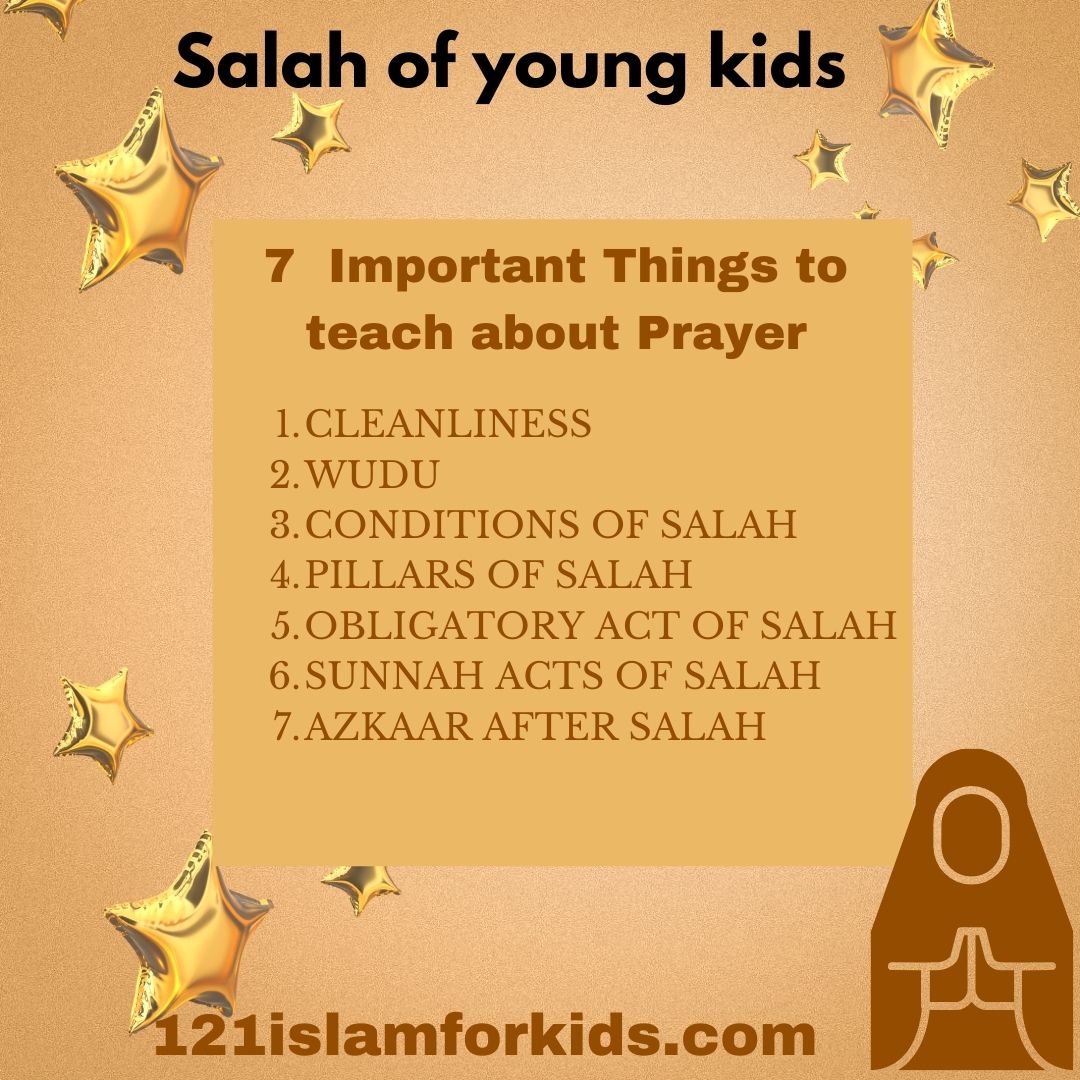
Prayer for kids course is a short course to teach about taharat, Gusal, wudu, times of prayers, number and names of prayers, pillars and conditions, and prayer method. Search as Prayer for kids course on the search bar.
Welcome to our online hadith courses. This is a 30-short hadith with stories course(Teaching method). We have free stories, and videos to teach these hadiths online. You can also get a soft worksheets book to get more benefits from this course.
Scroll down to get whatever you more from the site.
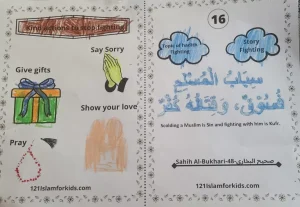
The topic of today’s hadith is about Abusing others, calling bad names, and fighting with other Muslim brothers, In Islam, it is a big sin to bully others and Kufer to fight with Muslims.
Today, people behave more impatiently. So in this environment where people are not ready to bear others or forgive others, this hadith will teach them to forgive others, say sorry, and keep away from any kind of quarrel.
In this session, we are presenting two important incidents/stories from the Life of Muhammad SAW and Shabah.
The first is about scolding and calling names and the second is about fighting. In the concept of fights of the age of ignorance, we will show children the losses and negative impacts of fighting on daily life. They will learn to say sorry and forgetting of all the previous mistakes of others to make a strong Muslim brotherhood.
2. Jews trick to conflict Muslims, Please read the full story from the link. I’m giving an outline of the story. In this story, a Jew who was actually a Munafiq invited some Muslims for dinner.
During this, he raised some points that would make them remember their era of enmity. The wounds were re-opened, memories revived and a call to armed ensued. They choose a place and they fight again.
When Prophet come to know this, he said, you were Jahlil Allah had guided you and honored you and escaped you from hellfire and reunite you. You will fight when I’m here with you.
They realized that they are being trapped. People on both sides cried and begged for forgiveness. Now You can read the story yourself also.
ہماری آج کی حدیث مسلمان کا آپس میں لڑناجھگڑنا اور برا بھلا کہنے کے متعلق ہے- آج کل کے بے صبرے پن اور عدم برداشت کے ماحول میں بچوں کو یہ حدیث معاف کرنا، معذرت کرنا اور لڑائی جھگڑے سے بچنا سکھاۓ گے..
اس کہانی میں سیرت کے دو واقعیت پیش کے گیے ہیں. جن میں سے ایک دوسروں کو برا کہنے یا برے نام سے پکارنے اور لڑائی سے روکنے کے متعلق ہے-اور دوسرا زمانہ جاہلیت کی خاندانی لڑائیوں کے تناظر میں لڑائی کے نقصانات بتایے گے ہیں اور ساتھ میں معافی مانگنے ا ور پرانی رنجشوں کو دل سے نکل کر بھائی چارہ قائم کرنے کا سبق ملتا ہے
اس حادث کو ترجمہ اور اس سے متعلق کہانی کے ساتھ نیچے دے گئی ویڈیو میں جمع کر دیا گیا ہے بچوں کو وڈیو دیکھیں اور ساتھ ساتھ ان کے سوالوں کا جواب دیں. اگر اس واقعہ کو تفصیل سے پڑھنا ہے موجودلنک میں پڑھ سکتے ہیں
براہ مہربانی بچوں کو ویڈیو لگاکر دکھاتے ہوۓ ساتھ بیٹھیں اور ان کی توجہ اہم نقاط پر ڈالیں.اس کے بعد حدیث لکھنے میں بچوں کی مدد کریں ا ور حدیث یاد کروائیں اس کے ساتھ ساتھ پچھلی احادیث بھی دوہرائیں-بچوں کی حدیث کی تصویر نام کے ساتھ پوسٹ کریں. تا کہ اس سیشن کے آخر میں وہ سرٹیفکیٹ حاصل کر سکیں .اگر بچوں کی احادیث سناتے ہوۓ ویڈیوبھیجنا چاہیں تو وہ بھی بھیج سکتے ہیں.شکریہ
Recommended Book for Hadith activities Recommended Book for Hadith activities
This is a short course of hadith and stories from My 30 short hadith with stories course. My hadith course is very much liked and appreciated by parents and students. Online group classes are available online for all time zones.
Recommended age for the class Hadith for kids is for all. These classes are available in English and Urdu. If you want to enroll your child in our classes contact us via.
Easy Tafseer for kids with interesting stories you can see that course in my hadith course tab.
Prayer for kids course is a short course to teach about taharat, Gusal, wudu, times of prayers, number and names of prayers, pillars and conditions, and prayer method. Search as Prayer for kids course on the search bar.