Tag: muslim beliefs

  • Basic Beliefs in Islam: P3 Belief in angels:

    Basic Beliefs in Islam: P3 Belief in angels:

    This is a series of our course Basic Beliefs in Islam: This is part 3, Belief in Angels: Let’s see what is Muslim belief in Angels.
    basic beliefs in islam

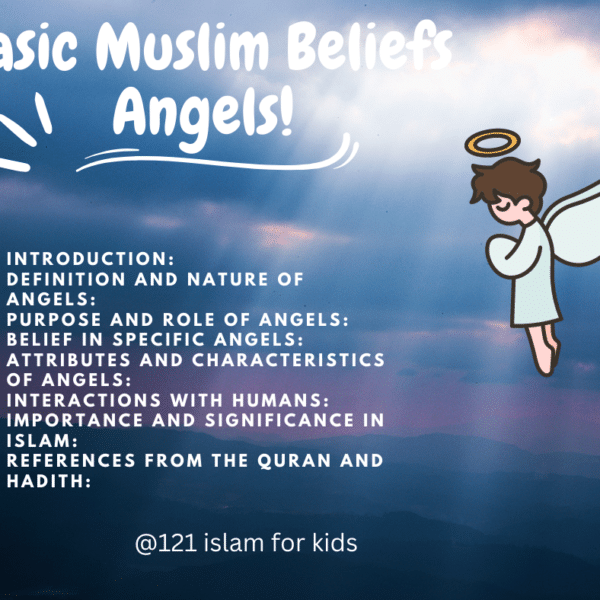
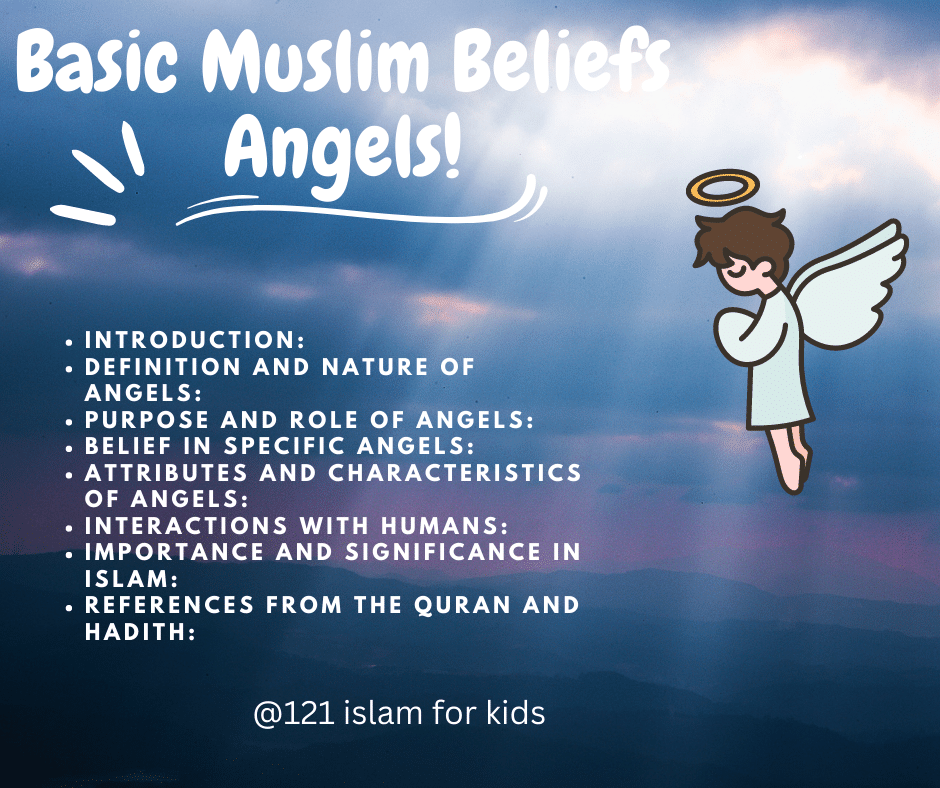
    Basic beliefs in Islam: Belief in Angels Mind Map:

    Main Topic: Islamic Belief in Angel

    1. Definition and Nature of Angels
      • Created by Allah
      • Spiritual beings made of light
      • Subservient to Allah’s commands
      • Invisible to humans
    2. Purpose and Role of Angels
      • Worship and glorify Allah
      • Carry out specific tasks assigned by Allah
      • Messengers between Allah and His creation
    3. Belief in Specific Angels
      • Jibril (Gabriel): Revelation and communication with prophets
      • Mikail (Michael): Responsible for natural provisions and sustenance
      • Israfil: Blowing the trumpet on the Day of Judgment
      • Izrail (Azrael): Angel of death
      • Raqib and Atid: Recording angels who document deeds
      • Munkar and Nakir: Questioning Angels in the Grave
    4. Attributes and Characteristics of Angels
      • Purity and obedience to Allah
      • No free will or ability to disobey
      • Unlimited knowledge and power
      • Vast in number, beyond human comprehension
    5. Interactions with Humans
      • Conveying messages from Allah to prophets
      • Assisting and supporting believers
      • Recording deeds and actions
      • Intervening in human affairs with Allah’s permission
    6. Importance and Significance in Islam
      • Affirming the unseen realm and the divine order
      • Serving as a reminder of Allah’s power and presence
      • Reinforcing the concept of accountability and divine justice
      • Inspiring awe, reverence, and gratitude toward Allah
    7. References from the Quran and Hadith
      • Quranic verses mentioning angels
      • Hadiths narrated by the Prophet Muhammad (peace be upon him) about angels
      • Examples of angelic interventions and interactions in Islamic history

    Conclusion: The Islamic belief in angels is a fundamental aspect of faith, affirming the unseen realm and the presence of Allah’s divine order. Angels play various roles, carrying out specific tasks assigned by Allah and serving as messengers between Allah and His creation. They possess unique attributes and characteristics, emphasizing their purity, obedience, and knowledge. Belief in angels reinforces accountability, divine justice, and the importance of a spiritual connection with Allah. References from the Quran and Hadith provide further evidence and guidance on the significance of angels in Islam.

    Definition and Nature of Angels

    Angels are special beings created by Allah from pure light. They obey Allah perfectly and have no choice but to follow His commands.

    Angels are messengers between Allah and people. The angel Jibril (Gabriel) brought the Qur’an to Prophet Muhammad, and other angels have different jobs like protecting people and recording our deeds.

    There are many angels, but we cannot count them. They watch over us, protect us, and help keep everything in the universe organized.

    Muslims should respect and honor angels by making duaa (prayers). However, we should only worship Allah, not the angels.

    Believing in angels is very important in Islam. The Qur’an and Hadith tell us many stories about angels and what they do.

    Muslims confirm their belief in angels in various ways:

    1. We learn about angels from the Qur’an, which is Allah’s holy message.
    2. The Hadith (sayings of Prophet Muhammad) also tells us about angels and their jobs.
    3. Islamic teachers explain the stories about angels to help us understand them better.
    4. Some Muslims feel the protection and guidance of angels through their dreams and personal experiences.
    5. Our faith in Allah gives us faith in the angels He created to help us.
    6. We see Allah’s mercy, protection, and guidance in our lives, which angels help deliver.
    7. Muslims all over the world believe in angels, and this shared belief confirms it is true.

    By understanding these beliefs, Muslims grow closer to Allah and appreciate His perfect plan.

    Names of some angels and their role

    1. Archangels:
      • Jibril (Gabriel): He is known as the angel of revelation and is responsible for delivering Allah’s messages to the prophets.
      • Mikail (Michael): He is associated with the distribution of provisions and sustenance from Allah.
    2. Guardian Angels:
      • Raqib and Atid: These angels are assigned to record the good and bad deeds of every individual.
    3. Recording Angels:
      • Kiraman Katibin: They are a group of angels who record every action, word, and thought of humans. They write the deeds in a person’s book of records.
    4. Angel of Death:
      • Izrail (Azrael): He is tasked with the responsibility of taking the souls of individuals at the time of their death.
    5. Angels of the Grave:
      • Munkar and Nakir: These angels visit the deceased in their graves to question them about their faith and deeds.
    6. Angels of Mercy and Punishment:
      • Ridwan: He is responsible for welcoming righteous believers into Paradise.
      • Malik: He is in charge of Hellfire and overseeing its punishments.
    7. Angels of Protection:
      • Muaqqibat: These angels are assigned to protect and accompany individuals, especially during critical moments.

    Different types of angels have different roles and names mentioned in Islamic tradition. Each one has an important job in Allah’s creation.

    Teaching Method Islamic Belief in Angels to Children:

    Introduction:

    • Start the lesson by introducing the topic of angels in Islam and their significance.
    • Explain that angels are spiritual beings created by Allah and play an important role in the unseen world.

    Definition and Nature of Angels:

    • Teach children that angels are made of light and are subservient to Allah’s commands.
    • Emphasize that angels are invisible to humans and exist in a realm beyond our perception.

    Purpose and Role of Angels:

    • Discuss the purpose of angels, which is to worship and glorify Allah.
    • Explain that angels also carry out specific tasks assigned by Allah, such as delivering messages to prophets.

    Belief in Specific Angels:

    • Introduce some prominent angels in Islam, such as Jibril (Gabriel), Mikail (Michael), Israfil, and Izrail (Azrael).
    • Explain their roles and responsibilities, making the concepts relatable to children.
    • Share stories from Islamic history that involve these angels to engage children’s interest.

    Attributes and Characteristics of Angels:

    • Discuss the qualities of angels, such as their purity, obedience to Allah, and vast knowledge.
    • Explain that angels do not have free will or the ability to disobey Allah.
    • Highlighting their power and vast numbers, which are beyond human comprehension.

    Interactions with Humans:

    • Explain that angels serve as messengers between Allah and His creation.
    • Discuss how angels deliver revelations to prophets, such as Jibril conveying the Quran to Prophet Muhammad (peace be upon him).
    • Teach children that angels record their deeds and actions, and will be present during the questioning in the grave.

    Importance and Significance in Islam:

    • Emphasize the importance of believing in angels as part of faith in Islam.
    • Explain that belief in angels affirms the unseen realm and the divine order established by Allah.
    • Discuss how angels remind us of Allah’s power, presence, and the concept of accountability.

    References from the Quran and Hadith:

    Different angels have different jobs. Some bring messages from Allah to the prophets, some record what we do, and some manage the weather. Each angel’s job is important and helps keep everything in the universe working perfectly.

    Duties of Angels in Islam

    We don’t know exactly how many angels exist. Allah created so many angels that no human can count them. Each person has angels with them to protect and watch over them.

    How Many Angels are There in Islam?

    Yes! Believing in angels is a very important part of being Muslim. The Qur’an and Hadith teach us that angels are real and they help Allah’s creation in many ways.

    Do Muslims Believe in Angels?

    • Share selected Quranic verses mentioning angels, such as Surah Al-Baqarah (2:97) and Surah Al-Anbiya (21:27).
    • Narrate age-appropriate hadiths from the Prophet Muhammad (peace be upon him) about angels and their interactions.
    • Relate examples from Islamic history where angels played significant roles, such as the Angel Jibril appearing to Maryam (Mary).

    Conclusion:

    • Summarize the key points covered in the lesson, emphasizing the belief in angels as an integral part of the Islamic faith.
    • Encourage children to reflect on the importance of angels in their lives and to appreciate Allah’s creation.
    • Remind them that belief in angels strengthens their connection with Allah and reinforces the concept of accountability.

    When teaching children about angels, use simple words, stories, and fun activities. This helps them understand and love learning about the unseen world and Allah’s perfect creation.

    This article is a series of our 6 articles in Islam course. Other articles on this course.
    A short course on 6 Articles of Faith in Islam:

    Article 1: Who is Allah? Towheed, first Article of Muslim Faith

    What is Monotheism? The largest monotheism Religions:

  • Who is Allah? Towheed, first Article of Muslim Faith

    Who is Allah? Towheed, first Article of Muslim Faith

    who is the allah

    Who is the Allah?

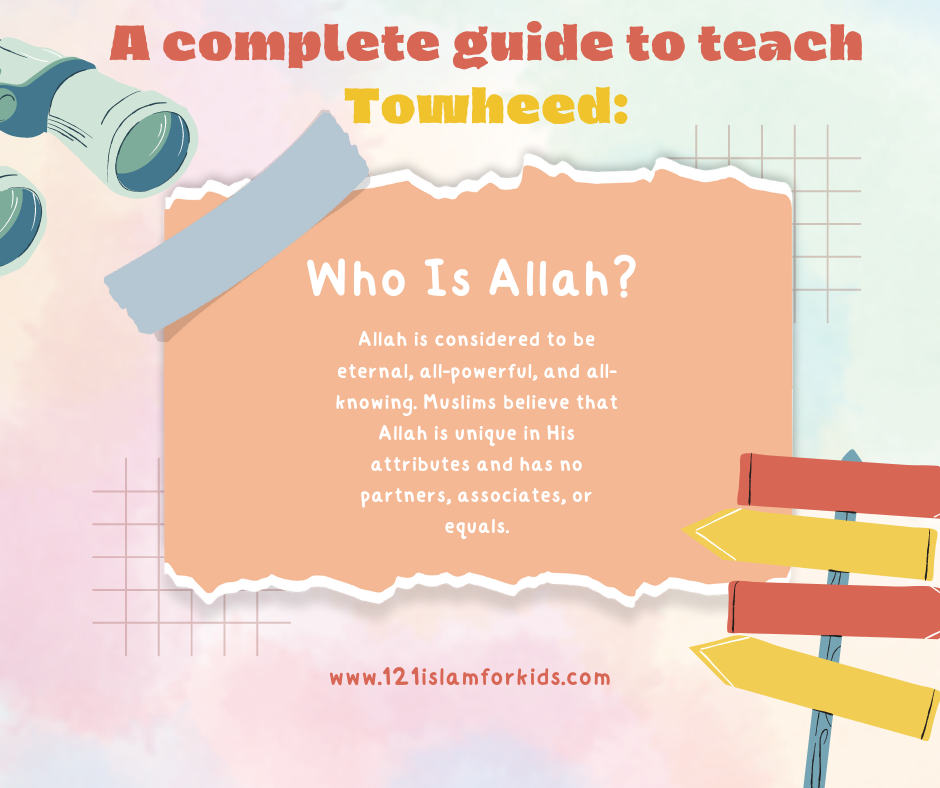
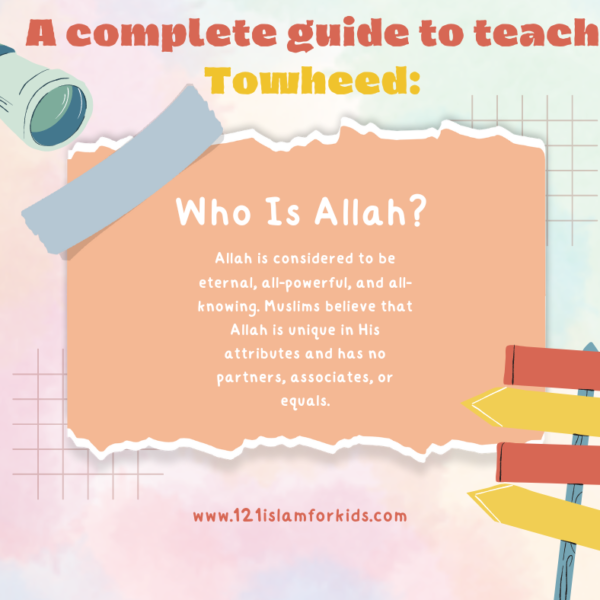
    Allah is the Arabic term for God in Islam. Muslims believe that Allah is the one and only true God, the creator and sustainer of the universe. Allah is considered to be eternal, all-powerful, and all-knowing. Muslims believe that Allah is unique in His attributes and has no partners, associates, or equals.

    Allah is described in the Quran, which Muslims believe to be the direct word of God as revealed to Prophet Muhammad. The Quran emphasizes Allah’s divine attributes, including His mercy, wisdom, justice, and love. Allah is seen as the source of guidance, the ultimate judge, and the one who responds to the prayers and needs of His creation.

    Muslim believe in Allah

    Muslims believe that Allah has revealed His will and guidance to humanity through prophets and scriptures, including the Quran. They strive to worship and obey Allah, seeking His pleasure and following the teachings and example of Prophet Muhammad.

    Allah is seen as a compassionate and forgiving God, and Muslims are encouraged to develop a personal and intimate relationship with Him through acts of worship, prayer, supplication, and remembrance.

    Tawheed: The Oneness of Allah – A Fundamental Belief in Islam

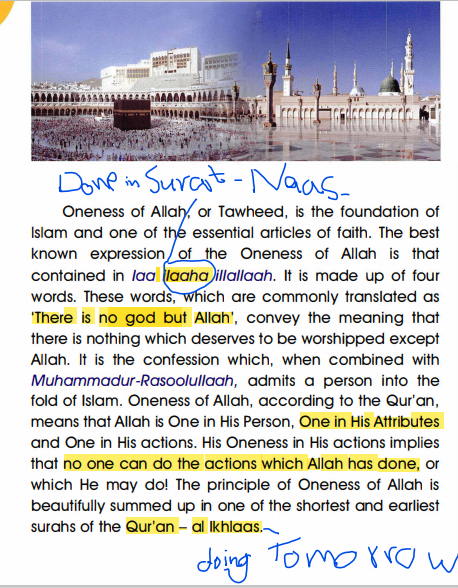
    Tawheed is an Arabic term that refers to the concept of the oneness of Allah in Islamic belief. It is derived from the root word “Wahid,” which means “one.” Tawheed encompasses the belief in the absolute unity and uniqueness of Allah, recognizing Him as the one and only true God, with no partners, associates, or equals.

    Tawheed is the foundation of Islamic monotheism, highlighting the core belief that Allah is the sole creator, sustainer, and controller of the universe. Muslims firmly affirm that there is no deity worthy of worship except Allah. It involves acknowledging and accepting Allah’s divine attributes, such as His knowledge, power, mercy, and justice.

    The concept of Tawheed is based on the teachings of the Quran, which repeatedly emphasizes the oneness of Allah and rejects any form of polytheism or association of partners with Him. It is also supported by the Hadiths (sayings and actions of Prophet Muhammad), where the Prophet emphasized the importance of pure monotheism.

    1. Tawheed in the Quran:
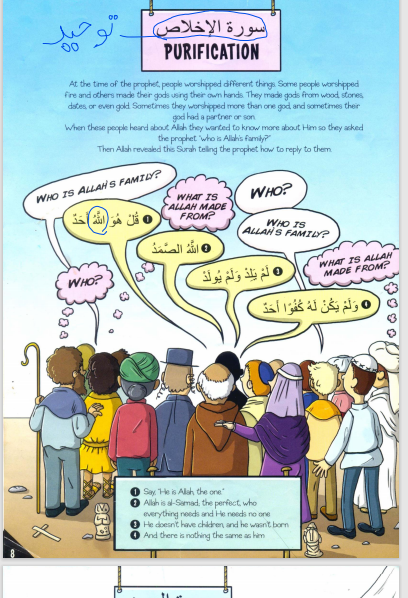
      • “Say, ‘He is Allah, the One and Only. Allah, the Eternal, Absolute. He begets not, nor is He begotten. And there is none comparable unto Him.’” (Quran 112:1-4)
      • “Your God is One God; there is no deity except Him, the Entirely Merciful, the Especially Merciful.” (Quran 2:163)
      • Numerous verses emphasize the uniqueness, sovereignty, and oneness of Allah.
    2. Tawheed in the Hadiths:
      • Prophet Muhammad said, “Whoever testifies that there is no deity worthy of worship except Allah alone, without partners, and that Muhammad is His servant and messenger, Allah will enter them into Paradise.” (Sahih Muslim)
      • The Prophet emphasized the importance of pure monotheism and rejecting any form of polytheism or association of partners with Allah.
    3. Prophets’ Teachings on Tawheed:
      • Prophet Abraham (Ibrahim) taught Tawheed to his people, calling them to worship Allah alone and abandon false gods.
      • Prophet Moses (Musa) emphasized the oneness of Allah, as seen in the Ten Commandments.
      • Prophet Jesus (Isa) taught monotheism, affirming the worship of Allah alone.
    4. Categories of Tawheed:
      • Tawheed ar-Rububiyyah: The belief in Allah’s lordship, acknowledging His exclusive right to create, sustain, and govern the universe.
      • Tawheed al-Uluhiyyah: The belief in the worship of Allah alone, rejecting the worship of anything or anyone else.
      • Tawheed al-Asma’ wa al-Sifat: The belief in Allah’s unique names and attributes, recognizing their perfection and incomparability.
    5. Effects of Tawheed:
      • Unity and harmony: Tawheed unifies Muslims and promotes harmony among believers, as they direct their worship solely to Allah.
      • Trust in Allah: Belief in Tawheed encourages reliance on Allah’s guidance, mercy, and provision.
      • Abandoning idolatry: Tawheed rejects the worship of false deities and objects, freeing believers from superstitions and polytheistic practices.

    Tawheed: three aspects:

    1. Tawheed ar-Rububiyyah: The belief in Allah’s lordship, recognizing that He is the sole creator, sustainer, and controller of all things.
    2. Tawheed al-Uluhiyyah: The belief in the worship of Allah alone, directing all acts of worship and devotion solely to Him, without associating partners with Him.
    3. Tawheed al-Asma’ wa al-Sifat: The belief in Allah’s unique names and attributes, acknowledging their perfection and incomparability.

    By understanding and affirming Tawheed, Muslims establish a deep connection with Allah, recognizing His supreme authority and surrendering themselves to His will. It brings about unity, clarity of purpose, and a strong sense of devotion, guiding Muslims in their worship, moral conduct, and relationship with Allah and His creation. Tawheed is a fundamental principle in Islam, shaping the faith and practice of Muslims worldwide.

    Conclusion: Tawheed, the oneness of Allah, forms the bedrock of Islamic belief. Muslims affirm the uniqueness, sovereignty, and perfection of Allah, worshiping Him alone and rejecting any partners or rivals. The Quranic verses, Hadiths, and teachings of the prophets emphasize the centrality of Tawheed in the Islamic faith. Understanding and embracing Tawheed brings unity, trust, and a profound sense of purpose to the lives of Muslims, as they submit themselves wholly to the worship and service of Allah, the one and only true God.

    How we will teach Towheed (Who is Allah) to our students?

    Teaching children about the concept of tawhid (the oneness of Allah) and introducing them to the concept of Allah can be done in several ways. Here are some suggestions for teaching children about Allah and fostering their understanding of tawhid:

    1. Start with age-appropriate explanations: Begin by providing simple and concise explanations suitable for the child’s age and level of understanding. Use language and examples that they can relate to and comprehend easily. ( We will explain it with the help of Islamic education Book )
    2. Use stories and analogies: Children often respond well to stories and analogies. Utilize age-appropriate stories from Islamic literature or from the lives of the prophets to illustrate the concept of Allah and His oneness. Analogies such as comparing Allah’s oneness to the uniqueness of a parent’s love for their child can also help children grasp the idea.
    3. Teach through observation: Encourage children to observe and appreciate the signs of Allah’s creation in the world around them. Take them on nature walks, point out the beauty and intricacy of the natural world, and explain that all of it is a reflection of Allah’s creation. ( Art and Craftwork will be down)
    4. Recite and explain Quranic verses: Select simple verses from the Quran that highlight Allah’s attributes and His oneness. Teach children the Arabic words for Allah and help them understand the meaning and significance of those verses in a way that is accessible to them. ( We have selected Surah Ikhlas and other short verses)
    5. Practice gratitude and prayer: Teach children to express gratitude to Allah for His blessings, both big and small. Encourage them to say simple prayers, such as thanking Allah for food, family, and other blessings in their lives. Instill in them the habit of turning to Allah in times of need and teaching them that Allah is always there for them.( Asma ul Hasna activity, Some supplications and Calligraphy work will be done. 5 prayers in a day will be also taught to children)
    6. Lead by example: Children learn by observing their parents and caregivers. Demonstrate your own devotion and connection to Allah through your daily prayers, acts of kindness, and adherence to Islamic principles. This sets a powerful example and reinforces the importance of tawhid in their lives.
    7. Answer questions patiently: Children are naturally curious and may have many questions about Allah and tawhid. Be patient and open to answering their questions, even if you don’t have all the answers. Encourage them to explore and seek knowledge about Allah and His attributes.

    Common questions children might ask

    Children may ask a wide range of questions about Allah as they begin to explore and understand the concept of God. Here are some common questions children might ask:

    1. Who is Allah?
    2. Is Allah like a person?
    3. Can we see Allah?
    4. Where does Allah live?
    5. How did Allah create everything?
    6. Why can’t we see Allah?
    7. Does Allah have a family?
    8. Does Allah love us?
    9. Can we talk to Allah?
    10. Can Allah hear us?
    11. Why does Allah allow bad things to happen?
    12. Can Allah make anything happen?
    13. Why do we pray to Allah?
    14. How does Allah answer our prayers?
    15. What does Allah look like?
    16. How can Allah be everywhere at the same time?
    17. Why do we say “Allah” instead of another name for God?
    18. Can Allah make mistakes?
    19. Does Allah forgive us when we make mistakes?
    20. Can we ask Allah for anything we want?

    It’s important to approach these questions with patience, age-appropriate explanations, and a willingness to explore and learn together. Encouraging children to seek knowledge and providing them with simple, understandable answers will help them develop a better understanding of Allah and their faith.

    Remember, teaching children about Allah and tawhid is a gradual process. It is important to be consistent, and patient, and create an environment where they feel comfortable asking questions and learning about their faith

    Online class activity:

    After Reading the stories of creations and Introduction of Allah from Surah Ikhlaas.
    We know about Allah’s creation.
    The first Man.
    Al-Aleem Allah’s attribution.
    Allah has created man ( Story of His creation was told, Allah gathers the soil of all kinds and made a man and then gave him life.
    Then Allah gifted his eyes to see, ears to listen, heart to feel, and mind to think)
    So Allah Knows what is best for mankind.
    Allah knows,
    How to live?
    He guided us through his book Al-Quran
    How to talk?
    What is bad and good?
    What food and drink is better for us?
    All other creatures were created and forced to do what Allah wanted them to do.
    But Mankind is free to choose.
    Allah Gave him the mind to think what is good and bad.
    .
    If we will be thankful to Allah , He will increase His blessings.
    see the answers given by the kids in the Last picture.

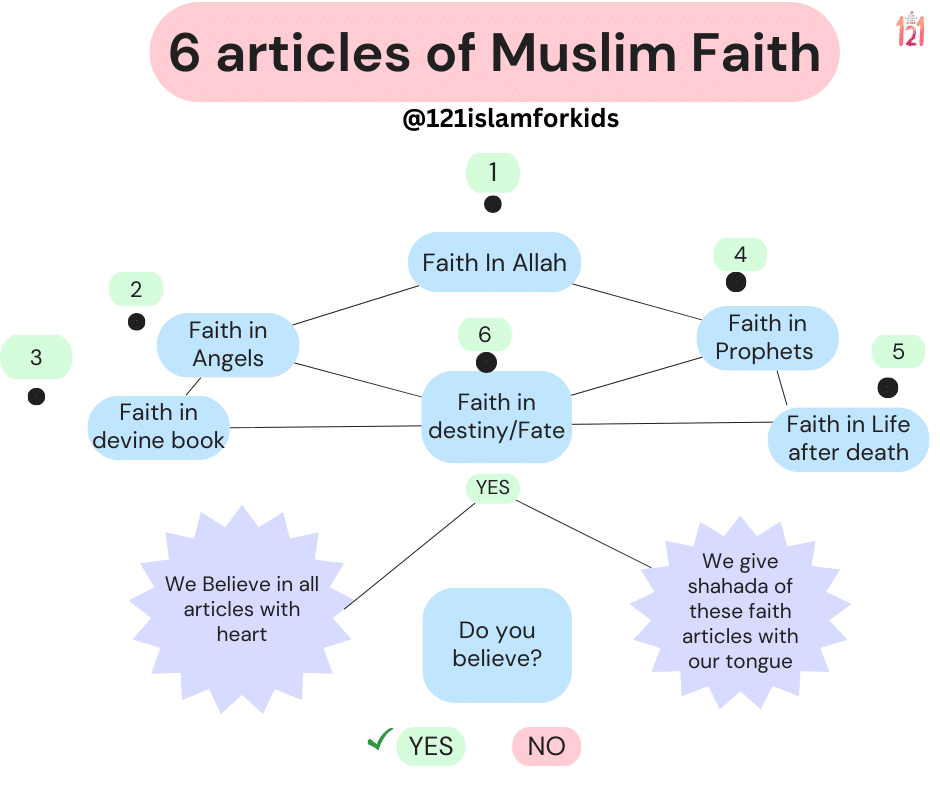
    6 Articles of Muslim Faith

    Resources:

    Books

    free books – 121 Islam for Kids

    Pinterest

    Videos

    Courses – 121 Islam for Kids

    How is this article? Do you like my teaching method? Enroll your children in our Online class Email or sign up here.

  • A short course on 6 Articles of Faith in Islam:

    A short course on 6 Articles of Faith in Islam:

    Title: Exploring the 6 Articles of Faith in Islam: Online Course for Children

    6 articles of faith in islam

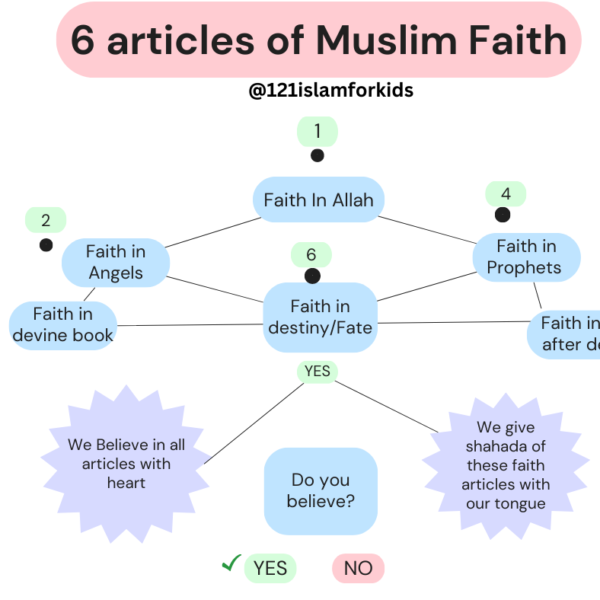
    The six articles of faith, also known as the pillars of iman, are the foundational beliefs that Muslims hold. Here is a detailed explanation of each article:

    Belief in Allah (God):

    Muslims believe in the oneness of Allah, that there is only one God.

    Allah is eternal, all-powerful, and the creator of the universe.

    Muslims believe in Allah’s divine attributes, such as His mercy, knowledge, and justice.

    They believe in worshipping and obeying Allah alone and recognizing Him as the ultimate authority. Read More

    Belief in Angels:

    Muslims believe in the existence of angels, who are spiritual beings created by Allah.

    Angels have no physical form and are invisible to humans.

    They carry out specific tasks assigned by Allah, such as delivering messages, recording deeds, and protecting individuals.

    Muslims believe in the archangel Jibril (Gabriel), who brought revelations from Allah to the prophets. Read more

    Belief in Prophets:

    Muslims believe in the prophets and messengers sent by Allah to guide humanity.

    They include well-known figures like Prophet Muhammad, Jesus, Moses, Abraham, and others.

    Prophets were chosen by Allah and were entrusted with delivering His message to people.

    Muslims believe that Prophet Muhammad is the final messenger and that his teachings and example (Sunnah) are to be followed.

    Belief in Divine Books:

    Muslims believe that Allah revealed divine books to guide humanity.

    The Quran is the central and final book of Islam, believed to be the direct word of Allah as revealed to Prophet Muhammad.

    Muslims also believe in the original scriptures sent to earlier prophets, such as the Torah revealed to Moses and the Injeel (Gospel) revealed to Jesus.

    The Quran is considered the most authentic and complete book, providing guidance for all aspects of life. Read more about this faith here.

    Belief in the Day of Judgment:

    Muslims believe in the Day of Judgment, also known as the Last Day or the Day of Resurrection.

    On this day, Allah will resurrect all individuals from their graves to be held accountable for their deeds.

    Muslims believe in the balance of justice, where each person’s good and bad deeds will be weighed.

    The righteous will be rewarded with Paradise (Jannah), while the wicked will face punishment in Hellfire (Jahannam).

    Belief in Divine Decree (Qadr):

    Muslims believe in Allah’s divine decree and predestination.

    They believe that everything happens according to Allah’s will and knowledge.

    This belief includes accepting that Allah has knowledge of all things past, present, and future.

    Muslims understand that while humans have free will, Allah’s ultimate plan and decree are always in effect.

    These six articles of faith form the foundation of Islamic belief. They guide Muslims in understanding the purpose of life, the relationship with Allah, and the principles and values that shape their actions and interactions with others. By adhering to these beliefs, Muslims strive to lead a righteous life, seeking Allah’s pleasure and aiming for eternal happiness in the Hereafter.

    Course Outline:

    Introduction to Islam

    Understanding the basics of Islam as a comprehensive way of life.

    Introducing the concept of the Seven Articles of Islam.

    Tawhid: Oneness of Allah

    Explaining the belief in the Oneness of Allah.

    Discussing the attributes of Allah and His role as the Creator.

    Engaging children through stories and interactive activities.

    Prophethood: Belief in Prophets and Messengers

    Introducing the concept of Prophets and Messengers in Islam.

    Highlighting the importance of Prophet Muhammad (PBUH) as the final Messenger.

    Learning about other Prophets and their significant contributions.

    Divine Books: Belief in Revealed Scriptures

    Understanding the importance of Divine Books in Islam.

    Discussing the Quran as the final and preserved revelation.

    Exploring the stories and lessons from various Prophets and scriptures.

    Angels: Belief in Angelic Beings

    Exploring the world of angels and their role in Islamic beliefs.

    Learning about popular angels like Jibril (Gabriel) and Mika’il (Michael).

    Understanding the concept of guardian angels and their presence in our lives.

    Day of Judgment: Belief in the Afterlife

    Discussing the belief in the Day of Judgment and life after death.

    Exploring the concept of accountability and the scale of deeds.

    Engaging children through thought-provoking discussions on the significance of righteous actions.

    Qadar: Belief in Divine Decree and Destiny

    Understanding the concept of Qadar, the divine decree.

    Discussing the balance between free will and predestination.

    Encouraging children to trust in Allah’s wisdom and guidance.

    Conclusion and Recap

    Summarizing the key teachings and principles of the Seven Articles of Islam.

    Providing an opportunity for children to ask questions and seek clarification.

    Encouraging reflection and application of the learned knowledge in daily life.

    Mind Map:

    Seven Articles of Islam
    |
    ---------------------------------------
    | | | | |
    Tawhid Prophethood Divine Angels Day of Judgment
    Books
    |
    Qadar

    By following this course outline and utilizing engaging teaching methods, interactive discussions, stories, and activities, children will develop a solid understanding of the Seven Articles of Islam in a fun and interactive online learning environment.

    Teaching Method of 6 Articles of Islam

    Crafts, Activities, and Assessments for Exploring the Seven Articles of Islam:

    Introduction to Islam

    Craft: Create an Islamic art collage using cut-out shapes and patterns.

    Activity: Share personal stories of how Islam is practiced in daily life.

    Assessment: Conduct a group discussion to assess children’s prior knowledge about Islam.

    Tawhid: Oneness of Allah

    Craft: Design and decorate “Allah is One” posters.

    Activity: Play a game where children identify and match attributes of Allah.

    Assessment: Ask children to draw or write about how they practice Tawhid in their lives.

    Prophethood: Belief in Prophets and Messengers

    Craft: Make paper puppets of Prophets and act out their stories.

    Activity: Create a timeline of major Prophets and their key messages.

    Assessment: Have children narrate a Prophet’s story and explain its moral lesson.

    Divine Books: Belief in Revealed Scriptures

    Craft: Decorate mini Quran bookmarks with Islamic calligraphy.

    Activity: Organize a “Quran Challenge” where children find verses related to specific topics.

    Assessment: Ask children to present their favorite Quranic verse and explain its meaning.

    Angels: Belief in Angelic Beings

    Craft: Construct angel wings using paper, feathers, and glitter.

    Activity: Role-play different scenarios where angels play a part in guiding individuals.

    Assessment: Have children create a comic strip depicting an angel’s role in their lives.

    Day of Judgment: Belief in the Afterlife

    Craft: Design and decorate “Jannah (Paradise)” and “Jahannam (Hell)” posters.

    Activity: Organize a mock trial where children discuss moral choices and consequences.

    Assessment: Conduct a reflective writing activity on how to prepare for the Day of Judgment.

    Qadar: Belief in Divine Decree and Destiny

    Craft: Create a “Trust in Allah” jar filled with positive affirmations and gratitude notes.

    Activity: Engage in a discussion on overcoming challenges and trusting Allah’s plan.

    Assessment: Ask children to share a personal story highlighting their trust in Allah’s decree.

    Conclusion and Recap

    Craft: Design a “Seven Articles of Islam” booklet with illustrations and summaries.

    Activity: Conduct a group quiz or crossword puzzle on the key concepts learned.

    Assessment: Assign children to create a presentation showcasing their understanding of the Seven Articles.

    By incorporating crafts, activities, and assessments, children will have hands-on experiences, engage their creativity, and reinforce their understanding of the Seven Articles of Islam. These interactive methods will make the learning process enjoyable, memorable, and effective.

    Our Islamic courses

    Our curriculum books

    Islamic Studies Grade 05

    My First Quran Stories Book