Online Quran Classes for Kids: The Communication Problem in Traditional LearningThe problem in the online Quran class. Lack of Parent Communication
Online Quran classes for kids face a major challenge: most providers offer poor parent communication. When searching for the best online Quran teachers or affordable Quran tutors for kids, parents often discover that many programs focus solely on students during interactive Quran learning sessions while neglecting to keep parents informed.
This lack of communication in Islamic studies online creates significant problems—children miss classes, forget homework, and struggle to maintain progress while parents remain unaware of their child’s development in learning Quran at home.
At 121 Islam for Kids, we understand the importance of comprehensive Islamic education that involves the entire family.At 121 Islam for Kids, we understand the importance of comprehensive Islamic education that involves the entire family.Online Quran classes for kids face a major challenge: most providers offer poor parent communication. When searching for the best online Quran teachers or affordable Quran tutors for kids, parents often discover that many programs focus solely on students during interactive Quran learning sessions while neglecting to keep parents informed. This lack of communication in Islamic studies online creates significant problems—children miss classes, forget homework, and struggle to maintain progress while parents remain unaware of their child’s development in learning Quran at home. At 121 Islam for Kids, we understand the importance of comprehensive Islamic education that involves the entire family.Online Quran classes for kids face a major challenge: most providers offer poor parent communication. When searching for the best online Quran teachers or affordable Quran tutors for kids, parents often discover that many programs focus solely on students during interactive Quran learning sessions while neglecting to keep parents informed. This lack of communication in Islamic studies online creates significant problems—children miss classes, forget homework, and struggle to maintain progress while parents remain unaware of their child’s development in learning Quran at home.
Whether you’re seeking Quran lessons for beginners or advanced Islamic education for children, effective parent-teacher communication remains crucial. Many families prefer one-on-one Quran classes for personalized attention, while others choose group sessions for Quran study online.
For quality Islamic education resources, parents often turn to established institutions like Islamic Online University and platforms such as Quran.com for additional Quranic resources. Regardless of the format, most virtual Quran academy for kids providers fail to establish proper communication channels with parents.For quality Islamic education resources, parents often turn to established institutions like Islamic Online University and platforms such as Quran.com for additional Quranic resources. Regardless of the format, most virtual Quran academy for kids providers fail to establish proper communication channels with parents.Whether you’re seeking Quran lessons for beginners or advanced Islamic education for children, effective parent-teacher communication remains crucial. Many families prefer one-on-one Quran classes for personalized attention, while others choose group sessions for Quran study online. For quality Islamic education resources, parents often turn to established institutions like Islamic Online University and platforms such as Quran.com for additional Quranic resources. Regardless of the format, most virtual Quran academy for kids providers fail to establish proper communication channels with parents.Whether you’re seeking Quran lessons for beginners or advanced Islamic education for children, effective parent-teacher communication remains crucial. Many families prefer one-on-one Quran classes for personalized attention, while others choose group sessions for Quran study online. Regardless of the format, most virtual Quran academy for kids providers fail to establish proper communication channels with parents.
One of the most overlooked mistakes in online Qur’an teaching is neglecting regular and clear communication with parents. Many teachers focus only on the student during class time and fail to keep parents informed and engaged.
As a result, children may miss classes, forget to complete homework, and struggle to stay on track—while parents remain unaware of their child’s actual progress. This communication gap affects both Muslim children’s Quran tutoring effectiveness and overall learning outcomes in Islamic education for children.As a result, children may miss classes, forget to complete homework, and struggle to stay on track—while parents remain unaware of their child’s actual progress. This communication gap affects both Muslim children’s Quran tutoring effectiveness and overall learning outcomes in Islamic education for children.One of the most overlooked mistakes in online Qur’an teaching is neglecting regular and clear communication with parents. Many teachers focus only on the student during class time and fail to keep parents informed and engaged. As a result, children may miss classes, forget to complete homework, and struggle to stay on track—while parents remain unaware of their child’s actual progress. This communication gap affects both Muslim children’s Quran tutoring effectiveness and overall learning outcomes in Islamic education for children.One of the most overlooked mistakes in online Qur’an teaching is neglecting regular and clear communication with parents. Many teachers focus only on the student during class time and fail to keep parents informed and engaged. As a result, children may miss classes, forget to complete homework, and struggle to stay on track—while parents remain unaware of their child’s actual progress. This communication gap affects both Muslim children’s Quran tutoring effectiveness and overall learning outcomes in Islamic education for children.One of the most overlooked mistakes in online Qur’an teaching is neglecting regular and clear communication with parents. Many teachers focus only on the student during class time and fail to keep parents informed and engaged. As a result, children may miss classes, forget to complete homework, and struggle to stay on track—while parents remain unaware of their child’s actual progress. This communication gap affects both Muslim children’s Quran tutoring effectiveness and overall learning outcomes in Islamic education for children.Online Quran classes for kids face a major challenge: most providers offer poor parent communication. When searching for the best online Quran teachers or affordable Quran tutors for kids, parents often discover that many programs focus solely on students during interactive Quran learning sessions while neglecting to keep parents informed. This lack of communication in Islamic studies online creates significant problems—children miss classes, forget homework, and struggle to maintain progress while parents remain unaware of their child’s development in learning Quran at home.One of the most overlooked mistakes in online Qur’an teaching is neglecting regular and clear communication with parents. Many teachers focus only on the student during class time and fail to keep parents informed and engaged. As a result, children may miss classes, forget to complete homework, and struggle to stay on track—while parents remain unaware of their child’s actual progress.One of the most overlooked mistakes in online Qur’an teaching is neglecting regular and clear communication with parents. Many teachers focus only on the student during class time and fail to keep parents informed and engaged. As a result, children may miss classes, forget to complete homework, and struggle to stay on track—while parents remain unaware of their child’s actual progress.One of the most overlooked mistakes in online Qur’an teaching is neglecting regular and clear communication with parents. Many teachers focus only on the student during class time and fail to keep parents informed and engaged. As a result, children may miss classes, forget to complete homework, and struggle to stay on track—while parents remain unaware of their child’s actual progress.One of the most overlooked mistakes in online Qur’an teaching is neglecting regular and clear communication with parents. Many teachers focus only on the student during class time and fail to keep the parents informed and engaged. As a result, children may miss classes, forget to complete homework, and struggle to stay on track—while parents remain unaware of their child’s actual progress.
At 121 Islam for Kids, we firmly believe that Qur’an education is not a one-way process between teacher and child. Instead, it’s a triangle of cooperation where the child, teacher, and parent work closely together to build a strong, faith-centered learning journey. That’s why we’ve designed a thoughtful and highly effective communication strategy for every enrolled family.
Our Communication System: How We Keep Parents Informed and Involved
1. Dedicated WhatsApp Group for Every Student We create a private WhatsApp group for every student, which includes the child, their parent or guardian, and the teacher. This group becomes the central hub for all communication—announcements, feedback, reminders, class summaries, and file sharing. Parents never feel disconnected or left out. Everything is documented and organized in one place, creating transparency and mutual trust.
2. Timely Reminders Before Every Class We understand that families have busy schedules, and children often juggle school and other activities. To support regular attendance and punctuality, we send two reminders for every class. The first is sent a day in advance, and the second is sent a few hours before the class begins. This double reminder system helps parents and children prepare mentally and practically—no more missed or forgotten sessions.
3. Early Notification in Case of Emergency or Schedule Changes If, for any reason, a class has to be rescheduled or delayed, we never wait till the last minute. Our team ensures that parents are notified well in advance—usually several hours before class. This respect for parents’ time has helped us build strong, appreciative relationships with families across different time zones.
4. Daily Class Summaries and Progress Sharing At the end of each class, we provide a concise and clear summary of the material covered. This includes the Qur’anic verses covered, key vocabulary, any moral or emotional lessons discussed, and details of in-class activities. Parents appreciate knowing what their child is learning without having to ask. It also helps them reinforce the lesson at home or review it if needed.
5. Clear Homework and Revision Instructions We make sure students and parents know exactly what needs to be revised or prepared before the next class. Homework instructions are sent in the group with due dates and any extra help or notes if needed. Parents can help ensure the work is done on time, and children feel more confident coming to class prepared.
6. Encouraging Feedback and Positive Reinforcement Children thrive when their effort is recognized. After checking each child’s homework or class activity, we send personal responses to appreciate their work. We use kind words, gentle encouragement, and positive phrases that build their self-esteem. This simple yet powerful practice keeps motivation high and builds a positive connection between the child and their teacher.
7. Zoom Class Access Made Simple Our Zoom classes run on a consistent, recurring schedule using the same Zoom link every time. We pin this link at the top of each WhatsApp group so it’s always easy to find. Children don’t waste time searching for links or dealing with last-minute confusion. They log in quickly and confidently, and our classes start on time.
8. Small Group Sizes with Big Benefits We intentionally keep our class groups small. This allows for more personal attention, individual feedback, and a calm, focused learning environment. With fewer students per group, the teacher can manage time better, correct recitation carefully, and address each child’s emotional and educational needs. And despite this quality-focused model, we keep our fees affordable to support more families.
Why Parents Love This Approach
Many of our parents have told us they’ve never seen such consistent and respectful communication from any other online program. They know exactly what their child is learning, what to revise, and how their child is progressing. They feel like true partners in their child’s Islamic education. That’s why they stay committed and encourage their children to do the same.
This system has led to excellent results:
High class attendance and punctuality
Strong parent-teacher relationships
Confident, motivated children
A happy and supportive learning environment
Conclusion
At 121 Islam for Kids, we don’t just teach Qur’an—we build a supportive bridge between child, parent, and teacher. Our communication strategy is thoughtful, respectful, and proven to work. This is one of the key reasons our classes are so successful, and our students and parents are always satisfied, Alhamdulillah.
If you’re looking for a comprehensive virtual Quran academy for kids where your child receives excellent Islamic education for children, we welcome you to join us. Whether you need Quran lessons for beginners, one-on-one Quran classes, or Muslim children’s Quran tutoring, our program combines quality Quran study online with exceptional parent communication—exactly what your family deserves.
If you’re looking for a Qur’an program where your child is loved, guided, and understood—and where you as a parent are included every step of the way—we welcome you to join us.If you’re looking for a Qur’an program where your child is loved, guided, and understood—and where you as a parent are included every step of the way—we welcome you to join us.If you’re looking for a comprehensive virtual Quran academy for kids where your child receives excellent Islamic education for children, we welcome you to join us. Whether you need Quran lessons for beginners, one-on-one Quran classes, or Muslim children’s Quran tutoring, our program combines quality Quran study online with exceptional parent communication—exactly what your family deserves.If you’re looking for a comprehensive virtual Quran academy for kids where your child receives excellent Islamic education for children, we welcome you to join us. Whether you need Quran lessons for beginners, one-on-one Quran classes, or Muslim children’s Quran tutoring, our program combines quality Quran study online with exceptional parent communication—exactly what your family deserves.If you’re looking for a Qur’an program where your child is loved, guided, and understood—and where you as a parent are included every step of the way—we welcome you to join us.
5 Common Mistakes Qur’an Teachers Make When Teaching Young Children Online
— and How to Avoid Them —
Enhancing Online Qur’an Education for Children
Teaching the Qur’an to young children online presents unique challenges and opportunities. While technology offers incredible reach, it also requires adapting traditional teaching methods to keep young minds engaged and inspired. This post highlights five common pitfalls online Qur’an teachers encounter and provides practical solutions to transform your virtual classroom into a vibrant, effective learning space.
By understanding these mistakes and implementing the suggested strategies, teachers can foster a deeper connection to the Qur’an in their young students, ensuring a joyful and meaningful learning journey.
1. Lack of Engagement and Visual Tools
Mistake:
Simply reading or repeating the Qur’an without using any visual aids, stories, or interactive tools.
Solution:
Make lessons more engaging by using slides, colorful flashcards, digital whiteboards, or interactive tools like Kahoot or Wordwall. These resources help children enjoy learning and retain what they learn more effectively.
2. Focusing Only on Memorization Without Meaning
Mistake:
Emphasizing rote memorization without helping children understand the meanings or connect emotionally to the Qur’an.
Solution:
Introduce simple explanations (tafsir), stories of the prophets, and real-life examples that help children appreciate and love the words of Allah from an early age.
3. Ignoring Emotional and Behavioral Needs
Mistake:
Being too strict or formal and not recognizing when a child is tired, shy, or feeling anxious.
Solution:
Begin the class with a warm and friendly approach—perhaps a light conversation or a short nasheed. Creating a safe and caring environment makes learning easier and more enjoyable for children.
4. Overloading Lessons with Long Sessions or Too Much Content
Mistake:
Teaching for extended periods or covering too much material in a single session.
Solution:
Keep lessons short and focused. Divide the time into clear parts: revision, new learning, and a brief review. End with something light and enjoyable, such as a short quiz or a story.
5. Weak Communication with Parents
Mistake:
Failing to keep parents informed or involved in their child’s Qur’an learning journey.
Solution:
Send a short weekly update, a voice message, or invite parents to observe a session occasionally. Strong parent-teacher communication greatly supports the child’s progress.
Empowering Qur’an Teachers for Success
By being mindful of these common mistakes and actively implementing these solutions, online Qur’an teachers can significantly enhance the learning experience for young children. Creating an engaging, meaningful, and supportive environment is key to nurturing their love for the Qur’an and ensuring their continued spiritual growth.
A study for young learners on Religions definitions, role of religion, Islam, and different world religions. This outline is designed for our online students. For Full curriculum and course details, please visit this link.
Table of Contents
Religions definitions
The term “religion” refers to a complex system of beliefs, practices, values, rituals, and moral codes centered around the worship of a higher power or divine being. It provides a framework for understanding the meaning and purpose of life, the nature of existence, and the relationship between humans and the spiritual realm.
Religion plays a significant role in shaping individual and collective identities, influencing ethical and moral principles, and providing a sense of belonging and purpose to its followers. It has been a fundamental aspect of human history and culture, with numerous religions existing around the world, each with its unique beliefs and practices.
Understanding Religion and Its Role in Our Lives – A Religion Guide for Muslim Kids
Hello there, young learners! Today, we’re going to explore a fascinating topic – religion. You might have heard grown-ups talk about it or see your family follow certain traditions, but what exactly is religion, and why is it important? Let’s dive into this exciting journey to understand the role of religion in our lives, especially from a Muslim perspective.
What is Religion?
Religion is like a special road map that helps us connect with something bigger than ourselves. In Islam, the religion followed by Muslims, that something bigger is Allah, the One and Only God. Imagine Allah as your guide, your best friend, and the one who watches over you.
Why Do We Need Religion in Our Lives?
Religion is essential for several reasons, and here’s why it’s important for kids like you:
Guidance: Religion acts as a guide, showing us the right way to behave, make good choices, and treat others kindly. It’s like a treasure map that leads us to being our best selves.
Comfort: When we’re feeling sad, scared, or need help, we can talk to Allah through our religion. It’s like having a comforting friend who listens and cares about us.
Community: Religion brings people together who share the same beliefs. It’s like being part of a big, loving family where everyone supports and cares for each other.
Hope: Religion gives us hope. It reminds us that there’s always a friend (Allah) looking out for us, no matter what happens.
Traditions and Celebrations: Islam has special traditions and celebrations, like Eid, that make our lives colorful and fun. They bring joy and excitement to our days.
How Does the Creator of the Universe Guide Us?
Allah, the Creator of the universe, guides us through the Quran, which is like a special book full of stories, wisdom, and lessons. It teaches us how to be good, kind, and respectful to others. It’s like a magic book that shows us the way to live a happy and meaningful life.
The major religions in the world
Here are some of the major religions in the world, along with approximate estimates of their followers:
Christianity: With approximately 2.3 billion followers, Christianity is the largest religion globally. It includes various denominations, such as Roman Catholicism, Protestantism, and Eastern Orthodoxy.
Islam: Islam is the second-largest religion, with around 1.9 billion adherents. Muslims follow the teachings of the Quran and believe in the prophethood of Muhammad.
Hinduism: Hinduism has around 1.2 billion followers, predominantly in India and Nepal. It is one of the oldest religions and encompasses a wide range of beliefs and practices.
Buddhism: Buddhism has over 520 million followers, mainly concentrated in Asia. It follows the teachings of Siddhartha Gautama, known as the Buddha.
Sikhism: Sikhism has approximately 30 million followers, primarily in Punjab, India. Sikhs believe in one God and follow the teachings of Guru Nanak and nine other Gurus.
Judaism: Judaism has about 14 million adherents worldwide, with a significant presence in Israel and the Jewish diaspora.
Bahá’í Faith: The Bahá’í Faith has millions of followers around the world, advocating for the unity of all religions and humanity.
African Traditional Religions: These religions are practiced by millions across Africa, encompassing a wide variety of indigenous beliefs and practices.
Jainism: Jainism has several million followers, mainly in India. Jains follow the teachings of Mahavira and emphasize non-violence and compassion.
Shinto: Shinto is the indigenous religion of Japan, with millions of followers.
The Prophet Muhammad (peace be upon him) is like our superhero in Islam. He showed us by example how to be a good and kind person. His life and sayings (Hadith) are like a light guiding us in the right direction.
Similarities of Major religions of the world
Islam shares several similarities and shared values with other major religions, including Judaism and Christianity, as well as with various aspects of other faiths. Here are some of the key similarities and shared values:
Monotheism (Belief in One God):
Islam, Judaism, and Christianity are all monotheistic religions that believe in the existence of one supreme deity. In Islam, Allah is considered the one and only God, while Judaism believes in Yahweh, and Christianity believes in the Holy Trinity, consisting of God the Father, God the Son (Jesus Christ), and God the Holy Spirit.
Prophets and Holy Scriptures:
Islam, Judaism, and Christianity all revere various prophets and have sacred texts. Muslims believe in the prophethood of Adam, Noah, Abraham, Moses, and Jesus, among others. The Quran is the holy book of Islam, while Jews follow the Torah, and Christians have the Bible, which includes the Old and New Testaments.
Moral and Ethical Values:
All three religions emphasize the importance of moral and ethical conduct. Concepts like compassion, honesty, justice, kindness, and charity are promoted as essential virtues in Islam, Judaism, and Christianity.
Charity and Almsgiving:
All three religions encourage their followers to be charitable and practice almsgiving. In Islam, this is exemplified through the practice of Zakat (obligatory charity), while in Judaism, Tzedakah, and in Christianity, the act of giving to those in need is emphasized.
Fasting and Spiritual Disciplines:
Islam, Christianity, and some sects of Judaism include fasting as a significant spiritual discipline. Muslims fast during the month of Ramadan, Christians observe Lent, and certain Jewish observances also involve fasting.
Pilgrimage:
Islam, Judaism, and Christianity have pilgrimage traditions. Muslims perform the Hajj to Mecca, Jews visit the Western Wall in Jerusalem, and Christians visit sites such as the Church of the Holy Sepulchre in Jerusalem or the Vatican in Rome.
Importance of Prayer and Worship:
All three religions stress the significance of prayer and worship. Regular and communal prayers are practiced in Islam and Christianity, while Judaism observes daily prayers and special services.
Family and Community Values:
Islam, Judaism, and Christianity place importance on family values and community life. They encourage strong family ties, mutual support, and a sense of responsibility towards others in the community.
Concern for the Needy:
All three religions promote caring for the less fortunate and those in need. This emphasis on social welfare and helping others is evident in various religious teachings and practices.
Belief in the Afterlife:
Small religions of similarities and shared values:
Hinduism:
Emphasis on Dharma: Hinduism teaches the concept of Dharma, which refers to righteousness, duty, and moral order. It aligns with the idea of ethical values found in Islam, Judaism, and Christianity.
Cycle of Life and Reincarnation: Like Islam’s belief in the afterlife, Hinduism believes in the cycle of birth, death, and rebirth (reincarnation), wherein a person’s actions (Karma) in one life influence their next life.
Buddhism:
Compassion and Non-Violence: Buddhism places great importance on compassion, kindness, and non-violence, similar to the emphasis on these values in Islam, Judaism, and Christianity.
Mindfulness and Meditation: Buddhism practices mindfulness and meditation, which share similarities with Islamic concepts of remembrance of Allah (Dhikr) and inner peace through prayer.
Sikhism:
Oneness of God: Sikhism, like Islam, emphasizes the belief in the oneness of God and rejects idol worship.
Service to Others: Sikhism encourages selfless service to others, aligning with the values of charity and community service emphasized in Islam, Judaism, and Christianity.
Jainism:
Non-Violence (Ahimsa): Jainism’s principle of non-violence towards all living beings resonates with the value of compassion and care for all creatures found in Islam, Judaism, and Christianity.
Ascetic Practices: Some aspects of asceticism in Jainism share similarities with certain spiritual practices in Islam, such as fasting and detachment from material desires.
Bahá’í Faith:
Unity of Religions: The Bahá’í Faith teaches the unity of all religions and emphasizes that all faiths come from the same divine source, reflecting an inclusive perspective similar to Islam’s acknowledgment of prophets in other religions.
Elimination of Prejudice: The Bahá’í Faith promotes the elimination of prejudices and the unity of humanity, resonating with the shared value of treating all individuals with respect and equality found in various religions.
Native Indigenous Religions:
Harmony with Nature: Many indigenous religions emphasize living in harmony with nature, similar to the Islamic concept of stewardship of the Earth and environmental responsibility.
Ancestor Veneration: In some indigenous religions, there is a practice of ancestor veneration, akin to the importance of family ties and the remembrance of ancestors in various religious traditions.
key differences between Islam and the religions mentioned above:
Islam vs. Judaism and Christianity:
Beliefs about Prophet Jesus: While Islam acknowledges Jesus as a prophet, Muslims do not believe in his divinity or crucifixion. In Christianity, Jesus is considered the Son of God and the Savior, and in Judaism, Jesus is not recognized as the Messiah.
Trinity vs. Oneness of God: Christianity teaches the doctrine of the Holy Trinity, which is the belief in one God existing in three persons: God the Father, God the Son (Jesus), and God the Holy Spirit. In contrast, Islam emphasizes the absolute Oneness of God (Tawheed) and rejects the concept of a Trinity.
Sacred Scriptures: Islam considers the Quran as the final and complete revelation from Allah, while Judaism has the Torah, and Christianity includes the Old and New Testaments. The content and teachings of these scriptures differ significantly in certain aspects.
Salvation and Atonement: Christianity emphasizes salvation through belief in Jesus’ sacrifice and atonement for sins, while Islam emphasizes salvation through faith in Allah’s mercy, good deeds, and sincere repentance.
Priesthood and Religious Hierarchy: Islam does not have a hierarchical priesthood like Christianity. Instead, Muslims believe in direct communication with Allah through prayer and do not require intermediaries.
Islam vs. Hinduism:
Polytheism vs. Monotheism: Hinduism is a polytheistic religion with a diverse pantheon of gods and goddesses, while Islam strictly upholds monotheism, believing in the Oneness of Allah.
Caste System: Hinduism has a caste system, which categorizes individuals into specific social groups with varying privileges and restrictions. Islam rejects any form of social hierarchy and emphasizes the equality of all individuals before Allah.
Reincarnation vs. Afterlife: Hinduism teaches the concept of reincarnation, wherein the soul is reborn into different bodies based on karma. Islam, on the other hand, believes in a single life followed by judgment and an eternal afterlife.
Idol Worship: Hinduism includes various forms of idol worship, while Islam strictly prohibits any form of idolatry or image worship.
Islam vs. Buddhism and Jainism:
Belief in God: Buddhism and Jainism are non-theistic religions that do not have a belief in a supreme creator god. Islam, as mentioned earlier, is monotheistic, affirming belief in Allah as the one and only God.
Concept of Soul: Buddhism and Jainism have unique beliefs about the nature of the soul and its liberation from the cycle of birth and death. Islam’s concept of the soul and its purpose is different.
Afterlife and Salvation: Buddhism and Jainism have their notions of salvation, liberation, and the afterlife, which differ from Islam’s understanding of the afterlife and the concept of Paradise and Hell.
Islam vs. Bahá’í Faith:
Prophethood: While Islam acknowledges certain prophets, including Abraham, Moses, and Jesus, the Bahá’í Faith recognizes additional prophets, including Bahá’u’lláh as the most recent messenger of God.
Oneness of Religion: The Bahá’í Faith promotes the concept of the unity of religions, considering them as successive stages in humanity’s spiritual evolution. In contrast, Islam believes in the finality of prophethood with the seal of the prophethood being Prophet Muhammad (Peace be upon him).
Administration: The Bahá’í Faith has a unique administrative structure with elected governing bodies, which differs from the traditional Islamic religious leadership.
In Conclusion
So, religion is like a road map that helps us connect with Allah and become the best version of ourselves. It teaches us to be kind, loving, and helpful to others. Whether you pray, read the Quran, fast during Ramadan, or perform other religious acts, remember that being a good person is what matters most.
Learning about your religion is a wonderful journey, just like exploring the most exciting adventure in the world. It’s a guide that will help you find happiness, kindness, and a connection to something special. Enjoy the journey!
These are just some of the major religions worldwide, and there are many other smaller religions and belief systems practiced by diverse communities across the globe. It’s important to recognize and respect the rich diversity of religious and spiritual traditions that exist within humanity.
Method of Teaching a Muslim child about other religions
Teaching a Muslim child about other religions can be approached thoughtfully and respectfully. It’s essential to promote an understanding of different faiths while maintaining a strong foundation in their own beliefs. Here are some tips on how to teach about other religions to a Muslim child:
Start with the Basics of Islam: Before introducing other religions, ensure that the child has a clear understanding of their faith. Teach them about the core beliefs, practices, and values of Islam, so they have a strong foundation to compare and contrast with other religions.
Promote Respect and Tolerance: Emphasize the importance of respecting other people’s beliefs and practices. Teach the child that diversity in religion is a natural part of humanity, and every individual has the right to follow their chosen faith.
Use Age-Appropriate Material: Choose age-appropriate books, videos, or educational resources to introduce the child to other religions. Ensure that the material is presented in a simple, non-biased, and respectful manner.
Highlight Similarities and Shared Values: Point out the similarities and shared values between Islam and other religions. Emphasize common themes, such as the importance of kindness, compassion, honesty, and charity.
Address Differences Gently: When discussing differences between religions, do so gently and without criticism. Encourage the child to ask questions and answer them truthfully and objectively.
Visit Places of Worship: If possible, consider visiting places of worship of other religions, such as churches, synagogues, temples, or gurdwaras. This can provide a firsthand experience and a better understanding of different practices.
Encourage Dialogue and Discussion: Encourage open discussions about religion and faith. Listen to the child’s thoughts, questions, and concerns, and provide thoughtful and age-appropriate answers.
Avoid Overwhelming: Introduce one religion at a time to avoid overwhelming the child with too much information. Give them time to process and understand each religion before moving on to the next.
Address Misconceptions: If the child comes across misconceptions or stereotypes about other religions, address them with accurate information. Teach them the importance of verifying information from reliable sources.
Be a Role Model: Demonstrate respect and tolerance for people of different faiths in your actions and interactions. Children often learn from observing the behavior of adults around them.
Reinforce Islamic Values: Throughout the process of learning about other religions, reinforce Islamic values and teachings. Emphasize the uniqueness of Islam while fostering an open and understanding attitude towards others.
Remember, the goal is to instill in the child a sense of curiosity, respect, and empathy towards people of diverse faiths. By promoting an atmosphere of understanding and acceptance, you can help the child become a well-informed and compassionate individual in an increasingly diverse world.
Islam, Judaism, and Christianity all have beliefs in the afterlife, including concepts of heaven, hell, and judgment based on one’s actions and beliefs in this world.
These shared values demonstrate that, despite their theological differences, Islam, Judaism, and Christianity, as well as other religions, often share common ethical principles and teachings. Focusing on these commonalities can foster understanding, respect, and peaceful coexistence among people of different faiths.
By recognizing and celebrating these shared values among different religions, we can foster interfaith understanding, mutual respect, and peaceful coexistence, promoting a more harmonious world where people of diverse faiths can work together for the betterment of humanity.
While Islam shares some similarities with other religions, it also has distinct beliefs, practices, and teachings that set it apart. Here are some of the key differences between Islam and the religions mentioned above:
It is essential to approach these differences with respect and open-mindedness, promoting interfaith dialogue and understanding. While there are distinctions between Islam and other religions, recognizing common ground and engaging in respectful conversations can lead to mutual respect and peaceful coexistence among people of different faiths.
Surah Ad Duha in English is Taught in Our classes online.
Surah Ad Duha and Surah Ash-Sharh teach us valuable lessons about patience, trust in Allah, gratitude, and the promise of relief after difficulty. They show us that Allah is always with us, no matter what we face. Let’s start to learn this Surah.
Let’s Start to learn step by step: Surah Ad Duha in English and Urdu
Table of Contents
1. Introduction of Surah Ad duha in English
Surah Ad-Duha is the 93rd chapter (surah) of the Quran, which is the holy book of Islam. It is composed of 11 verses and is located in the 30th Juz’ (section) of the Quran. The title “Ad-Duha” translates to “The Morning Hours” or “The Forenoon” in English, referring to the time of day when the sun is rising and the day is becoming brighter.
This surah is a Meccan surah, meaning it was revealed to the Prophet Muhammad (peace be upon him) during the early years of his prophethood in the city of Mecca. Surah Ad-Duha is often recognized for its message of hope, encouragement, and assurance to the Prophet Muhammad, who was experiencing a period of revelation pause and personal difficulty at that time.
The central theme of this surah revolves around reassurance, gratitude, and the concept that after moments of difficulty and adversity, there is a promise of ease and prosperity from Allah (God). It encourages believers to be patient, and thankful, and to continue doing good deeds, emphasizing that the rewards from Allah are abundant and everlasting.
Surah Ad-Duha serves as a source of comfort and motivation for Muslims, reminding them of Allah’s blessings and the importance of perseverance during challenging times. It teaches that difficulties are temporary and that Allah’s mercy and support are always present for those who have faith and patience.
The surah is relatively short but carries a powerful message of faith, trust, and optimism, making it a source of inspiration for Muslims seeking solace and encouragement in their daily lives.
2. Introduction to Surah Ad Duha with Sharah (Paired Surah) for Kids:
Surah Ad-Duha: Surah Ad-Duha is the 93rd chapter of the Quran, and it’s also known as “The Morning Hours” or “The Forenoon.”
Short and Sweet: It’s a relatively short surah with only 11 verses, making it easy for kids to memorize and recite.
Encouragement and Comfort: This surah offers a message of encouragement and comfort to the Prophet Muhammad (peace be upon him) during a difficult time in his life.
Pairing with Surah Sharah: Surah Ad-Duha is often paired with Surah Ash-Sharh (Chapter 94), which continues the message of comfort and reassurance.
Together They Teach: When read together, these surahs teach us about patience during tough times and the promise of better days ahead.
Morning and Evening: Surah Ad-Duha talks about the morning hours when the day is starting, while Surah Ash-Sharh focuses on the evening when the day is ending.
Positive Message: Kids can learn from these surahs that after every hardship, there is ease, and Allah’s blessings are always with us.
Easy to Understand: The language is simple and easy for kids to understand, making it a great choice for learning and reflection.
Important Values: These surahs emphasize gratitude, patience, and the importance of turning to Allah during both good and challenging times.
Memorization: Many kids around the world memorize Surah Ad-Duha and Surah Ash-Sharh as part of their Quranic studies.
Source of Hope: These surahs offer hope and remind kids that Allah is always there for them, no matter what they’re going through.
Great for Reflection: Parents and teachers can encourage kids to reflect on the meanings of these surahs and how they can apply the lessons in their lives.
Surah Ad-Duha, along with its paired surah, Surah Ash-Sharh, provides valuable life lessons and spiritual guidance for kids, helping them develop a strong and positive outlook on life.
3. Tajweed and Memorisation Surah ad duha in English and Urdu:
We Teach to read and Recite the Quran in our Quran classes online. But for the students, we also prepare Tajweed video lessons. Children would watch videos of word-by-word and verse-by-verse tajweed and recitation and memorize the Surah by heart. Then there would be a Quran recitation activity in our online classes. You can Get the Tajweed videos from the playlist of SUrah Ad duha link downside.
4. Word to Word Meanings
Verse 1
(Arabic): وَٱلضُّحَىٰ
Word-to-Word Meaning:
وَٱلضُّحَىٰ (Wa Ad-Duhaa): And the morning brightness
Translation: “And by the morning brightness,”
Verse 2
(Arabic): وَٱلَّيْلِ إِذَا سَجَىٰ
Word-to-Word Meaning:
وَٱلَّيْلِ (Wal-Layli): And [by] the night
إِذَا (Itha): When
سَجَىٰ (Sajaa): It covers with darkness
Translation: “And by the night when it covers with darkness,”
These verses serve as an oath by the morning brightness and the night’s darkness, emphasizing the blessings and beauty of both day and night.
Verse 3
(Arabic): مَا وَدَّعَكَ رَبُّكَ وَمَا قَلَىٰ
Word-to-Word Meaning:
مَا (Ma): Not
وَدَّعَكَ (Wadda’aka): Abandoned you
رَبُّكَ (Rabbuka): Your Lord
وَمَا (Wa Ma): And not
قَلَىٰ (Qalaa): Hated
Translation: “Your Lord has not abandoned you, nor does He hate [you].”
This verse is a message of reassurance to the Prophet Muhammad (peace be upon him) from Allah, emphasizing that Allah has not left him and is not displeased with him. It reminds the Prophet of Allah’s continuous support and love.
وَلَلْآخِرَةُ (Wa Lil-Ākhiratu): And the Hereafter
خَيْرٌ (Khayrun): Is better
لَّكَ (Laka): For you
مِنَ (Mina): Than
الْأُولَىٰ (Al-Ūlā): The first [life]
Translation: “But the Hereafter is better for you than the first [life].”
In this verse, Allah is emphasizing to the Prophet Muhammad (peace be upon him) that the life to come in the Hereafter is far better and more rewarding than the worldly life. It reassures the Prophet and all believers that the difficulties faced in this world are temporary, and the ultimate success lies in the Hereafter.
Translation: “And your Lord will give you [so] you will be pleased.”
In this verse, Allah is reassuring the Prophet Muhammad (peace be upon him) that He will provide him with blessings and favors in the future, to the extent that the Prophet will be pleased and content with what he receives. It is a message of hope and comfort, emphasizing Allah’s continuous support and care for His messenger.
Translation: “Did He not find you [an] orphan, so He sheltered [you]?”
In this verse, Allah reminds the Prophet Muhammad (peace be upon him) of his childhood when he was an orphan, emphasizing that Allah found him in that state and provided him with shelter and care. It is a reminder of Allah’s continuous care and protection throughout the Prophet’s life.
Translation: “And He found you astray, so He guided [you].”
In this verse, Allah reminds the Prophet Muhammad (peace be upon him) of a time when he was searching for guidance and truth, and Allah guided him. It emphasizes Allah’s guidance and care for His messenger, guiding him from a state of confusion to the path of truth and righteousness.
Translation: “And He found you in need, so He enriched [you].”
In this verse, Allah reminds the Prophet Muhammad (peace be upon him) of a time when he was in need, and Allah provided for him, enriching him. It emphasizes Allah’s provision and support for His messenger, showing that Allah cares for His servant’s well-being and sustenance.
Translation: “So as for the orphan, then do not reproach [him].”
In this verse, Allah instructs believers not to mistreat or oppress orphans and specifically advises against reproaching them or treating them unkindly. It emphasizes the importance of showing kindness and compassion to orphans and protecting their rights and dignity.
ٱلسَّآئِلَ (As-Saa’il): The petitioner (the one who asks)
فَلَا (Fala): Then do not
تَنْهَرْ (Tanhar): Repel [him]
Translation: “But as for the petitioner (the one who asks), then do not repel [him].”
In this verse, Allah advises believers not to turn away or repel those who ask for help or assistance, emphasizing the importance of being kind and responsive to the needs of those who seek assistance or support. It encourages believers to be compassionate and helpful to those who ask for help, rather than refusing or repelling them.
Translation: “But as for the favor of your Lord, then speak about it.”
In this verse, Allah instructs the Prophet Muhammad (peace be upon him) to proclaim and speak about the favors and blessings of his Lord. It encourages believers to express gratitude for the blessings they receive from Allah and share these blessings with others, ultimately acknowledging and sharing the good things that come from Allah.
5. Verse by Verse Tafsir od Surah Ad Duha ( Tafsir Ibne Kathir)
Verse 1:
“By the morning hours”
In this verse, Allah swears by the morning hours, which are the early hours of the day. This is a form of oath used by Allah in the Quran to emphasize the importance of what is being said. The morning hours are mentioned here because they symbolize the beginning of a new day, a time of renewal and hope. It signifies the blessings and opportunities that each new day brings.
Verse 2:
“And [by] the night when it covers with darkness”
In this verse, Allah swears by the night when it covers the world in darkness. The night is mentioned in contrast to the morning hours, signifying the passage of time from darkness to light. It represents the cycle of day and night, which is a sign of Allah’s creation and His control over the universe. The mention of night here serves to highlight the contrast between the darkness of the night and the brightness of the morning, emphasizing the concept of renewal and hope after a period of darkness.
These verses, according to Ibn Kathir, set the stage for the message of Surah Ad-Duha, which revolves around the theme of hope, renewal, and Allah’s blessings. The contrast between the morning hours and the night serves as a powerful visual and symbolic representation of the message that follows in the surah.
Verse 3:
“Your Lord has not taken leave of you, [O Muhammad], nor has He detested [you].”
In this verse, Allah addresses the Prophet Muhammad (peace be upon him) directly, reassuring him that Allah has not abandoned or left him, nor is Allah displeased with him.
Ibn Kathir explains this verse by emphasizing the profound comfort it provided to the Prophet Muhammad (peace be upon him) during a period when there was a pause in the revelation. This pause caused the Prophet to feel anxious and concerned about his relationship with Allah and his role as a messenger. People around him, especially his adversaries, took this opportunity to spread doubt and rumors about him.
Allah, in His infinite wisdom and mercy, revealed this verse to alleviate the Prophet’s concerns and provide him with reassurance. The verse serves as a reminder that Allah’s support for the Prophet is unwavering, and any pause in revelation is part of Allah’s divine plan. It was a test of the Prophet’s faith and patience.
Ibn Kathir also emphasizes that this verse holds a broader message for all believers. It teaches us that sometimes we may face difficulties or periods of apparent silence from Allah, but it doesn’t mean that Allah has abandoned us or is displeased with us. Rather, it is an opportunity for us to strengthen our faith, trust in Allah’s plan, and maintain our dedication to doing good deeds.
In summary, Surah Ad-Duha, verse 3, provides reassurance to the Prophet Muhammad (peace be upon him) during a period of pause in revelation, emphasizing Allah’s continuous support and love. It serves as a reminder to all believers that Allah’s guidance and blessings are always present, even during challenging times.
Verse 4:
“And the Hereafter is better for you than the first [life].”
In this verse, Allah is addressing the Prophet Muhammad (peace be upon him) and reassuring him that the life to come, the Hereafter, is far better than the life of this world. It is a promise from Allah that the difficulties and trials faced in this world will be replaced by eternal blessings and rewards in the Hereafter.
Ibn Kathir explains that this verse serves as a source of great comfort and encouragement for the Prophet Muhammad (peace be upon him), who was experiencing hardships and challenges during the early days of his mission. It reminded him that his ultimate reward and success would be in the Hereafter, and the difficulties of this world were temporary.
Furthermore, Ibn Kathir highlights that this verse holds a universal message for all believers. It encourages them to maintain hope and optimism, especially in the face of adversity. It reminds us that the trials and tribulations of this world are fleeting, and the true success lies in the life to come. This message encourages believers to endure difficulties with patience and to strive for the reward that awaits them in the Hereafter.
In summary, Surah Ad-Duha, verse 5, conveys the message that the Hereafter is far better than the worldly life, providing hope, encouragement, and a reminder of the ultimate reward for those who remain steadfast in their faith and perseverance through life’s challenges.
Verse 5:
“And your Lord is going to give you, and you will be satisfied.”
In this verse, Allah is addressing the Prophet Muhammad (peace be upon him) and assuring him that He will provide him with blessings and gifts. Allah emphasizes that these blessings will be so abundant and satisfying that the Prophet will be content and pleased with them.
Tafsir in Easy Language: Imagine a close friend telling you, “Don’t worry, very soon, you will receive many wonderful gifts from someone, and you will be extremely happy with them.” This is similar to what Allah is telling the Prophet Muhammad (peace be upon him). Allah promises that He will give him many blessings and gifts, and the Prophet will be very pleased with what he receives.
This verse is a message of hope and comfort not only for the Prophet Muhammad but for all believers. It reminds us that Allah is the Giver of all blessings, and He knows what will make us content and satisfied. It encourages us to trust in Allah’s plan and His generosity.
Verse 6:
“Did He not find you an orphan and give [you] refuge?”
In this verse, Allah is reminding the Prophet Muhammad (peace be upon him) of His care and protection throughout his life, especially during his childhood when he was an orphan.
Tafsir in Easy Language: Imagine a time when someone was all alone, with no parents to take care of them. Allah is saying to the Prophet Muhammad (peace be upon him), “Remember when you were a little child and had no parents to look after you? I was there for you, and I took care of you. I provided you with a safe and loving home.”
This verse teaches us that Allah is always watching over us, especially during times of difficulty and need. Just as Allah protected and cared for the Prophet when he was an orphan, Allah continues to provide for us and guide us through life’s challenges. It’s a message of comfort and reassurance for all believers, reminding us of Allah’s constant care and love.
Verse 7:
“And He found you lost and guided [you].”
In this verse, Allah is reminding the Prophet Muhammad (peace be upon him) of a time when he was searching for guidance and truth, and Allah guided him.
Tafsir in Easy Language: Think of a time when you were confused and didn’t know what to do or where to go. Allah is telling the Prophet Muhammad (peace be upon him), “Remember when you were looking for the right way, and you felt lost? I guided you to the truth and showed you the right path.”
This verse is a reminder that Allah is the Guide, and He helps us find our way, especially when we’re unsure or lost. Just as Allah guided the Prophet Muhammad, He guides us through life’s challenges and helps us make the right choices. It’s a message of hope and trust in Allah’s guidance for all believers.
Verse 8:
“And He found you poor and made [you] self-sufficient.”
In this verse, Allah reminds the Prophet Muhammad (peace be upon him) of a time when he was in need and Allah provided for him, making him self-sufficient.
Tafsir in Easy Language: Imagine a time when someone didn’t have much and struggled to meet their needs. Allah is telling the Prophet Muhammad (peace be upon him), “Remember when you were in a situation where you didn’t have much, and you needed help? I made you self-sufficient. I gave you what you needed so you wouldn’t have to depend on others.”
This verse highlights Allah’s power and generosity. It teaches us that Allah is the Provider, and He can change our circumstances, making us self-sufficient when we are in need. It’s a message of gratitude and a reminder that Allah takes care of His servants, ensuring they have what they need.
Verse 9:
“But as for the orphan, do not oppress [him].”
In this verse, Allah instructs believers not to mistreat or oppress orphans.
Tafsir in Easy Language: Imagine there’s a child who has lost their parents, and they’re all alone. Allah is telling us, “When you come across such a child, don’t be unkind to them or treat them unfairly. Instead, be caring and supportive.”
This verse teaches us about the importance of kindness and justice, especially towards vulnerable individuals like orphans. It reminds us to be compassionate and protective of those who have lost their parents and may be in need of help and support. Allah encourages us to be their advocates and not to take advantage of their vulnerability.
Verse 10:
“And as for the petitioner, do not repel [him].”
In this verse, Allah advises believers not to turn away or repel those who ask for help or assistance.
Tafsir in Easy Language: Imagine someone coming to you with a request for help or support. Allah is telling us, “When someone asks you for help, don’t push them away or say no unkindly. Instead, be open-hearted and willing to assist.”
This verse emphasizes the importance of compassion and generosity. It teaches us to be kind and responsive to the needs of those who seek our help. Instead of refusing or repelling them, we should consider how we can support them, whether it’s through our time, resources, or assistance. It’s a reminder to be considerate and helpful to those who reach out to us for help.
Verse 11:
“And as for the favor of your Lord, report [it].”
In this verse, Allah instructs the Prophet Muhammad (peace be upon him) to proclaim and speak about the favors and blessings of his Lord.
Tafsir in Easy Language: Imagine someone has done something very kind for you. Allah is telling the Prophet Muhammad (peace be upon him), “When I bless you with something wonderful or show you kindness, tell others about it. Share the good news and the favors I have granted you.”
This verse encourages us to express gratitude and share the blessings and goodness we receive from Allah with others. It teaches us that when Allah bestows His favors upon us, we should not keep them to ourselves but rather talk about them, showing appreciation and spreading positivity. It’s a reminder to acknowledge and share the good things that come our way, ultimately leading to a sense of gratitude and generosity.
6. Here’s a shorter summary of the verse-by-verse explanation of Surah Ad-Duha in English:
Verses 1-3: Allah swears by the morning light, reminding us of His blessings and the beauty of each day.
Verses 4-5: Allah reassures Prophet Muhammad (pbuh) that even in tough times, He is always with us, promoting patience and trust.
Verses 6-8: Allah promises that the Hereafter is better, reminding us that life’s difficulties are temporary, encouraging hope and positivity.
Verses 9-11: Allah urges us to be grateful for His blessings and to show kindness to others.
Messages from Surah Ad-Duha:
Appreciate Allah’s Blessings: The surah begins by drawing attention to the morning brightness, signifying the blessings of each day. It teaches us to appreciate the beauty of the world around us and recognize Allah’s countless gifts.
Trust in Allah: When the revelation paused for a period, Surah Ad-Duha reassured the Prophet Muhammad (peace be upon him) that Allah had not abandoned him. It emphasizes that even during challenging times, Allah is with us, and we should trust in His plan.
Hope and Positivity: The surah promises that the Hereafter is better and more rewarding. It reminds us that life’s difficulties are temporary trials, encouraging hope, positivity, and perseverance in the face of adversity.
Gratitude: Surah Ad-Duha highlights the importance of gratitude. We should be thankful for everything we have, both outwardly and inwardly. Gratitude leads to contentment and a more fulfilling life.
Kindness and Helping Others: The surah encourages acts of kindness and helping those in need. It emphasizes that those who have been blessed by Allah should share their blessings with others.
7. Reflection Based on Surah Ad-Duha:
Express Gratitude: Start your day by expressing gratitude for the blessings in your life. Recognize and appreciate the small and big gifts Allah has bestowed upon you.
Trust in Allah: In times of difficulty or uncertainty, remember the message of Surah Ad-Duha. Trust that Allah is with you, guiding you through challenges.
Maintain Hope: Cultivate a positive outlook on life. When faced with hardships, remember that they are temporary, and better days will come. Have hope in Allah’s promise of a better Hereafter.
Help Others: Actively seek opportunities to help those less fortunate. Engage in acts of kindness and charity to share your blessings with others.
Reflect and Recite: Regularly recite Surah Ad-Duha and reflect on its messages. Use it as a source of spiritual strength and a reminder to be thankful, patient, and hopeful.
By incorporating these messages and actions from Surah Ad-Duha into your life, you can cultivate a deeper sense of gratitude, patience, and trust in Allah while spreading kindness and positivity to those around you.
8. Teaching method Surah Ad-Duha:
Introduction: Start by introducing the surah to your students, mentioning its name (Surah Ad-Duha) and its number in the Quran (Chapter 93). Explain that this surah is a beautiful message from Allah about hope, reassurance, and gratitude.
Recitation: Begin with the recitation of Surah Ad-Duha. Recite it slowly and clearly, and encourage students to repeat after you to practice their pronunciation. (Videos are added to the Playlist)
Translation: Provide a simple and age-appropriate translation of the surah’s verses, emphasizing key themes like hope, gratitude, and trust in Allah. Discuss the meanings in a way that the students can relate to. (Videos are added to the Playlist)
Discussion: Engage the students in a discussion about the surah’s message. Ask open-ended questions like:
What do you think this surah is trying to tell us?
How can we apply the surah’s teachings in our lives?
Why is it important to be hopeful and thankful?
Storytelling: Share a relevant story or example from the life of the Prophet Muhammad (peace be upon him) that relates to the themes of Surah Ad-Duha. For instance, tell the story of the surah’s revelation and how it comforted the Prophet during tough times. (Videos are added to the Playlist, and Written stories are linked down)
Infographics: Create simple infographics or visual aids that highlight the key messages of the surah. Use images and brief explanations to make it visually engaging. (Visit Gallery down)
Mind Maps: Have students create mind maps of Surah Ad-Duha. In the center, write the surah’s name, and then branch out with keywords or phrases related to its themes. This helps students visualize and organize their understanding. (Videos are added to the Playlist)
Exercises: Provide exercises or activities based on the surah. For example:
Write a short paragraph about something you’re grateful for.
Draw a picture that represents hope.
Role-play a scenario where you help someone in need.
Memorization: Encourage students to memorize parts of the surah, starting with a few verses and gradually progressing. Make it a rewarding and collaborative effort.
Application: Discuss practical ways students can apply the surah’s teachings in their daily lives. Encourage them to set goals for being hopeful, grateful, and kind to others.
Review: Periodically review the surah and its message to reinforce learning. Use quizzes, games, or storytelling sessions for this purpose.
Homework: Assign homework tasks related to the surah, such as creating a gratitude journal or making a poster about hope and kindness. (Photos in Gallery)
By incorporating these interactive activities and exercises, you can make the teaching of Surah Ad-Duha more engaging and effective, allowing students to connect with its valuable teachings on a deeper level.
10. Activities
Create a short story that embodies the themes of hope and kindness found in Surah Ad-Duha.
Recitation Challenge:
writing prompt such as “Write a letter to a friend or family member expressing gratitude.
Create posters that promote hope, kindness, and gratitude.
11. Exercises Ad Duha in English.
Exercise: Fill in the Blanks
Instructions: Fill in the blanks with the correct words or phrases from Surah Ad-Duha to complete the sentences.
Surah Ad-Duha is the ______________ chapter of the Quran.
This surah is about themes of ______________, ______________, and ______________.
Allah swears by the ______________ to emphasize the importance of what is being said in the surah.
The morning brightness represents the blessings and opportunities that each new day ______________.
Verse 3 of Surah Ad-Duha reassures the Prophet Muhammad (peace be upon him) that Allah has not ______________ him.
The surah teaches us to trust in Allah’s ______________ and to have ______________ in His plan.
Verse 5 reminds us that the ______________ is better for us than the ______________ life.
It encourages us to be ______________, ______________, and ______________ in the face of adversity.
The exercise of keeping a journal and writing down things we are grateful for is a practice of ______________.
Surah Ad-Duha encourages us to be kind and help those who are ______________ or in ______________.
Answers:
93rd
hope, reassurance, gratitude
morning hours
brings
abandoned
support, faith
Hereafter, worldly
hopeful, positive, persevering
gratitude
needy, need
Reply with yes or No
Is Surah Ad-Duha the 93rd chapter of the Quran?
(Yes/No)
Does Surah Ad-Duha contain themes of hope, reassurance, and gratitude?
(Yes/No)
Does Allah swear by the morning brightness in this surah?
(Yes/No)
Does the morning brightness symbolize the blessings and opportunities of each new day?
(Yes/No)
Does verse 3 of Surah Ad-Duha reassure the Prophet Muhammad (peace be upon him) that Allah has abandoned him?
(Yes/No)
Does the surah encourage trust in Allah’s support and faith in His plan?
(Yes/No)
Does verse 5 of Surah Ad-Duha remind us that the Hereafter is better than the worldly life?
(Yes/No)
Does the surah encourage us to be hopeful, positive, and persevering in challenging times?
(Yes/No)
Is keeping a gratitude journal a practice mentioned in the exercise related to Surah Ad-Duha?
(Yes/No)
Does Surah Ad-Duha encourage us to be kind and help those who are needy or in need?
(Yes/No)
Think and Answers
What does the word “Duha” mean in Surah Ad-Duha? (Hint: It’s about the morning.)
Why is the morning brightness mentioned in the surah? What does it symbolize?
Can you name one thing you are grateful for today, just like the surah encourages us to be grateful?
What message do you think Surah Ad-Duha has for us when we’re feeling sad or worried?
Who was the surah revealed to? (Hint: He is a beloved prophet.)
How can we show kindness to someone who is in need, just like the surah advises?
What is the Hereafter, and why does the surah say it’s better than the worldly life?
Can you think of a time when you helped someone, and it made you feel good, just like the surah encourages?
What does it mean to trust in Allah’s plan, even when things seem difficult?
Have you ever created a journal to write down things you’re thankful for? How did it make you feel?
FAQ’s of Surah Ad Duha in English
1. What is the meaning of “Ad-Duha”?
“Ad-Duha” refers to the morning brightness or the early part of the day when the sun rises.
2. How many verses are there in Surah Ad-Duha?
Surah Ad-Duha has a total of 11 verses.
3. What are the main themes of Surah Ad-Duha?
The main themes of Surah Ad-Duha are hope, reassurance, gratitude, trust in Allah, and kindness to others.
4. Why does Allah swear by the morning brightness in this surah?
Allah uses this oath to emphasize the importance of the message and to draw attention to the blessings and opportunities of each new day.
5. Who was the surah revealed to?
Surah Ad-Duha was revealed to the Prophet Muhammad (peace be upon him).
6. What is the significance of the message in this surah for believers?
The surah provides hope and encouragement during difficult times, reminding believers to be patient, grateful, and kind.
7. How can we apply the teachings of Surah Ad-Duha in our daily lives?
We can apply the teachings by being hopeful, expressing gratitude, trusting in Allah’s plan, and showing kindness to those in need.
8. What does the surah say about the Hereafter?
The surah emphasizes that the Hereafter is better than the worldly life, encouraging believers to have hope in the eternal rewards to come.
9. Is there a specific exercise or practice mentioned in relation to Surah Ad-Duha?
Yes, one practice mentioned is keeping a gratitude journal to record things we are thankful for.
10. How can children benefit from learning about Surah Ad-Duha? – Children can benefit by developing a positive outlook, practicing gratitude, and learning the importance of kindness and trust in Allah.
These FAQs provide answers to common questions that individuals may have about Surah Ad-Duha and its teachings.
Short and Easy-to-understand Quran translation and tafseer will be taught to the young learners. Infographics, mindmaps, work-by-word tajweed and meanings, stories, and duas are included in these classes.
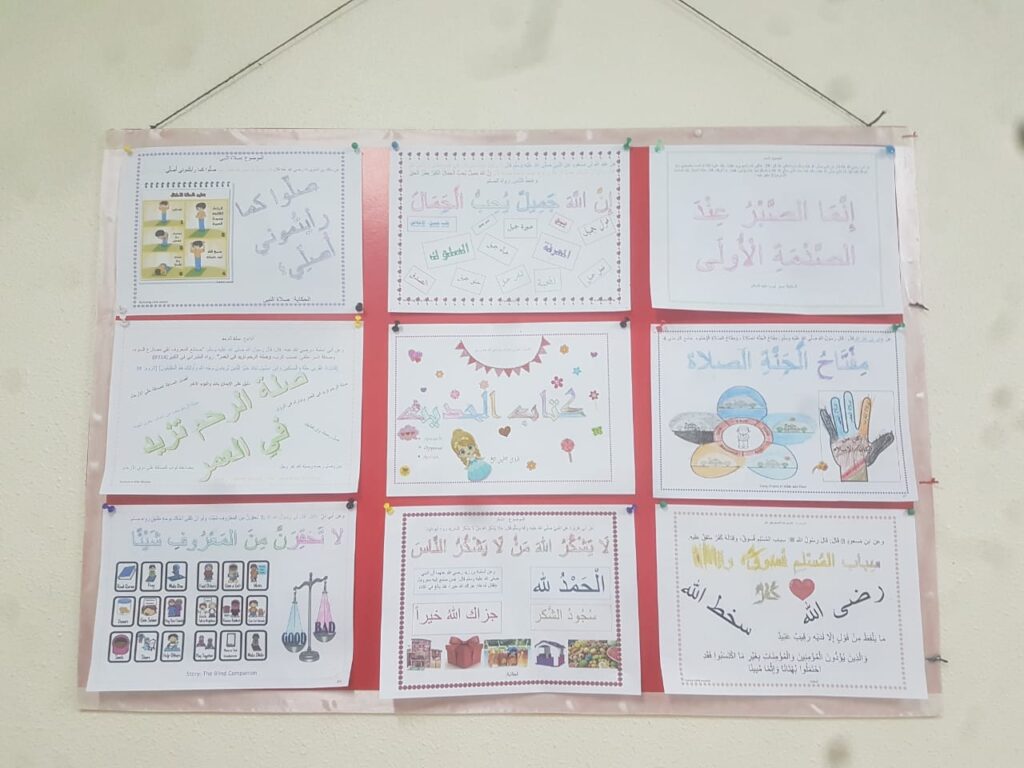
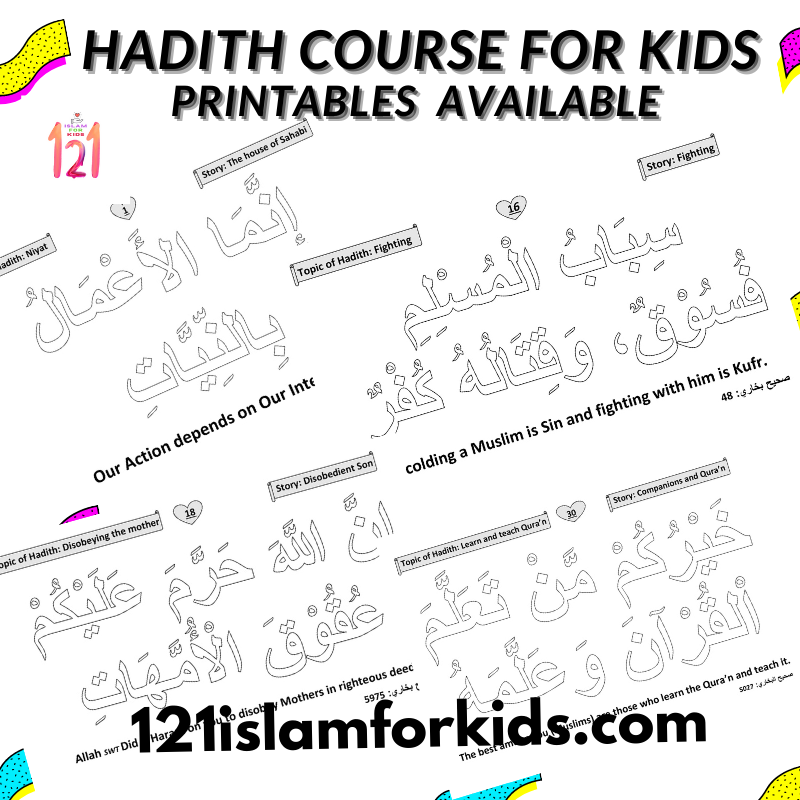
It’s a personality development course for children with interesting stories. 30 short hadiths would be taught with stories. We have worksheets to solve after learning hadiths for implications.
A short course to teach about taharat, Gusal, wudu, times of prayers, number and names of prayers, pillars, conditions of prayer, and method of prayer.
Islamic rules of dressing, Aurah/covering body rules, and modesty dressing will be included in this one-week course.
Ramzan Boost course:
1 month before Ramzan we started this course. Everything about fasting rules and supplication with the Ramzan checklist and daily to-do list is included in this course.
Faith boosts course in December to say NO MARYY CHRISTMAS:
Stories of faith by the Quran will be added in this course with basic articles of faith in this course.
Enrolments Available
All courses Are available to start as one on 1 classes. Please have a look at our group courses continued here.
Islamic Studies Online for Children in CA by 121 Islam for Kids: Nurturing Faith and Knowledge
Table of Contents
Introduction:
In today’s fast-paced world, it is crucial to provide children with a solid foundation in Islamic education. Recognizing this need, 121 Islam for Kids offers comprehensive and interactive online Islamic studies courses specifically designed for children in California / all over Canada. With a focus on nurturing faith and knowledge, these courses provide a unique opportunity for children to learn about Islam conveniently and engagingly.
Features of Islamic studies online :
Tailored Curriculum:
The online Islamic studies courses offered by 121 Islam for Kids are carefully curated to meet the specific needs of children in California/Canada. The curriculum covers a wide range of topics, including Quranic studies, Prophetic stories, Islamic manners and etiquette, and the lives of the companions. The courses are structured progressively, allowing children to build a strong foundation in their understanding of Islam.
Engaging and Interactive Learning:
121 Islam for Kids understands the importance of engaging children in their learning journey. The online courses employ interactive teaching methods such as storytelling, multimedia presentations, quizzes, and activities to capture the attention and interest of young learners. This ensures that children actively participate in their learning and retain knowledge effectively.
Qualified and Dedicated Instructors:
The courses are led by qualified and dedicated instructors who have expertise in teaching Islamic studies to children. These instructors have a deep understanding of Islamic principles and values and are skilled at delivering the content in an age-appropriate manner. They create a supportive and nurturing environment where children feel comfortable asking questions and actively engaging in discussions.
Flexibility and Convenience:
One of the key advantages of online Islamic studies courses is the flexibility and convenience they offer. Parents can easily enroll their children in the courses without the need for travel or fixed schedules. The courses are accessible from the comfort of home, allowing children to learn at their own pace and at a time that suits their schedule.
Fostering Faith and Character Development:
Beyond imparting knowledge, the courses offered by 121 Islam for Kids aim to foster faith and character development in children. Through lessons on Islamic values, ethics, and moral teachings, children are encouraged to develop strong faith, empathy, kindness, and good manners. The courses instill a sense of responsibility, community engagement, and respect for others, nurturing well-rounded individuals.
Conclusion:
In a multicultural society like California and Canada, providing children with a solid Islamic education is essential for their spiritual growth and identity formation. 121 Islam for Kids offers a valuable opportunity for children to learn about Islam in a convenient, engaging, and interactive online setting. With tailored courses, qualified instructors, and a focus on faith and character development, these courses empower children to build a strong connection with their faith and navigate their lives as confident and morally upright individuals.
Enrolling your child in the online Islamic studies courses by 121 Islam for Kids is a step towards nurturing their faith and knowledge, providing them with a strong foundation for a meaningful and fulfilling life.
Courses:
Quran classes:
We have online quran tajweed, recitation, and Quran Hifz classes for children. One-on-one classes with Qualified teachers.
Short and Easy to understand Quran translation and tafseer will be taught to the young learners. Infographics, mindmaps, work-by-word tajweed and meanings, stories, and duas are included in these classes.
It’s a personality development course for children with interesting stories. 30 short hadiths would be taught with stories. We have worksheets to solve after learning hadiths for implications.
A short course to teach about taharat, Gusal, wudu, times of prayers, number and names of prayers, pillars, conditions of prayer, and method of prayer.
Islamic rules of dressing, Aurah/covering body rules, and modesty dressing will be included in this one-week course.
Ramzan Boost course:
1 month before Ramzan we start this course. Everything about fasting rules and supplication with the Ramzan checklist and daily to-do list is included in this course.
Faith boosts course in December to say NO MARYY CHRISTMAS:
Stories of faith by the Quran will be added in this course with basic articles of faith in this course.
Enrolments Available
All courses Are available to start as in one on one classes. Please have a look at our group courses continued here.
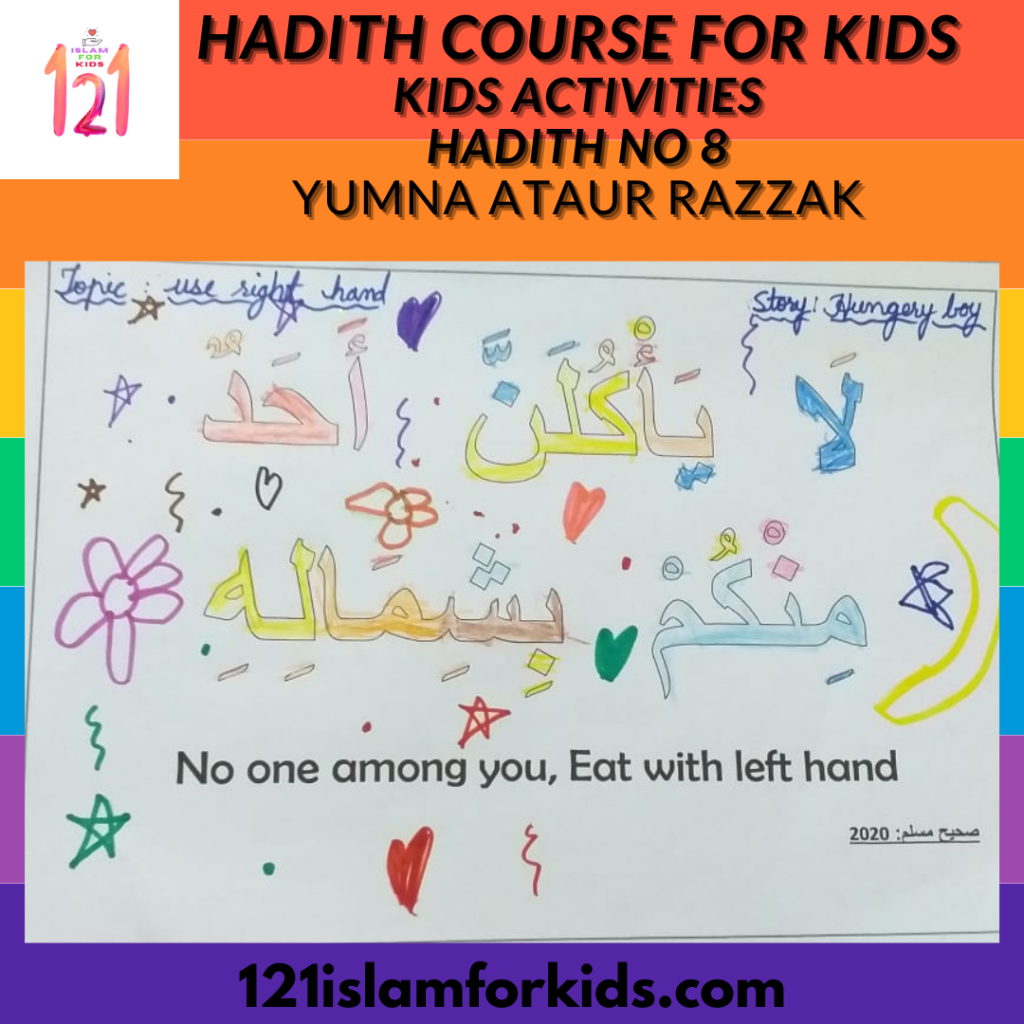
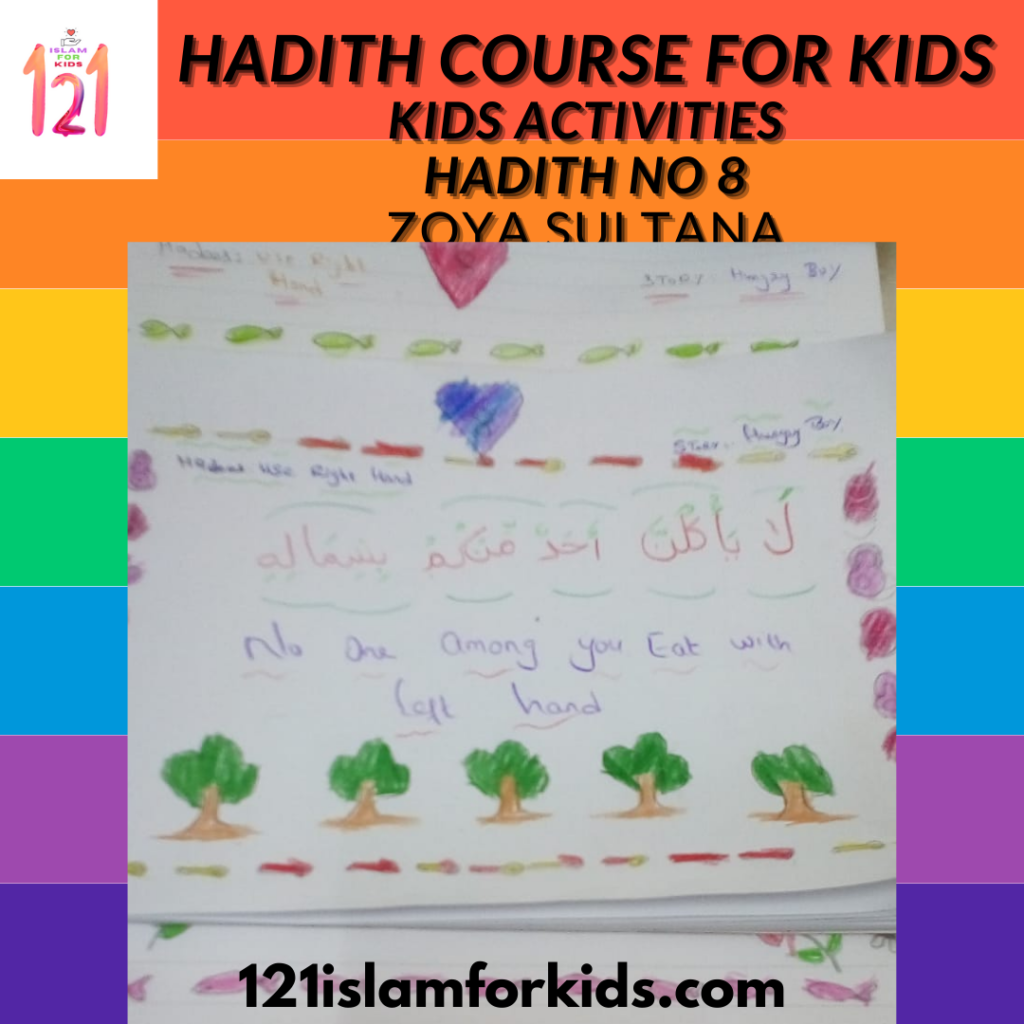
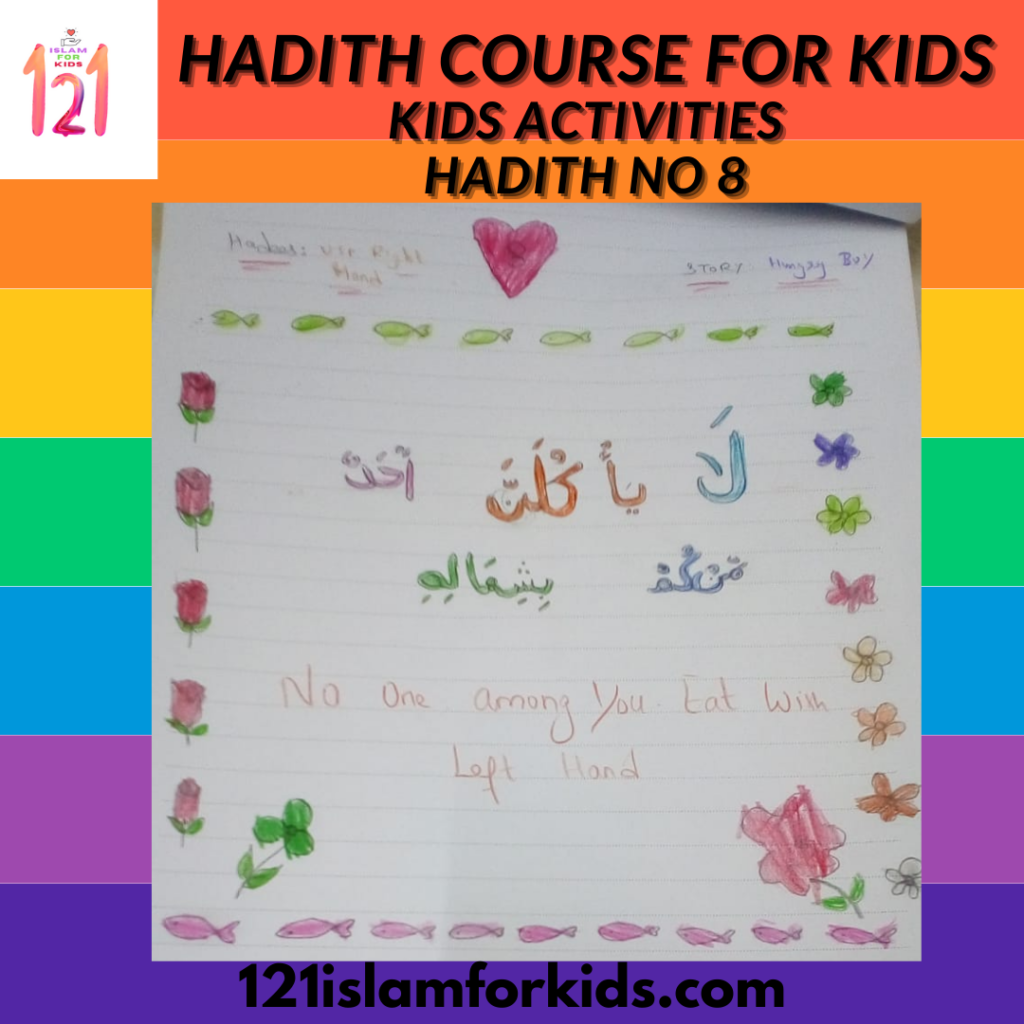
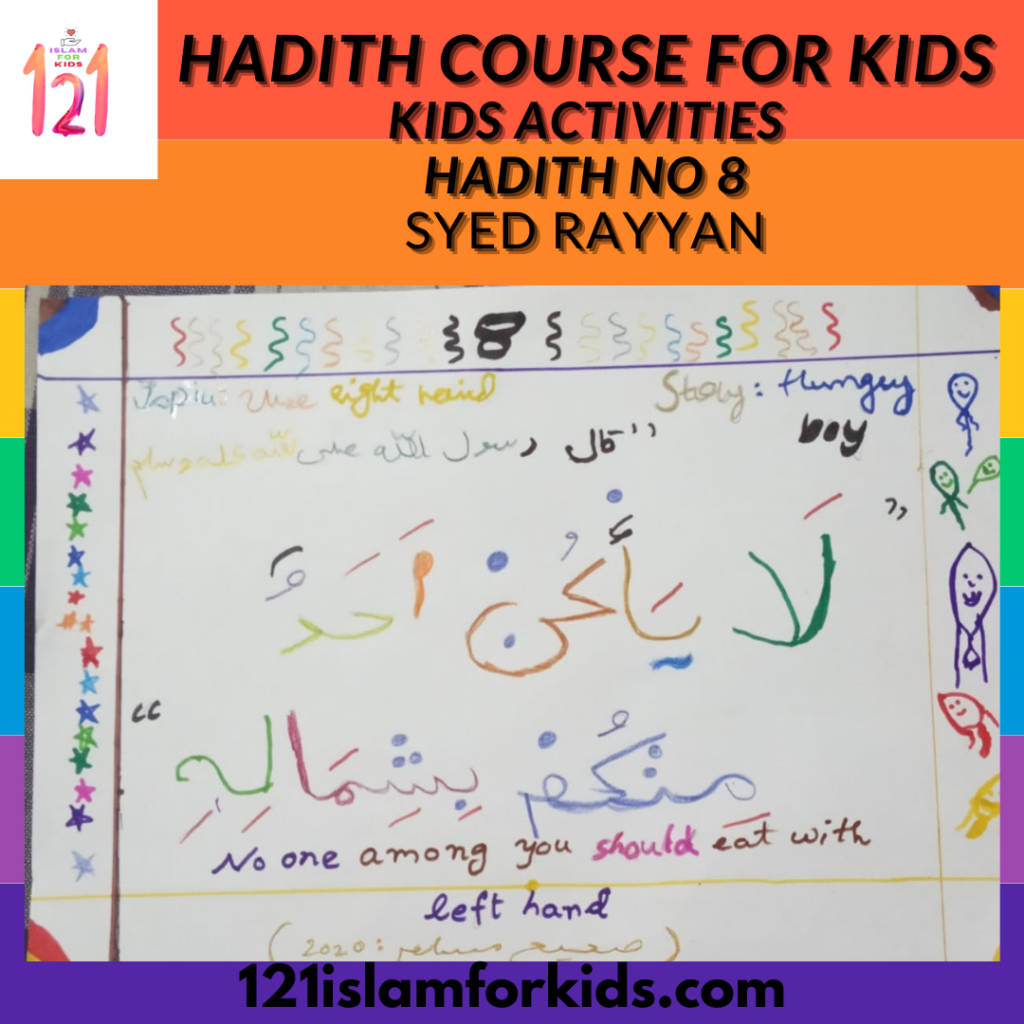
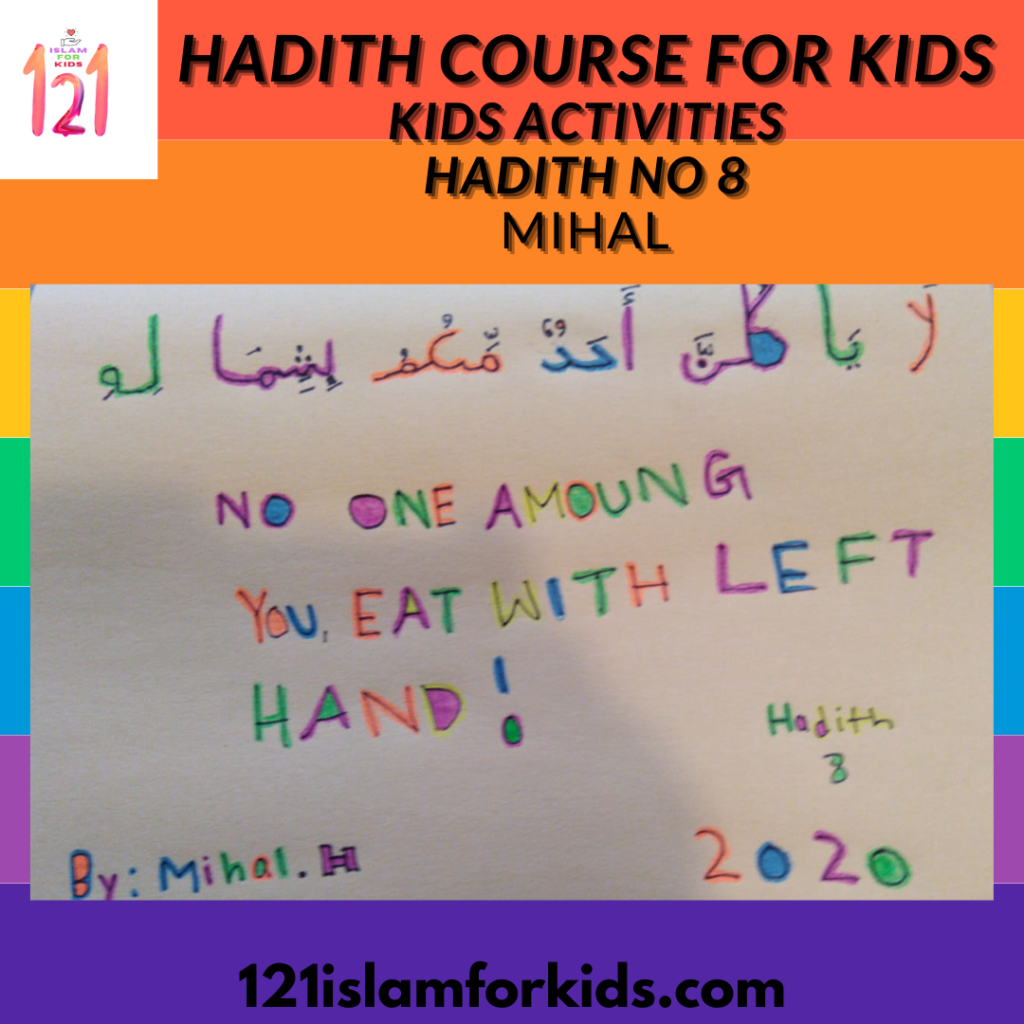
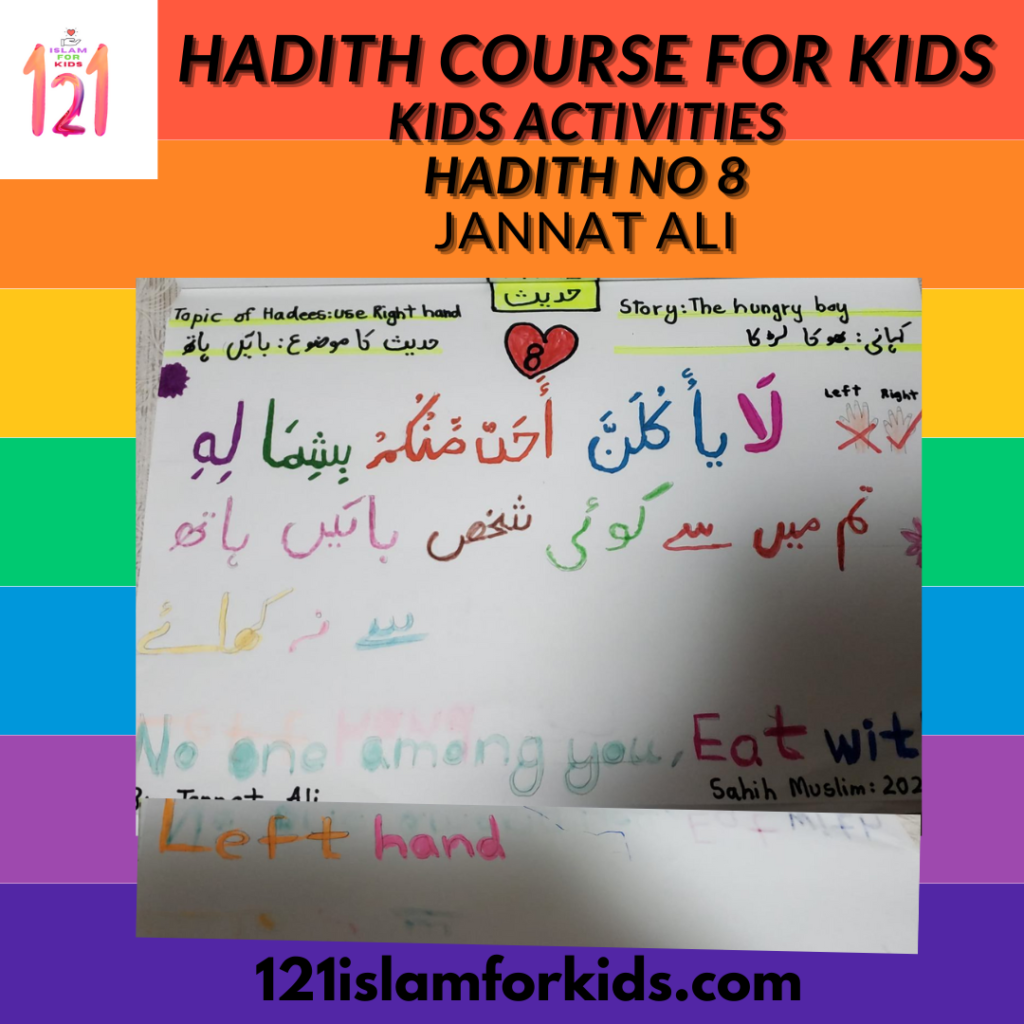
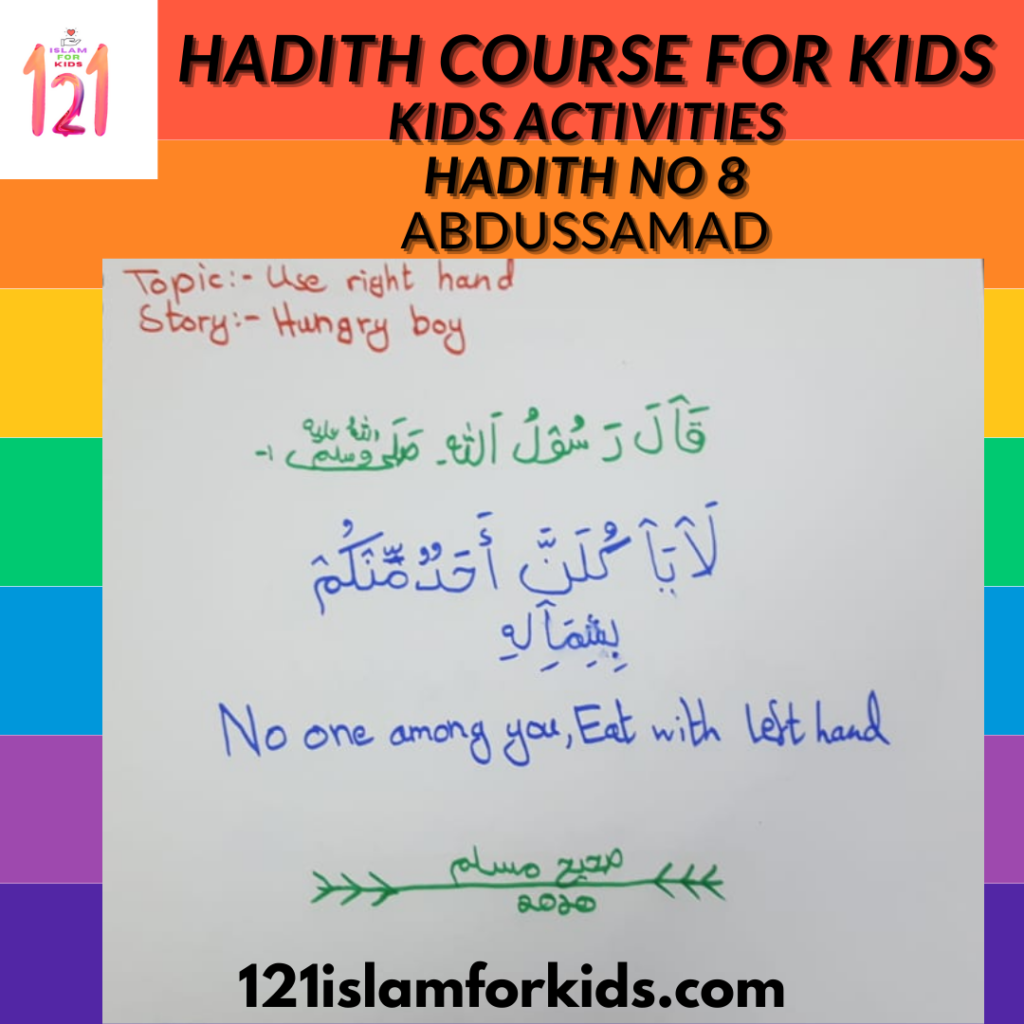
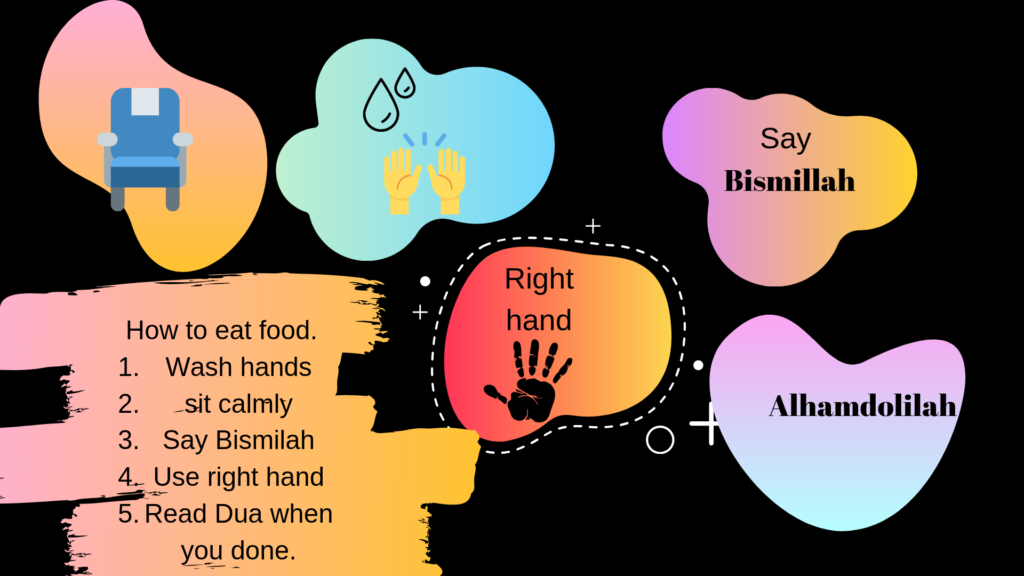
Welcome to our special lesson today! We are excited to share with you one of the most important hadiths about eating manners in Islam. This hadith teaches us how to eat with respect, gratitude, and good behavior – something that touches every part of our daily lives as Muslim children and adults.
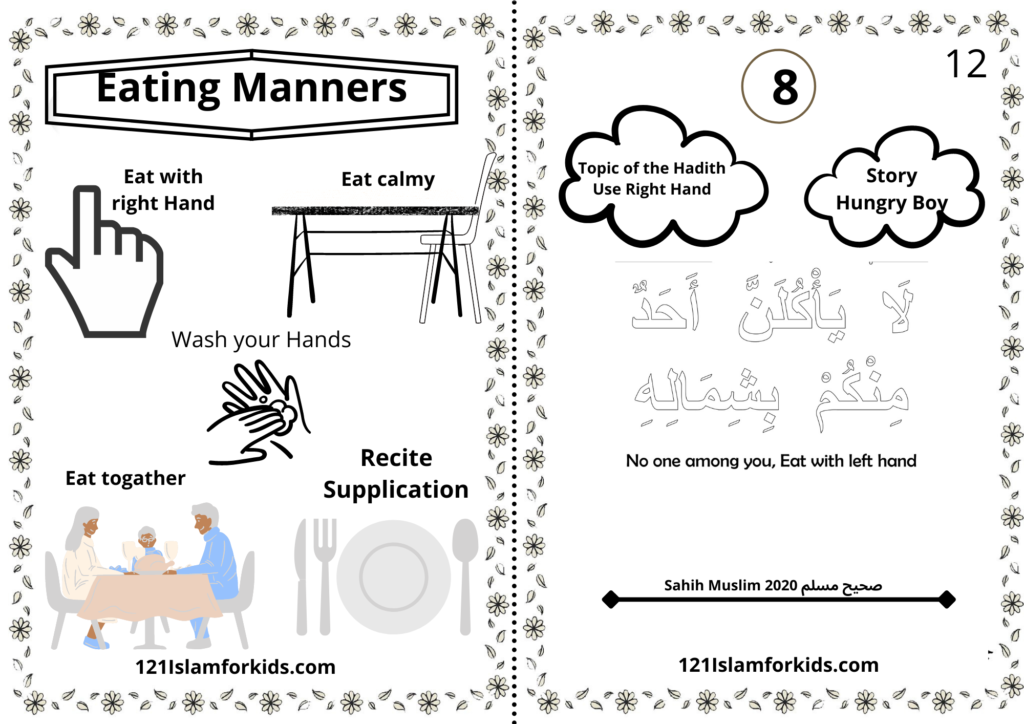
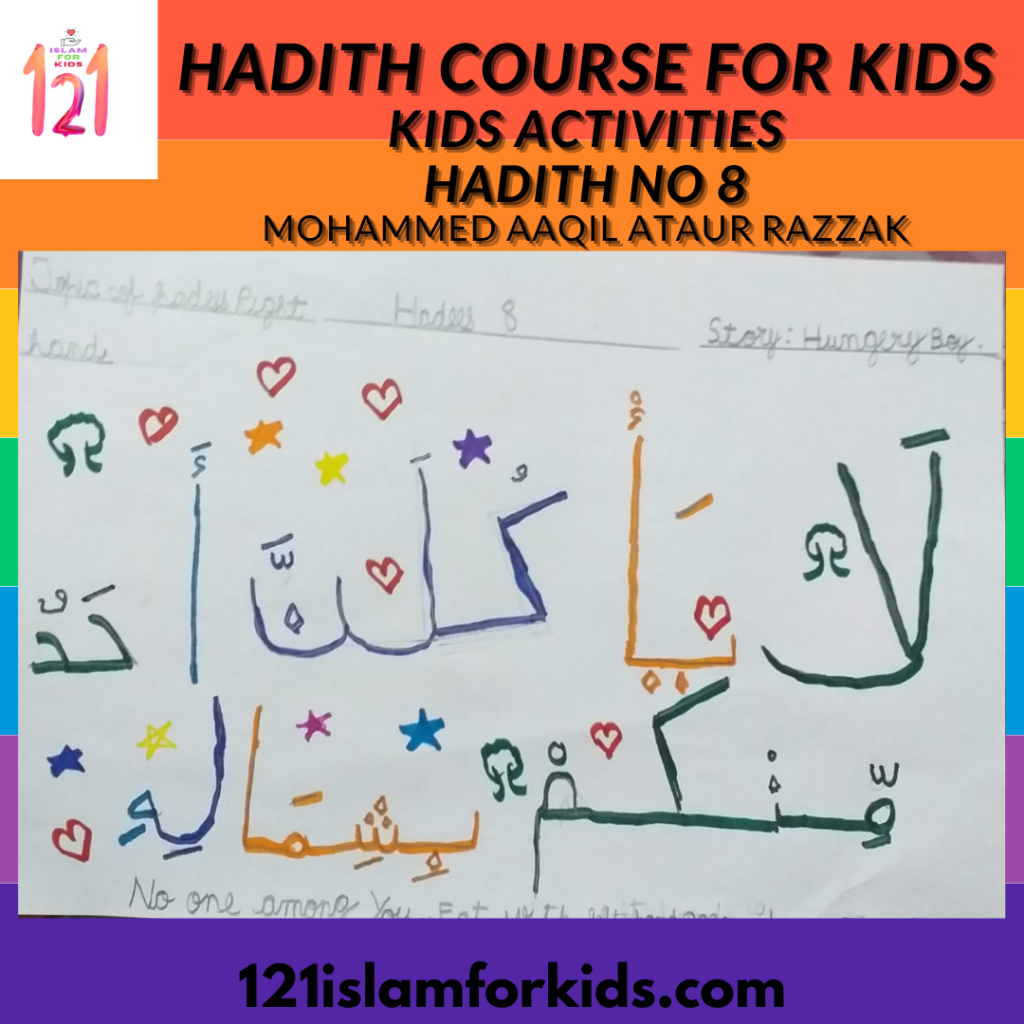
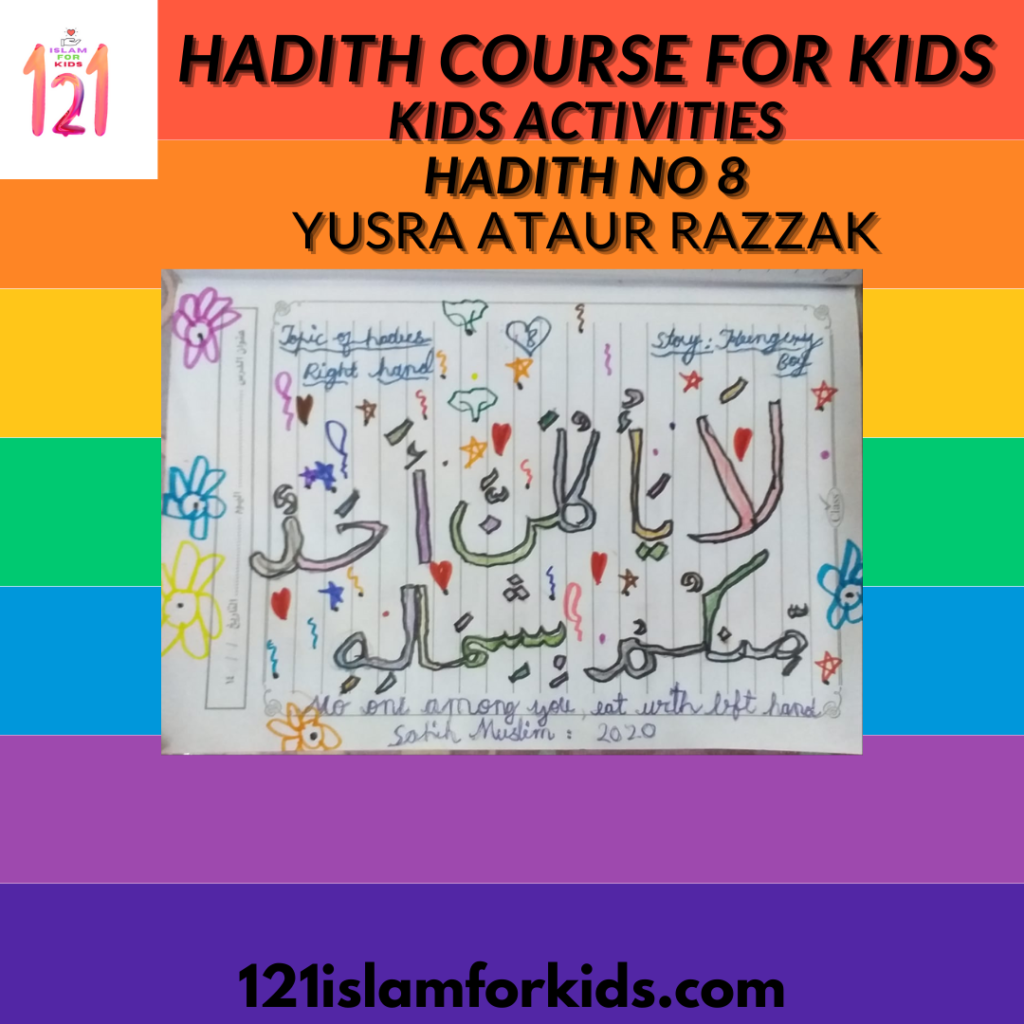
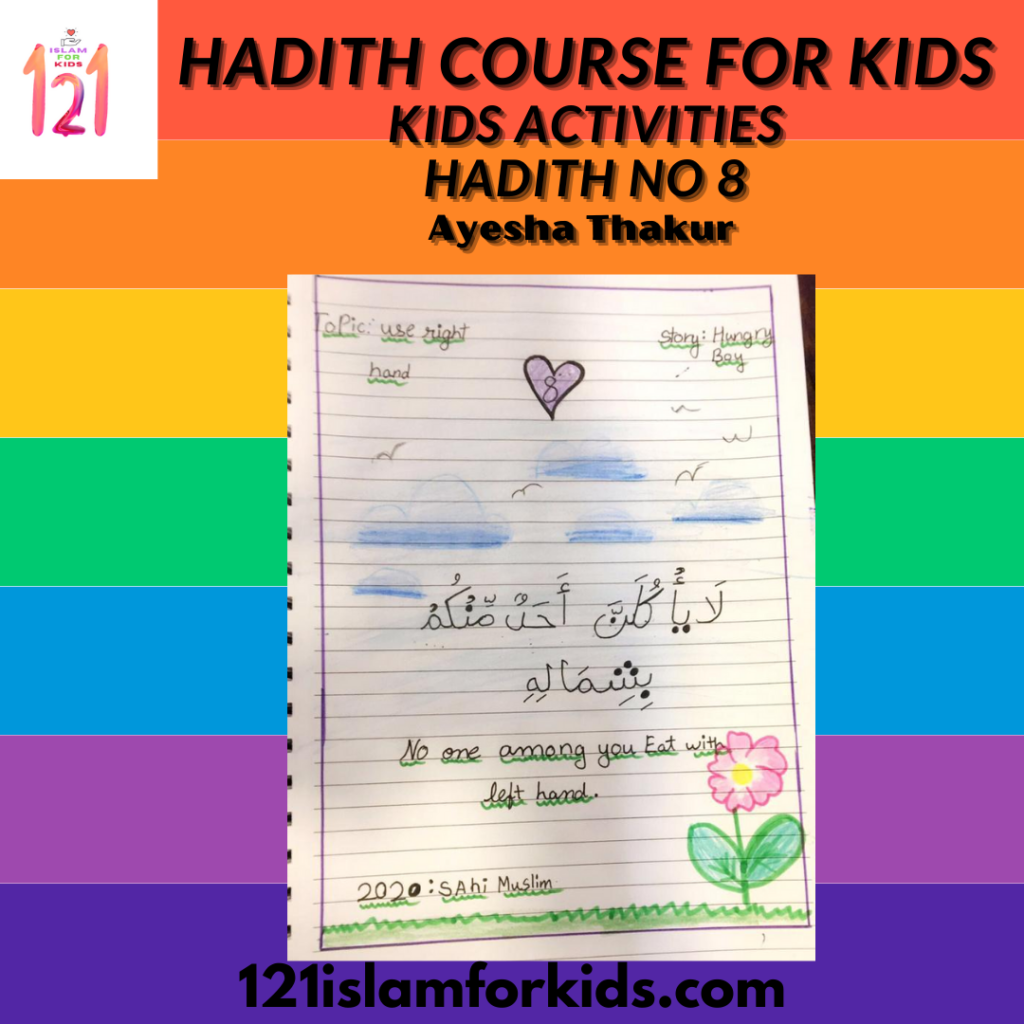
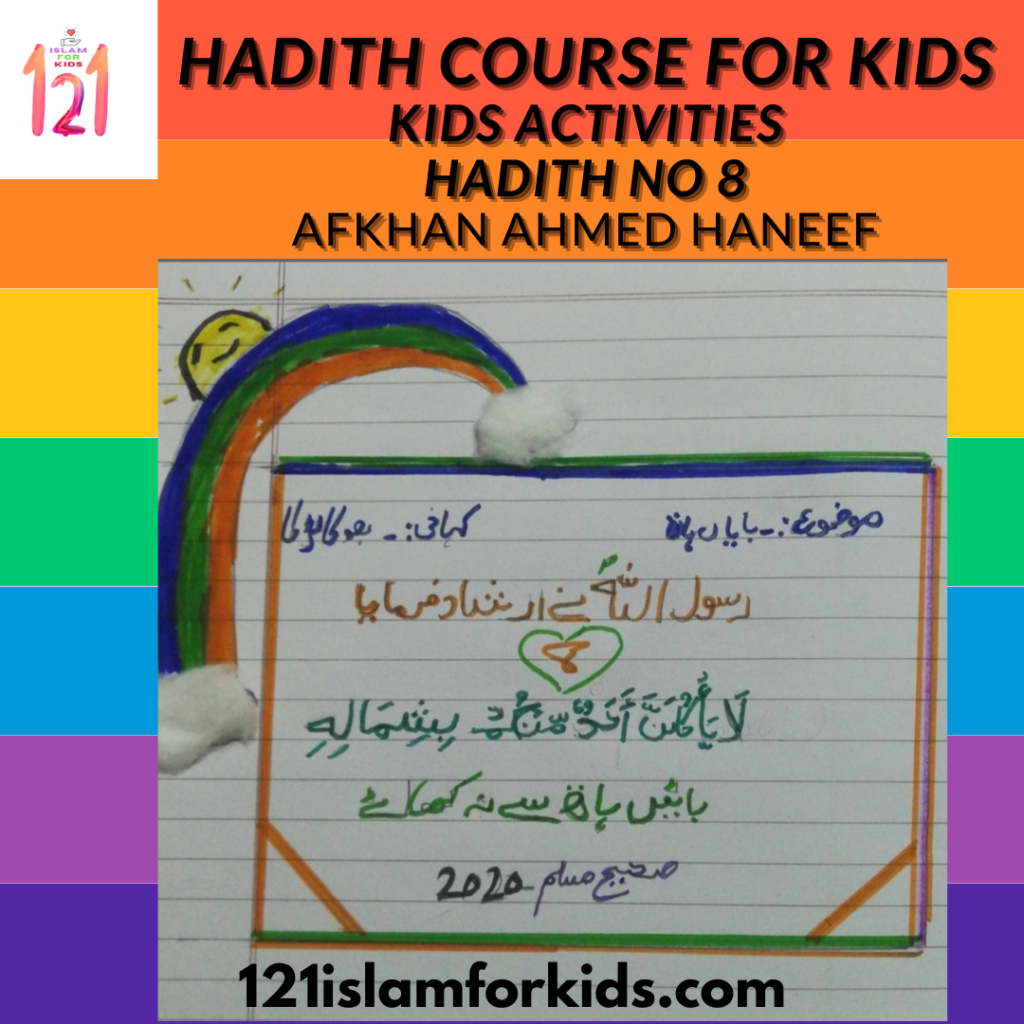
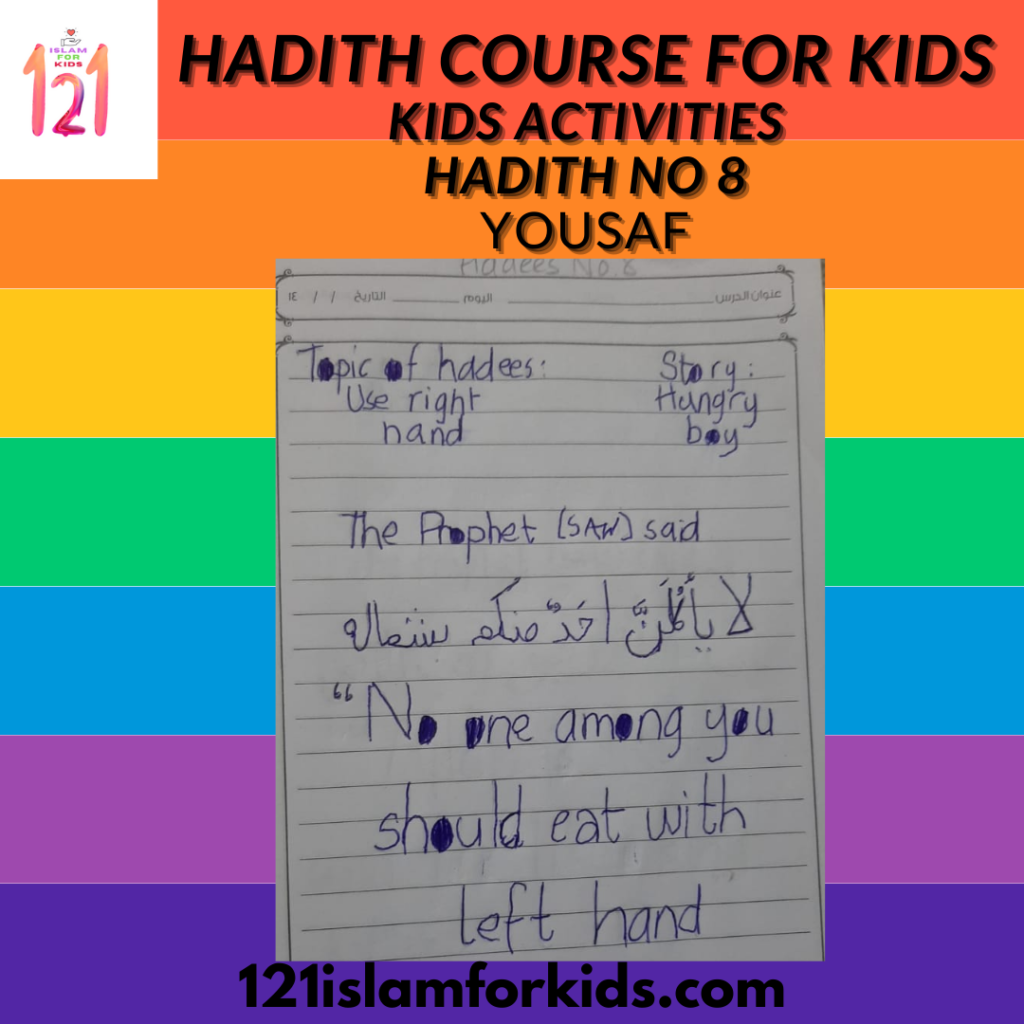
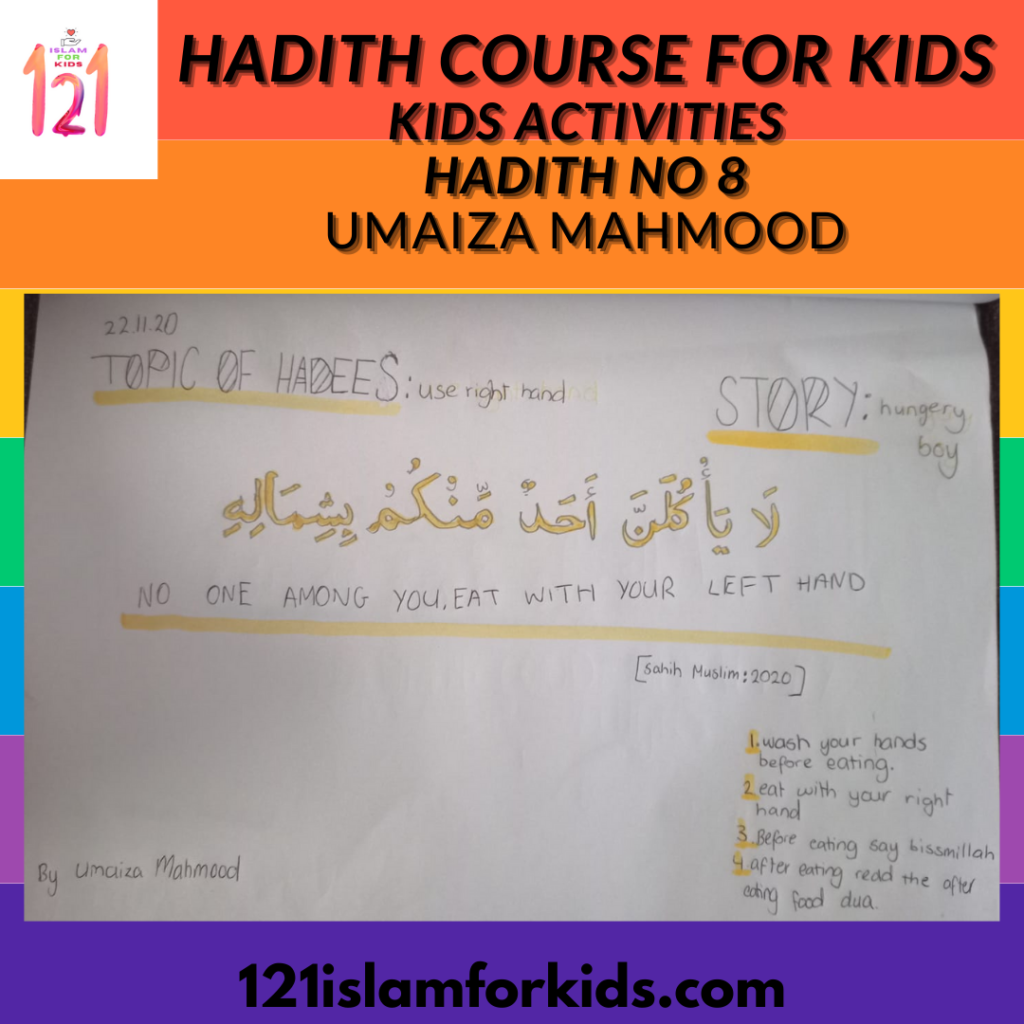
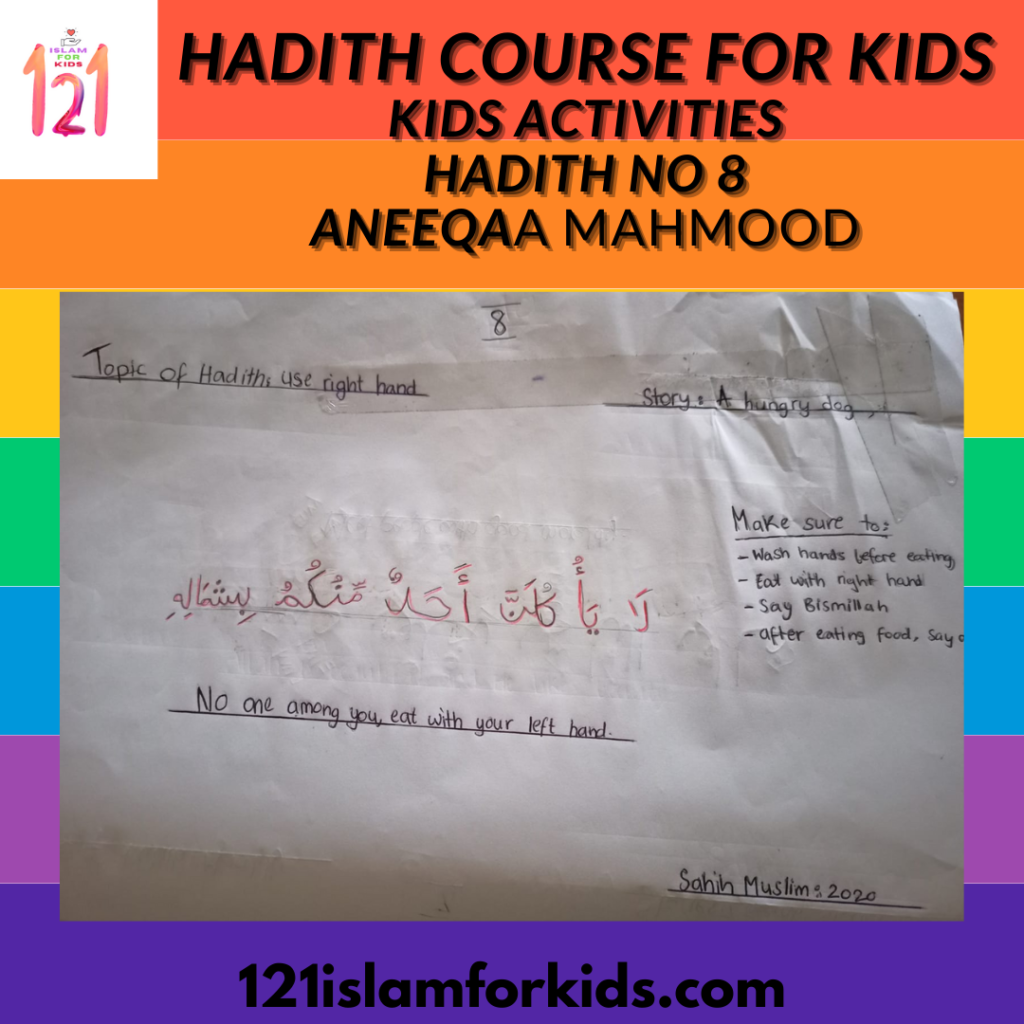
Another Hadith is.. The Prophet Muhammad (Peace be upon him) said: “Eat with your right hand and drink with your right hand, for the Shaitan eats with his left hand and drinks with his left hand.”
This beautiful hadith teaches us several important lessons about Islamic etiquette and our relationship with Allah. The right hand in Islamic tradition is considered the hand of honor, purity, and respect. When the Prophet Muhammad (PBUH) instructs us to eat with our right hand, he is not just giving us a physical instruction – he is teaching us about Islamic values, respect for ourselves, and maintaining cleanliness.
THE IMPORTANCE OF THE RIGHT HAND IN ISLAM:
Purity and Cleanliness: In Islamic tradition, the left hand is specifically designated for personal hygiene and cleaning. The right hand is reserved for eating, greeting, giving and receiving gifts, and other noble acts. This separation helps maintain cleanliness and respect.
Obedience to the Prophet: Following the Sunnah (the teachings and practices of Prophet Muhammad PBUH) is a fundamental part of being a Muslim. When we eat with our right hand, we are directly following his example.
Avoiding Evil Influence: The mention of Shaitan (Satan) eating with the left hand reminds us that we should distance ourselves from evil and base our actions on goodness and purity.
Respect and Dignity: Using the right hand for eating shows respect for the food, respect for ourselves, and acknowledgment of Allah’s blessings upon us.
OTHER EATING MANNERS IN ISLAM:
Beyond using the right hand, Islam teaches us many other important eating manners:
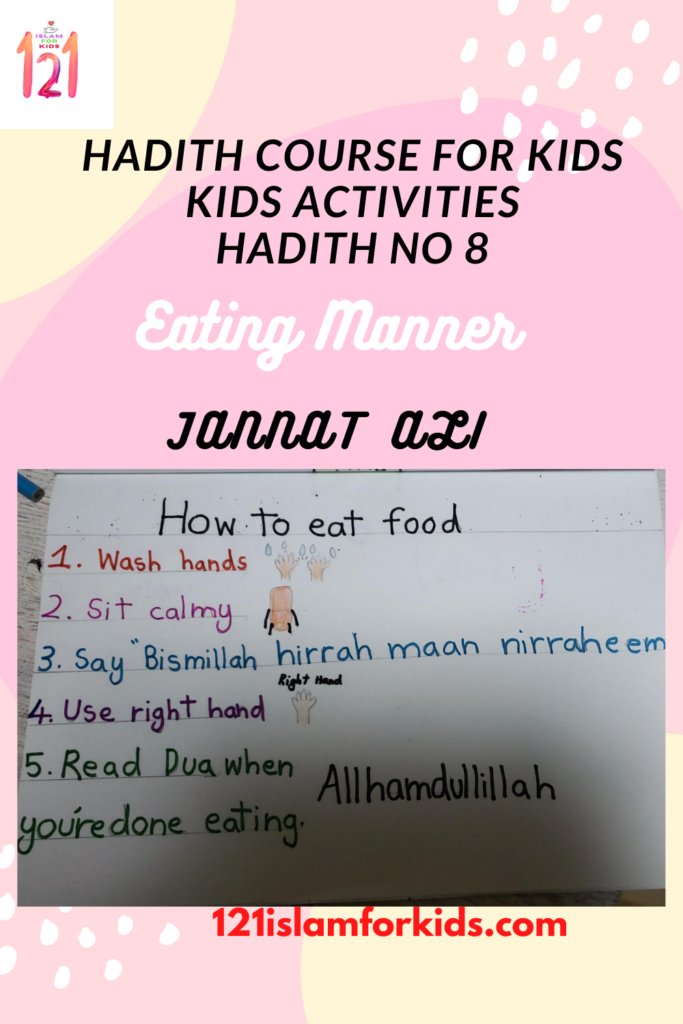
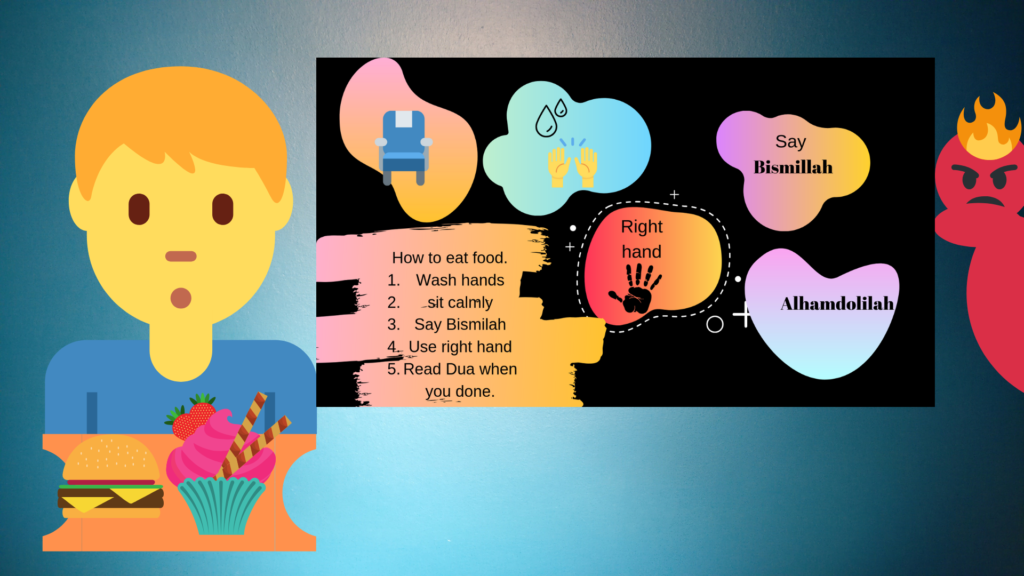
✓ Say Bismillah Before Eating: Always say “Bismillah” (In the name of Allah) before beginning to eat. This is a form of gratitude and remembrance of Allah.
✓ Wash Your Hands Before Eating: Cleanliness is part of Islamic faith. Always wash your hands thoroughly before eating.
✓ Sit While Eating: Eating while sitting is more dignified and helps with proper digestion. Standing and eating hastily is discouraged.
✓ Eat with Others: The Prophet (PBUH) enjoyed eating with family and friends. Sharing meals brings people together.
✓ Don’t Waste Food: Islam strongly discourages wasting food. We should take only what we can eat and be grateful for every bite.
✓ Don’t Talk While Chewing: Keep your mouth closed while chewing to maintain cleanliness and respect.
✓ Eat Moderately: The Prophet (PBUH) taught us not to overeat. We should eat until we are satisfied, not until we are completely full.
✓ Say Alhamdulillah After Eating: After finishing your meal, always say “Alhamdulillah” (All praise is due to Allah) to express gratitude.
✓ Use Your Right Hand to Give and Receive: When giving or receiving something from others, use your right hand as a sign of respect.
Setting: A Muslim household where good manners are valued
Main Character: Ali, a 9-year-old boy who is generally well-behaved and obedient
The Problem: Ali had fallen into a bad habit of using his left hand for eating, despite his parents’ constant reminders. His parents had noticed that when he ate with his left hand, other negative behaviors would follow – he would eat hastily, forget to say Bismillah, not sit properly, and often waste food. It was as if this one bad habit was opening the door to many other impolite behaviors.
The Struggle: The more Ali continued with this habit, the worse things became. He started experiencing:
Constant hunger, never feeling satisfied even after eating large amounts
Losing concentration in his studies because he was always thinking about food
Becoming irritable and upset with his family
Forgetting all the beautiful manners his parents had taught him
His stomach would hurt, and he wasn’t feeling well
His parents realized something had to change. They recognized that this wasn’t just about eating – it was about building character and following the teachings of Islam.
The Solution: Ali’s parents took him to visit a respected Islamic teacher and counselor. The teacher sat with Ali and explained to him:
“Dear Ali, do you know that our beloved Prophet Muhammad (PBUH) taught us to eat with our right hand? This isn’t just a rule – it’s a way of showing respect to yourself, to your food, and to Allah. When we follow this teaching, we invite blessings (barakah) into our lives. When we ignore it, we invite confusion and frustration.”
The teacher then taught Ali the complete way to eat according to Islamic manners:
Always say “Bismillah” before eating
Sit down while eating
Eat with your right hand
Eat slowly and mindfully
Chew your food properly
Don’t waste any food
Say “Alhamdulillah” after finishing
The Transformation: As Ali began to practice these manners consistently:
He started feeling satisfied and content after meals
His concentration improved in school
He felt calmer and more respectful
His family relationships became more peaceful
His health improved, and his stomach problems disappeared
He noticed how much happier everyone was around him when he practiced good manners
The Lesson: Ali realized that the Shaitan (negative influences and bad habits) had been making him miserable through that one bad habit. But now that he was following the Prophet’s (PBUH) teachings, he felt at peace, healthy, and happy. He understood that good manners are not restrictions – they are gifts from Allah that help us live better lives.
Moral of the Story: Good Islamic manners, especially eating manners, are blessings from Allah. When we follow them, we experience blessings in our health, our relationships, and our hearts. When we ignore them, we invite problems. Ali learned that being obedient to Islamic teachings brings joy and satisfaction in all areas of life.
After learning about this hadith and the story of Ali, let’s think about these important questions:
Why did the Prophet Muhammad (PBUH) teach us to eat with the right hand? Answer: To maintain cleanliness, purity, and respect. The right hand is for noble actions, and the left hand is for personal hygiene.
What happened to Ali when he didn’t follow the Prophet’s teachings? Answer: He felt hungry all the time, couldn’t concentrate, had stomach problems, and forgot other good manners.
How did Ali’s life change when he started eating with the right hand and following proper eating manners? Answer: He felt satisfied, healthier, calmer, and his relationships with family improved.
Can you think of other ways we use our right hand in Islam? Answers: Giving and receiving gifts, greeting others with handshakes, writing, eating, drinking, etc.
What does it mean when we say the Shaitan eats with his left hand? Answer: It means that following bad habits and ignoring Islamic teachings is like inviting Shaitan into our lives. But when we follow the Sunnah, we keep ourselves pure and away from evil influences.
What other eating manners did you learn from the story? Answers: Saying Bismillah before eating, sitting while eating, not wasting food, saying Alhamdulillah after eating, eating slowly, etc.
How can you practice these manners starting today? Answer: Each student should think about how they will apply at least one eating manner in their next meal.
Teaching eating manners is one of the most important aspects of raising well-mannered Muslim children. Here are some practical tips to help you teach and reinforce these behaviors at home:
1. Model the Behavior Yourself Children learn best by observing. Always eat with your right hand, say Bismillah and Alhamdulillah, sit while eating, and practice all the manners you want your child to learn. When children see you doing these things consistently, they naturally want to imitate you.
2. Make It Practical and Gradual Don’t expect perfection immediately. Start with one or two habits – perhaps saying Bismillah before eating and using the right hand. Once these become automatic, add more manners gradually.
3. Explain the “Why” Behind the Rules Children are more likely to follow rules when they understand the purpose. Explain that:
Bismillah reminds us that food is a blessing from Allah
Using the right hand shows respect and maintains cleanliness
Sitting while eating is more dignified and helps digestion
Not wasting food respects Allah’s blessings
4. Praise and Encourage When you notice your child practicing good eating manners, praise them specifically: “Masha’Allah! I saw you say Bismillah before your meal today. That shows you remember Allah’s blessings.” Positive reinforcement is much more effective than criticism.
5. Create a Family Mealtime Culture Make mealtimes special by:
Eating together as a family when possible
Having meaningful conversations
Creating a calm, respectful atmosphere
Avoiding screens and distractions during meals
6. Be Patient with Younger Children Very young children (3-5 years old) may need more reminders and gentle guidance. Use simple language and be consistent. Don’t show frustration – patience is key.
7. Use Reminders Without Shaming Instead of: “You’re eating like Shaitan,” try: “Remember, the Sunnah of the Prophet (PBUH) is to eat with our right hand. Let’s use our right hand, okay?”
8. Incorporate Islamic Stories Share stories like “The Hungry Boy” regularly. Children remember lessons better when they’re attached to stories and characters they can relate to.
9. Let Them Help in Food Preparation When children help prepare meals, they develop a better appreciation for food. This naturally leads to them wanting to eat mindfully and not waste.
10. Connect to the Quran and Sunnah Help your child understand that eating manners are not just “mom’s rules” or “dad’s rules” – they are teachings from our beloved Prophet (PBUH) and part of Islamic culture for centuries.
11. Address Challenges Kindly If your child is struggling with a particular manner (like using the right hand if they are naturally left-handed), work with them patiently. Some children may need occupational therapy, and that’s okay. The goal is to gradually improve behavior, not create stress or shame.
12. Celebrate the Progress When your child has been consistently practicing good eating manners for a week or month, celebrate that achievement. You might say, “Alhamdulillah, I’ve noticed how well you’ve been eating! I’m so proud of your good manners.”
One important concept to teach children is Barakah – which means blessing, abundance, and increase of goodness from Allah.
When we follow the teachings of the Prophet Muhammad (PBUH), especially something as simple as eating manners, we invite Barakah into our lives. This means:
✓ The food satisfies us more even if we eat less ✓ We feel healthier and stronger ✓ Our minds are clearer and we can focus better ✓ Our family relationships improve ✓ We feel Allah’s presence and blessings in our daily activities ✓ We develop good character and self-discipline
Conversely, when we ignore these teachings, we lose the Barakah. We feel:
Constantly hungry and unsatisfied
Restless and confused
Weak and unhealthy
Disconnected from our Islamic identity
Frustrated and unhappy
This is a powerful lesson for children: Following Islam isn’t restrictive – it’s the key to happiness and blessings in life.
This Hadith course consists of hadith with storytelling via a zoom live session with kids with activities, memorization revision, and assessment. The course is also available on WhatsApp. If you want to learn About this course read this. Hadith Introduction and tips to Teach 30 short Hadith with Stories.
بچوں کی حدیث کی تصویر گروپ میں نام کے ساتھ پوسٹ کریں. تا کہ اس سیشن کے آخر میں وہ سرٹیفکیٹ حاصل کر سکیں
Written Story in Urdu.اگر بچوں کی احادیث سناتے ہوۓ ویڈیو بجھنا چاہیں تو وہ بھی بیجھ سکتے ہیں.شکریہ
Some manners activities book and cards are presented down. They are made for Muslim kids and very helpful Have a look at them. Jazak Allah.
May Allah make it easy for all of us. Ameen. Books recommended by me.
Enrolments Available
This is a short course of hadith and stories from My 30 short hadith with stories course. My hadith course is very much liked and appreciated by parents and students. Online group classes are available online for all time zones. Recommended age for the class Hadith for kids is 7+. These classes are available in English and Urdu. If you want to enroll your child in our classes contact us via.
Other courses we have
Easy Tafseer for kids with exciting stories you can see that course in my hadith course tab.
Prayer for kids course is a short course to teach about taharat, Gusal, wudu, times of prayers, number and names of prayers, pillars and conditions, and prayer methods. Search as Prayer for kids course on the search bar.