Tag: parenting

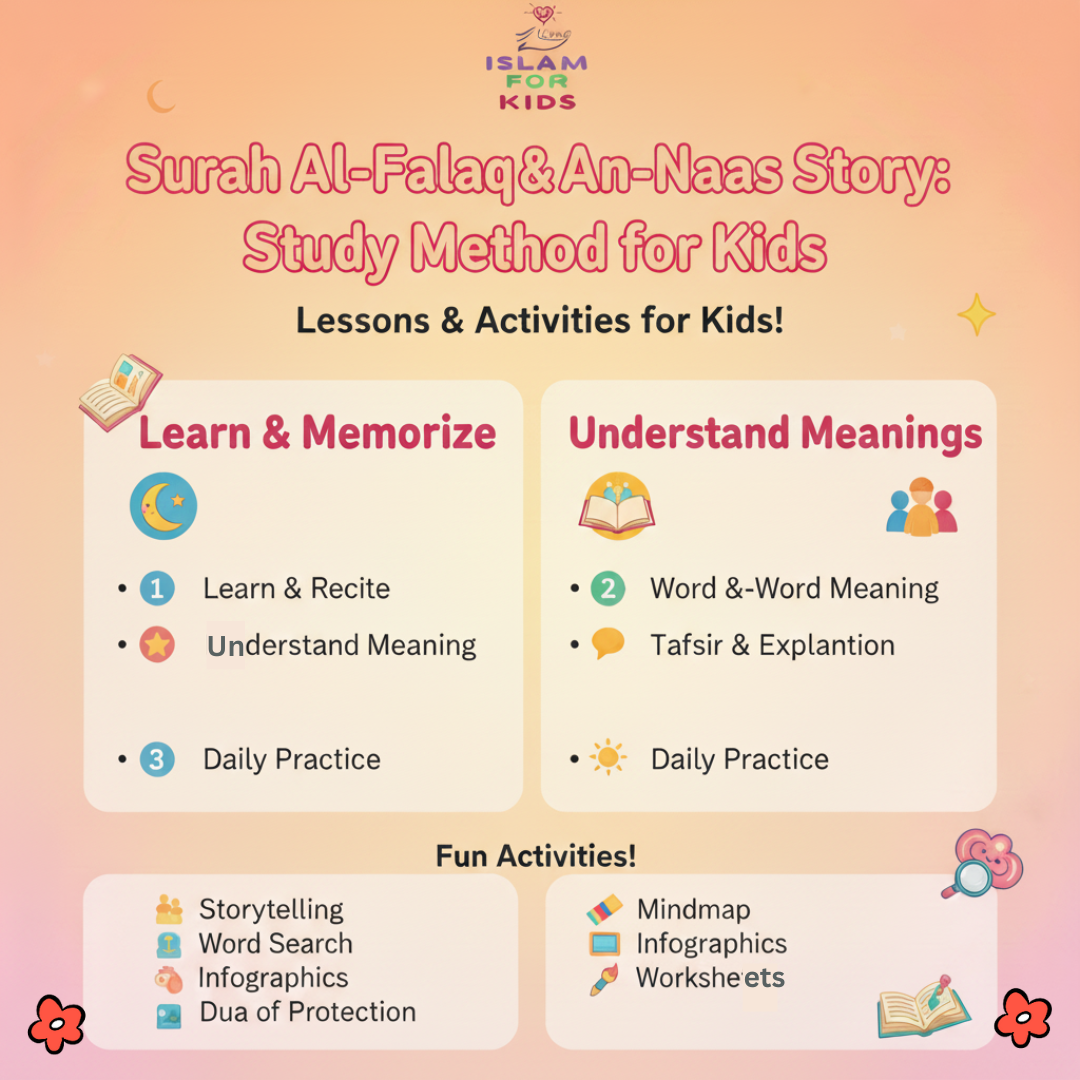
  • Surah Al-Falaq – An-Naas Study Method: Understanding the Chapter of Dawn (سورة الفلق)Surah Al-Falaq (سورة الفلق)

    Surah Al-Falaq – An-Naas Study Method: Understanding the Chapter of Dawn (سورة الفلق)Surah Al-Falaq (سورة الفلق)

    Surah Al-Falaq An-Naas study method provides comprehensive learning techniques for these two protective chapters of the Quran. This interactive guide includes detailed verse-by-verse explanations, word meanings, translations, and educational activities for understanding Surah Al-Falaq and Surah An-Naas.Surah.
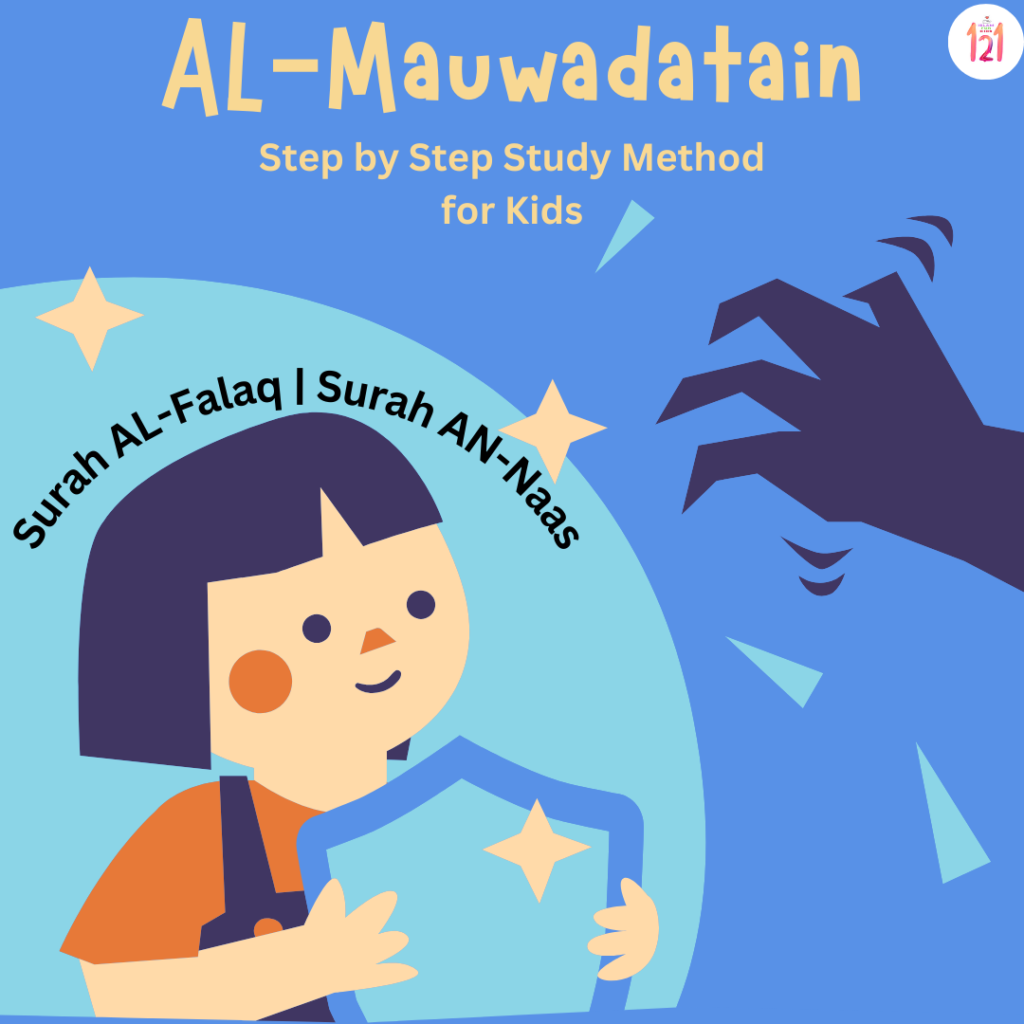
    Surah Al-Falaq An-Naas study method comprehensive guide with interactive learning techniques for children


    Surah Surah Al-Falaq An-Naas Study Method: Understanding the Chapter of Dawn (سورة الفلق)Surah Al-Falaq (سورة الفلق)

    These Surah Al-Falaq An-Naas teachings guide us to seek Allah’s protection from all types of evil.This Surah teaches us to seek Allah’s protection from all types of evil.

    Verse 1:

    Arabic:
    قُلْ أَعُوذُ بِرَبِّ الْفَلَقِ

    English Translation:
    “Say: I seek refuge in the Lord of the dawn.”

    Word Meanings:

    • قُلْ (Qul) – Say
    • أَعُوذُ (A’udhu) – I seek refuge
    • بِرَبِّ (bi-Rabbi) – In the Lord
    • الْفَلَقِ (al-Falaq) – The dawn or the daybreak

    Explanation:
    In this verse, we are told to seek protection from Allah, the One who causes the dawn to break through the darkness. The “dawn” symbolizes light, hope, and the power to overcome darkness and evil.


    Verse 2:

    Arabic:
    مِن شَرِّ مَا خَلَقَ

    English Translation:
    “From the evil of what He has created.”

    Word Meanings:

    • مِن شَرِّ (min sharri) – From the evil
    • مَا (ma) – What
    • خَلَقَ (khalaqa) – He has created

    Explanation:
    This verse asks for protection from any harmful or evil things in Allah’s creation. While Allah’s creation is good, some things or beings may cause harm, so we ask Allah to protect us from any possible danger.


    Verse 3:

    Arabic:
    وَمِن شَرِّ غَاسِقٍ إِذَا وَقَبَ

    English Translation:
    “And from the evil of the night when it grows dark.”

    Word Meanings:

    • غَاسِقٍ (ghasiqin) – Darkness
    • إِذَا (idha) – When
    • وَقَبَ (waqab) – It settles

    Explanation:
    This verse seeks protection from the dangers of the night, when darkness falls, and we cannot see clearly. The night can bring fear and unknown dangers, but Allah can protect us.


    Verse 4:

    Arabic:
    وَمِن شَرِّ النَّفَّاثَاتِ فِي الْعُقَدِ

    English Translation:
    “And from the evil of those who blow on knots.”

    Word Meanings:

    • النَّفَّاثَاتِ (an-naffathat) – Those who blow
    • فِي الْعُقَدِ (fi-l-‘uqad) – On knots

    Explanation:
    This verse refers to the evil of those who practice magic or sorcery by tying knots and blowing on them. It’s a form of evil behavior that people may use to harm others. We seek Allah’s protection from such harmful acts.


    Verse 5:

    Arabic:
    وَمِن شَرِّ حَاسِدٍ إِذَا حَسَدَ

    English Translation:
    “And from the evil of the envious one when he envies.”

    Word Meanings:

    • حَاسِدٍ (hasid) – The envious one
    • حَسَدَ (hasada) – He envies

    Explanation:
    This verse seeks protection from those who feel jealous and wish harm upon others. When someone envies another person, they might desire bad things to happen to them. We ask Allah to protect us from such jealousy.


    Surah An-Naas (سورة الناس)

    This Surah teaches us to seek protection from the evil whispers of Shaytan (Satan) and all harmful influences.

    Verse 1:

    Arabic:
    قُلْ أَعُوذُ بِرَبِّ النَّاسِ

    English Translation:
    “Say: I seek refuge in the Lord of mankind.”

    Word Meanings:

    • قُلْ (Qul) – Say
    • أَعُوذُ (A’udhu) – I seek refuge
    • بِرَبِّ (bi-Rabbi) – In the Lord
    • النَّاسِ (an-Naas) – Of mankind

    Explanation:
    In this verse, we are instructed to seek refuge in Allah, the Lord of all people. This reminds us that Allah is the Creator and Protector of every human being.


    Verse 2:

    Arabic:
    مَلِكِ النَّاسِ

    English Translation:
    “The King of mankind.”

    Word Meanings:

    • مَلِكِ (Malik) – King
    • النَّاسِ (an-Naas) – Of mankind

    Explanation:
    Here, we acknowledge that Allah is the King of all people. He is in charge of everything, and no one has power or authority over Him. He alone controls and protects us.


    Verse 3:

    Arabic:
    إِلَٰهِ النَّاسِ

    English Translation:
    “The God of mankind.”

    Word Meanings:

    • إِلَٰهِ (Ilah) – God
    • النَّاسِ (an-Naas) – Of mankind

    Explanation:
    This verse reminds us that Allah is the only God of all humans. He is the One we worship and rely on. By stating that Allah is our God, we confirm our belief in His power to protect us from harm.


    Verse 4:

    Arabic:
    مِن شَرِّ الْوَسْوَاسِ الْخَنَّاسِ

    English Translation:
    “From the evil of the whisperer who withdraws.”

    Word Meanings:

    • شَرِّ (sharri) – Evil
    • الْوَسْوَاسِ (waswas) – Whisperer
    • الْخَنَّاسِ (khannas) – Who withdraws

    Explanation:
    This verse asks for protection from the whisperer, meaning Shaytan, who quietly puts evil thoughts into our minds and then hides. Shaytan tries to make us do bad things, but we seek Allah’s protection to avoid falling into these traps.


    Verse 5:

    Arabic:
    الَّذِي يُوَسْوِسُ فِي صُدُورِ النَّاسِ

    English Translation:
    “Who whispers in the hearts of mankind.”

    Word Meanings:

    • يُوَسْوِسُ (yuwaswisu) – Whispers
    • فِي (fi) – In
    • صُدُورِ (sudoor) – Hearts
    • النَّاسِ (an-Naas) – Of mankind

    Explanation:
    Shaytan tries to enter people’s hearts and minds to make them think bad things. He whispers evil ideas into our hearts to lead us away from the right path, but Allah can protect us from these whispers.


    Verse 6:

    Arabic:
    مِنَ الْجِنَّةِ وَالنَّاسِ

    English Translation:
    “From among jinn and among mankind.”

    Word Meanings:

    • الْجِنَّةِ (al-jinnah) – The jinn (invisible beings)
    • النَّاسِ (an-Naas) – Mankind

    Explanation:
    This verse tells us that evil whispers can come from both jinn (invisible beings) and humans. Some people or beings might try to lead us astray, but by seeking Allah’s protection, we can stay safe from all types of evil influences.


    Summary of Both Surah Al-Falaq An-Naas

    • Surah Al-Falaq protects us from the dangers of the outside world—whether they come from people, jealousy, or magic.
    • Surah An-Naas protects us from the dangers within—whispers and evil thoughts that try to lead us away from the right path.

    Reciting both Surah Al-Falaq An-Naas reminds us that Allah is our ultimate protector from all forms of evil, and we should always turn to Him in times of fear or difficulty.Reciting these Surahs reminds us that Allah is our ultimate protector from all forms of evil, and we should always turn to Him in times of fear or difficulty.

    Additional Information:

    • These Surahs should be recited in the morning and evening as part of Azkar (remembrance of Allah) to seek protection from all harm throughout the day and night.
    • It’s also recommended to recite them before sleeping, to seek Allah’s protection from evil during the night.

    Quiz: Surah Al-Falaq & Surah An-Naas

    Here’s a fun and educational quiz for kids based on the key facts and explanations of Surah Al-Falaq and Surah An-Naas.


    Multiple Choice Questions (MCQs):

    1. Who do we ask for protection in Surah Al-Falaq?
    • A) The sun
    • B) The moon
    • C) The Lord of the dawn
    • D) The stars Answer: C) The Lord of the dawn

    1. In Surah Al-Falaq, we ask Allah to protect us from the evil of:
    • A) Animals
    • B) Darkness, jealousy, and magic
    • C) Angels
    • D) Trees Answer: B) Darkness, jealousy, and magic

    1. What does “Al-Falaq” mean?
    • A) Night
    • B) Darkness
    • C) Daybreak/Dawn
    • D) Stars Answer: C) Daybreak/Dawn

    1. In Surah An-Naas, who is the King of mankind?
    • A) A Prophet
    • B) Allah
    • C) Angels
    • D) Shaytan Answer: B) Allah

    1. Who tries to whisper bad thoughts in our hearts?
    • A) Shaytan
    • B) Angels
    • C) Prophets
    • D) Friends Answer: A) Shaytan

    1. What does “An-Naas” mean in Surah An-Naas?
    • A) People
    • B) Angels
    • C) Shaytan
    • D) Jinn Answer: A) People

    1. How many verses (ayahs) are in Surah Al-Falaq?
    • A) 3
    • B) 5
    • C) 7
    • D) 6 Answer: B) 5

    1. How many verses (ayahs) are in Surah An-Naas?
    • A) 6
    • B) 4
    • C) 3
    • D) 7 Answer: A) 6
    1. When is it recommended to recite Surah Al-Falaq and Surah An-Naas?
      • A) Only during Ramadan
      • B) During morning and evening
      • C) After every meal
      • D) Before sleeping only
      Answer: B) During morning and evening

    1. Why do we recite Surah Al-Falaq and Surah An-Naas in the morning and evening?
    • A) To protect ourselves from hunger
    • B) To ask for Allah’s protection from all kinds of evil throughout the day and night
    • C) To bring rain
    • D) To avoid studying

    Answer: B) To ask for Allah’s protection from all kinds of evil throughout the day and night


    Short Answer Questions:

    1. What is the main theme of Surah Al-Falaq?
    • Answer: The main theme is seeking Allah’s protection from external evils, such as darkness, jealousy, and magic.

    1. What is the main theme of Surah An-Naas?
    • Answer: The main theme is seeking Allah’s protection from the evil whispers of Shaytan and evil thoughts.

    1. From which two types of beings can evil whispers come, according to Surah An-Naas?
    • Answer: Evil whispers can come from both jinn and humans.

    1. Why are Surah Al-Falaq and Surah An-Naas called “Al-Mu’awwidhatayn”?
    • Answer: They are called Al-Mu’awwidhatayn because they are the two Surahs of seeking protection from Allah.

    1. What was the occasion for the revelation of these two Surahs?
    • Answer: These Surahs were revealed when Prophet Muhammad (peace be upon him) was affected by magic, and Allah revealed these Surahs to protect him from harm.

    1. Why are these two Surahs recited together often?
    • Answer: These Surahs are recited together because both provide protection from external and internal evils, making them powerful for seeking Allah’s protection.

    True/False Questions:

    1. Surah Al-Falaq protects us from the evil whispers of Shaytan.
    • Answer: False (It’s Surah An-Naas that protects from evil whispers of Shaytan).

    1. Surah An-Naas teaches us to seek refuge in Allah, who is the Lord, King, and God of mankind.
    • Answer: True

    1. The word “Falaq” means darkness.
    • Answer: False (It means dawn or daybreak).

    1. Surah Al-Falaq has 6 verses.
    • Answer: False (It has 5 verses).

    1. Both Surah Al-Falaq and Surah An-Naas were revealed to help protect the Prophet Muhammad (peace be upon him) from the effects of magic.
    • Answer: True

    This quiz can help children review the key facts and concepts from Surah Al-Falaq An-Naas in a fun and engaging way!This quiz can help children review the key facts and concepts from the two Surahs in a fun and engaging way!

    Study method

    In our online classes, we use an engaging and comprehensive study method to teach Surah Al-Falaq and Surah An-Naas. Our goal is to ensure students not only learn to recite and memorize these Surahs but also understand their meanings through creative and interactive learning tools. Here’s how we do it, with links to detailed resources for each step:


    1. Recitation (تلاوت)

    Objective:
    We begin by focusing on the correct recitation of the Surahs. Using videos of expert reciters, students follow along to perfect their pronunciation. Each verse is practiced until fluency is achieved.
    Click here for our recitation videos.


    2. Tajweed (تجوید)

    Objective:
    We introduce the essential rules of Tajweed so students can recite the Quran correctly. We pay special attention to proper articulation of Arabic sounds and apply these rules in real-time recitation practice.
    Explore our Tajweed lessons with videos and guides.


    3. Memorization (حفظ)

    Objective:
    Memorization is made easy with the help of videos that guide students step-by-step. The process is broken into small sections, and each is repeated multiple times to ensure retention.
    Learn more about our Hifz videos and memorization techniques.


    4. Words Meaning and Translation

    Objective:
    We teach word meanings and translations using the “My First Quran with Pictures” book, making it easy for students to grasp the Arabic words along with their English meanings. This method makes learning engaging and fun.
    See how we use “My First Quran with Pictures” in our lessons.


    5. Tafsir (تفسیر) Surah Al-Falaq An-Naas

    Objective:
    We explain the meanings and lessons of the Surahs through the Islamic Education Book. Each verse is discussed in a simple and age-appropriate way, helping students understand the significance of seeking Allah’s protection.
    Explore our Tafsir lessons and resources.


    6. Infographics Surah Al-Falaq An-Naas

    Objective:
    Infographics are used to simplify the Surahs’ key themes. We either use visuals from “My First Quran with Pictures” or encourage students to create their own. This visual learning helps students retain the key messages of each verse.
    Check out our infographic tools and creative projects.


    7. Storytelling

    Objective:
    We enhance understanding through storytelling in class and with video animations. Stories like “Sarah and the Magic of Light” bring the Surahs’ meanings to life, making them more relatable for children.
    Watch our storytelling videos and animations.


    8. Mind Mapping

    Objective:
    We teach mind mapping using pre-designed images and videos to help students visually organize the lessons from the Surahs. These mind maps make it easier to understand and remember the concepts.
    Discover our mind mapping resources and videos.


    9. Exercises and Revisions (نظرثانی)

    Objective:
    We conduct regular revisions to ensure long-term retention. For assessments, we use interactive quizzes and exercises that test the students’ understanding and memorization of the Surahs.
    Check out our revision quizzes and exercises.


    Our method combines the power of visual aids, videos, books, and interactive tools to make learning Surah Al-Falaq and Surah An-Naas both fun and effective.
    Visit the links below for our resources and activities:

    Explore our resources and enroll today!

  • New Short story for kids “Who is Allah”? Surah ‘Al-Ikhlas’

    New Short story for kids “Who is Allah”? Surah ‘Al-Ikhlas’

    Surah Ikhlas is a short but excellent and powerful Surah of the Quran. Surah Ikhlas is an introduction to Allah.

    This is a story crafted to teach our children ”Who is Allah’

    Reflection to Surah ‘Al-Ikhlas’

    surah ikhlas

    “Who is Allah”?

    Once upon a time, in a small village nestled between mountains and fields, three inseparable friends lived: Ahmed, Fatima, and Ali. Their days were filled with laughter and exploration as they ventured into the wonders of their surroundings. One sunny afternoon, while sitting beneath a large tree, they noticed an elderly man making his way toward them. His serene smile and wise eyes captivated their attention.

    The old man introduced himself as Sheikh Mustafa, and he could sense the children’s eagerness to learn. He decided to share a profound story about the importance of monotheism and the rejection of polytheism, using the enlightening Surah Al-Ikhlas as a guiding light.

    Sheikh Mustafa began, “Dear children, have you ever heard about the concept of monotheism? It means believing in the Oneness of Allah and recognizing that there is no deity worthy of worship except Him.”

    Ahmed, Fatima, and Ali exchanged puzzled glances, expressing their curiosity. Sheikh Mustafa smiled and continued, “Surah Al-Ikhlas beautifully encapsulates the essence of monotheism. It teaches us that Allah is One, and there is nothing and no one comparable to Him. He is absolutely unique, with no partners, children, or equals.”

    The children’s eyes widened in awe as they absorbed the profound teachings. Sheikh Mustafa explained, “Surah Al-Ikhlas invites us to reflect on the fact that Allah is eternal, and He exists independently, while everything else in the universe relies upon Him. He is the Creator, Sustainer, and Lord of all that exists.”

    Amazed by this revelation, Ahmed, Fatima, and Ali began to understand the significance of monotheism in their lives. Sheikh Mustafa further clarified, “Polytheism, on the other hand, refers to the belief in multiple deities or associating partners with Allah. It is a deviation from the truth and leads to confusion and spiritual emptiness.”

    As Sheikh Mustafa concluded his explanation, the children felt a newfound appreciation for the importance of monotheism. They recognized that embracing the concept of Oneness in their hearts and rejecting polytheism would bring them closer to Allah and fill their lives with purpose and tranquility.

    Ahmed, Fatima, and Ali wholeheartedly pledged to recite Surah Al-Ikhlas every day, understanding that it served as a reminder of their commitment to monotheism. It became a cherished part of their daily routine, reinforcing their belief in the uniqueness of Allah and the rejection of false gods.

    As the years passed, the trio faced challenges and uncertainties, but the message of Surah Al-Ikhlas remained steadfast within them. It reminded them to stay true to the path of monotheism, to turn to Allah in times of need, and to shun any form of polytheism.

    The story of Ahmed, Fatima, and Ali serves as an enlightening example for children and adults alike, emphasizing the significance of understanding and embracing monotheism while rejecting polytheism. Surah Al-Ikhlas teaches us that Allah is the One and Only, deserving of our utmost devotion and worship. It instills in us a deep sense of gratitude, love, and reliance on Allah’s guidance and mercy.

    So, my dear children, always remember the profound teachings of Surah Al-Ikhlas. Let it resonate in your hearts, illuminating your journey through life. Embrace the beauty of monotheism and reject any false paths. May Surah Al-Ikhlas inspire you to seek the Oneness of Allah and find solace in His love and guidance.

    Surah Ikhlas Tafseer

    More Islamic Stories in a video on Channel (English)

    More Islamic Story in a video on Channel (Urdu)

    Islamic courses online ~ Surah Al-Ikhlas in 11 easy steps (121islamforkids.com)

    More Islamic / Quranic stories

    Stories in Urdu

    Our online courses and classes for kids and beginners

    Stories Books

  • Quotations from the Quran: 40+ Powerful Verses of the Quran

    Quotations from the Quran: 40+ Powerful Verses of the Quran

    Here are 40 quotations from the Quran, along with their references: List of powerful Quran Verses with Verse numbers and Surah Numbers.

    quotations from the quran

    40 quotations from the Quran

    1. “In the name of Allah, the Most Gracious, the Most Merciful.” – Quran 1:1
    2. “Allah does not burden a soul beyond that it can bear.” – Quran 2:286
    3. “And whoever is conscious of Allah – He will make for him a way out.” – Quran 65:2
    4. “Indeed, with hardship comes ease.” – Quran 94:6
    5. “And your Lord is the Forgiving, Full of Mercy. If He were to impose blame upon them for what they earned, He would have hastened for them the punishment.” – Quran 18:58
    6. “And whoever fears Allah – He will make for him a way out.” – Quran 65:3
    7. “Call upon Me; I will respond to you.” – Quran 40:60
    8. “So verily, with hardship, there is relief.” – Quran 94:6
    9. “The ones who believe, and their hearts find comfort in the remembrance of Allah. Unquestionably, by the remembrance of Allah hearts are assured.” – Quran 13:28
    10. “And your Lord is the Forgiving, the Most Merciful.” – Quran 18:110
    11. “And do not kill the soul which Allah has forbidden, except by right.” – Quran 6:151
    12. “And be not like those who forgot Allah, so He made them forget themselves.” – Quran 59:19″Do not despair of the mercy of Allah. Indeed, Allah forgives all sins.” – Quran 39:53
    13. “And those who, when they commit an immorality or wrong themselves, remember Allah and seek forgiveness for their sins – and who can forgive sins except Allah?” – Quran 3:135
    14. “And the servants of the Most Merciful are those who walk upon the earth easily, and when the ignorant address them [harshly], they say [words of] peace.” – Quran 25:63
    15. “Indeed, with hardship comes ease.” – Quran 94:6″And your Lord is the Forgiving, the Merciful.” – Quran 85:14
    16. “And rely upon the Ever-Living who does not die.” – Quran 25:58
    17. “He is with you wherever you are.” – Quran 57:4
    18. “Allah does not change what is in a people until they change what is in themselves.” – Quran 13:11
    19. “And whoever is grateful is grateful for [the benefit of] himself.” – Quran 31:12
    20. “O you who have believed, seek help through patience and prayer. Indeed, Allah is with the patient.” – Quran 2:153
    21. “And those who say, ‘Our Lord, grant us from among our wives and offspring comfort to our eyes and make us an example for the righteous.’” – Quran 25:74
    22. “Say, ‘He is Allah, [Who is] One, Allah, the Eternal Refuge. He neither begets nor is born, nor is there to Him any equivalent.’” – Quran 112:1-4
    23. “The example of [a deed] driven by ignorance is like the one who calls upon one who hears nothing except screams.” – Quran 2:171
    24. “And He is with you wherever you are.” – Quran 57:4″And Allah is the best of providers.” – Quran 62:11
    25. “So remember Me; I will remember you.” – Quran 2:152
    26. “To Allah belongs whatever is in the heavens and whatever is on the earth.” – Quran 24:64
    27. “And whoever relies upon Allah – then He is sufficient for him.” – Quran 65:3
    28. “Do not consume one another’s wealth unjustly or send it [in bribery] to the rulers in order [for them] to [help] you [in the unlawful seizure of the prop
    29. erty] of the [other] people.” – Quran 2:188
    30. “And be not like those who forgot Allah, so He made them forget themselves.” – Quran 59:19
    31. “And your Lord is the Forgiving, Full of Mercy.” – Quran 18:58
    32. “Indeed, Allah is with those who fear Him and those who are doers of good.” – Quran 16:128
    33. “And establish prayer and give zakah and bow with those who bow [in worship and obedience].” – Quran 2:43″
    34. And never say of anything, ‘Indeed, I will do that tomorrow,’ except [when adding], ‘If Allah wills.’” – Quran 18:23-24
    35. “Say, ‘If the sea were ink for [writing] the words of my Lord, the sea would be exhausted before the words of my Lord were exhausted, even if We brought the like of it as a supplement.’” – Quran 18:109
    36. “Say, ‘O My servants who have transgressed against themselves [by sinning], do not despair of the mercy of Allah. Indeed, Allah forgives all sins. Indeed, it is He who is the Forgiving, the Merciful.’” – Quran 39:53
    37. “But perhaps you hate a thing and it is good for you; and perhaps you love a thing and it is bad for you.” – Quran 2:216
    38. “And take provisions, but indeed, the best provision is Taqwa (piety, righteousness).” – Quran 2:197
    quotations from the quran

    Here are some verses that highlight these attributes:

    1. Allah Loves the Righteous: “Indeed, Allah loves those who are constantly repentant and loves those who purify themselves.” (Quran 2:222)
    2. Allah Loves the Just: “Allah does not like wrongdoing.” (Quran 2:205)
    3. Allah Loves the Patient: “And Allah loves the steadfast.” (Quran 3:146)
    4. Allah Loves Those Who Trust Him: “And Allah loves the steadfast.” (Quran 3:159)
    5. Allah Loves the Doers of Good: “Indeed, Allah loves the doers of good.” (Quran 3:134)
    6. Allah Loves Those Who Trust in Him: “And put your trust in Allah. And Allah is sufficient as Disposer of affairs.” (Quran 33:3)
    7. Allah Loves Those Who Repent: “For Allah loves those who are constantly repentant and loves those who purify themselves.” (Quran 2:222)
    8. Allah Loves Those Who Are Just and Kind: “And do not let the hatred of a people for having obstructed you from the Sacred Mosque lead you to transgress. But help one another in righteousness and piety, but do not help one another in sin and aggression. And fear Allah; indeed, Allah is severe in penalty.” (Quran 5:2)

    These are just a few verses from the Quran.

    The Quran is a rich source of guidance, wisdom, and inspiration for Muslims and people of various backgrounds.

    You may also like to read

    Quran short surah tafseer

    Hadith with stories

    Islamic stories

  • Umrah and Hajj packages 2023/2024 from USA Best Guide

    Umrah and Hajj packages 2023/2024 from USA Best Guide

    Umrah and Hajj Packages 2023 from the USA: A Complete Guide Choosing the Right Agency for Your Sacred Journey and select your plan according to your budget.

    hajj packages 2023 from usa

    Introduction: Hajj packages 2023 from USA

    The Hajj, one of the Five Pillars of Islam, is a sacred pilgrimage to the holy city of Mecca in Saudi Arabia, and it is an obligation for every capable Muslim to undertake at least once in their lifetime. Muslims from all over the world travel to Mecca to fulfill this religious duty, including those from the United States. Planning a Hajj pilgrimage requires careful consideration, as it involves numerous logistical, religious, and cultural aspects. This article provides a comprehensive guide to selecting the right Hajj package from the USA, including information on agencies, package types, pricing, and essential considerations.

    I. Understanding Hajj and Its Significance

    1.1 The Significance of Hajj

    Hajj is a profound religious journey that holds immense spiritual significance in Islam. It symbolizes the submission to Allah, and unity among Muslims, and commemorates the experiences of Prophet Ibrahim and his family, particularly the willingness to sacrifice for the sake of faith. As one of the Five Pillars of Islam, the Hajj is obligatory for those who meet the criteria.

    1.2 Hajj Preparation

    Preparing for the Hajj involves several key steps, including:

    • Determining eligibility: Pilgrims must be physically and financially capable, and free from any debts or obligations that could hinder their journey.
    • Obtaining a visa: All pilgrims traveling from the USA must acquire the necessary visa for entry into Saudi Arabia.
    • Health and vaccination requirements: Complying with health regulations and obtaining necessary vaccinations is crucial.
    • Booking a Hajj package: Selecting a reputable agency to facilitate your pilgrimage is a crucial step.

    II. Choosing the Right Hajj Package

    2.1 Understanding the Types of Hajj Packages

    Hajj packages can vary in terms of services, accommodation, transportation, and overall experience. The primary types of Hajj packages from the USA include:

    • Group packages: These are organized by agencies and involve traveling with a group of fellow pilgrims. Group packages often offer a cost-effective and structured approach to the Hajj.
    • Private packages: Private packages provide more flexibility, allowing you to customize your pilgrimage experience. This can be a preferred option for those seeking a more personalized journey.

    2.2 Factors to Consider When Selecting a Hajj Package

    When choosing a Hajj package from the USA, consider the following factors:

    • Reputation of the agency: Research the agency’s track record, customer reviews, and certifications to ensure reliability and trustworthiness.
    • Package details: Review the specific services and accommodations included in the package, including the quality of hotels, transportation, and meal arrangements.
    • Pricing: Compare package prices and ensure they align with your budget. Keep in mind that packages can vary significantly in cost.
    • Itinerary: Examine the detailed itinerary to understand the daily activities and rituals included in the package.
    • Group size: For group packages, consider the number of fellow pilgrims in your group, as this can impact the level of individual attention and comfort.
    • Distance from Haram: The proximity of your accommodation to the Holy Mosque in Mecca (Haram) can significantly impact the convenience of your pilgrimage.

    III. Agencies Offering Hajj Packages from the USA

    3.1 Notable Hajj Agencies in the USA

    There are numerous reputable agencies in the USA that specialize in organizing Hajj packages. Some of the well-known agencies include:

    • Dar El Salam: A prominent agency with years of experience in facilitating Hajj and Umrah journeys.
    • Adam Travel: Known for its well-organized group packages and personalized services.
    • Dawn Travels: Offers a variety of packages and has a strong online presence for easy booking and information.
    • Al-Hashar: Known for its commitment to pilgrims’ comfort and satisfaction.

    3.2 Research and Due Diligence

    When selecting an agency, conduct thorough research and due diligence to ensure the agency is licensed and accredited. Seek recommendations from friends, family, or community members who have previously undertaken the Hajj. Reading reviews and testimonials can provide valuable insights into the experiences of past pilgrims with a particular agency.

    IV. Hajj Package Pricing

    4.1 Understanding the Cost of Hajj Packages 2023/2024

    The cost of a Hajj package can vary significantly depending on factors such as the type of package, the quality of accommodations, the proximity to the Haram, and the agency’s reputation. As of 2023, 2024, a basic group Hajj package from the USA can range from $6,000 to $8,000 or more, while private packages tend to be more expensive.

    4.2 Hidden Costs

    When evaluating the pricing of Hajj packages, be aware of potential hidden costs, including:

    • Visa fees: The cost of the Saudi Arabian visa is often separate from the package price.
    • Zabiha (sacrifice): If not included in the package, you may incur additional costs for the ritual sacrifice of an animal.
    • Travel insurance: It is advisable to have travel insurance, which may not be included in the package.

    V. Important Considerations

    5.1 Early Booking

    To secure your preferred Hajj package, it is recommended to book well in advance. Agencies often have limited spots, and early booking ensures better choices in terms of accommodations and group size.

    5.2 Health and Safety

    Before embarking on your journey, consult with a healthcare professional to ensure you are in good health and have received any required vaccinations. Additionally, familiarize yourself with safety protocols and health guidelines related to the Hajj.

    5.3 Spiritual Preparation

    The Hajj is a deeply spiritual journey, and it is essential to prepare both physically and mentally. Study the rituals and significance of Hajj, engage in prayer and supplication, and seek guidance from religious scholars or leaders.

    Conclusion

    Selecting the right Hajj package from the USA is a crucial step in your sacred journey to Mecca. It is essential to research and choose a reputable agency that aligns with your budget, preferences, and expectations. With proper planning and preparation, your Hajj experience can be a spiritually enriching and fulfilling one, allowing you to fulfill this important religious duty with ease and peace of mind.

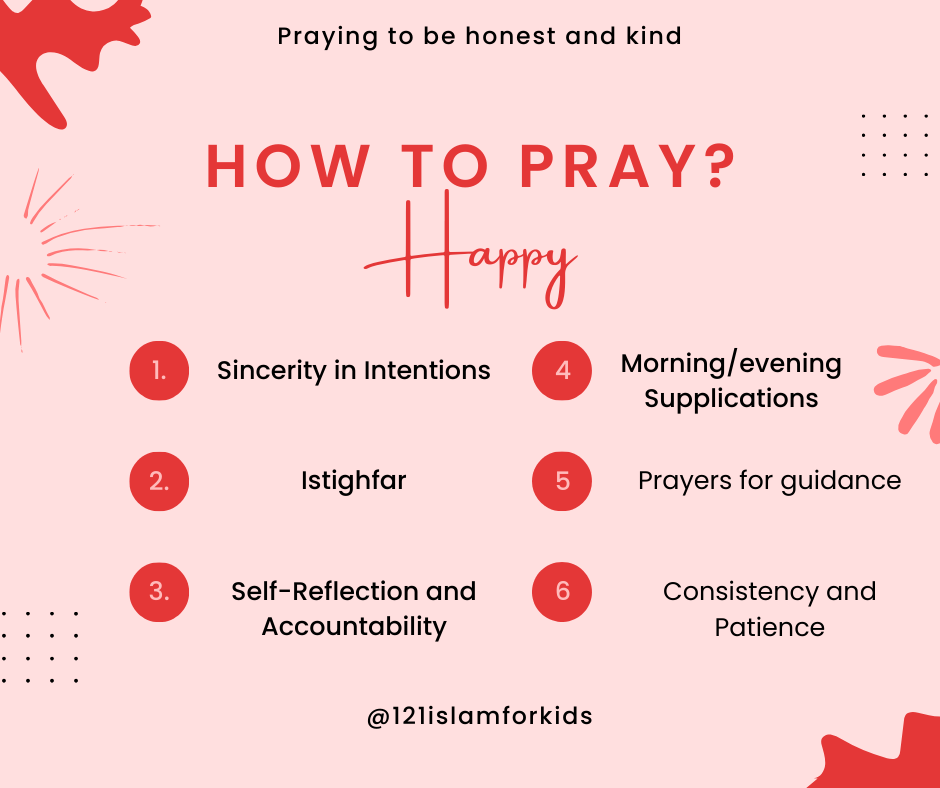
  • Praying to be honest and kind: How to Pray? 10 Tip

    Praying to be honest and kind: How to Pray? 10 Tip

    Praying to be honest and kind is a noble intention. Let’s learn, How to Pray. You can incorporate this into your daily prayers and life by following these steps and using relevant supplications (duas): Let’s learn How to Pray.

    how to pray?

    Sincerity in Intention (Niyyah):

    Begin by making a sincere intention to be honest and kind in all your actions. Your intention should be solely for the sake of pleasing Allah and following the path of the Prophet Muhammad (peace be upon him).

    Morning and Evening Supplications:

    Incorporate the morning and evening supplications (adhkar) recommended by the Prophet Muhammad (peace be upon him) into your routine.

    For example, recite the following du’a in the morning and evening: “O Allah, I ask You for truthful speech and for a heart full of honesty and kindness.”

    Istighfar (Seeking Forgiveness):

    Seek forgiveness from Allah for any past dishonesty or unkindness.

    Use the supplication: “Astaghfirullaha Rabbi min kulli dhambin wa atubu ilayh” (I seek forgiveness from Allah, my Lord, for every sin, and I turn to Him).

    Self-Reflection and Accountability:

    Regularly evaluate your actions and words to ensure they align with honesty and kindness.

    Make a sincere effort to rectify any wrongdoings.

    Charity and Acts of Kindness:

    Engage in acts of charity and kindness toward others, as these actions promote honesty and kindness.

    Seek opportunities to help those in need.

    Prayers for Guidance:

    During your daily prayers (Salah), ask Allah for guidance to remain on the path of honesty and kindness.

    Make a personal supplication from your heart, expressing your desire to embody these qualities.

    Reading and Reflecting on Quranic Verses:

    Read Quranic verses and stories of the Prophet’s life emphasizing honesty and kindness.

    Reflect on their meanings and how you can apply them in your life.

    Seeking Knowledge:

    Learn about the Prophet Muhammad’s (peace be upon him) character and his interactions with others.

    Study Islamic ethics and morals to understand better how to practice honesty and kindness.

    Surround Yourself with Good Company:

    Associate with people who encourage and exemplify honesty and kindness.

    Positive peer influence can help reinforce these values.

    Consistency and Patience:

    Remember that personal growth takes time.

    Be patient with yourself and continue to pray, seek knowledge, and make a conscious effort to improve.
    By incorporating these steps and supplications into your life, you can strive to be a more honest and kind individual, following the teachings of Islam and the example set by Prophet Muhammad (peace be upon him).

    More Islamic / Quranic stories

    Stories in Urdu

    Our online courses and classes for kids and beginners

    Stories Books

  • How to teach Surah Aser step by step? 9 Ways

    How to teach Surah Aser step by step? 9 Ways

    . This step-by-step teaching method of Surah Aser word meanings Translation, tafsir, and activities.

    surah aser

    Introduction

    Surah Al-Asr is the 103rd chapter of the Quran, the holy book of Islam. It is a short but powerful surah, consisting of only three verses, and is considered one of the most profound and impactful surahs in the Quran.

    The word “Asr” in Arabic means “time” and the surah emphasizes the importance of utilizing time wisely. It serves as a reminder to believers that time is a precious and finite resource and that they must use it wisely in the pursuit of their spiritual goals and in doing good deeds.

    The surah also emphasizes the importance of faith, good deeds, and patience. It reminds believers that these are the key ingredients for success in both this life and the hereafter.
    Surah Aser Word-by-word Meanings and Translation:

    Here are the Arabic words in Surah Al-Asr, along with their English translations:

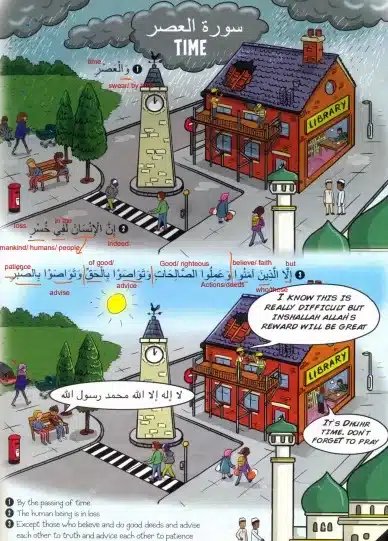
    Verse 1: وَالْعَصْرِ (Wal-‘Asr) – By the time

    Verse 2: إِنَّ (Inna) – Indeed الْإِنسَانَ (al-insana) – mankind لَفِي (lafi) – is in خُسْرٍ (khusr) – loss,

    Verse 3: إِلَّا (Illa) – Except الَّذِينَ (alladhīna) – those who آمَنُوا (āmanū) – have believed وَعَمِلُوا (wa ‘amilū) – and done الصَّالِحَاتِ (al-ṣāliḥāti) – righteous deeds وَتَوَاصَوْا (wa tawāṣaw) – and advised each other بِالْحَقِّ (bi-al-ḥaqqi) – to truth وَتَوَاصَوْا (wa tawāṣaw) – and advised each other بِالصَّبْرِ (bi-aṣ-ṣabr) – to patience.

    Here’s the complete translation of Surah Al-Asr:

    Verse 1: وَالْعَصْرِ (Wal-‘Asr) –

    By the time

    Verse 2: إِنَّ الْإِنسَانَ لَفِي خُسْرٍ (Inna al-insana lafi khusr) –

    Indeed, mankind is in loss,

    Verse 3: إِلَّا الَّذِينَ آمَنُوا وَعَمِلُوا الصَّالِحَاتِ وَتَوَاصَوْا بِالْحَقِّ وَتَوَاصَوْا بِالصَّبْرِ

    (Illa alladhīna āmanū wa ‘amilū al-ṣāliḥāti wa tawāṣaw bi-al-ḥaqqi wa tawāṣaw bi-aṣ-ṣabr) –

    Except for those who have believed and done righteous deeds and advised each other to truth and advised each other to patience.

    “By the time, Indeed, mankind is in loss, Except for those who have believed and done righteous deeds and advised each other to truth and advised each other to patience.”

    Each word in Surah Al-Asr carries significance and contributes to the overall meaning of the chapter, emphasizing the importance of faith, good deeds, and mutual guidance toward truth and patience.

    Tafsir:

    Surah Al-Asr is a short but powerful surah that carries a deep message about the importance of time and the consequences of wasting it. Here’s a brief tafsir (explanation) of each verse:

    Verse 1: “By the time,

    The first verse of Surah Al-Asr highlights the importance of time and the value of every moment. The phrase “By the time” refers to the fleeting nature of time, and how quickly it passes by.

    Verse 2: Indeed, mankind is in the loss.”

    The verse then goes on to state that humanity is in a state of loss or ruin, emphasizing that time is a precious resource that should be used wisely to seek Allah’s pleasure and to do good deeds.

    Verse 3: “Except for those who have believed and done righteous deeds and advised each other to truth and advised each other to patience.”

    The third verse of Surah Al-Asr offers hope to those who have faith and do good deeds. It emphasizes that those who believe in Allah, perform righteous deeds, and encourage each other to truth and patience will be exempt from the state of loss mentioned in the first verse. The verse highlights the importance of working towards the betterment of humanity, promoting truth and justice, and encouraging each other towards good deeds and righteousness.

    “Indeed, Allah is with the patient.”

    The final verse of Surah Al-Asr emphasizes the importance of patience in the face of adversity. It reassures believers that Allah is with those who show patience and perseverance and that He will reward them in this life and the hereafter. The verse reminds us that life is full of challenges and difficulties, but with patience and faith in Allah, we can overcome them and attain success and happiness.

    Overall, Surah Al-Asr reminds us that time is a precious resource and that every moment should be used wisely to seek Allah’s pleasure and to do good deeds. It encourages us to have faith in Allah, perform righteous deeds, and encourage each other toward truth and patience. The surah is a powerful reminder of the ultimate purpose of our existence and the importance of working toward the betterment of humanity.

    Step by Step teaching method:

    Tajweed and Recitation:

    It is necessary to read Quran with perfect Tajweed. Children need to memorize this surah with good recitation and proper tajweed rules. So our quran teacher will start to teach them this surah in Quran class. We also provide Tajweed videos to children. Within 2 or 3 weeks, while we will complete the translation and tafsir of the surah and other activities, students will be able to recite this surah with good recitation. In sha Allah

    Word by word Translation of My first Quran with pictures book:

    From ”my first quran with Picture” book, we will do word-by-word translations of the Surah. Word-by-word translation will be done online from the soft book and children will write meanings on their copies or Quran notebooks. word by word translation and verse-by-verse translation are compulsory to memorize by heart. So daily revision and class work will make it easy to learn by heart. (More pictures in Gallery)

    Tafsir and explanation from Islamic education book

    Tafsir and explanation are done during word meanings and translation of the surah from the picture book. For the deep study, we get help from the book ‘Islamic Education’ by ‘Darusslam for more detail and complete understanding. The tafsir in this book is pretty easy and age-appropriate. You can download this book form here.

    Infographics:

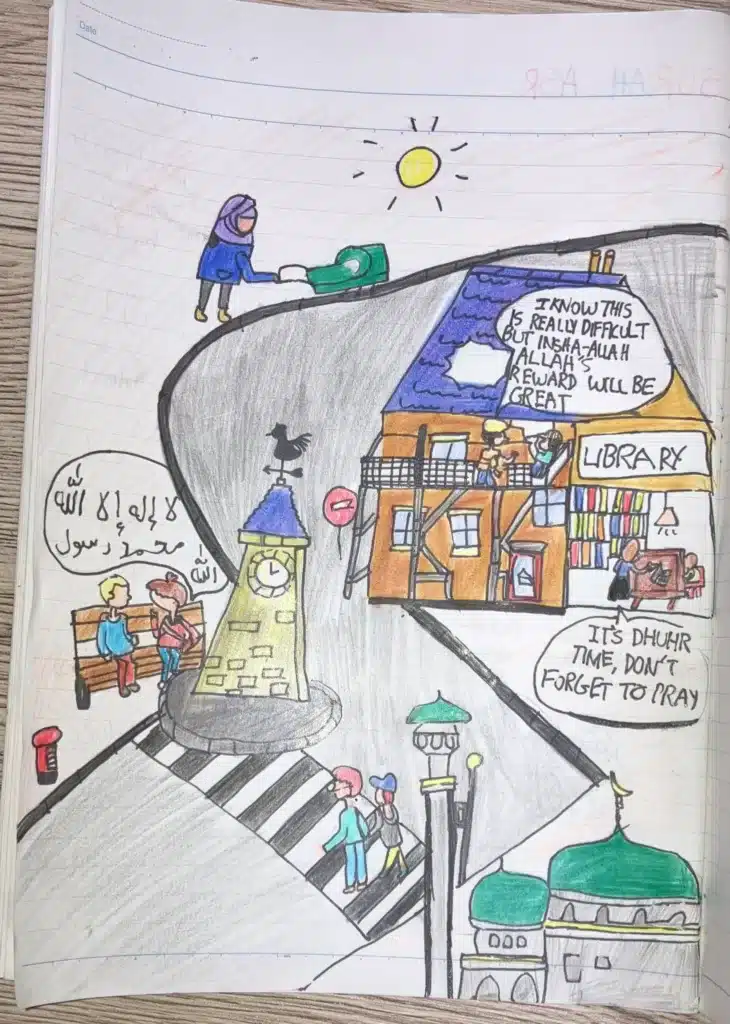
    My first QUran with pictures has the best infographics for children. It is quite easy to draw the important graphics from the book. But we appreciate our children using their creativity. So children may draw, or create with the help of any app. Children may draw their imaginary understanding of the surah. Discussion on their creativity is the next part of our class lecture.

    Lesson and implication of this surah:

    There are 4 life goals that Allah emphasizes in this surah. We have learned from this surah that life is very short. We have to fulfill world duties, but for life hereafter is also. Our life should be spent on these purposes of life

    1. Faith in Allah
    2. Good deeds/actions
    3. Advice for good to others
    4. Advise patience to others

    Activities:

    The last verse of the surah is the central subject of the surah. This verse is about the whole deen. In this surah Allah, Subhan was Tallah informed us of the strategies of a successful life in this world and hereafter. So we will understand this topic with two activities.

    We will make an hourglass to see how time is passing ( see video or gallery)

    We will have an experiment with ice blocks. We will make a target to fulfill a task before melting a small block of ice.

    Revision and Exercise:

    Children will tell word meanings with full translation. Then the introduction of the surah will be revised. And we will have a discussion on the lesson and practical things we started to follow after learning this surah. Exercises from the Islamic education book will be solved by the children themself.

    Story:

    The stories of the Muslim faith hold immense importance for children as they provide a powerful medium to instill Islamic values, inspire good behavior, and nurture a strong sense of identity and love for Allah and His religion. These stories shape their character, moral compass, and understanding of Islam, equipping them with the knowledge and values needed to navigate the world as faithful and conscientious individuals. So we selected the story of Ibrahim’s faith for children from boo” My first quran stories book. Pictures are in the gallery.

    Time management story is also a good exposure for children. So We can select any other story about it.

    Mind map:

    We have mindmaps from Islamlive.org which we use in our class. It is a very helpful activity that after teaching everything about surah, children would sum up what they have learned from the Surah so You can see the mindmap prepared by our students in the picture. A video of the mindmap of Surah Aser will also be provided to students for deep understanding and long-term memory. (See Gallery)

    Excellency of Surah Al-Aser

    Surah Al-Asr is often recited in daily prayers and other Islamic rituals, and its message is considered relevant and applicable to all Muslims, regardless of their background or circumstance. Its concise yet powerful message continues to inspire and guide Muslims around the world.

    Resources

    My First Quran Picture Book

    My First Quran Stories Book

    Islamic education By Molvi Abdula Aziz Grade 6

    Lectures videos in English

    Lectures videos in Urdu

    Courses

    Quran classes:

    We have online quran tajweed, recitation, and Quran Hifz classes for children. One-on-one classes with Qualified teachers.

    Quran Tafseer classes:

    Short and Easy to understand Quran translation and tafseer will be taught to the young learners. Infographics, mindmaps, work-by-word tajweed and meanings, stories, and duas are included in these classes.

    Hadith with Stories course consists of 30 short hadith 

    It’s a personality development course for children with interesting stories. 30 short hadiths would be taught with stories. We have worksheets to solve after learning hadiths for implications.

    Prayer for kids course :

    A short course to teach about taharat, Gusal, wudu, times of prayers, number and names of prayers, pillars, conditions of prayer, and method of prayer.

    Kindness to Parents:

    1-week course to teach the rights of parents with practical work. Dua and how to be kind to parents is included in this course.

    6 articles on the Muslim faith:

    Faiths/Muslim beliefs would be taught one by one with the help of mind maps and stories in the Quran.

    Islamic dress code:

    Islamic rules of dressing, Aurah/covering body rules, and modesty dressing will be included in this one-week course.

    Ramzan Boost course:

    1 month before Ramzan we start this course. Everything about fasting rules and supplication with the Ramzan checklist and daily to-do list is included in this course.

    Faith boosts course in December to say NO MARYY CHRISTMAS:

    Stories of faith by the Quran will be added in this course with basic articles of faith in this course.

    Enrolments Available

    All courses Are available to start as in one on one classes. Please have a look at our group courses continued here.

    Email
    Facebook.
    Youtube Urdu Channel
    YYoutubeEnglish Channel
    If this teaching method is helpful for you? leave a comment.
  • The first surah revealed by Prophet Muhammad: Surah ALAlaq

    The first surah revealed by Prophet Muhammad: Surah ALAlaq

    _

    The first Surah reveald in Makkah on Prophet Muhammad SAW when he was 40 yrs old. This is a very important surah which was revealed in two parts. Both parts have different thems.

    Surah Alaq can be taught step by step using an approach that encompasses understanding the meaning of the verses and memorizing the surah. Here is a suggested teaching method for Surah Alaq:

    Step 1: Introduction and Background

    • Introduction: The first surah revealed, Surah Alaq is the 96th chapter (surah) of the Quran and is also known as “Iqra,” which means “Read” or “Recite.” It holds great importance as one of the earliest revelations received by the Prophet Muhammad (peace be upon him) during the early years of his prophethood.
    • This chapter marks a pivotal moment in the revelation of the Quran, introducing profound concepts and messages that continue to guide Muslims to this day.
    • Background: Surah Alaq was revealed in Makkah, prior to the migration (Hijrah) of the Prophet Muhammad (peace be upon him) to Madinah. Verse 1 to 5 is the first revelation. During this period, the Prophet was meditating in the cave of Hira, contemplating the social and spiritual challenges of his community. It was during one such occasion in the month of Ramadan that the angel Jibril (Gabriel) descended upon him and commanded him to “Read” (Iqra).
    • The Prophet, who was unlettered and had not received any formal education, was initially taken aback by the command. However, he humbly responded,
    • “I am not able to read.”
    • The angel Jibril then embraced him tightly, and after releasing him, repeated the command to read. This interaction, believed to have occurred several times, resulted in the revelation of the first verses of Surah Alaq.
    • The revelation of Surah Alaq not only marked the beginning of the Prophet Muhammad’s (peace be upon him) prophethood but also emphasized the importance of seeking knowledge and the pursuit of education.
    • It instilled in the Muslim community a profound appreciation for learning, literacy, and the acquisition of wisdom.
    • The background of Surah Alaq verse 9 to 19 was revealed later. These verses are about Abu Jahal. It reflects the challenges faced by the Prophet during the early stages of his mission.
    • The pagan society of Makkah, deeply rooted in idolatry and unaware of the monotheistic teachings of Islam, presented significant obstacles to the spreading of the message.
    • However, the revelation of Surah Alaq and subsequent revelations served as a source of guidance, encouragement, and fortitude for the Prophet and his followers.
    • Understanding the introduction and background of Surah Alaq helps to contextualize the significance of this chapter and the transformative impact it had on the early Muslim community. It emphasizes the themes of seeking knowledge, the importance of literacy, and the profound spiritual journey that began with the command to “Read” (Iqra).

    Step 2: Recitation and Listening

    • We encourage students to listen to a recitation of Surah Alaq to familiarize themselves with the Correct Tajweed.
    • We Emphasize correct pronunciation and Tajweed rules during the recitation.
    • We provide word-by-word Tajweed and Recitation videos with word meanings

    Step 3: Translation and Tafsir (Exegesis)

    • We Break down the meaning of each verse, explaining the concepts and ideas conveyed in Surah Alaq. For this purpose, we Read the book ‘My first quran with Pictures’. This book has beautiful infographics that help students understand every verse’s theme.
    • We translate the surah into the student’s easy English, ensuring they understand the message being conveyed.
    • We Use Tafsir resources or explanations by scholars to provide deeper insights into the context and interpretations of the verses. Islamic education books by Molvi Abdul Aziz have excellent short tafsir for children, which is very easy to read and understand.

    Step 4: Reflection and Discussion

    • We encourage students to reflect on the lessons and guidance offered in Surah Alaq. For this purpose, we do some practical work. For example, to teach them the importance of creation, we did an activity of seeding. So a been in a glass jar was grown by children. As humans were created by a clot.
    • We Facilitate a discussion about the significance of seeking knowledge, the consequences of arrogance, and the importance of humility in their lives. The example is clear, Animals and other creatures have very small knowledge so they can’t change their life. But humans are learning and making big changes in this world just because they have knowledge given by Allah.

    Step 5: Memorization

    • We Break down Surah Alaq into manageable segments or verses for memorization. We have 2 classes every week. So 1 or 2 verses would be memorized every day. Children get much time to memorise surah during other activities.
    • We Teach the memorization of the surah using repetition, recitation practice through videos , and memorization techniques.
    • We Emphasize the importance of understanding the meaning of the verses while memorizing them to foster a deeper connection with the surah.

    Step 6: Application and Integration

    • We encourage students to apply the teachings of Surah Alaq in their daily lives.
    • We Discuss practical ways to seek knowledge, practice humility, and avoid arrogance.
    • We encourage them to reflect on the lessons of Surah Alaq in their interactions with others, their studies, and their pursuit of personal growth.

    Step 7: Revision and Assessment

    • We Conduct regular revision sessions to reinforce the memorization of Surah Alaq.
    • We Assess students’ understanding of the surah through quizzes, discussions, or written assignments.
    • We Provide opportunities for students to recite Surah Alaq in class one by one. Every student gets a chance to recite and participate in reading word meanings and discussions to build confidence in their recitation and memorization skills.

    Step 8: Mindmap and Infographic

    • We encourage our students to write word meaning with infographics. It helps to remember meanings as image memory power.
    • After completing the surah, we also help students to mindmap the theme and lessons of the surah with keywords.

    Step 9: Activities.

    • We include various activities during our lessons.
    • We encourage students to do crafting, drawing, and practicals according to the lessons
    • For Surah Alaq we did an activity to grow a seed. It helped students how Allah has created everything.
    • Another activity was About making a list of Skills and knowledge of this world.
    • We also had an activity about picking all the nouns from the surah and making drawings of nouns, like pen, human, Alaq.

    Step 10: Story

    • Storytelling is a basic part of our teaching style.
    • We have the story Story: “From Arrogance to Humility” to read in our class.
    • We collect stories of the creations,
    • Stories of Seerat tu Nbi SAW

    By following this step-by-step teaching method, students can develop a comprehensive understanding of Surah Alaq, memorize its verses, and internalize its timeless teachings, allowing them to apply its wisdom in their lives.

    Resources

    My First Quran Picture Book

    My First Quran Stories Book

    Islamic education By Molvi Abdula Aziz Grade 6

    Lectures videos in English

    Lectures videos in Urdu

    Courses

    Quran classes:

    We have online quran tajweed, recitation, and Quran Hifz classes for children. One-on-one classes with Qualified teachers.

    Quran Tafseer classes:

    Short and Easy to understand Quran translation and tafseer will be taught to the young learners. Infographics, mindmaps, work-by-word tajweed and meanings, stories, and duas are included in these classes.

    Hadith with Stories course consists of 30 short hadith 

    It’s a personality development course for children with interesting stories. 30 short hadiths would be taught with stories. We have worksheets to solve after learning hadiths for implications.

    Prayer for kids course :

    A short course to teach about taharat, Gusal, wudu, times of prayers, number and names of prayers, pillars, conditions of prayer, and method of prayer.

    Kindness to Parents:

    A 1-week course to teach the rights of parents with practical work. Dua and how to be kind to parents is included in this course.

    6 articles on the Muslim faith:

    Faiths/Muslim beliefs would be taught one by one with the help of mind maps and stories in the Quran.

    Islamic dress code:

    Islamic rules of dressing, Aurah/covering body rules, and modesty dressing will be included in this one-week course.

    Ramzan Boost course:

    1 month before Ramzan we start this course. Everything about fasting rules and supplication with the Ramzan checklist and daily to-do list is included in this course.

    Faith boosts course in December to say NO MARYY CHRISTMAS:

    Stories of faith by the Quran will be added in this course with basic articles of faith in this course.

    Enrolments Available

    All courses Are available to start as in one on one classes. Please have a look at our group courses continued here.

    Email
    Facebook.
    Youtube Urdu Channel
    Youtube English Channel
    If this teaching method is helpful for you? leave a comment.
  • How to start Muslim homeschooling? 8 steps guide

    How to start Muslim homeschooling? 8 steps guide

    muslim homeschool

    Starting Muslim homeschooling can be a rewarding experience for both parents and children. As a parent, you have the opportunity to provide your child with a tailored education that aligns with your values and beliefs. Here is a detailed guide on how to start a Muslim homeschooling program:

    The first step in starting a Muslim homeschooling program is to research the legal requirements in your state or country. Laws and regulations can vary widely from one location to another. In the United States, for example, homeschooling is legal in all 50 states, but the specific requirements can vary depending on where you live. To ensure that you are in compliance with the law, start by researching the homeschooling laws and regulations in your area.

    Step 2: Goals and objectives

    Define Your Educational Goals and Objectives The next step is to define your educational goals and objectives. As a Muslim homeschooling parent, you have the flexibility to tailor your child’s education to your values and beliefs. Start by considering the subjects that are important to you and your family, such as Islamic Studies, Arabic Language, and Quranic Studies. You may also want to consider other subjects, such as Math, Science, and Social Studies.

    Step 3: Curriculum (Get Books)

    Choose a Curriculum Once you have defined your educational goals and objectives, the next step is to choose a curriculum. There are many options available online, including secular curricula that can be adapted to a Muslim homeschooling program, as well as specialized Muslim curricula.

    There are many curriculums and books available for Muslim homeschooling families. Here are some popular options:

    1. The Islamic Education Series: This is a comprehensive Islamic curriculum that covers all aspects of Islamic studies for children from kindergarten through grade 12. It is published by the International Islamic Publishing House.
    2. Noorart: Noorart offers a variety of Islamic curriculums and textbooks for children of all ages. Their curriculums cover Quran, Islamic studies, the Arabic language, and more.
    3. Islamic School Book: This is a series of textbooks published by the Islamic Services Foundation that cover Islamic studies, the Quran, and the Arabic language for children in grades 1-12.
    4. I Love Islam: (Get Books) This is a comprehensive Islamic curriculum for children from kindergarten through grade 5. It is published by the Islamic Services Foundation.
    5. A Guide to Islamic Studies: This is a comprehensive curriculum for Islamic studies for children from kindergarten through grade 12. It is published by the Muslim American Society.
    6. The Seerah Trail: (Get Book)This is a unique Islamic curriculum that teaches the life of the Prophet Muhammad (peace be upon him) through a trail format. It is designed for children aged 7-11.
    7. Learning Roots: (Get Books) Learning Roots offers a variety of Islamic books and resources for children of all ages. Their books cover topics such as Quran, Islamic studies, and Arabic language.

    These are just a few of the many curriculums and books available for Muslim homeschooling families. It’s important to research and find a curriculum that fits your family’s needs and goals.

    Some popular Muslim homeschool curricula include:

    Be sure to research the different curricula available to find the one that best meets your needs and goals.

    Step 4: Plan Your Lessons

    Plan your lessons With your curriculum in hand, it’s time to plan your lessons. Start by breaking down the curriculum into manageable units and then plan the lessons for each unit. Be sure to allocate enough time for each subject and use a variety of teaching methods to keep your child engaged.

    Step 5: Get the Necessary Resources

    To effectively homeschool your child, you will need the necessary resources. This may include textbooks, workbooks, educational software, and other materials. Many resources are available online, or you may be able to find them at local homeschooling stores or Islamic bookstores. ( View or Buy)

    When it comes to homeschooling, there are several resources that are necessary to ensure a successful and effective learning experience. Here are some essential homeschool resources:

    1. Curriculum: A curriculum is the backbone of homeschooling. It provides a structured framework for learning and ensures that the child is learning what they need to know. There are many options for homeschool curriculums, including religious-based curriculums, secular curriculums, and online curriculums.
    2. Learning Materials: Learning materials include textbooks, workbooks, worksheets, and other materials that are used to teach specific subjects. These materials are often part of the curriculum, but they can also be purchased separately or found online.
    3. Supplies: Homeschooling requires various supplies, such as pencils, paper, art supplies, and manipulatives for math. Having the necessary supplies on hand is important for ensuring that the child has everything they need to complete their work.
    4. Technology: In today’s world, technology is an essential part of homeschooling. Computers, tablets, and educational software can enhance the learning experience and provide a wealth of information and resources.
    5. Support: Homeschooling can be challenging, and having a support system is essential. This can include other homeschooling families, online groups, co-ops, and tutors.
    6. Field Trips: Field trips provide a hands-on learning experience and are an essential part of homeschooling. Trips to museums, historical sites, and other educational destinations can help bring learning to life.
    7. Assessment Tools: Assessment tools, such as tests, quizzes, and progress reports, are essential for tracking the child’s progress and ensuring that they are meeting learning objectives.

    These resources are essential for successful homeschooling. However, it’s important to remember that every family’s needs are different, and what works for one family may not work for another. It’s important to do research and find the resources that work best for your family’s unique needs and goals.

    Step 6: Join Muslim Homeschooling Group

    Joining a Muslim homeschooling group can provide valuable support and resources for both parents and children. These groups may offer online forums, in-person meetings, and other resources to help you connect with other Muslim homeschooling families. Some popular Muslim homeschooling groups include:

    • Muslim Homeschoolers Unite
    • Muslim Homeschooling Resources
    • Muslim Homeschool Network

    Some Muslim homeschool groups on Facebook

    There are many Muslim homeschooling groups on Facebook that offer support and resources to Muslim homeschooling families. Here are some of the popular Muslim homeschooling groups on Facebook:

    1. Muslim Homeschoolers Unite: This is a global community of Muslim homeschooling parents and educators. The group offers support, resources, and advice on Muslim homeschooling.
    2. Muslim Homeschooling Resources: This group is a resource hub for Muslim homeschooling parents. The group shares free resources, curriculum ideas, and tips for Muslim homeschooling.
    3. Muslim Homeschool Network: This group is for Muslim homeschooling parents and students. The group shares advice, resources, and support for Muslim homeschooling families.
    4. Muslimah Homeschool: This is a group for Muslim women who homeschool their children. The group offers support, resources, and advice on Muslim homeschooling.
    5. Islamic Homeschooling: This group is for Muslim homeschooling parents who are interested in using an Islamic curriculum. The group shares curriculum ideas, resources, and advice on Islamic homeschooling.
    6. Muslim Homeschooling Moms: This is a group for Muslim homeschooling moms to share their experiences, advice, and resources on Muslim homeschooling.
    7. Islamic Homeschooling for Little Muslims: This group is for Muslim homeschooling parents with young children. The group shares ideas, resources, and advice on teaching Islam to young children.

    These are just a few of the many Muslim homeschooling groups on Facebook. Joining a group can provide valuable support and resources for both parents and children.

    Step 7: Keep Records and Create a Portfolio (Get)

    Keeping records and creating a portfolio is essential for documenting your child’s progress and meeting legal requirements. Your portfolio should include samples of your child’s work, a record of lessons, and any assessments or evaluations.

    Step 8: Decorating and managing (view or buy)

    Decorating and managing a homeschooling space can be an important part of creating a productive and inspiring learning environment. Here are some tips for Muslim homeschool decor and management:

    1. Create a dedicated homeschool space: Designate a specific area in your home for homeschooling. This could be a separate room or a corner of a larger room. Having a dedicated space helps create a sense of structure and routine.
    2. Incorporate Islamic art and decor: Including Islamic art and decor in your homeschooling space can help create a sense of connection to Islamic culture and values. This could include Islamic calligraphy, paintings, or even decorative items such as prayer rugs or Islamic-themed wall hangings.
    3. Keep it organized: A well-organized homeschooling space can help create a calm and focused environment. Invest in storage solutions such as shelves, bins, and drawers to keep materials organized and easily accessible.
    4. Create a schedule: Having a schedule helps create structure and routine in your homeschooling day. Create a schedule that includes time for prayer, breaks, and different subjects. This can help keep your homeschooling day on track and ensure that you cover all necessary subjects.
    5. Utilize technology: Technology can be a valuable tool for homeschooling. Consider incorporating educational apps, online resources, and virtual field trips into your curriculum.
    6. Take breaks: It’s important to take regular breaks to avoid burnout and maintain focus. Encourage your child to take breaks throughout the day, and use this time to relax and recharge.
    7. Keep it comfortable: Creating a comfortable learning environment is important for ensuring that your child can focus and learn effectively. Make sure the space is well-lit, and consider adding comfortable seating or a cozy rug to create a warm and inviting atmosphere.

    These tips can help create an effective and inspiring Muslim homeschooling space. Remember to personalize your homeschooling space to fit your family’s unique needs and preferences.

    In summary, starting a Muslim homeschooling program requires careful planning and preparation. Research the legal requirements in your area, define your educational goals and objectives, choose a curriculum, plan your lessons, get the necessary resources, join a Muslim homeschooling group, keep records, and create a portfolio. With dedication and commitment, you can provide your child with a quality education that aligns with your values and beliefs.

    Here are some book suggestions for a Muslim homeschool library:

    1. “The Seerah of the Prophet Muhammad” by Ibn Kathir – This book provides a comprehensive account of the life of the Prophet Muhammad, including his teachings and character.
    2. The Quran (get)” – The Quran is the central religious text of Islam and is essential for Muslim education. Consider having a copy of the Quran in your homeschool library for reference and study.
    3. “Stories of the Prophets” by Ibn Kathir ( view books)– This book provides a collection of stories about the Prophets in Islam, including Adam, Noah, Abraham, Moses, and Jesus.
    4. “1001 Inventions: Muslim Heritage in Our World” by Salim Al-Hassani – (Get Book)This book explores the contributions of Muslim scholars and inventors to science, technology, and culture throughout history.
    5. “The Islamic Golden Age” by Jonathan Bloom and Sheila Blair – This book provides an overview of the Islamic Golden Age, a period of cultural, scientific, and artistic flourishing in the Muslim world from the 8th to the 14th century.
    6. “The Complete Idiot’s Guide to Understanding Islam” by Yahiya Emerick –(Get Book)This book provides an introduction to Islam, including its beliefs, practices, and history.
    7. “The Prophet’s Ramadan Handbook” by Dr. Taqi Hashmi and Dr. Abidullah Ghazi – This book provides guidance for observing Ramadan, including the history and significance of the holy month, fasting practices, and daily devotions.
    8. “The Muslim Family Guide to Successful Homeschooling” by Dr. Nafiisah Chowdhury – This book provides guidance and advice for Muslim families who are homeschooling their children. (Get Parenting Book)

    These books are a great starting point for a Muslim homeschool library, but there are many other books and resources available as well. It’s important to choose materials that align with your family’s values and goals for education.

    Here are some Muslim children’s books available on Amazon:

    1. “My First Quran Storybook” by Saniyasnain Khan
    2. “Allah Gave Me Two Hands and Feet” by Fatima D’Oyen
    3. “Under My Hijab” by Hena Khan
    4. “Ilyas & Duck and the Fantastic Festival of Eid-al-Fitr” by Omar Khawaja
    5. “The Story of the Elephant: Surah Al-Feel” by Hajera Memon
    6. “A to Z of Akhlaaq: Moral Values for Children” by Sr. Nafees Khan
    7. “Zaki’s Ramadan Fast” by Shaima Abdullah
    8. “What is Jannah?” by Shahada Abdul Haqq
    9. “The Adventures of Hakim: 2” by Wafa’ Tarnowska
    10. “The Perfect Gift” by J. Samia Mair

    Please note that this is just a small sample of the many Muslim children’s books available on Amazon, and there are many more titles and authors to explore.

    Muslim Parenting books to read

    Muslim children books

    121 Islam for Kids Online Classes for kids

    Online Quran classes for kids

    Online Quran Tafseer and Translation for Kids

    Online Hadith course for kids

    Islamic stories for kids

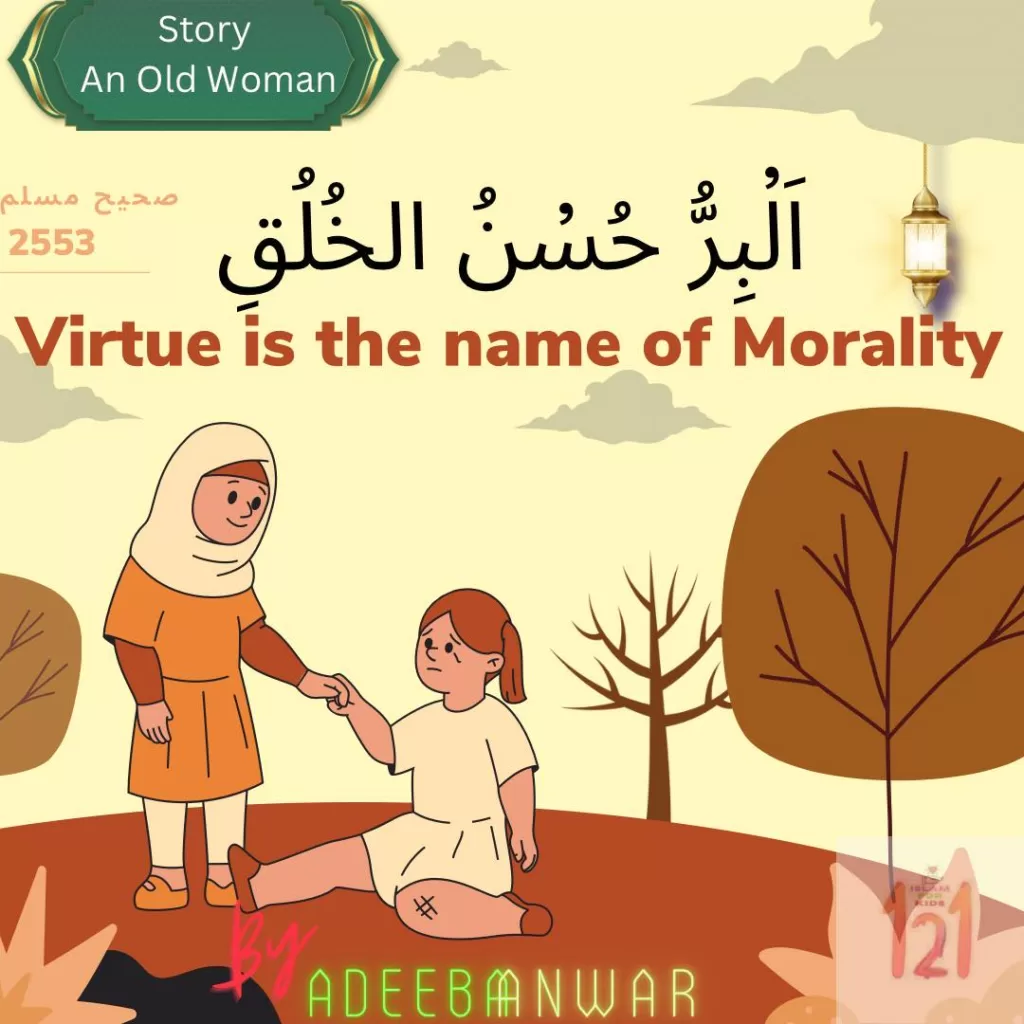
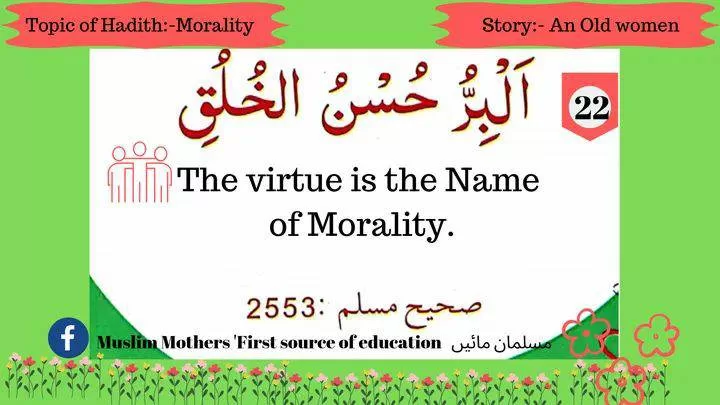
  • New Islamic Story No.22: Virtue is the name of Morality

    New Islamic Story No.22: Virtue is the name of Morality

    islamic story

    Is Morality different from virtue? Are these two separate things? Not.

    Then Why do people differentiate Morality from religion? Let’s read an Islamic Story about Virtue and morality.

    Dear Students Aslam O Alikum 

    Today’s Hadith is about morality. We had already done a hadith about this topic. And do you remember there were 7 Seerah stories in that hadith. . We need this topic and practice regularly. Today our manners and morality are decreasing. Many of us don’t even smile without reason. Our faces and our expression are at dead steam. We may be good with our friends and strangers outside.

    Our society did not understand that our charity and morality begin from home.  We forget the Sunnah of our prophet. We don’t deal appropriately with our youngsters, our servants, our children, and our family members. And children are the biggest victim of this behavior.  They misbehave and react poorly as well as they are also losing their temper at minor things. We have no relation to each other. So we must learn the Seerah of our prophet and the gems of Islam.

    Let’s start our today’s hadith. Sahih Muslim 2553

    Islamic Story

    My dear students, Our prophet was very kind and generous with others. He is the biggest example of Good morality. It is easy to show our morality to others, but when someone tries to hurt us or do bad to us, then how we behave shows our morality. Today I will tell you a story of a woman who behaved so badly with our Prophet SAW but in response, our Prophet SAW was so generous with her.

    Once there was an Old woman. She was not Muslim. She heard about our Prophet SAW that he is against idol worship. She was scared of the change. She can’t understand where this is coming from. She was in her old age and she could not understand anything.  She started to hate our Prophet SAW silently. She can’t do anything against Prophet SAW because she was old and lived alone at home. She started to show her hate by throwing garbage at Our prophet (nauozobillah). Our prophet SAW often passed through her street. She actually knows the time when Prophet passed through her street.

    She would keep garbage and wait for Him. When he passed through her street she threw garbage at him. Our prophet looked at her, She was so old, so in respect of her, he didn’t say anything to her. Now from that day, she did this every time when he passed this street.

    But do you know what happened?

    One day Prophet SAW passed from the street but she was not there to throw the garbage. The next day she was again not there. Our prophet SAW thought about the woman. And when the next day she was again not there, He asked her neighbor.

    Where is the woman who lived in this house?

    They told him that she is sick.

    The prophet SAW was worried about her. 

    He thought about visiting her. He entered his house after getting permission.

    When she recognized him, she was so afraid.

    She thought,

    I’m so weak now. He would take his revenge. I do so badly with him. Definitely, he will harm me.

    But she was surprised when he smiled softly. Asked her about her health. He also took care of her. And then left. Then he would visit her till she was healthy. Now she regretted it. She thought this nice man would not be a liar. So she accepted Islam. My dear kids. This happened just because of His Good morality.

    Only virtue, love, and sincerity could change a heart.

    We should also be very nice and noble with others even if they would be non-Muslims. It is a sunnah of our Prophet. 

    Now please write this hadith into your hadith journal and Learn it.

    You can make a video of any story of your Morality and send us. Share this story with your Grandparents.

    AslamoAlikum.

    Video of this Islamic story and Hadith

    Enrolments Available

    This is a short course of hadith and stories from My 30 short hadith with stories course. My hadith course is very much liked and appreciated by parents and students. Online group classes are available online for all time zones. Recommended age for the class Hadith for kids is 7+. These classes are available in English and Urdu. If you want to enroll your child in our classes contact us via.

    Other courses we have

    • Easy Tafseer for kids with interesting stories you can see that course in my hadith course tab.
    • Prayer for kids course is a short course to teach about taharat, Gusal, wudu, times of prayers, number and names of prayers, pillars and conditions of prayer, and method of prayer. Search as Prayer for kids course on the search bar.
    • Ramzan boost course we do start 2 weeks before Ramzan.
    • Faith boos course In December to say No To Marry Christmas.
    • Kindness to Parents

    If you want to start this course with me then leave a comment, Email me or enroll your child here.

    Download your free copy of 30 short Hadith book pdf in Urdu/Eng from the Posts tab.

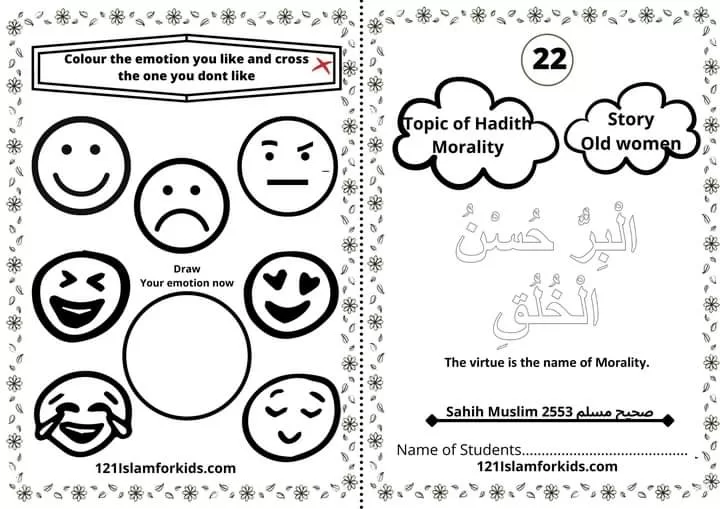
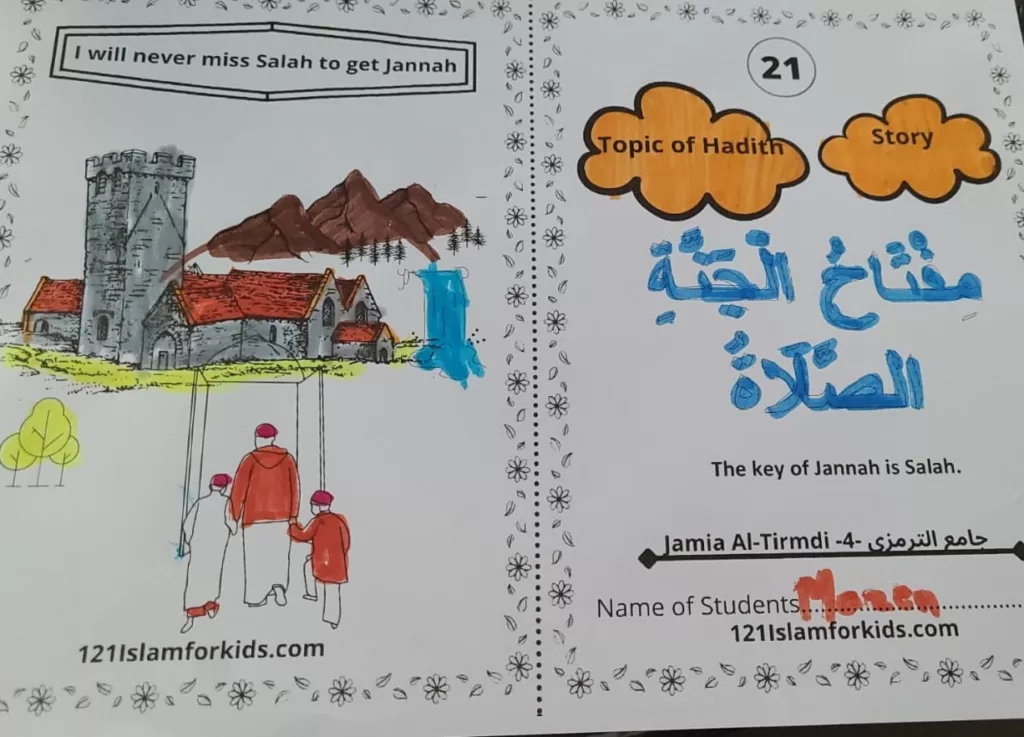
    Worksheet for this Hadith and story.

    (Buy This worksheet book here)

    Islamic Story

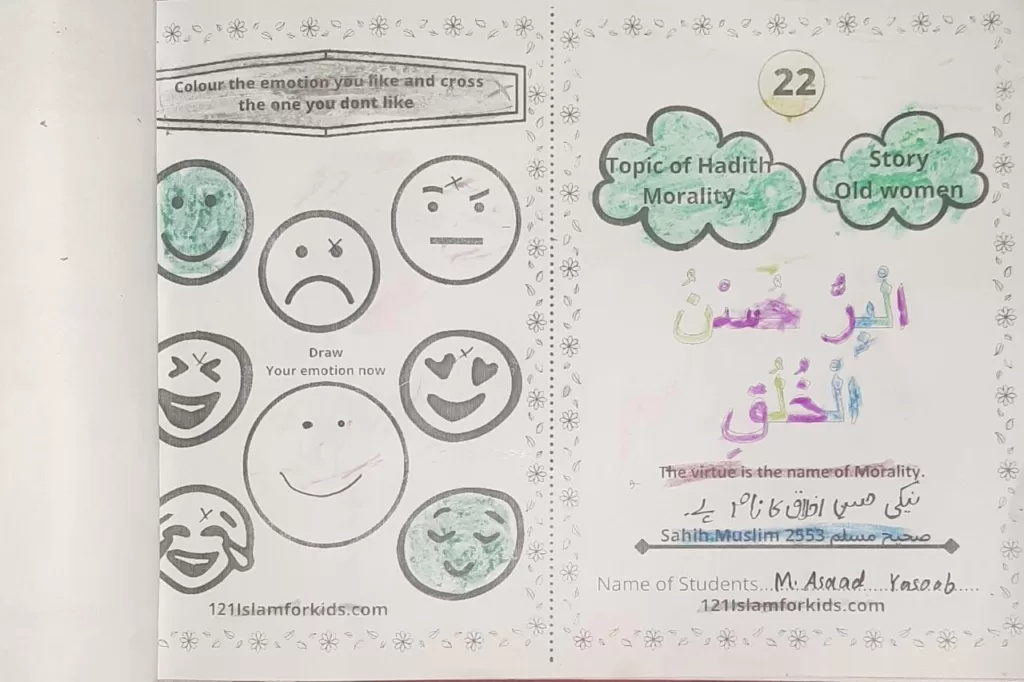
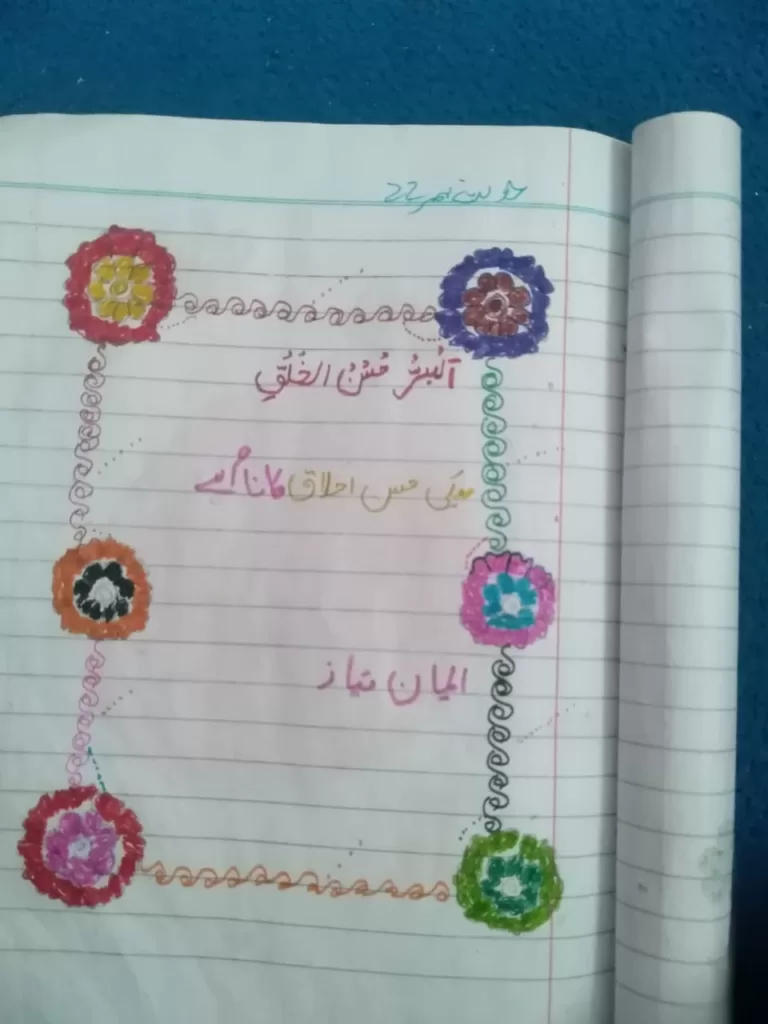
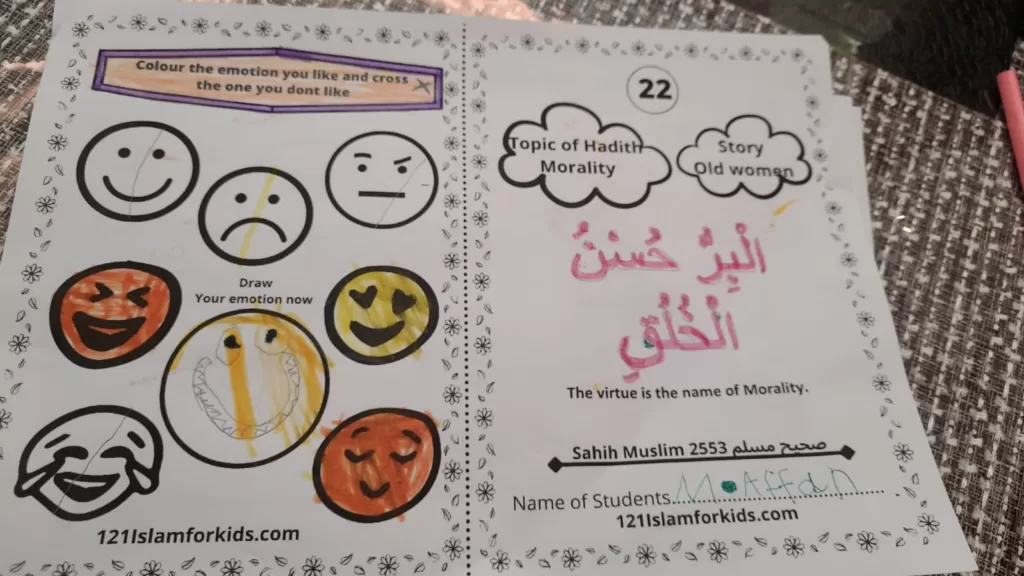
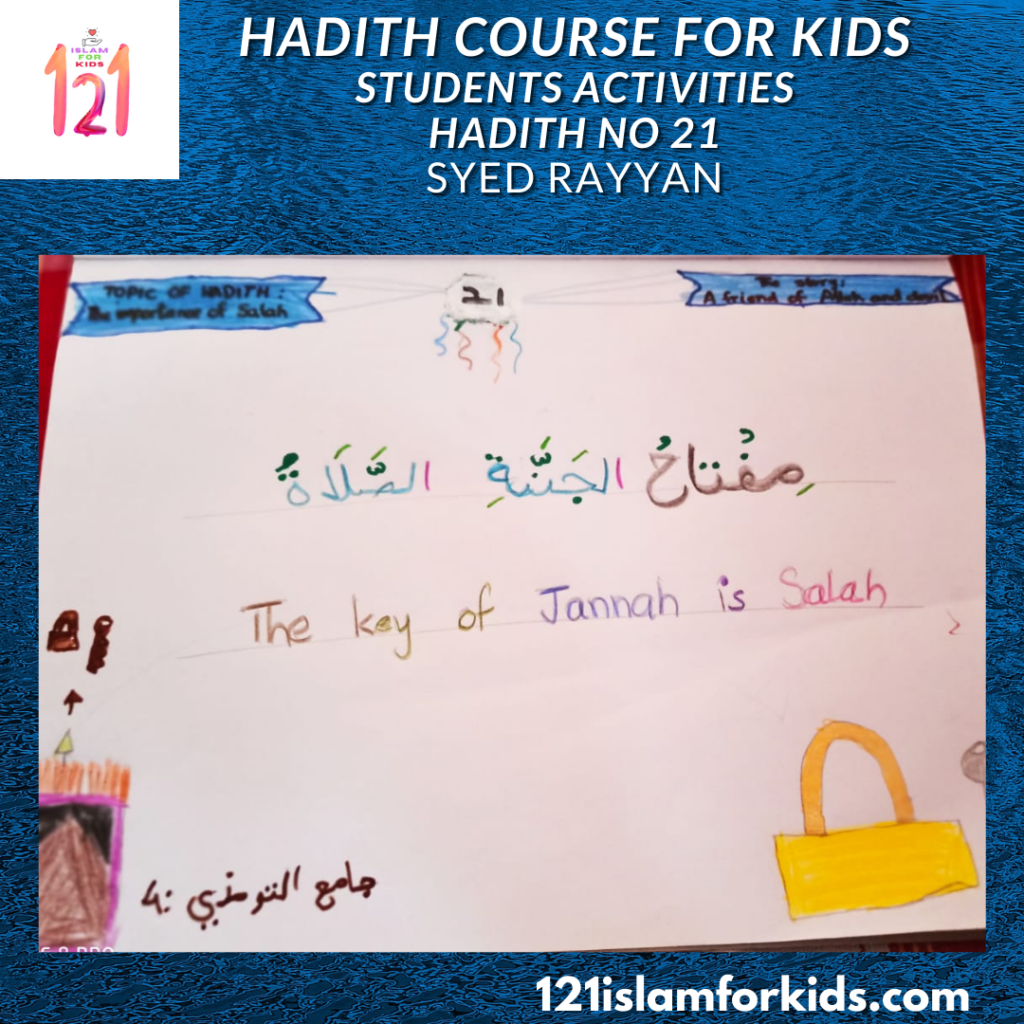
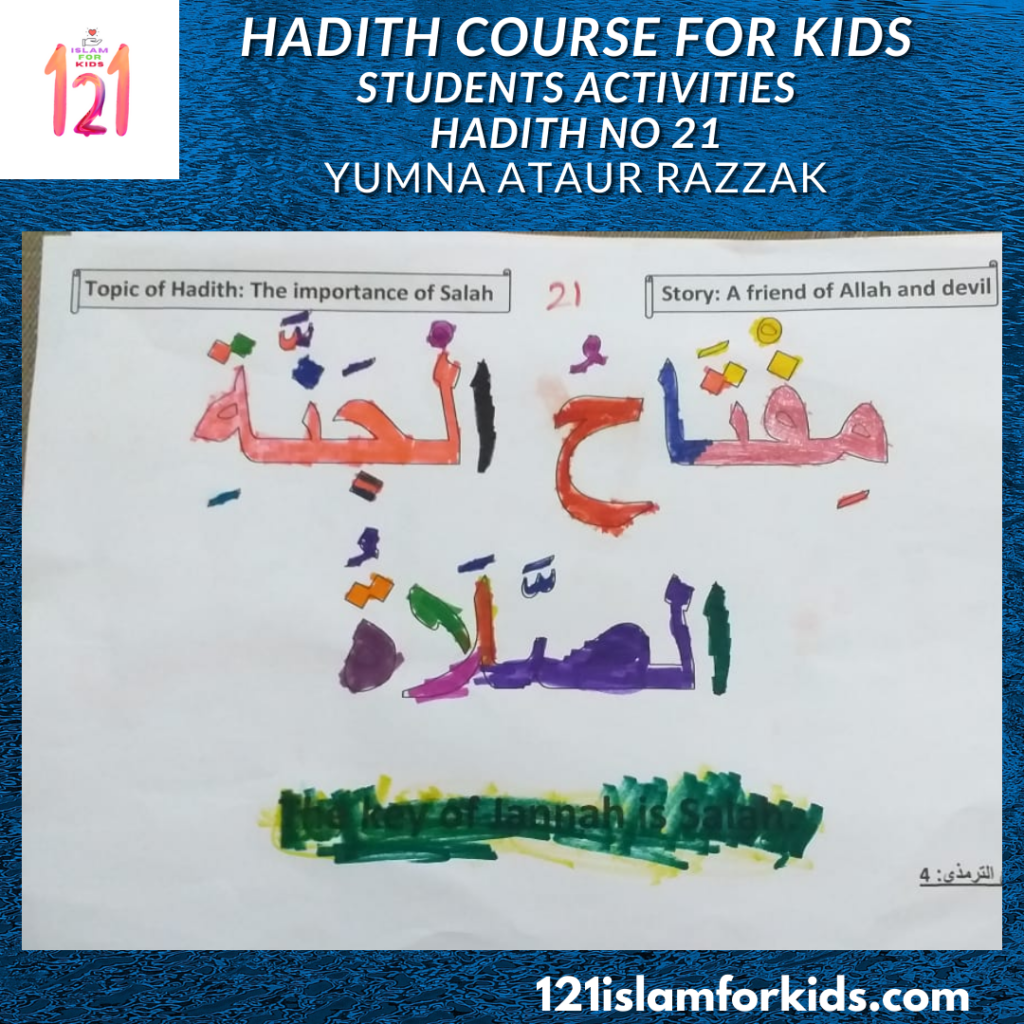
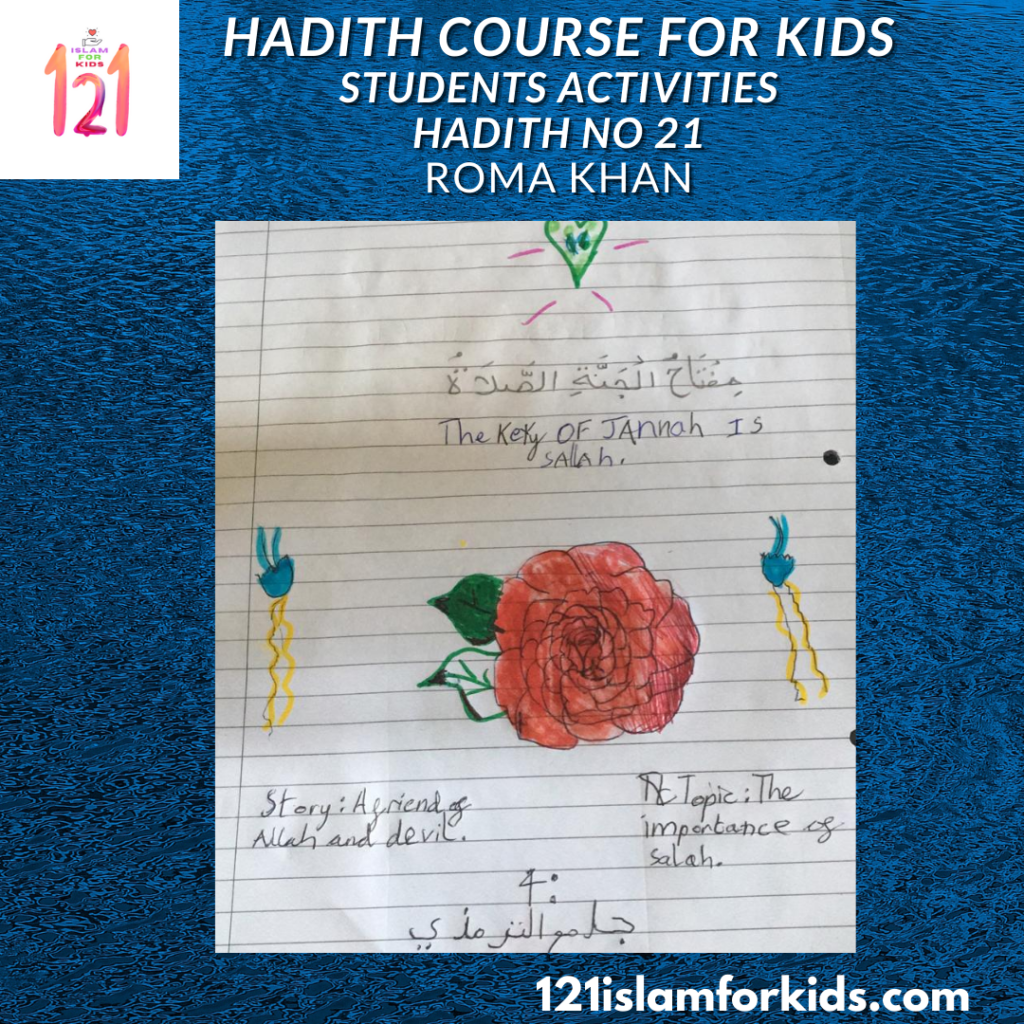
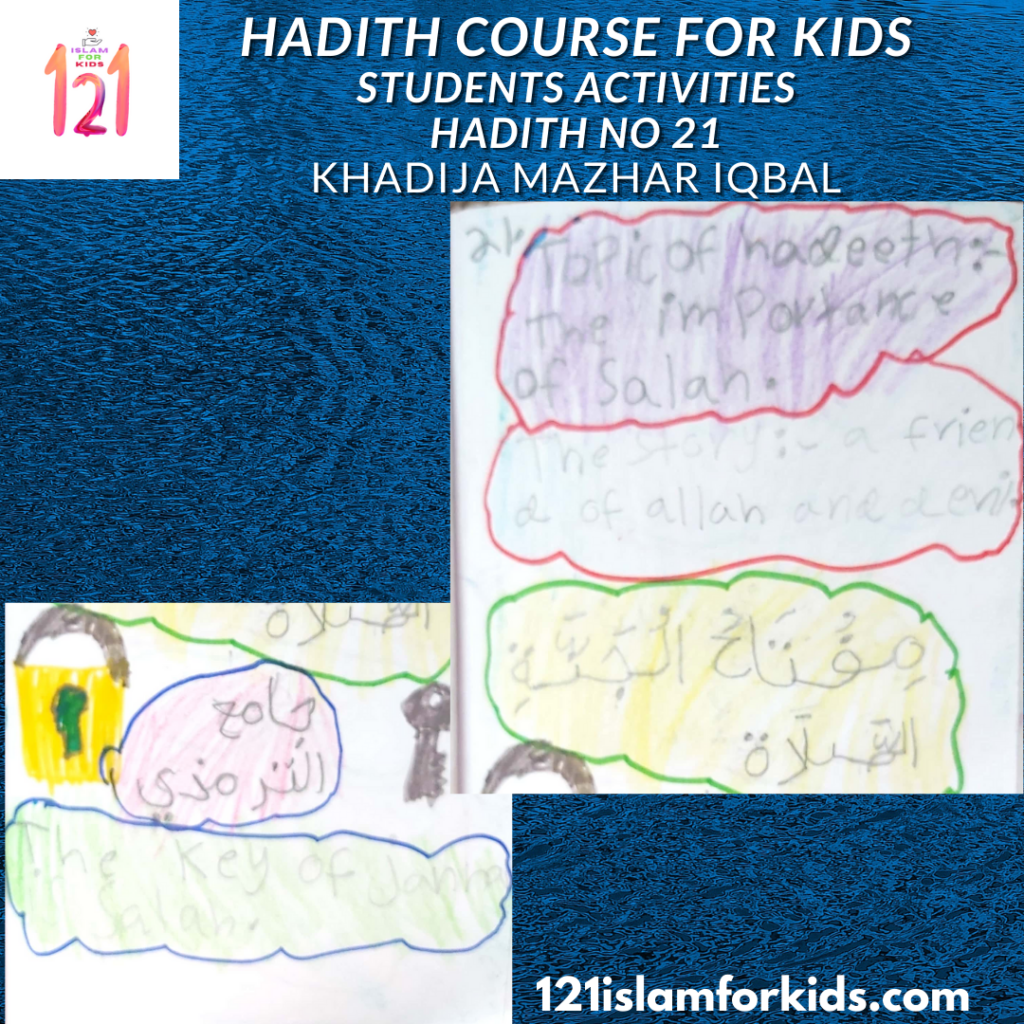
    Worksheet assignments by students

    islamic story

    islamic story

    islamic story

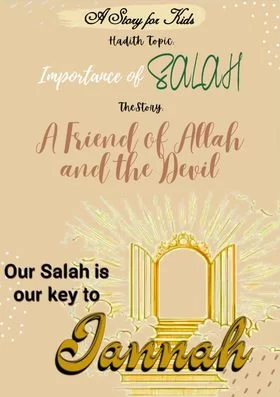
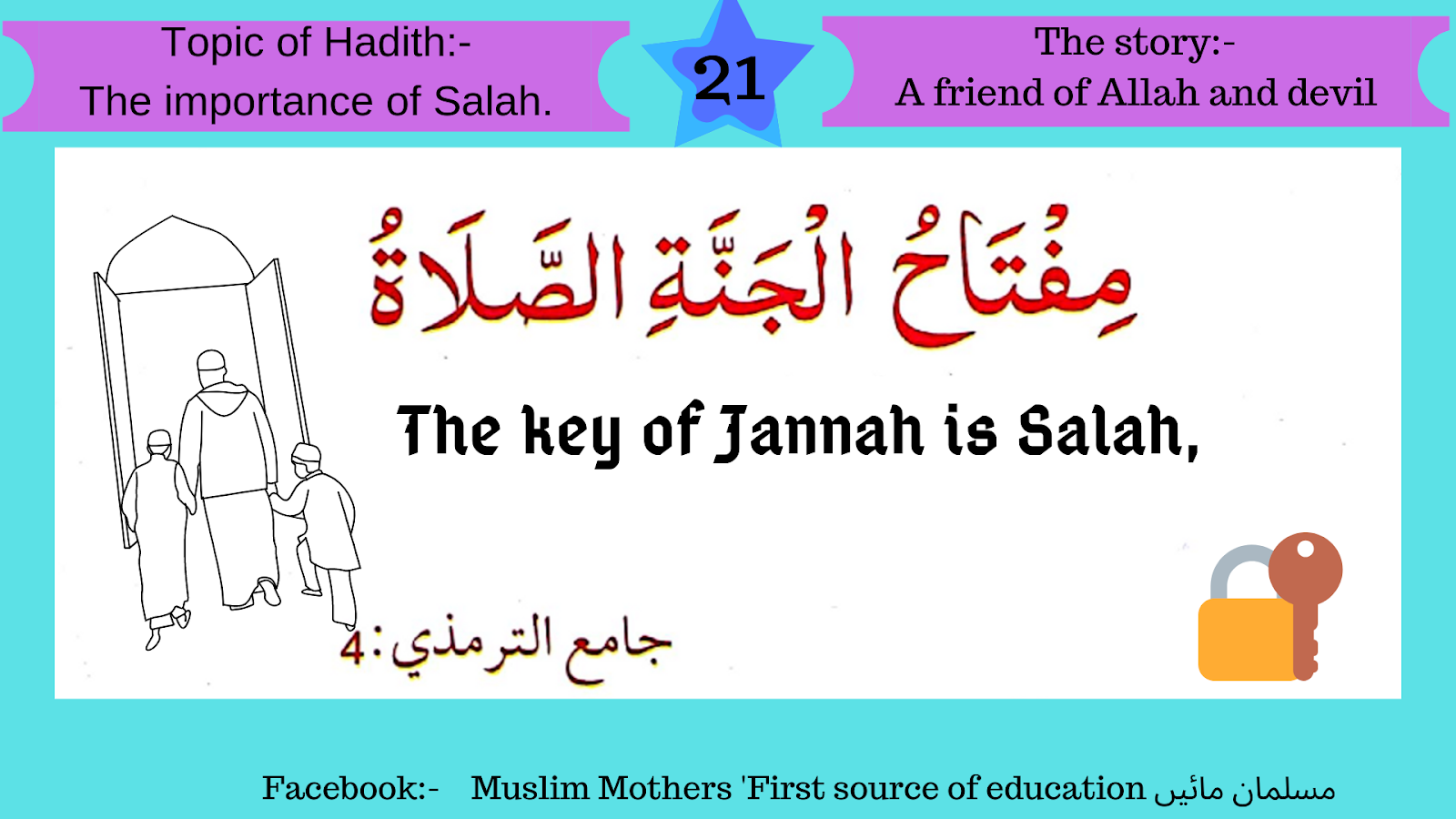
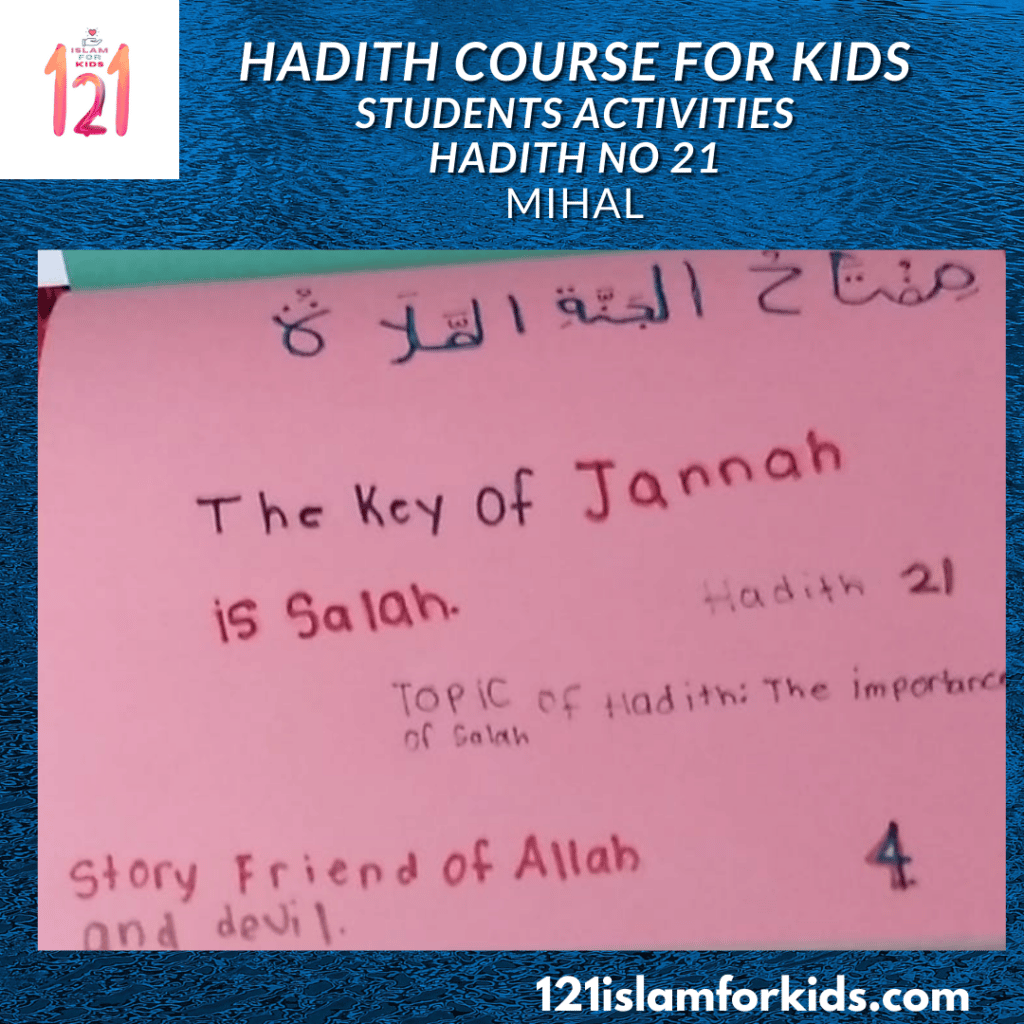
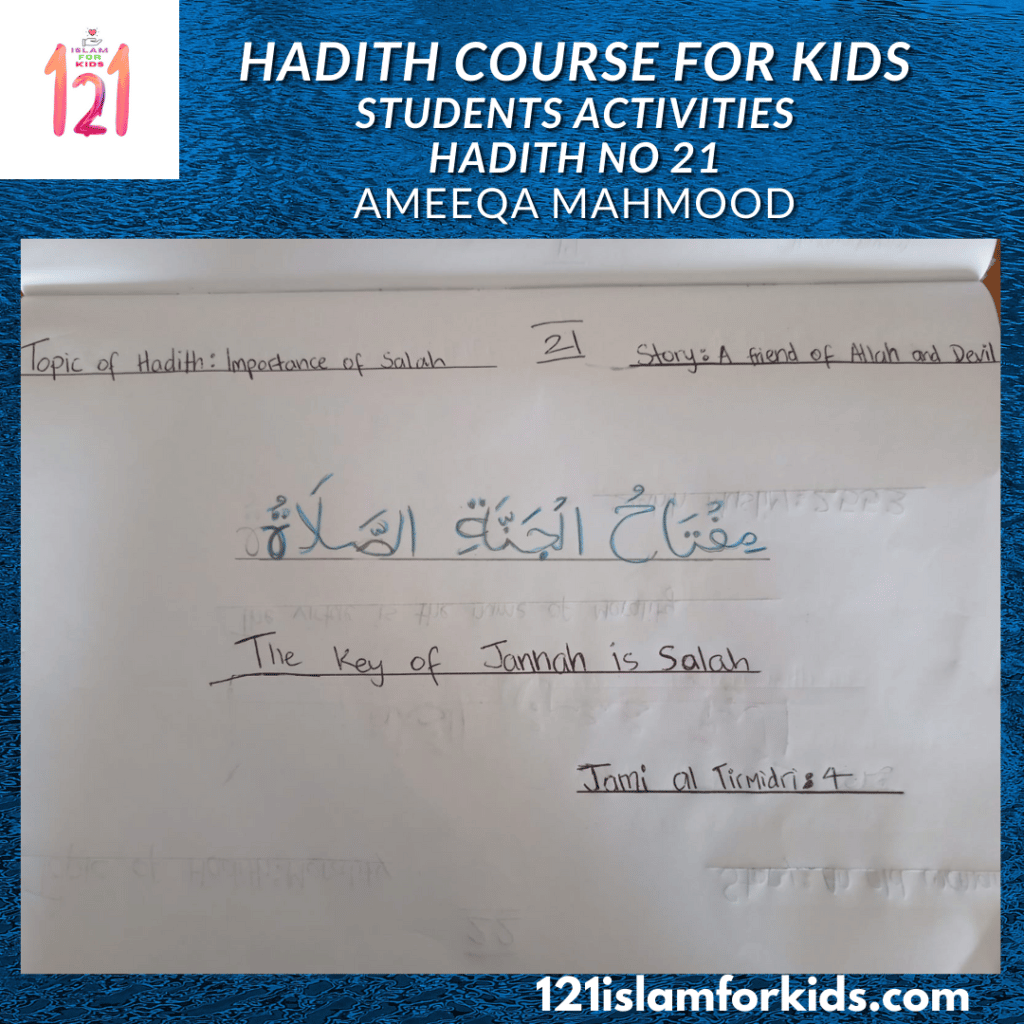
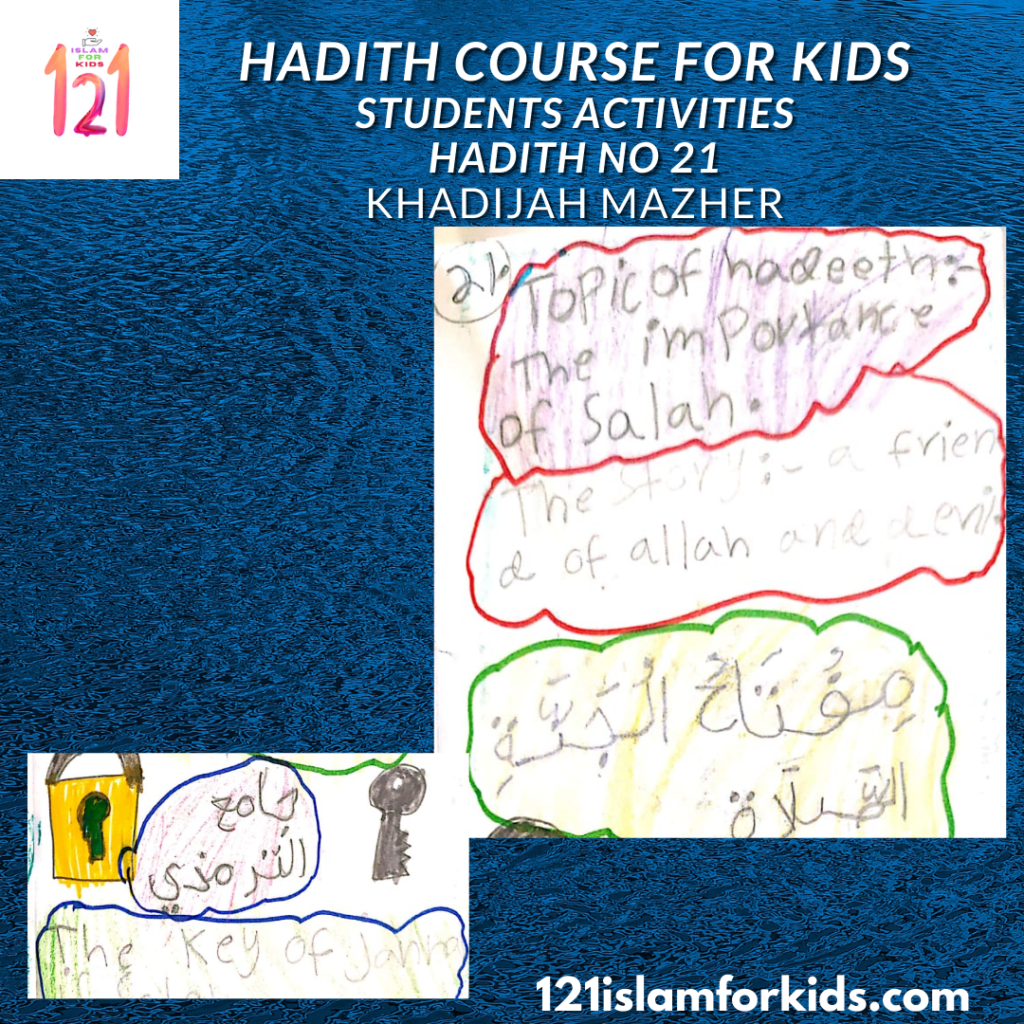
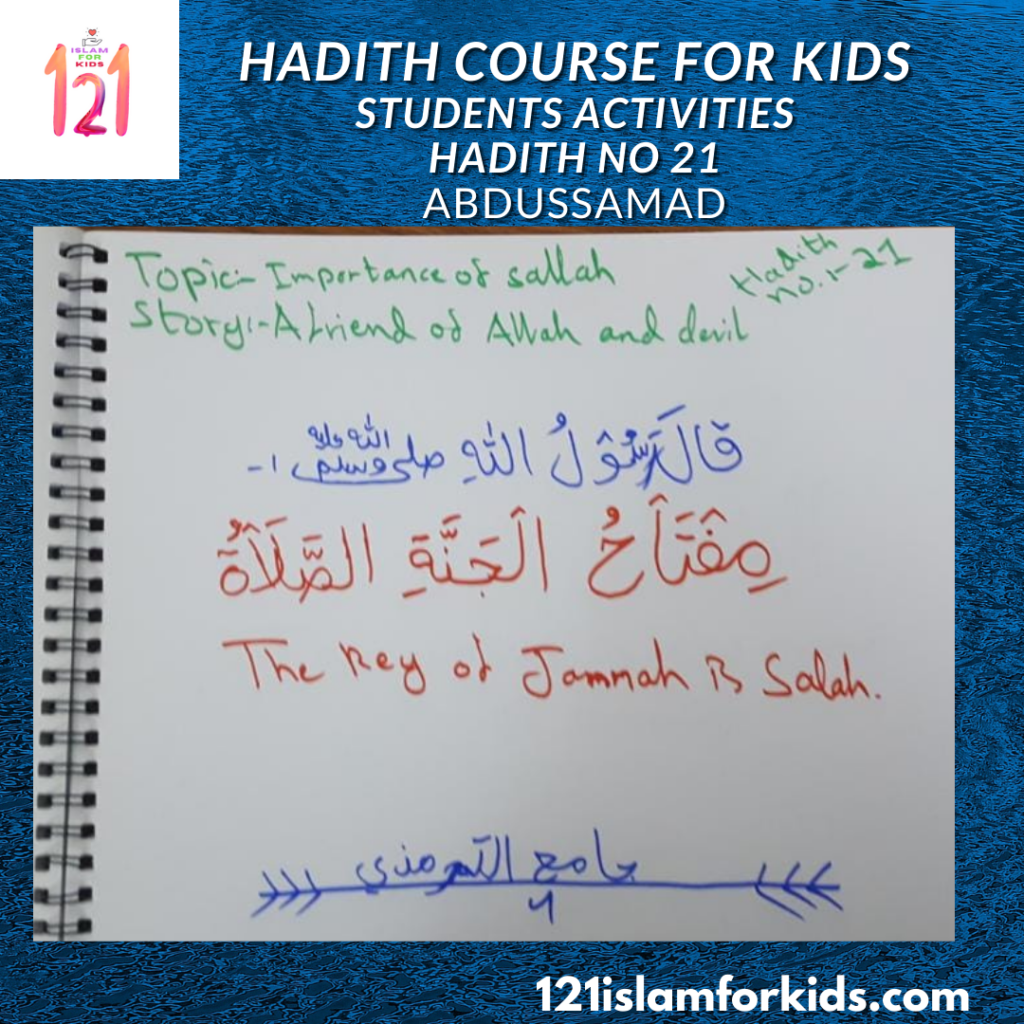
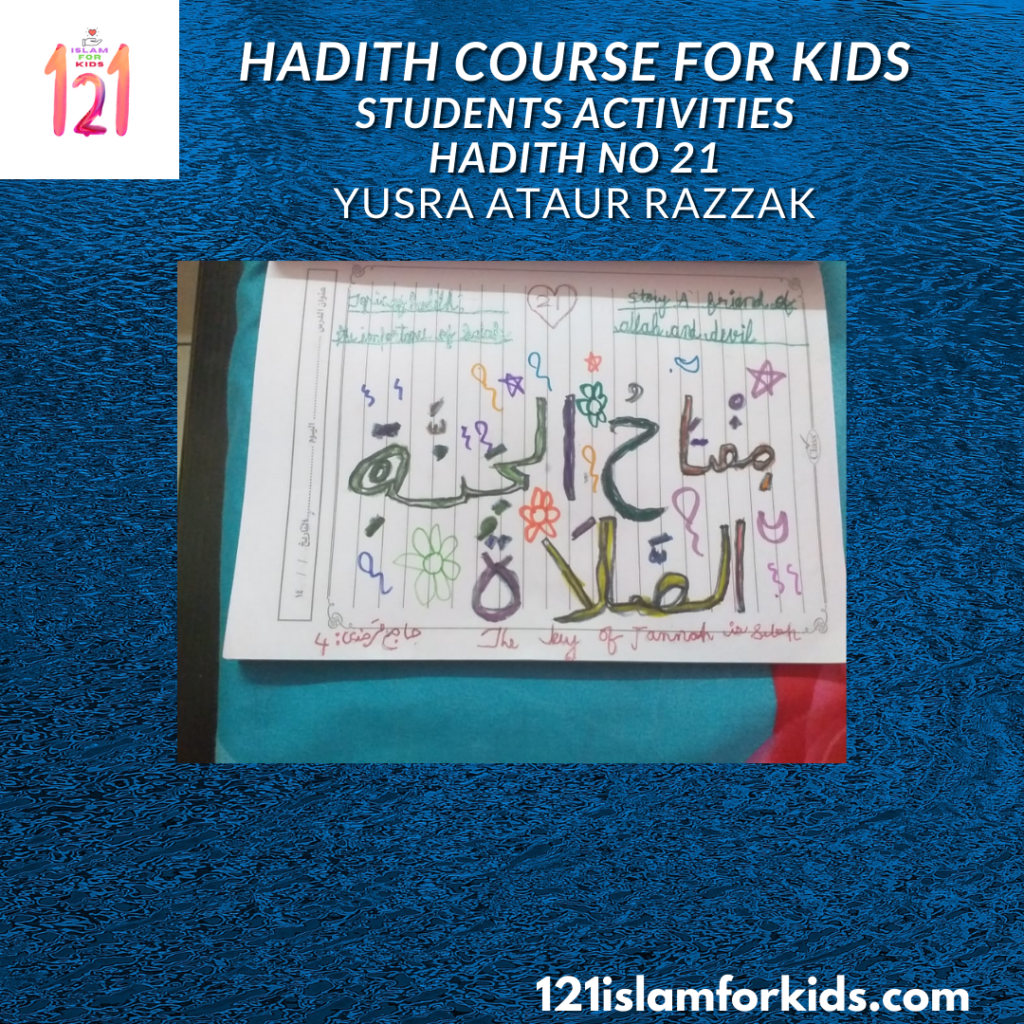
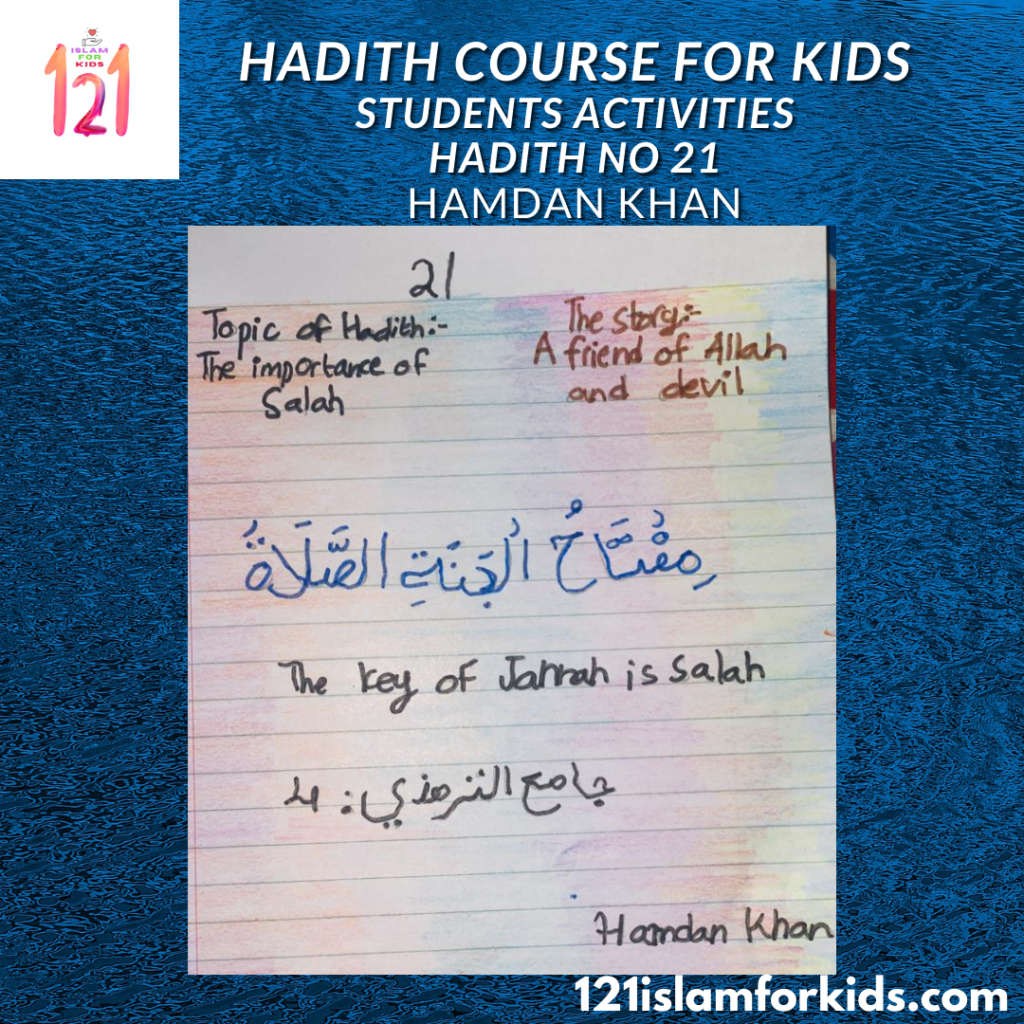
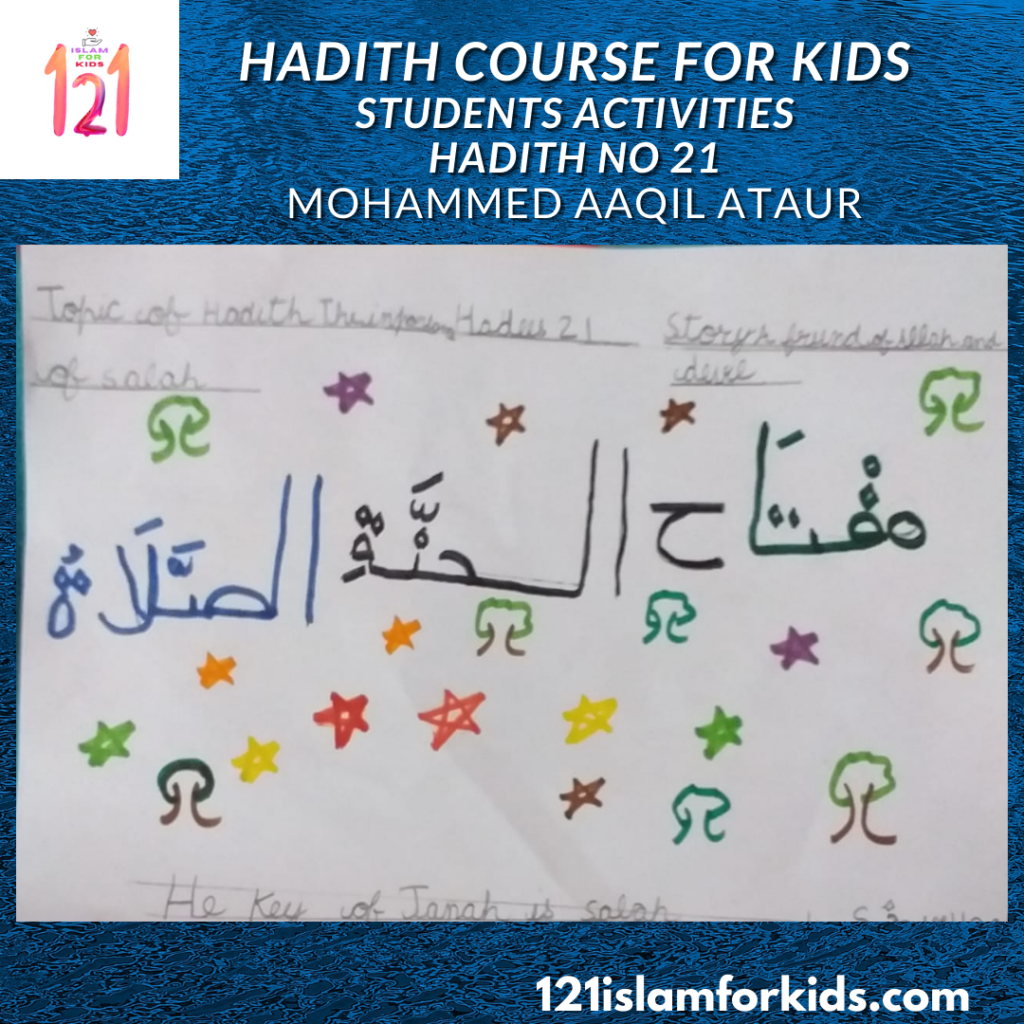
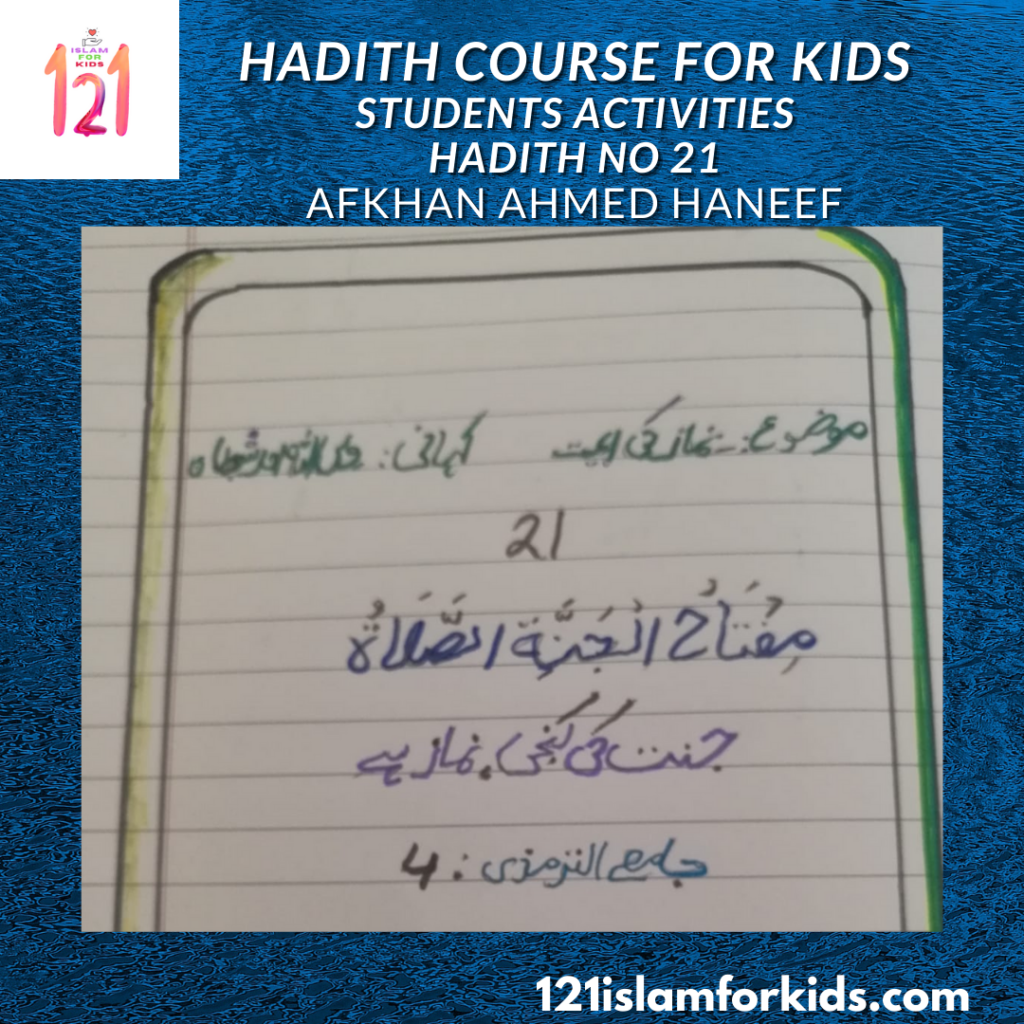
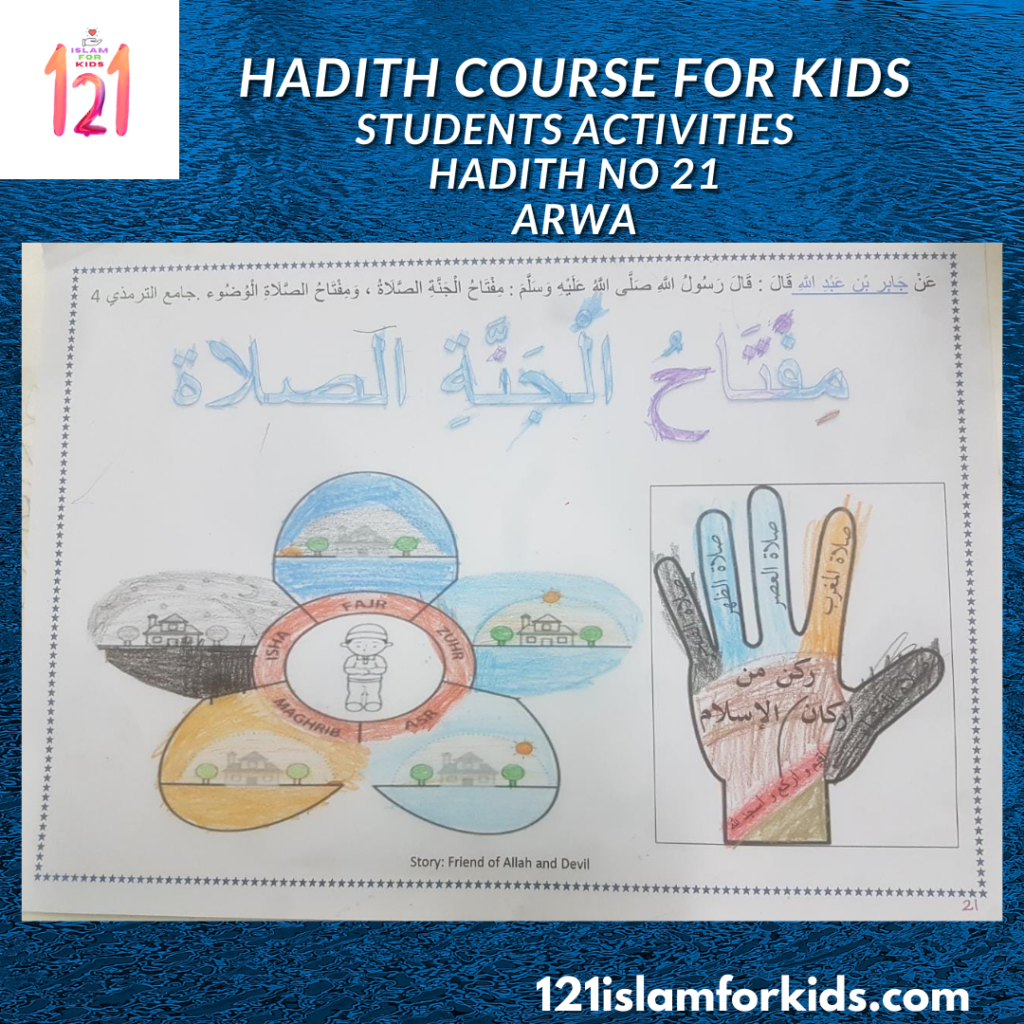
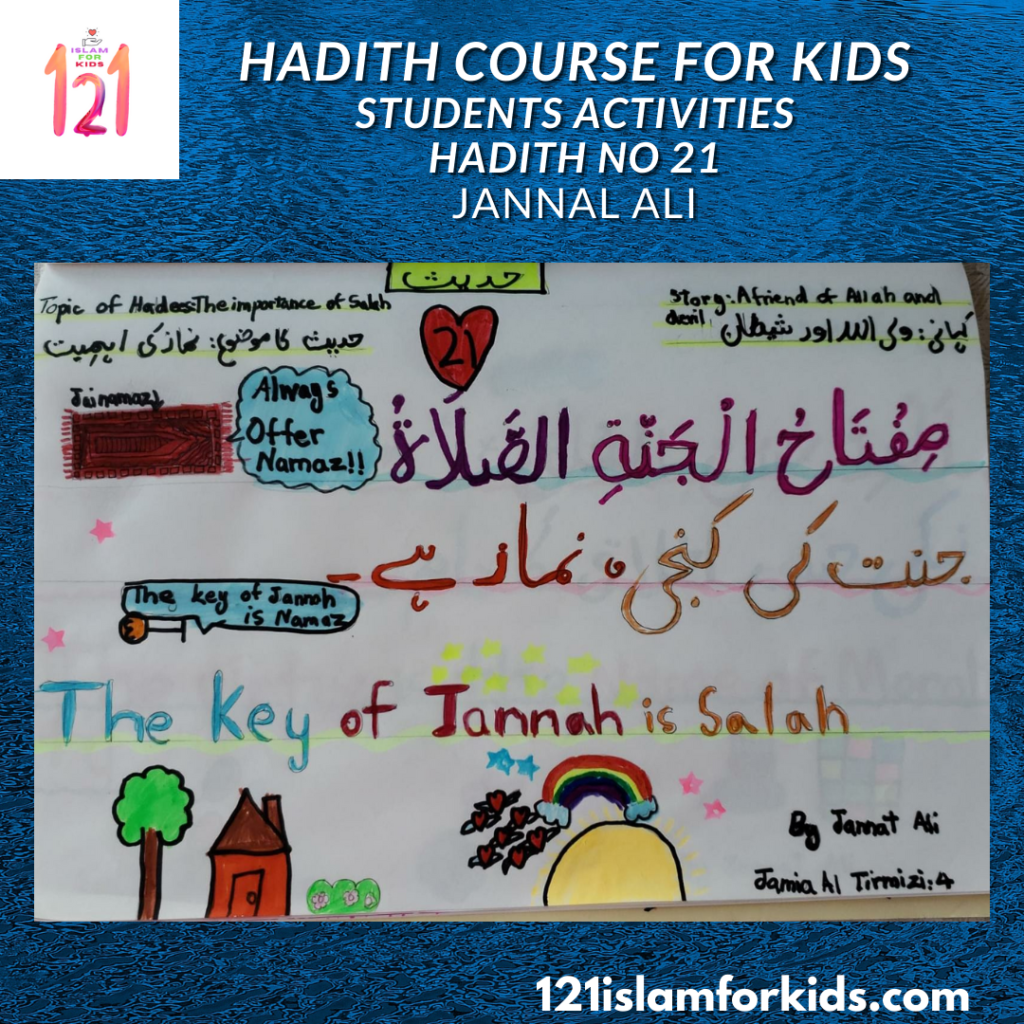
  • Story 21 Eng|Hadith What is the Importance Of Salah?

    Kitab-Ul-Hadith

    lesson no 22

    Hadith No 21  (Alhamdolilah) 

    A story about the Importance of Salah

    Welcome to our Hadith Classes Online

    We will provide you free 30-short Hadiths course with the introduction, stories, videos tips to teach, and worksheets

    Hadith Classes Online

    Aslam-o-Alikum!

    My dear students

    Our today’s topic of hadith is ”The importance of Salah

    Today’s Hadith is Jamia Al-Tirmidhi Hadith no 4 on Salah

    Hadith Classes Online

    My dear students, Salah is the second pillar of Islam and it is Farz. We can’t leave it in any condition. Because we will be asked about this. And if we will miss some or many prayers, Allah will not be happy. Salah is our Jannah, because it protects us from many other sins. I will tell you a story in which you will learn how shaytan tries to keep us away from Slat. 

    Once there was an old man. He was very poise and a true believer in Allah. Because of his Ibadah, Good character, and helpful nature, he became a good friend of Allah and Allah protected him from the Shetan. In the start, Shaytan was not happy with him. And later he became his worst enemy. Shaytan tried his best to indulge him in any sin but failed. He came to him with many tricks. He tried to mislead him many times but failed. Shaytan was not happy. There was a feeling of heartburn in satan

     ‘This old man would go into Jannah? No no never

    He made a final decision that he will not let this old man offer prayers. I will snatch his key to Jannah. I have to stop this man from offering prayer. Hooon ….. because his Salah is protecting him from me.

    So he thought of a very powerful trick and he decided what to do to keep that old man away from Salaah. 

    One Day, He comes to the old man in the face from an angle. He praised the old man. He said to him that Allah is very happy with him. And Allah sent me to you to give you news of Jannah. The old man was happy and asked again if it is true.

     He (the devil) Said ‘ yes, this is true because you are very kind to others and you are serving humanity. Your good deeds raised your status in the eye of Allah

    Allah Also appointed me to tell you that you are a true believer. Allah is happy with you. Your struggle to help people and offer prayer on time was a trial and you succeeded in it. So Allah says that now you are free to fulfill your rights. You don’t need to offer prayers. Instead, you should spend more time helping my people. The old man was not happy with this. He remains silent. His heart was not ready to believe in it. Then He thought something and stood up saying,

    Aouzo billahhe minashaitan nirajeem.

    And shouted  ‘

     get away from here you Mardood Shaytan.

     You are here to mislead me. It was you who denied the fulfilling order of Allah and did not prostrate. You are a big enemy of humans. . Allah had never said to his prophets to leave any prayer ever, then how would give me permission to do this?

    Shaytan was frightened and ran away. Finally, He was defeated. He never tried to come to this old man again. Now Allah SWT was happier with this old man. He increased BARAKAH in the health and time of this old man. 

    May Allah protect us from shytan.

    My dear students here is a good lesson for us, every time when we intend to do Wudu and offer our Salah, shytan doesn’t let but his Salah was protecting him from shaytan. us to do this. He creates many hurdles. Some time gets late to reach our Salah on time. But we don’t have to give up. Instead, we should be steady in our actions. 

    Because Our Salah is our key to JANNAH.

    Now Do write this hadith in your Hadith book.

    And make a beautiful Prayer checklist.

    Share the story of this hadith with your grandparents, friends, and people around you. 

    And don’t forget to send me your videos and activities about this hadith and story. ( comment )

    Aslam-o-Alikum. 

    Video of our Hadith classes online

    Workbook

    Students activities

    To Download a Pdf of these 30 Hadiths in Urdu and English. Comment Below. (Or download from here )

    Search All 30 hadiths with stories, videos, and Pictures in the Search box or scroll down.

    Online classes Hadith courses and Islamic studies for kids are Available. If you are interested then contact me for details.

    Other courses we have

    Quran classes for kids Online( Bigger age under 7, Intermediate, Advance level)

    Tafseer for short Surahs

    Seerat classes with Mind Maps and story Reading
    Hadith with stories course consists of 30 short hadith for children with interesting stories you can see that course in my hadith course tab.
    Prayer for kids courses is short courses to teach about taharat, Gusal, wudu, times of prayers, number and names of prayers, pillars and conditions of prayer, and method of prayer. Search as Prayer for kids course on the search bar.
    Kindness to Parents
    Ramzan Boost course
    Faith boost course in December to say NO MARYY CHRISTMAS

    Enrolments Available

    Tafseer for kids’ group classes is available online for all time zones. Recommended age for the class Tafseer for kids is 9+. These classes are available in English and Urdu. If you want to enroll your child in our classes contact us via.
    email: bhallitaha@gmail.com

    Facebook.

    Youtube Urdu Channel

    Youtube English Channel