More Than a Story: Teaching Our Children the Divine Console of Al-Isra’ wal-Mi’raj
As parents, we strive to equip our children with faith that is not only robust but also deeply personal. Few events in Islamic history offer a more profound foundation for this than the miraculous Night Journey and Ascension of Prophet Muhammad (peace and blessings be upon him): Al-Isra’ wal-Mi’raj.
This isn’t just a tale of travel; it is a demonstration of Divine love, reassurance, and the immense honor bestowed upon our Prophet during his darkest hour. Teaching it correctly provides children (ages 9-14) with essential lessons in perseverance, reliance on Allah, and the status of the salah (prayer).
Al-Isra’ wal-Mi’raj free story for kids
The Context: When Faith Was Faltering
Before diving into the miracle, it’s vital that children understand the human side of the Prophet’s journey. This event took place during the ‘Am al-Huzn’ (The Year of Sorrow), following the devastating losses of his beloved wife Khadijah and his protector, uncle Abu Talib.
When teaching this: Emphasize the human struggle. This shows our children that even the greatest people face immense hardship. Allah planned this journey specifically to console His Messenger and show him that his struggles were seen and honored. This frames the entire miracle not as a show of power, but as an act of profound mercy.
Core Lessons: Highlights for Your Child
To make this story stick, focus on the following key narrative highlights:
1. The Lightning Steed and the Assembly of Prophets
The Buraq: Introduce the magnificent creature, Al-Buraq, whose name means ‘lightning.’ This instantly captures a child’s imagination.
The Imam of Prophets: The Prophet’s first stop was Al-Masjid Al-Aqsa in Jerusalem, where he led all the previous Prophets—from Adam to Isa—in prayer. This moment officially confirmed his status as the leader of all mankind, validating the entirety of his mission to every other prophet’s mission.
2. Jibril’s True Form and the Limit of Creation
The Angel’s Appearance: On the journey, the Prophet witnessed Angel Jibril in his true, magnificent form—an angel with six hundred wings, spanning the horizon. This reveals the unbelievable scope of creation that exists beyond our world.
Sidrat-ul-Muntaha: When they reached the Lote Tree of the Utmost Boundary, Jibril stopped, stating that he could not advance further without being annihilated by the Divine Light. The Prophet continued alone. This highlights the unique honor and closeness the Prophet attained with Allah (SWT).
3. The Mercy of the Five Daily Prayers
This is the single greatest gift of the Mi’raj. Allah initially commanded fifty prayers daily. Through the advice of Prophet Musa (Moses), the Prophet repeatedly sought mercy until the number was reduced to five. Allah declared: “They are five (in number) but fifty (in reward).”
Teaching Point: Explain that we perform five acts of prayer, but receive the reward for fifty. This illustrates Allah’s unparalleled mercy and establishes the salah as our direct, personal connection to the Divine, a true gift from the Heavens.
How We Approach Miracles in 1-to-1 Online Teaching
At our 1-to-1 Islam for Kids Institute, we believe foundational stories must be taught through personalized, interactive methods. Simply reading the facts is not enough.
Our success in online education is built on:
Contextualization: We link the events of Al-Isra’ wal-Mi’raj directly to the seerah (Prophet’s biography), helping children understand why the miracle happened when it did.
Visual Engagement: We utilize digital illustrations and guided discussions (perfect for a one-on-one setting) to help students visualize Al-Buraq, the Seven Heavens, and the Sidrat-ul-Muntaha.
Application: We use activities and personalized worksheets to help students connect the story to their own salah practice and their efforts to avoid Shirk (associating partners with Allah)—two of the core gifts received during the Mi’raj.
This one-on-one attention ensures the learning is not passive, leading to high performance in both knowledge retention and practical application of Islamic values.
Your Invitation: Bring This Story to Life
We encourage you to read the full, amazing narrative of Al-Isra’ wal-Mi’raj to your children tonight. It is a story of hope, resilience, and reward.
To help you turn this narrative into a memorable educational experience, we invite you to join our FREE Storytelling Session on the Night Journey!
We’ll provide interactive activities, engaging discussion prompts, and custom-designed worksheets you can use at home.
Click the link below to join our WhatsApp community and secure your free spot:
WhatsApp: +30 693 138 2944
Let us work together to give our children a deep, loving appreciation for the wonders of Islam.
Indeed, it [i.e., Hellfire] will be closed down upon them
In extended columns.
Step-by-Step teaching method
Teaching Surah Al-Humazah (Chapter 104) comprehensively can be done through a structured step-by-step approach that incorporates various methods to engage learners. Here’s a suggested plan:
1. Introduction:
Begin by introducing the Surah’s name, Al-Humazah, and its significance.
Discuss the theme of the Surah, which focuses on the consequences of backbiting, slander, and arrogance.
2. Word Meaning and Tafsir:
Break down each verse, explaining the meanings of keywords and phrases.
Use resources like Ibn Kathir’s Tafsir to provide deeper insights into the context and interpretation of the Surah.
Encourage students to ask questions and engage in discussions to enhance their understanding.
3. Memorization:
Provide techniques for memorizing the Surah, such as repetition, visualization, and listening to recitations.
Break the Surah into smaller sections for easier memorization.
Encourage regular practice and revision to reinforce memorization.
4. Infographics and Mindmaps:
Create visually appealing infographics that summarize the key themes and messages of each verse.
Use mind maps to organize the main ideas and connections within the Surah, aiding in comprehension and retention.
5. Storytelling:
Narrate stories or anecdotes related to the theme of the Surah to make it more relatable and memorable.
Highlight examples from the life of Prophet Muhammad (peace be upon him) or other historical incidents that illustrate the consequences of backbiting and arrogance.
6. Activities:
Role-playing: Divide students into groups and assign roles to act out scenarios involving backbiting and its consequences, followed by discussions on alternative positive behaviors.
Art/crafts projects: Have students create artwork or posters depicting the Surah’s message using symbols and imagery. Like making a heart with wounds and stitching it or bandaging it.
Writing exercises: Ask students to write reflections or journal entries on how they feel when they get bad remarks. make a list of the sentences or words, you never like to hear for you.
7. Quiz and Exercises:
Create quizzes or worksheets to assess students’ understanding of the Surah’s content, including its meanings and lessons.
Incorporate interactive exercises such as fill-in-the-blank, matching, or true/false questions.
Provide feedback and review any areas where students may need clarification or additional support.
By following this structured approach, learners can gain a comprehensive understanding of Surah Al-Humazah while also developing their memorization skills, critical thinking abilities, and moral awareness.
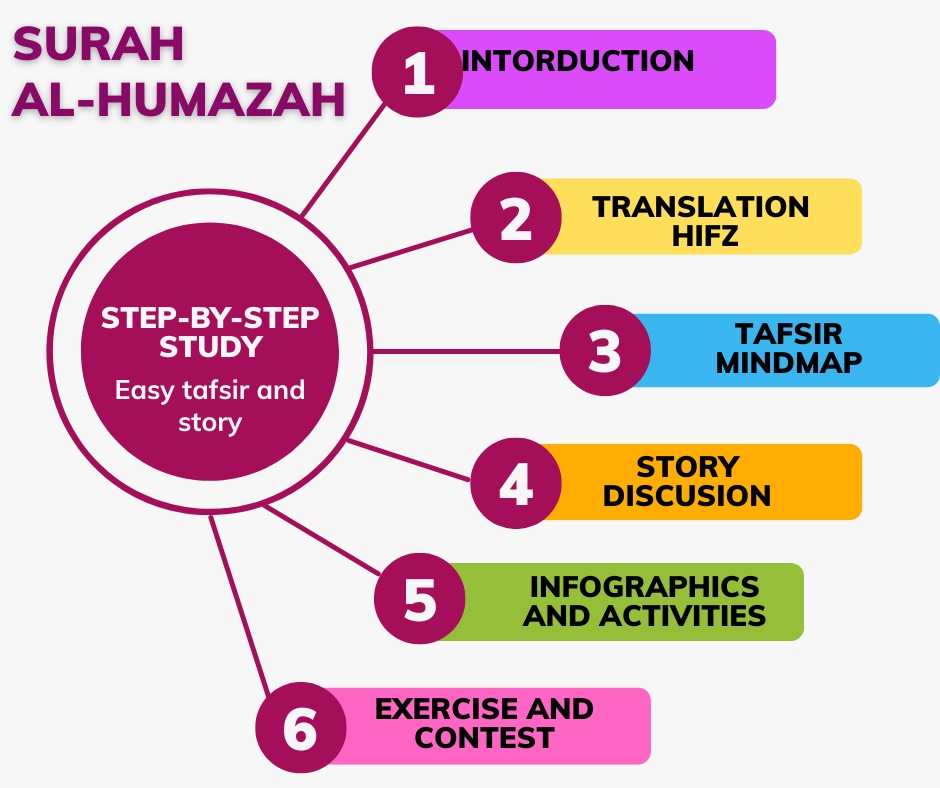
Let’s start Surah Al-Humazah Step-by-step study
1.Intorduction
Surah Al-Humazah was revealed in Makkah during the early period of Prophet Muhammad’s mission. Its revelation came as a response to the widespread mockery, slander, and arrogance prevalent among the Quraysh, particularly towards the Prophet and his followers.
According to Tafsir and Seerah books, some of the prominent figures in Makkah who were known for their mockery and slander against the Prophet and the early Muslims included:
Abu Lahab: He was the uncle of Prophet Muhammad and one of his staunchest opponents. Abu Lahab and his wife Umm Jamil were notorious for their hostility towards Islam and their relentless persecution of the Prophet and his followers.
Abu Jahl (Amr ibn Hisham): He was one of the leaders of the Quraysh and a fierce enemy of Islam. Abu Jahl was known for his arrogance, hostility, and relentless opposition to the Prophet and his message.
Muhammad ibn Ishaaq said: We continue to hear that this surah was revealed about Umayyah ibn Khalaf: He was a wealthy and influential figure in Makkah who openly opposed Islam and mistreated the early Muslims. Umayyah was known for his cruelty and disdain towards the Prophet and his followers.
‘Ata and Al-Kalbi said: This surah was revealed about Al-Akhnas ibn Shariq, who used to criticize people and gossip about them, especially the Messenger of Allah.
Muqatil said: This surah was revealed about Al-Walid ibn Al-Mughira, who used to gossip about the Messenger of Allah in his absence and mock him to his face.
Ibn Ashour said: This surah encompasses all polytheists who engaged in this act, whether their names are known or not.”
These individuals, along with others from the Quraysh tribe, actively engaged in mocking, ridiculing, and slandering the Prophet and his followers, seeking to discredit Islam and undermine its message. The Prophet Muhammad (peace be upon him) continued his mission undeterred, guided by the light of truth and compassion, while those who had opposed him were left to face the consequences of their deeds in the Hereafter Surah Al-Humazah was revealed to condemn their behavior and warn them of the consequences of their actions in the Hereafter.
2. Word-by-Word meaning and translation
بِسْمِ اللَّهِ الرَّحْمَٰنِ الرَّحِيمِ
In the name of Allah, the Entirely Merciful, the Especially Merciful.
Verse 1:
Arabic: وَيْلٌ لِكُلِّ هُمَزَةٍ لُمَزَةٍ
English: Woe to every scorner and mocker
يْلٌ (Woe)
لِكُلِّ (to every)
هُمَزَةٍ (scorner)
لُمَزَةٍ (mocker)
Verse 2:
Arabic: الَّذِي جَمَعَ مَالًا وَعَدَّدَهُ
English: Who collects wealth and [continuously] counts it.
الَّذِي (Who)
جَمَعَ (collects)
مَالًا (wealth)
وَعَدَّدَهُ (and [continuously] counts it)
Verse 3:
Arabic: يَحْسَبُ أَنَّ مَالَهُ أَخْلَدَهُ
English: He thinks that his wealth will make him immortal.
يَحْسَبُ (He thinks)
أَنَّ (that)
مَالَهُ (his wealth)
أَخْلَدَهُ (will make him immortal)
Verse 4:
Arabic: كَلَّا ۖ لَيُنبَذَنَّ فِي الْحُطَمَةِ
English: No! He will surely be thrown into the Crusher.
كَلَّا (No!)
لَيُنبَذَنَّ (He will surely be thrown)
فِي (into)
الْحُطَمَةِ (the Crusher)
Verse 5:
Arabic: وَمَا أَدْرَاكَ مَا الْحُطَمَةُ
English: And what can make you know what is the Crusher?
وَمَا (And what)
أَدْرَاكَ (can make you know)
مَا (what)
الْحُطَمَةُ (is the Crusher)
Verse 6:
Arabic: نَارُ اللَّهِ الْمُوقَدَةُ
English: It is the fire of Allah, [eternally] fueled,
نَارُ (fire of)
اللَّهِ (Allah)
الْمُوقَدَةُ (eternally fueled)
Verse 7:
Arabic: الَّتِي تَطَّلِعُ عَلَى الْأَفْئِدَةِ
English: Which mounts directed at the hearts.
الَّتِي (Which)
تَطَّلِعُ (mounts directed)
عَلَى (at)
الْأَفْئِدَةِ (the hearts)
Verse 8:
Arabic: إِنَّهَا عَلَيْهِم مُّؤْصَدَةٌ
English: Indeed, it [i.e., Hellfire] will be closed down upon them
إِنَّهَا (Indeed, it)
عَلَيْهِم (upon them)
مُّؤْصَدَةٌ (will be closed down)
Verse 9:
Arabic: فِي عَمَدٍ مُّمَدَّدَةٍ
English: In extended columns.
فِي (in)
عَمَدٍ (columns)
مُّمَدَّدَةٍ (extended)
3. Easy Tafsir of surah humazah
You’re correct, the Bismillah is not included in Surah Al-Humazah (Chapter 104) of the Quran. Here’s a detailed Tafsir of Surah Al-Humazah according to Ibn Kathir’s interpretation:
Verse 1: The word “Woe” is a severe warning from Allah to those who habitually engage in backbiting and slander. They are constantly looking for faults in others to mock and ridicule them.
“Woe” is a warning of punishment for those who habitually ridicule and mock others. This indicates that mocking and making fun of people is a serious offense in the sight of Allah. Imagine if you worked hard on a drawing and someone laughed at it. That’s not nice, right?
Verse 2: Allah describes the habit of such people, who amass wealth through any means possible and constantly count and hoard it as if their entire existence revolves around their wealth.
Verse 3: These individuals have the false belief that their wealth will grant them eternal life and happiness as if they will never face any consequences for their actions.
This verse talks about people who love to collect money and keep counting it all the time, thinking it’s the most important thing. It’s like someone who collects a lot of toys but never shares them with their friends.
Verse 4: Allah refutes this false belief with a resolute “No!” They will not live forever in luxury; rather, they will be cast into the Crusher, a place of severe punishment in the Hereafter.
Such a person believes that their wealth will make them immortal, showing their arrogance and false sense of security in their riches. But that’s not true because life is about more than just money. Even if you have lots of toys, you still need friends to play with.
Verse 5: The severity of this punishment is emphasized, prompting reflection on its terrifying nature.
This false belief is shattered by the reality of death and the Hereafter. They will be thrown into a crushing punishment Keep in mind, punishment is not just because of a lot of money or more toys. But it’s because of your arrogant behavior and showing off and denying to share it with others. It’s like when you build a sandcastle at the beach and then a big wave comes and washes it away.
Just suppose you have a variety of dishes to eat. And someone in your neighbor is very hungry. The aroma of food is spread. But instead of sharing food, you are being rude to him. How would you feel if it happened to you?
Verse 6: The Crusher is described as a fire kindled by Allah Himself, symbolizing the intense and unrelenting nature of the punishment awaiting the wrongdoers.
Verse 7: This fire will leap onto the hearts of the offenders, causing them unbearable agony and distress.
This fire burns so hot that it reaches right into people’s hearts, causing them pain and sadness. As they cause pain and sadness in the worldly life.
Verse 8: They will be trapped in this torment, unable to escape or find any relief from its heat and pain.
Verse 9: They will be confined in long columns in Hell, indicating the severity and permanence of their punishment, with no hope of reprieve.
Once they’re in this place, there’s no escaping it. It’s like being stuck in a room with no doors or windows. They will be stuck there in long lines, waiting and unable to leave. It’s like waiting in line for a ride at an amusement park, but this ride never ends, and it’s not fun at all.
In summary, Surah Al-Humazah serves as a stern warning against the sins of backbiting, slander, and arrogance, highlighting the severe consequences they entail in the Hereafter. It reminds believers to be mindful of their words and actions and to avoid harming others with their tongues or through their pursuit of worldly wealth.
4. Infographics/ Hifz(Memorization)
After covering two or three verses. children would be asked to make infographics of the verses. My first Quran with pictures has good infographics. Children can copy them or add their creativity and explain the theme of the verse with the help of drawing objects. (Please visit gallary to see the pictures made by our students.) During this children will start to memorise the verses by heart. We have verse-by-verse tajweed recitation videos. Children will practice and memorize with the help of these videos. (visit the youtube playlist for Tajweed recitation videos)
5. Mindmap
Here is a mindmap of the Surah Humazah
Surah Al-Humaza
Meaning
The mockers
Mindmap
KEY FACTS!!
Surah Al-Humazah
It is in juzz 30
It has 9 verses.
It is Makki Surah..
Three topics have been discussed in this Surah
Warning to mockers
Vanity of wealth
Punishments of Jahanam
V. 1 warning to mockers.
Woe to the one woe goal is to speak about other people.
ONE OF THE ETTIQUETTES OF ISLAM IS TO MIND YOUR BUN BASINESS. QURAN CRITICISES THE ONE WHO IS ALWAYS GOSSIPING
Verse 2-5
Vanity of wealth
He, who counts his own money and he thinks that his money will cause him to live forever.
THE PEOPLE WHO THINK LIFE IS PURELY TO A MALS HEALTH THEY DON’T THINK ABOUT DEATH
Verse 4-9:
Punishment of Jahanam.
That person will be thrown into the crushing fire.
Points to remember:.
Never look down on anyone..
Mocking is not allowed by anyone.
Keep a balance between earning and spending money.
Do not count money with greed.
Remember it!!!
If we will mock others and hurt others, hellfire will burn our hearts, as we were hurting others by mocking.
Transliteration The dua is transliterated as A’udhu bi kalimat-illah il-tammati min sharri ma khalaq.
Meaning in English The meaning of the dua for protection from the evil eye is I seek refuge in the perfect words of Allah from the evil of that which He has created.
6. Story of surah humazah:
There are two stories to explain this surah. The first story is the revelation story of the surah. This story can help students, why this surah was revealed. And how mocking and slandering and greedy habits of disbelievers of the Makkah were answered.
2nd story is crafted for children. The theme of the story is How mocking and greed of more can leave us alone. You can read this story at our site or watch the video of the story. The Link is down in resources.
Exercise based on Surah Al-Humazah:
Quiz:
What is the theme of Surah Al-Humazah? a) Mercy and forgiveness b) Backbiting and slander c) Gratitude and generosity
What does “Woe” in verse 2 signify? a) Happiness b) Warning c) Comfort
In verse 3, what do people mentioned collect excessively? a) Toys b) Wealth c) Knowledge
What false belief do the wrongdoers have in verse 4? a) Their wealth will make them immortal b) Their friends will protect them c) They will never face consequences
What is the Crusher mentioned in verse 5? a) A tool for building b) A punishment in the Hereafter c) A type of food
Exercise:
Memorize the Arabic text of Surah Al-Humazah.
Write a summary of the Surah’s message in your own words.
Reflect on a time when you may have engaged in backbiting or gossip. Write about how you felt afterward and what you learned from the experience.
Create an infographic or poster illustrating the consequences of backbiting and slander mentioned in the Surah.
Role-play a scenario where someone is being mocked or ridiculed. Discuss alternative ways the situation could have been handled with kindness and respect.
Write a short story or poem inspired by the theme of Surah Al-Humazah.
Discuss with a friend or family member how you can apply the lessons from Surah Al-Humazah in your daily life to avoid backbiting and arrogance.
(FAQs) about Surah Al-Humazah along with short answers:
1. What is the main theme of Surah Al-Humazah?
The main theme is the consequences of backbiting, slander, and arrogance.
2. What does “Woe” signify in verse 2?
“Woe” signifies a severe warning or impending punishment from Allah.
3. What do people mentioned in verse 3 collect excessively?
They collect wealth excessively and count it repeatedly.
4. What false belief do the wrongdoers have in verse 4?
They believe that their wealth will make them immortal and protect them from any harm.
5. What is the “Crusher” mentioned in verse 5?
The Crusher refers to a severe punishment in the Hereafter for those who engage in wrongdoing.
6. What is the punishment described in verse 7?
The punishment described is like a fire kindled by Allah Himself, symbolizing intense and relentless torment.
7. How can we apply the lessons from Surah Al-Humazah in our daily lives?
We can avoid backbiting, slander, and arrogance, and instead strive to be kind, respectful, and considerate towards others.
Before the month of Preparing for Ramadan, individuals, especially women, can adopt certain habits for both spiritual and physical growth. It’s important to note that the habits of Prophet Muhammad (SAW) are a source of inspiration for Muslims seeking a guide to living a balanced and fulfilling life.
Table of Contents
Preparing for Ramadan Habits
Spiritual Habits before Ramzan:
Increased Prayer and Dhikr (Remembrance of Allah):
Engage in extra prayers (Nafl) and increase your overall devotion.
Recite morning and evening supplications (duas) regularly.
Reading and Reflecting on the Quran:
Establish a routine for reading and reflecting on the Quran.
Try to complete the recitation of the Quran at least once before Ramadan.
Seeking Forgiveness and Repentance:
Repent for past mistakes and seek forgiveness from Allah.
Reflect on one’s actions and strive for self-improvement.
Charity and Acts of Kindness:
Increase acts of charity and kindness towards others.
Volunteer in the community or contribute to charitable causes.
Building Gratitude and Patience:
Practice gratitude for the blessings in your life.
Develop patience and tolerance through daily challenges.
Physical Habits Before Ramzan:
Balanced Diet and Hydration:
Adopt a balanced diet with a focus on nourishing foods.
Stay well-hydrated, especially during non-fasting hours.
Regular Exercise:
Engage in light to moderate exercise to maintain physical health.
Include activities like walking, stretching, or yoga.
Adequate Rest and Sleep:
Ensure sufficient and quality sleep to rejuvenate the body.
Develop a consistent sleep schedule.
Stress Management:
Practice stress-reducing activities, such as deep breathing or mindfulness.
Identify and manage sources of stress in daily life.
Prophet Muhammad’s (SAW) Habits Before Ramadan:
Certainly! Here are some Hadiths about the pre-Ramadan habits of Prophet Muhammad (SAW):
Increasing Fasting in Sha’ban:
Aisha (RA) reported: “I never saw the Messenger of Allah (SAW) fast for a whole month except in Ramadan, and I never saw him fast more than he did in Sha’ban.” (Sahih Muslim)
Devotion to Prayer in Sha’ban:
Aisha (RA) narrated: “The Messenger of Allah (SAW) would increase his prayer during the month of Sha’ban.” (Sunan an-Nasa’i)
Reflecting on Deeds:
Aisha (RA) reported: “The Prophet (SAW) used to fast all of Sha’ban. He said, ‘That is a month between Rajab and Ramadan which people neglect. It is a month in which deeds are presented before the Lord of the Worlds, so I like my deeds to be presented while I am fasting.’” (Sunan an-Nasa’i)
Intensified Worship in Sha’ban:
Usamah bin Zaid (RA) reported: “I said, ‘O Messenger of Allah! I do not see you fasting any month as much as Sha’ban.’ The Prophet (SAW) replied, ‘That is a month to which people do not pay much attention, between Rajab and Ramadan. It is a month in which the deeds are taken up to the Lord of the worlds, and I like that my deeds be taken up when I am fasting.’” (Sahih al-Bukhari)
Preparation for Ramadan:
Aisha (RA) narrated: “The Messenger of Allah (SAW) never fasted a full month apart from Ramadan, and I never saw him do more fasting in any month than he did in Sha’ban.” (Sunan Ibn Majah)
These Hadiths highlight Prophet Muhammad’s (SAW) dedication to fasting, prayer, and spiritual preparation in the month of Sha’ban, as well as his emphasis on the importance of this month in preparing for Ramadan. They serve as guidance for Muslims to follow in preparing themselves spiritually for the blessed month of Ramadan.
References to the habits of Prophet Muhammad (SAW) can be found in authentic Hadith collections, such as Sahih al-Bukhari and Sahih Muslim. Additionally, the Seerah (biography) of the Prophet provides insights into his daily life and practices. Scholars like Ibn Kathir and Ibn Hisham have documented these aspects in their works.
Ramzan Habits and Activities of the Companions:
Abu Bakr (RA):
Known for his exceptional generosity and charity.
Devoted to the service of Prophet Muhammad (SAW) and Islam.
Deeply committed to prayer and worship.
Umar ibn al-Khattab (RA):
Emphasized justice and fairness during his caliphate.
Established various administrative reforms for the welfare of Muslims.
Regularly engaged in seeking knowledge and understanding Islam deeply.
Uthman ibn Affan (RA):
Renowned for his piety and humility.
Sponsored the compilation of the Quran into a single book during his caliphate.
Instrumental in expanding Islamic territories through peaceful means.
Ali ibn Abi Talib (RA):
Known for his knowledge and wisdom.
Famed for his bravery and valor in battles.
Committed to upholding justice and defending the oppressed.
Habits and Activities of Imams and Scholars:
Imam Abu Hanifa (Rahimahullah):
Founded the Hanafi school of Islamic jurisprudence.
Emphasized the importance of reasoning (ijtihad) in legal matters.
Encouraged the pursuit of knowledge and understanding.
Imam Malik ibn Anas (Rahimahullah):
Established the Maliki school of Islamic jurisprudence.
Compiled the Muwatta, one of the earliest collections of Hadith.
Focused on the importance of community consensus (ijma) in legal rulings.
Imam Ash-Shafi’i (Rahimahullah):
Founder of the Shafi’i school of Islamic jurisprudence.
Advocated for the systematic study of Islamic law.
Stressed the importance of evidence from the Quran and authentic Hadith in legal rulings.
Imam Ahmad ibn Hanbal (Rahimahullah):
Founder of the Hanbali school of Islamic jurisprudence.
Known for his adherence to the Quran and Hadith in legal matters.
Endured persecution for his beliefs and principles.
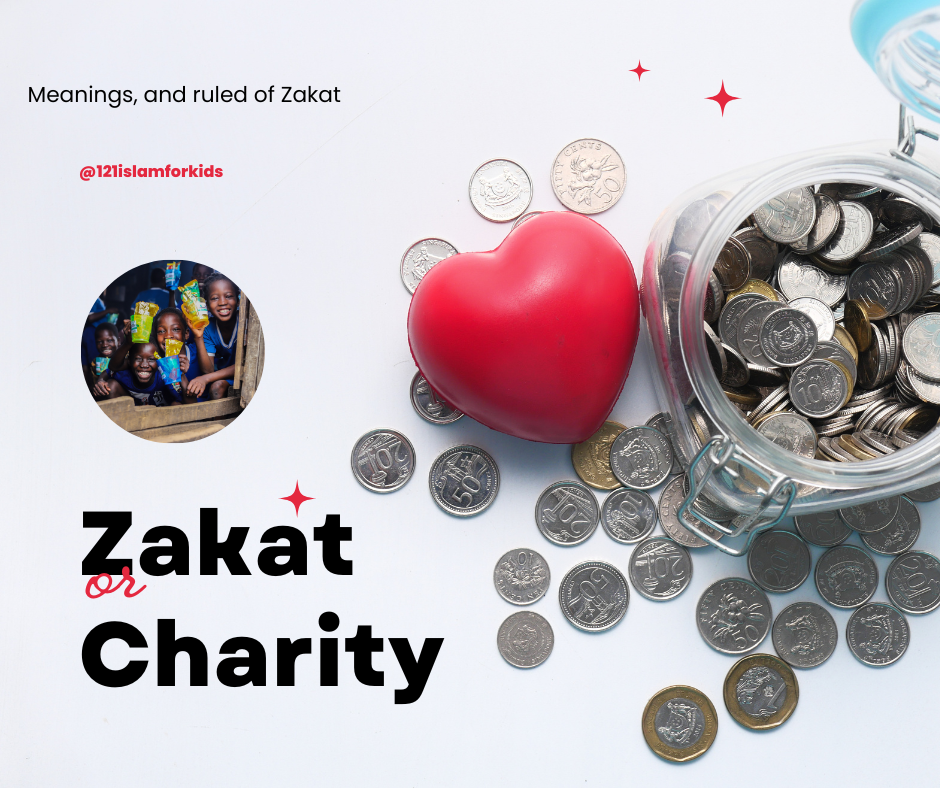
It’s obligatory to give charity in Islam. But do you know what the is difference between Charity Sadqa Zakat? And what are the rules for giving charity? Here a a complete guide to giving charity in Islam.
Table of Contents
Introduction to give charity in Islam:
Charity, known as “Sadaqah” in Islam, is a cornerstone of the faith, reflecting its core values of compassion, social justice, and community support. Giving charity holds profound meanings, is supported by numerous Quranic verses and Hadiths, and is guided by specific rules and principles. This article delves into the virtues and significance of charity in Islam, elucidating its meanings, exploring relevant Quranic verses and Hadiths, quoting renowned Islamic scholars, and providing a comprehensive understanding of the rules governing this noble act.
I. The Meanings of Charity in Islam
A. A Selfless Act of Giving
Charity in Islam signifies a selfless act of giving to those in need without expecting anything in return. It embodies the spirit of benevolence and empathy toward others, promoting a sense of community and social welfare.
B. A Means of Spiritual Growth
Charity is a path to spiritual growth and closeness to Allah (God). By giving generously, Muslims alleviate the suffering of the less fortunate and purify their souls, seeking blessings and forgiveness.
II. Quranic Verses on Charity
The Quran contains numerous verses that emphasize the importance and virtues of giving charity:
A. Surah Al-Baqarah (Chapter 2), Verse 267: “O you who have believed, spend from the good things which you have earned.”
This verse calls upon believers to share their earnings for the greater good, stressing the significance of giving from what is earned honestly and ethically.
B. Surah Al-Baqarah (Chapter 2), Verse 261: “The example of those who spend their wealth in the way of Allah is like that of a grain that sprouts seven ears, and in every ear, there are a hundred grains. Thus Allah multiplies the action of whomever He wills.”
This verse illustrates the abundant rewards and blessings that charity brings, highlighting the exponential growth of virtuous deeds.
III. Hadiths to give Charity in Islam
The Hadith, comprising the sayings and actions of the Prophet Muhammad, further emphasizes the importance of charity:
A. “Charity does not decrease wealth.” This Hadith conveys the notion that giving charity does not diminish one’s wealth. On the contrary, it brings spiritual and material rewards.
B. “The believers in their mutual kindness, compassion, and sympathy are like one body.” This Hadith illustrates the interconnectedness of believers, emphasizing that their collective compassion is akin to a unified body.
IV. Islamic Scholar Quotes on Charity
Renowned Islamic scholars throughout history have expounded on the significance of charity:
A. Imam Al-Ghazali: “Charity is a sign of faith, and whoever is not charitable has no faith.”
Imam Al-Ghazali underscores that charity is a fundamental expression of faith, serving as an indicator of one’s belief.
B. Ibn Qayyim Al-Jawziyya: “Charity given in secret extinguishes the wrath of the Lord.”
Ibn Qayyim Al-Jawziyya elucidates that giving charity privately not only aids those in need but also pleases Allah, quelling divine displeasure.
V. Rules of Giving Charity
Rules of Giving Zakat in Islam
Zakat is one of the Five Pillars of Islam and is a mandatory form of almsgiving. It is an act of worship and a means of wealth purification for Muslims. The rules of giving Zakat in Islam include:
Nisab Threshold: Zakat is obligatory for Muslims who possess wealth and assets beyond a specific threshold known as Nisab. The Nisab amount is determined based on the current value of silver or gold and may vary over time.
Eligible Recipients: Zakat must be given to specific categories of recipients, including the poor, the needy, those in debt, travelers in need, and others as defined in Islamic jurisprudence.
Calculation: Zakat is typically calculated as a specific percentage (usually 2.5%) of one’s eligible assets, which can include savings, investments, and certain types of income. The calculation is based on the assets held for one lunar year.
Intention and Sincerity: Giving Zakat should be done with the intention of fulfilling this religious obligation and seeking Allah’s pleasure. Sincerity is paramount.
Distribution: Zakat should be distributed directly to the eligible recipients or through reliable charitable organizations. It should not be used for administrative or overhead expenses.
Timing: Zakat can be given at any time during the year, but many Muslims choose to give it during the holy month of Ramadan.
Rules of Giving Charity (Sadaqah) in Islam
Charity, known as Sadaqah in Islam, is a voluntary act of giving to those in need and holds distinct rules from Zakat. These rules include:
Voluntary Nature: Sadaqah is entirely voluntary, and there are no specific thresholds or requirements for giving. It can be done at any time and in any amount.
Broad Eligibility: Sadaqah can be given to a wide range of recipients, including family, friends, neighbors, or any person in need. There are no strict criteria for eligibility.
Intention and Sincerity: Just like Zakat, giving Sadaqah should be done with a sincere intention and solely for the sake of Allah, seeking His pleasure.
Diversity of Forms: Sadaqah can take various forms, including financial donations, acts of kindness, volunteering, providing food, or assisting those in need through virtuous means.
Anonymity: It is highly commendable to give Sadaqah privately, without revealing the identity of the giver. Anonymity ensures the utmost sincerity and humility.
Regular Giving: Sadaqah can be given regularly and consistently, not limited to specific occasions or times of the year.
Both Zakat and Sadaqah play crucial roles in fulfilling the social and spiritual obligations of Muslims, and they complement each other in addressing the needs of the less fortunate while purifying the wealth of those who give. While Zakat is a mandatory form of almsgiving, Sadaqah offers greater flexibility and serves as a voluntary act of kindness and compassion.
Once upon a time, in a small village nestled between mountains and fields, three inseparable friends lived: Ahmed, Fatima, and Ali. Their days were filled with laughter and exploration as they ventured into the wonders of their surroundings. One sunny afternoon, while sitting beneath a large tree, they noticed an elderly man making his way toward them. His serene smile and wise eyes captivated their attention.
The old man introduced himself as Sheikh Mustafa, and he could sense the children’s eagerness to learn. He decided to share a profound story about the importance of monotheism and the rejection of polytheism, using the enlightening Surah Al-Ikhlas as a guiding light.
Sheikh Mustafa began, “Dear children, have you ever heard about the concept of monotheism? It means believing in the Oneness of Allah and recognizing that there is no deity worthy of worship except Him.”
Ahmed, Fatima, and Ali exchanged puzzled glances, expressing their curiosity. Sheikh Mustafa smiled and continued, “Surah Al-Ikhlas beautifully encapsulates the essence of monotheism. It teaches us that Allah is One, and there is nothing and no one comparable to Him. He is absolutely unique, with no partners, children, or equals.”
The children’s eyes widened in awe as they absorbed the profound teachings. Sheikh Mustafa explained, “Surah Al-Ikhlas invites us to reflect on the fact that Allah is eternal, and He exists independently, while everything else in the universe relies upon Him. He is the Creator, Sustainer, and Lord of all that exists.”
Amazed by this revelation, Ahmed, Fatima, and Ali began to understand the significance of monotheism in their lives. Sheikh Mustafa further clarified, “Polytheism, on the other hand, refers to the belief in multiple deities or associating partners with Allah. It is a deviation from the truth and leads to confusion and spiritual emptiness.”
As Sheikh Mustafa concluded his explanation, the children felt a newfound appreciation for the importance of monotheism. They recognized that embracing the concept of Oneness in their hearts and rejecting polytheism would bring them closer to Allah and fill their lives with purpose and tranquility.
Ahmed, Fatima, and Ali wholeheartedly pledged to recite Surah Al-Ikhlas every day, understanding that it served as a reminder of their commitment to monotheism. It became a cherished part of their daily routine, reinforcing their belief in the uniqueness of Allah and the rejection of false gods.
As the years passed, the trio faced challenges and uncertainties, but the message of Surah Al-Ikhlas remained steadfast within them. It reminded them to stay true to the path of monotheism, to turn to Allah in times of need, and to shun any form of polytheism.
The story of Ahmed, Fatima, and Ali serves as an enlightening example for children and adults alike, emphasizing the significance of understanding and embracing monotheism while rejecting polytheism. Surah Al-Ikhlas teaches us that Allah is the One and Only, deserving of our utmost devotion and worship. It instills in us a deep sense of gratitude, love, and reliance on Allah’s guidance and mercy.
So, my dear children, always remember the profound teachings of Surah Al-Ikhlas. Let it resonate in your hearts, illuminating your journey through life. Embrace the beauty of monotheism and reject any false paths. May Surah Al-Ikhlas inspire you to seek the Oneness of Allah and find solace in His love and guidance.
Here are 40 quotations from the Quran, along with their references: List of powerful Quran Verses with Verse numbers and Surah Numbers.
Table of Contents
40 quotations from the Quran
“In the name of Allah, the Most Gracious, the Most Merciful.” – Quran 1:1
“Allah does not burden a soul beyond that it can bear.” – Quran 2:286
“And whoever is conscious of Allah – He will make for him a way out.” – Quran 65:2
“Indeed, with hardship comes ease.” – Quran 94:6
“And your Lord is the Forgiving, Full of Mercy. If He were to impose blame upon them for what they earned, He would have hastened for them the punishment.” – Quran 18:58
“And whoever fears Allah – He will make for him a way out.” – Quran 65:3
“Call upon Me; I will respond to you.” – Quran 40:60
“So verily, with hardship, there is relief.” – Quran 94:6
“The ones who believe, and their hearts find comfort in the remembrance of Allah. Unquestionably, by the remembrance of Allah hearts are assured.” – Quran 13:28
“And your Lord is the Forgiving, the Most Merciful.” – Quran 18:110
“And do not kill the soul which Allah has forbidden, except by right.” – Quran 6:151
“And be not like those who forgot Allah, so He made them forget themselves.” – Quran 59:19″Do not despair of the mercy of Allah. Indeed, Allah forgives all sins.” – Quran 39:53
“And those who, when they commit an immorality or wrong themselves, remember Allah and seek forgiveness for their sins – and who can forgive sins except Allah?” – Quran 3:135
“And the servants of the Most Merciful are those who walk upon the earth easily, and when the ignorant address them [harshly], they say [words of] peace.” – Quran 25:63
“Indeed, with hardship comes ease.” – Quran 94:6″And your Lord is the Forgiving, the Merciful.” – Quran 85:14
“And rely upon the Ever-Living who does not die.” – Quran 25:58
“He is with you wherever you are.” – Quran 57:4
“Allah does not change what is in a people until they change what is in themselves.” – Quran 13:11
“And whoever is grateful is grateful for [the benefit of] himself.” – Quran 31:12
“O you who have believed, seek help through patience and prayer. Indeed, Allah is with the patient.” – Quran 2:153
“And those who say, ‘Our Lord, grant us from among our wives and offspring comfort to our eyes and make us an example for the righteous.’” – Quran 25:74
“Say, ‘He is Allah, [Who is] One, Allah, the Eternal Refuge. He neither begets nor is born, nor is there to Him any equivalent.’” – Quran 112:1-4
“The example of [a deed] driven by ignorance is like the one who calls upon one who hears nothing except screams.” – Quran 2:171
“And He is with you wherever you are.” – Quran 57:4″And Allah is the best of providers.” – Quran 62:11
“So remember Me; I will remember you.” – Quran 2:152
“To Allah belongs whatever is in the heavens and whatever is on the earth.” – Quran 24:64
“And whoever relies upon Allah – then He is sufficient for him.” – Quran 65:3
“Do not consume one another’s wealth unjustly or send it [in bribery] to the rulers in order [for them] to [help] you [in the unlawful seizure of the prop
erty] of the [other] people.” – Quran 2:188
“And be not like those who forgot Allah, so He made them forget themselves.” – Quran 59:19
“And your Lord is the Forgiving, Full of Mercy.” – Quran 18:58
“Indeed, Allah is with those who fear Him and those who are doers of good.” – Quran 16:128
“And establish prayer and give zakah and bow with those who bow [in worship and obedience].” – Quran 2:43″
And never say of anything, ‘Indeed, I will do that tomorrow,’ except [when adding], ‘If Allah wills.’” – Quran 18:23-24
“Say, ‘If the sea were ink for [writing] the words of my Lord, the sea would be exhausted before the words of my Lord were exhausted, even if We brought the like of it as a supplement.’” – Quran 18:109
“Say, ‘O My servants who have transgressed against themselves [by sinning], do not despair of the mercy of Allah. Indeed, Allah forgives all sins. Indeed, it is He who is the Forgiving, the Merciful.’” – Quran 39:53
“But perhaps you hate a thing and it is good for you; and perhaps you love a thing and it is bad for you.” – Quran 2:216
“And take provisions, but indeed, the best provision is Taqwa (piety, righteousness).” – Quran 2:197
Here are some verses that highlight these attributes:
Allah Loves the Righteous: “Indeed, Allah loves those who are constantly repentant and loves those who purify themselves.” (Quran 2:222)
Allah Loves the Just: “Allah does not like wrongdoing.” (Quran 2:205)
Allah Loves the Patient: “And Allah loves the steadfast.” (Quran 3:146)
Allah Loves Those Who Trust Him: “And Allah loves the steadfast.” (Quran 3:159)
Allah Loves the Doers of Good: “Indeed, Allah loves the doers of good.” (Quran 3:134)
Allah Loves Those Who Trust in Him: “And put your trust in Allah. And Allah is sufficient as Disposer of affairs.” (Quran 33:3)
Allah Loves Those Who Repent: “For Allah loves those who are constantly repentant and loves those who purify themselves.” (Quran 2:222)
Allah Loves Those Who Are Just and Kind: “And do not let the hatred of a people for having obstructed you from the Sacred Mosque lead you to transgress. But help one another in righteousness and piety, but do not help one another in sin and aggression. And fear Allah; indeed, Allah is severe in penalty.” (Quran 5:2)
These are just a few verses from the Quran.
The Quran is a rich source of guidance, wisdom, and inspiration for Muslims and people of various backgrounds.
Umrah and Hajj Packages 2023 from the USA: A Complete Guide Choosing the Right Agency for Your Sacred Journey and select your plan according to your budget.
Table of Contents
Introduction: Hajj packages 2023 from USA
The Hajj, one of the Five Pillars of Islam, is a sacred pilgrimage to the holy city of Mecca in Saudi Arabia, and it is an obligation for every capable Muslim to undertake at least once in their lifetime. Muslims from all over the world travel to Mecca to fulfill this religious duty, including those from the United States. Planning a Hajj pilgrimage requires careful consideration, as it involves numerous logistical, religious, and cultural aspects. This article provides a comprehensive guide to selecting the right Hajj package from the USA, including information on agencies, package types, pricing, and essential considerations.
I. Understanding Hajj and Its Significance
1.1 The Significance of Hajj
Hajj is a profound religious journey that holds immense spiritual significance in Islam. It symbolizes the submission to Allah, and unity among Muslims, and commemorates the experiences of Prophet Ibrahim and his family, particularly the willingness to sacrifice for the sake of faith. As one of the Five Pillars of Islam, the Hajj is obligatory for those who meet the criteria.
1.2 Hajj Preparation
Preparing for the Hajj involves several key steps, including:
Determining eligibility: Pilgrims must be physically and financially capable, and free from any debts or obligations that could hinder their journey.
Obtaining a visa: All pilgrims traveling from the USA must acquire the necessary visa for entry into Saudi Arabia.
Health and vaccination requirements: Complying with health regulations and obtaining necessary vaccinations is crucial.
Booking a Hajj package: Selecting a reputable agency to facilitate your pilgrimage is a crucial step.
II. Choosing the Right Hajj Package
2.1 Understanding the Types of Hajj Packages
Hajj packages can vary in terms of services, accommodation, transportation, and overall experience. The primary types of Hajj packages from the USA include:
Group packages: These are organized by agencies and involve traveling with a group of fellow pilgrims. Group packages often offer a cost-effective and structured approach to the Hajj.
Private packages: Private packages provide more flexibility, allowing you to customize your pilgrimage experience. This can be a preferred option for those seeking a more personalized journey.
2.2 Factors to Consider When Selecting a Hajj Package
When choosing a Hajj package from the USA, consider the following factors:
Reputation of the agency: Research the agency’s track record, customer reviews, and certifications to ensure reliability and trustworthiness.
Package details: Review the specific services and accommodations included in the package, including the quality of hotels, transportation, and meal arrangements.
Pricing: Compare package prices and ensure they align with your budget. Keep in mind that packages can vary significantly in cost.
Itinerary: Examine the detailed itinerary to understand the daily activities and rituals included in the package.
Group size: For group packages, consider the number of fellow pilgrims in your group, as this can impact the level of individual attention and comfort.
Distance from Haram: The proximity of your accommodation to the Holy Mosque in Mecca (Haram) can significantly impact the convenience of your pilgrimage.
III. Agencies Offering Hajj Packages from the USA
3.1 Notable Hajj Agencies in the USA
There are numerous reputable agencies in the USA that specialize in organizing Hajj packages. Some of the well-known agencies include:
Dar El Salam: A prominent agency with years of experience in facilitating Hajj and Umrah journeys.
Adam Travel: Known for its well-organized group packages and personalized services.
Dawn Travels: Offers a variety of packages and has a strong online presence for easy booking and information.
Al-Hashar: Known for its commitment to pilgrims’ comfort and satisfaction.
3.2 Research and Due Diligence
When selecting an agency, conduct thorough research and due diligence to ensure the agency is licensed and accredited. Seek recommendations from friends, family, or community members who have previously undertaken the Hajj. Reading reviews and testimonials can provide valuable insights into the experiences of past pilgrims with a particular agency.
IV. Hajj Package Pricing
4.1 Understanding the Cost of Hajj Packages 2023/2024
The cost of a Hajj package can vary significantly depending on factors such as the type of package, the quality of accommodations, the proximity to the Haram, and the agency’s reputation. As of 2023, 2024, a basic group Hajj package from the USA can range from $6,000 to $8,000 or more, while private packages tend to be more expensive.
4.2 Hidden Costs
When evaluating the pricing of Hajj packages, be aware of potential hidden costs, including:
Visa fees: The cost of the Saudi Arabian visa is often separate from the package price.
Zabiha (sacrifice): If not included in the package, you may incur additional costs for the ritual sacrifice of an animal.
Travel insurance: It is advisable to have travel insurance, which may not be included in the package.
V. Important Considerations
5.1 Early Booking
To secure your preferred Hajj package, it is recommended to book well in advance. Agencies often have limited spots, and early booking ensures better choices in terms of accommodations and group size.
5.2 Health and Safety
Before embarking on your journey, consult with a healthcare professional to ensure you are in good health and have received any required vaccinations. Additionally, familiarize yourself with safety protocols and health guidelines related to the Hajj.
5.3 Spiritual Preparation
The Hajj is a deeply spiritual journey, and it is essential to prepare both physically and mentally. Study the rituals and significance of Hajj, engage in prayer and supplication, and seek guidance from religious scholars or leaders.
Conclusion
Selecting the right Hajj package from the USA is a crucial step in your sacred journey to Mecca. It is essential to research and choose a reputable agency that aligns with your budget, preferences, and expectations. With proper planning and preparation, your Hajj experience can be a spiritually enriching and fulfilling one, allowing you to fulfill this important religious duty with ease and peace of mind.
This new Islamic Story a Reflection of the Surah Al-Bayyinah: This story has been crafted to teach Surah Al-Bayyinah in a very interesting and reflectiong methods. We encourage our students to craft their own Islamic stories after learning these short Surahs of the Quran. These are our online classes for teens/preteens and bigginers. More detail is available in the link below.
Table of Contents
Title: The Clear Sign – A Story of Farid and the Wise Sage (islamic stories)
In a peaceful village nestled between rolling green hills, there lived a curious and kind-hearted boy named Farid. Farid’s days were filled with wonder and questions about the world around him. One sunny morning, a wise and elderly traveler from a distant land arrived in their village, known as the Sage of Clarity.
Word spread like wildfire through the village, and soon, the villagers gathered around the sage, eager to hear his wisdom. Among the crowd, Farid was particularly intrigued by the idea of “The Clear Sign,” something he had never heard of before.
After a while, as the villagers eagerly listened to the sage’s words, Farid quietly slipped away and made his way toward the wise sage. Respectfully, he asked, “Honorable Sage, could you please explain to me what ‘The Clear Sign’ is?”
The sage looked down at Farid with a gentle smile and said, “Of course, young one. ‘The Clear Sign’ is like a guiding light, a beacon of truth and wisdom from Allah.”
Farid was genuinely interested now. “How can one find ‘The Clear Sign,’ and why is it so important?” he inquired.
The sage responded, “You find ‘The Clear Sign’ by seeking wisdom in the Quran, a book that contains Allah’s guidance and the keys to a good and righteous life. But remember, it’s not enough to just read the words; you must also understand and live by its teachings.”
Farid’s eyes sparkled with curiosity. “How can I make sure that ‘The Clear Sign’ shines in my heart?” he asked eagerly.
The wise sage continued, “To keep ‘The Clear Sign’ bright in your heart, you must act with honesty and kindness. These qualities are like the fuel that ignites the light of Allah’s wisdom within you. When you follow these virtues, you share the light of ‘The Clear Sign’ with others.”
Farid took this advice to heart and understood that merely reading the Quran was not enough. To truly bask in the radiance of “The Clear Sign,” he had to delve deep into its meanings and act upon its teachings.
As the wise sage shared stories about people who had received Allah’s guidance through scriptures, Farid learned that while some had embraced it with open hearts, others had turned away. “But why,” Farid wondered, “would anyone turn away from such a wonderful light?”
The sage explained, “Fear of change and a desire to hold onto power or old beliefs can lead some astray. That’s why it’s crucial to keep your heart open to the wisdom of ‘The Clear Sign.’”
From that moment forward, Farid was determined to live a life of honesty and kindness. He knew that these qualities were key to understanding and spreading the light of “The Clear Sign.” Farid not only read the Quran but also made an effort to comprehend its deeper meanings and act upon its teachings.
As Farid grew older, he continued to be a beacon of light and goodness in his community. His life’s mission was to embody “The Clear Sign” and help others understand that reading the Quran was just the beginning. True success in this life and the hereafter came from deeply comprehending its teachings and living by them.
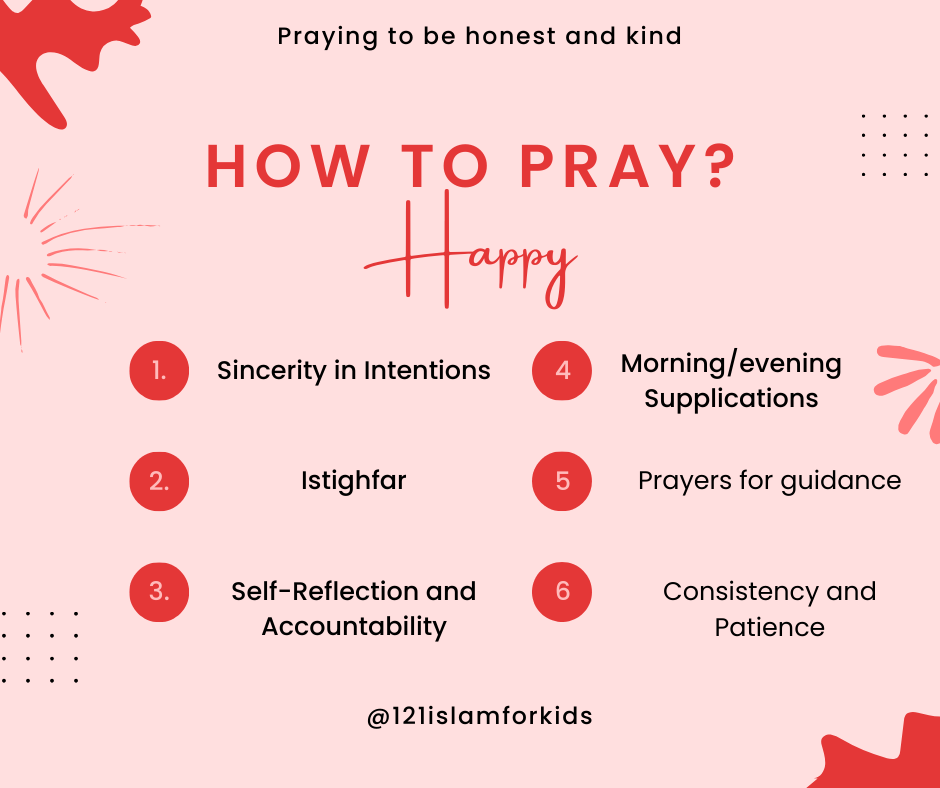
Praying to be honest and kind is a noble intention. Let’s learn, How to Pray. You can incorporate this into your daily prayers and life by following these steps and using relevant supplications (duas): Let’s learn How to Pray.
Table of Contents
Sincerity in Intention (Niyyah):
Begin by making a sincere intention to be honest and kind in all your actions. Your intention should be solely for the sake of pleasing Allah and following the path of the Prophet Muhammad (peace be upon him).
Morning and Evening Supplications:
Incorporate the morning and evening supplications (adhkar) recommended by the Prophet Muhammad (peace be upon him) into your routine.
For example, recite the following du’a in the morning and evening: “O Allah, I ask You for truthful speech and for a heart full of honesty and kindness.”
Istighfar (Seeking Forgiveness):
Seek forgiveness from Allah for any past dishonesty or unkindness.
Use the supplication: “Astaghfirullaha Rabbi min kulli dhambin wa atubu ilayh” (I seek forgiveness from Allah, my Lord, for every sin, and I turn to Him).
Self-Reflection and Accountability:
Regularly evaluate your actions and words to ensure they align with honesty and kindness.
Make a sincere effort to rectify any wrongdoings.
Charity and Acts of Kindness:
Engage in acts of charity and kindness toward others, as these actions promote honesty and kindness.
Seek opportunities to help those in need.
Prayers for Guidance:
During your daily prayers (Salah), ask Allah for guidance to remain on the path of honesty and kindness.
Make a personal supplication from your heart, expressing your desire to embody these qualities.
Reading and Reflecting on Quranic Verses:
Read Quranic verses and stories of the Prophet’s life emphasizing honesty and kindness.
Reflect on their meanings and how you can apply them in your life.
Seeking Knowledge:
Learn about the Prophet Muhammad’s (peace be upon him) character and his interactions with others.
Study Islamic ethics and morals to understand better how to practice honesty and kindness.
Surround Yourself with Good Company:
Associate with people who encourage and exemplify honesty and kindness.
Positive peer influence can help reinforce these values.
Consistency and Patience:
Remember that personal growth takes time.
Be patient with yourself and continue to pray, seek knowledge, and make a conscious effort to improve.
By incorporating these steps and supplications into your life, you can strive to be a more honest and kind individual, following the teachings of Islam and the example set by Prophet Muhammad (peace be upon him).
Jibril (Gabriel): Revelation and communication with prophets
Mikail (Michael): Responsible for natural provisions and sustenance
Israfil: Blowing the trumpet on the Day of Judgment
Izrail (Azrael): Angel of death
Raqib and Atid: Recording angels who document deeds
Munkar and Nakir: Questioning Angels in the Grave
Attributes and Characteristics of Angels
Purity and obedience to Allah
No free will or ability to disobey
Unlimited knowledge and power
Vast in number, beyond human comprehension
Interactions with Humans
Conveying messages from Allah to prophets
Assisting and supporting believers
Recording deeds and actions
Intervening in human affairs with Allah’s permission
Importance and Significance in Islam
Affirming the unseen realm and the divine order
Serving as a reminder of Allah’s power and presence
Reinforcing the concept of accountability and divine justice
Inspiring awe, reverence, and gratitude toward Allah
References from the Quran and Hadith
Quranic verses mentioning angels
Hadiths narrated by the Prophet Muhammad (peace be upon him) about angels
Examples of angelic interventions and interactions in Islamic history
Conclusion: The Islamic belief in angels is a fundamental aspect of faith, affirming the unseen realm and the presence of Allah’s divine order. Angels play various roles, carrying out specific tasks assigned by Allah and serving as messengers between Allah and His creation. They possess unique attributes and characteristics, emphasizing their purity, obedience, and knowledge. Belief in angels reinforces accountability, divine justice, and the importance of a spiritual connection with Allah. References from the Quran and Hadith provide further evidence and guidance on the significance of angels in Islam.
Definition and Nature of Angels
Angels are special beings created by Allah from pure light. They obey Allah perfectly and have no choice but to follow His commands.
Angels are messengers between Allah and people. The angel Jibril (Gabriel) brought the Qur’an to Prophet Muhammad, and other angels have different jobs like protecting people and recording our deeds.
There are many angels, but we cannot count them. They watch over us, protect us, and help keep everything in the universe organized.
Muslims should respect and honor angels by making duaa (prayers). However, we should only worship Allah, not the angels.
Believing in angels is very important in Islam. The Qur’an and Hadith tell us many stories about angels and what they do.
Muslims confirm their belief in angels in various ways:
We learn about angels from the Qur’an, which is Allah’s holy message.
The Hadith (sayings of Prophet Muhammad) also tells us about angels and their jobs.
Islamic teachers explain the stories about angels to help us understand them better.
Some Muslims feel the protection and guidance of angels through their dreams and personal experiences.
Our faith in Allah gives us faith in the angels He created to help us.
We see Allah’s mercy, protection, and guidance in our lives, which angels help deliver.
Muslims all over the world believe in angels, and this shared belief confirms it is true.
By understanding these beliefs, Muslims grow closer to Allah and appreciate His perfect plan.
Names of some angels and their role
Archangels:
Jibril (Gabriel): He is known as the angel of revelation and is responsible for delivering Allah’s messages to the prophets.
Mikail (Michael): He is associated with the distribution of provisions and sustenance from Allah.
Guardian Angels:
Raqib and Atid: These angels are assigned to record the good and bad deeds of every individual.
Recording Angels:
Kiraman Katibin: They are a group of angels who record every action, word, and thought of humans. They write the deeds in a person’s book of records.
Angel of Death:
Izrail (Azrael): He is tasked with the responsibility of taking the souls of individuals at the time of their death.
Angels of the Grave:
Munkar and Nakir: These angels visit the deceased in their graves to question them about their faith and deeds.
Angels of Mercy and Punishment:
Ridwan: He is responsible for welcoming righteous believers into Paradise.
Malik: He is in charge of Hellfire and overseeing its punishments.
Angels of Protection:
Muaqqibat: These angels are assigned to protect and accompany individuals, especially during critical moments.
Different types of angels have different roles and names mentioned in Islamic tradition. Each one has an important job in Allah’s creation.
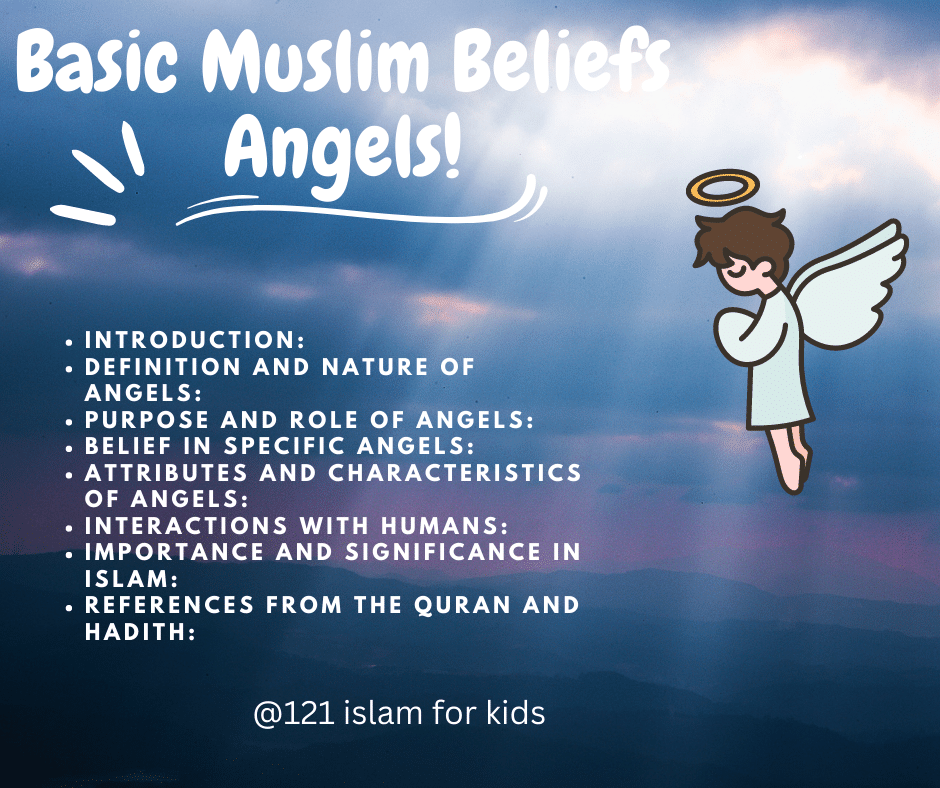
Teaching Method Islamic Belief in Angels to Children:
Introduction:
Start the lesson by introducing the topic of angels in Islam and their significance.
Explain that angels are spiritual beings created by Allah and play an important role in the unseen world.
Definition and Nature of Angels:
Teach children that angels are made of light and are subservient to Allah’s commands.
Emphasize that angels are invisible to humans and exist in a realm beyond our perception.
Purpose and Role of Angels:
Discuss the purpose of angels, which is to worship and glorify Allah.
Explain that angels also carry out specific tasks assigned by Allah, such as delivering messages to prophets.
Belief in Specific Angels:
Introduce some prominent angels in Islam, such as Jibril (Gabriel), Mikail (Michael), Israfil, and Izrail (Azrael).
Explain their roles and responsibilities, making the concepts relatable to children.
Share stories from Islamic history that involve these angels to engage children’s interest.
Attributes and Characteristics of Angels:
Discuss the qualities of angels, such as their purity, obedience to Allah, and vast knowledge.
Explain that angels do not have free will or the ability to disobey Allah.
Highlighting their power and vast numbers, which are beyond human comprehension.
Interactions with Humans:
Explain that angels serve as messengers between Allah and His creation.
Discuss how angels deliver revelations to prophets, such as Jibril conveying the Quran to Prophet Muhammad (peace be upon him).
Teach children that angels record their deeds and actions, and will be present during the questioning in the grave.
Importance and Significance in Islam:
Emphasize the importance of believing in angels as part of faith in Islam.
Explain that belief in angels affirms the unseen realm and the divine order established by Allah.
Discuss how angels remind us of Allah’s power, presence, and the concept of accountability.
References from the Quran and Hadith:
Different angels have different jobs. Some bring messages from Allah to the prophets, some record what we do, and some manage the weather. Each angel’s job is important and helps keep everything in the universe working perfectly.
Duties of Angels in Islam
We don’t know exactly how many angels exist. Allah created so many angels that no human can count them. Each person has angels with them to protect and watch over them.
How Many Angels are There in Islam?
Yes! Believing in angels is a very important part of being Muslim. The Qur’an and Hadith teach us that angels are real and they help Allah’s creation in many ways.
Do Muslims Believe in Angels?
Share selected Quranic verses mentioning angels, such as Surah Al-Baqarah (2:97) and Surah Al-Anbiya (21:27).
Narrate age-appropriate hadiths from the Prophet Muhammad (peace be upon him) about angels and their interactions.
Relate examples from Islamic history where angels played significant roles, such as the Angel Jibril appearing to Maryam (Mary).
Conclusion:
Summarize the key points covered in the lesson, emphasizing the belief in angels as an integral part of the Islamic faith.
Encourage children to reflect on the importance of angels in their lives and to appreciate Allah’s creation.
Remind them that belief in angels strengthens their connection with Allah and reinforces the concept of accountability.
When teaching children about angels, use simple words, stories, and fun activities. This helps them understand and love learning about the unseen world and Allah’s perfect creation.
This article is a series of our 6 articles in Islam course. Other articles on this course.