Tag: Islamic education

  • The Girl Who Chose Allah: The Story of Maryam (A.S.)

    The Girl Who Chose Allah: The Story of Maryam (A.S.)

    Maryam A.S as a role model for girls and women

    Imagine being the only woman mentioned by name in the entire Quran. Out of all the billions of women in history, Allah chose one—Maryam bint Imran—to be a permanent sign for humanity. Her life wasn’t a fairy tale; it was a journey of massive challenges and social pressure. Because of her loyalty and faith, Maryem A.S as a role modle of teen age girls and women remains the ultimate example of what it means to be truly brave.

    A Different Kind of Childhood

    It all started before she was even born. Her mother, Hannah, made a beautiful promise to Allah: “I want this child to be devoted only to You”. In those days, only boys were usually dedicated to temple service, but when Maryam was born, Allah accepted her with “goodly acceptance”.

    Maryam grew up in a private room called a Mihrab. She wasn’t out chasing trends; she was focused on her connection with her Creator. Her uncle, Prophet Zakariya, would visit her and find her with fresh fruits that weren’t even in season. When he asked where they came from, her answer was simple: “It is from Allah. He provides for whoever He wills”.

    The Lesson for You: Maryam didn’t wait until she was “old” to be pious. Her strength started in her teens. She knew that her worth wasn’t defined by people, but by Allah.

    The News from the Angel: “Kun” (Be)

    As she grew into a young woman, Maryam was known for her Batool nature—she was completely devoted and pure. One day, the Angel Jibril appeared in the form of a man. Her first reflex was modesty: “I seek refuge in Allah from you!”.

    It was at this incredible moment that Allah honors her character in the Quran:

    {And [the example of] Mary, the daughter of ‘Imraan, who guarded her chastity, so We blew into [her garment] through Our angel [i.e. Gabriel], and she believed in the words of her Lord and His scriptures and was of the devoutly obedient.}

    Jibril explained he was a messenger to give her news of a holy son. Maryam was shocked and asked, “How is it possible? I’m unmarried. And I’m a very pure lady. I don’t have any relation with any man…”.

    Jibril replied with the ultimate secret of the universe: “This is how… Allah says ‘kun’ (Be) and all things happen”. When Allah decrees something, He doesn’t need a “reason” or a “process.” He just says “Be,” and it is. Maryam trusted Allah’s plan instantly. She said “yes” to a destiny she knew would be almost impossible to explain to others.

    Bravery in the Wilderness

    When it was time to give birth, Maryam was alone. The pain was so intense and the fear of social judgment was so heavy that she cried out, “I wish I had died before this and was forgotten!”.

    If you’ve ever felt overwhelmed, Maryam felt that too. But Allah didn’t leave her. He gave her a stream of water and told her to shake the palm tree for fresh dates. Even in her weakest moment, Allah asked her to take action—to shake the tree.

    The Lesson for You: Faith doesn’t mean you never feel pain. It means that when you do, you turn to Allah and keep moving, even if you’re just “shaking the tree” with your last bit of strength.

    Facing the “Haters” with a Fast of Silence

    The hardest part was going home. Carrying a baby while unmarried was a social death sentence. But Allah gave her a specific order: You will not say anything. He commanded her to tell the people through signs: “Indeed, I have vowed a fast of silence to the Most Merciful, so I will not speak today to any human”.

    When she walked into town, the crowds gathered to mock her. She didn’t argue or try to defend herself. She remained silent with dignity and simply pointed to her baby.

    Then, the miracle happened. Baby Isa spoke from the cradle: “Indeed, I am the servant of Allah. He has given me the Scripture and made me a prophet… and He has made me kind to my mother”. Allah protected her reputation because she had protected her relationship with Him.

    The Perfect Mother: The Honor of “Ibne Maryam”

    Maryam raised her son to be a perfect human being—a Prophet who was kind and wise. Their bond was so powerful that in the Quran, Prophet Isa (A.S.) is almost always called “Ibne Maryam” (the Son of Maryam).

    In a world that usually names children after their fathers, Allah honored Maryam by linking a great Prophet’s name to hers over 23 times. This shows that a

    The Prophet Muhammad (peace be upon him) also confirmed her perfection in these famous Hadiths:

    “Many men reached the level of perfection, but no woman reached such a level except Maryam, the daughter of Imraan, and Asia, the wife of Pharaoh.”

    “The best of the women of the world are: “Maryam Bint ‘Imraan, Khadeejah Bint Khuwaylid, Faatimah Bint Muhammad, and Asia, the wife of Pharaoh.”

    Maryem A.S as a role modle of teen age girls and women shows us that a girl who trusts Allah is stronger than any challenge the world can throw at her.woman’s identity and her role as a mother are deeply respected in Islam.

    Conclusion: A Legacy of Faith for Today’s Girls

    Maryam (A.S.) isn’t just a figure from ancient history; her entire life story, from her devoted childhood to her unwavering strength as a mother, shines as a beacon for us all. She teaches us that true beauty lies in inner strength, that modesty is empowering, and that loyalty to Allah will always be rewarded, even in the face of the greatest challenges. Her incredible journey, crowned by the miracle of Prophet Isa (A.S.) speaking from the cradle, reminds every girl and woman that with faith, anything is possible.

    Want to learn more about the amazing miracles and teachings of Prophet Isa (A.S.) in Islam? Dive deeper with our special “Faith Boosting Course for Children about Isa (A.S.) in Islam” and unlock more incredible stories that will strengthen your child’s belief!

  • Surah Al-Balad for kids

    Surah Al-Balad for kids

    Surah Al-Balad for kids:

    Surah Al balad is one of the most inspiring chapters of the Quran for young learners. We will learn this surah step by step:

    Here are the detailed word meanings of Surah Al-Balad, for kids.

    Verse by verse words meaning of Surah Al-Balad for kids:

    1. لَاۤ اُقْسِمُ بِهٰذَا الْبَلَدِ

    • لَاۤ (Laa) – No, (or “Indeed” for emphasis)
    • اُقْسِمُ (Uqsimu) – I swear
    • بِهٰذَا (Bihaadha) – By this
    • الْبَلَدِ (Al-Balad) – The city

    2. وَ اَنۡتَ حِلٌّۢ بِهٰذَا الْبَلَدِ

    • وَ (Wa) – And
    • اَنۡتَ (Anta) – You
    • حِلٌّۢ (Hillun) – Free (or permitted)
    • بِهٰذَا (Bihaadha) – In this
    • الْبَلَدِ (Al-Balad) – The city

    3. وَ وَالِدٍ وَّ مَا وَلَدَ

    • وَ (Wa) – And
    • وَالِدٍ (Waalid) – A father
    • وَّ (Wa) – And
    • مَا (Maa) – What (or who)
    • وَلَدَ (Walad) – He fathered (or gave birth to)

    4. لَقَدْ خَلَقْنَا الْاِنْسَانَ فِيْ كَبَدٍ

    • لَقَدْ (Laqad) – Certainly
    • خَلَقْنَا (Khalaqnaa) – We created
    • الْاِنْسَانَ (Al-Insaan) – The human being (or mankind)
    • فِيْ (Fee) – In
    • كَبَدٍ (Kabad) – Hardship (or struggle)

    5. اَيَحْسَبُ اَنْ لَّنْ يَّقْدِرَ عَلَيْهِ اَحَدٌ

    • اَيَحْسَبُ (A-Yahsabu) – Does he think
    • اَنْ (An) – That
    • لَّنْ (Lan) – Not
    • يَّقْدِرَ (Yaqdira) – Anyone can have power
    • عَلَيْهِ (Alayhi) – Over him
    • اَحَدٌ (Ahad) – Anyone

    6. يَقُوْلُ اَهْلَكْتُ مَالًا لُّبَدًا

    • يَقُوْلُ (Yaqoolu) – He says
    • اَهْلَكْتُ (Ahlaktu) – I have spent (or destroyed)
    • مَالًا (Maalan) – Wealth
    • لُّبَدًا (Lubadan) – In abundance

    7. اَيَحْسَبُ اَنْ لَّمْ يَرَهٗۤ اَحَدٌ

    • اَيَحْسَبُ (A-Yahsabu) – Does he think
    • اَنْ (An) – That
    • لَّمْ (Lam) – Not
    • يَرَهٗۤ (Yarahu) – He is seen
    • اَحَدٌ (Ahad) – By anyone

    8. اَلَمْ نَجْعَلْ لَهٗ عَيْنَيْنِ

    • اَلَمْ (Alam) – Have We not
    • نَجْعَلْ (Naj’al) – Made
    • لَهٗ (Lahu) – For him
    • عَيْنَيْنِ (Aynayn) – Two eyes

    9. وَلِسَانًا وَّ شَفَتَيْنِ

    • وَ (Wa) – And
    • لِسَانًا (Lisaanan) – A tongue
    • وَّ (Wa) – And
    • شَفَتَيْنِ (Shafatayn) – Two lips

    10. وَهَدَيْنَاهُ النَّجْدَيْنِ

    • وَ (Wa) – And
    • هَدَيْنَاهُ (Hadaynaahu) – We showed him
    • النَّجْدَيْنِ (An-Najdayn) – The two paths (the good and bad ways)

    11. فَلَا اقْتَحَمَ الْعَقَبَةَ

    • فَلَا (Falaa) – But he has not
    • اقْتَحَمَ (IqtaHama) – Attempted (or crossed)
    • الْعَقَبَةَ (Al-Aqabah) – The difficult pass (obstacle)

    12. وَمَاۤ اَدْرٰىكَ مَا الْعَقَبَةُ

    • وَمَاۤ (Wa Maa) – And what
    • اَدْرٰىكَ (Adraaka) – Will make you know
    • مَا (Maa) – What is
    • الْعَقَبَةُ (Al-Aqabah) – The difficult pass

    13. فَكُّ رَقَبَةٍ

    • فَكُّ (Fakku) – The freeing
    • رَقَبَةٍ (Raqabah) – Of a slave (or a neck)

    14. اَوْ اِطْعَامٌ فِيْ يَوْمٍ ذِيْ مَسْغَبَةٍ

    • اَوْ (Aw) – Or
    • اِطْعَامٌ (Itaa’am) – Feeding
    • فِيْ (Fee) – On
    • يَوْمٍ (Yawmin) – A day
    • ذِيْ (Dhee) – Of
    • مَسْغَبَةٍ (Masghabah) – Severe hunger

    15. یَتِیْمًا ذَا مَقْرَبَةٍ

    • یَتِیْمًا (Yateeman) – An orphan
    • ذَا (Dhaa) – Of
    • مَقْرَبَةٍ (Maqrabah) – Near relationship (relative)

    16. اَوْ مِسْكِينًا ذَا مَتْرَبَةٍ

    • اَوْ (Aw) – Or
    • مِسْكِينًا (Miskeenan) – A needy person
    • ذَا (Dhaa) – Of
    • مَتْرَبَةٍ (Matrabah) – Misery (or covered with dust)

    17. ثُمَّ كَانَ مِنَ الَّذِينَ اٰمَنُوْا وَ تَوَاصَوْا بِالصَّبْرِ وَ تَوَاصَوْا بِالْمَرْحَمَةِ

    • ثُمَّ (Thumma) – Then
    • كَانَ (Kaana) – He was
    • مِنَ (Mina) – Among
    • الَّذِينَ (Alladheena) – Those who
    • اٰمَنُوْا (Aamanu) – Believed
    • وَ تَوَاصَوْا (Wa Tawaasaw) – And advised one another
    • بِالصَّبْرِ (Bis-Sabr) – To patience
    • وَ تَوَاصَوْا (Wa Tawaasaw) – And advised one another
    • بِالْمَرْحَمَةِ (Bil-Marhamah) – To compassion (or mercy)

    18. اُولٰۤىٕكَ اَصْحٰبُ الْمَيْمَنَةِ

    • اُولٰۤىٕكَ (Ulaa’ika) – Those are
    • اَصْحٰبُ (As-haabu) – The companions (or people)
    • الْمَيْمَنَةِ (Al-Maymanah) – Of the right hand (good people)

    19. وَ الَّذِیْنَ كَفَرُوْا بِاٰیَاتِنَا هُمْ اَصْحٰبُ الْمَشْئَمَةِ

    • وَ (Wa) – And
    • الَّذِیْنَ (Alladheena) – Those who
    • كَفَرُوْا (Kafaroo) – Disbelieved
    • بِاٰیَاتِنَا (Bi-Aayaatinaa) – In Our signs
    • هُمْ (Hum) – They
    • اَصْحٰبُ (As-haabu) – Are the companions (or people)
    • الْمَشْئَمَةِ (Al-Mash’amah) – Of the left hand (bad people)

    **20. عَلَیْهِمْ نَارٌ مُّؤ

    ْصَدَةٌ**

    • عَلَیْهِمْ (Alayhim) – Upon them
    • نَارٌ (Naarun) – Is fire
    • مُّؤْصَدَةٌ (Mu’sadah) – Closed in (sealed)

    This breakdown helps students understand the meaning of each word in Surah Al-Balad and supports their comprehension of the surah’s overall message.

    Full Translation (in English) of Surah Al-Balad for kids

    In the name of Allah, the Most Merciful, the Most Compassionate

    1. I swear by this city (Makkah),
    2. And you, [O Muhammad], are free of restriction in this city –
    3. And [by] the father and what he fathered,
    4. We have certainly created man into hardship.
    5. Does he think that no one has power over him?
    6. He says, “I have spent wealth in abundance.”
    7. Does he think that no one has seen him?
    8. Have We not made for him two eyes?
    9. And a tongue and two lips?
    10. And have shown him the two ways?
    11. But he has not broken through the difficult pass.
    12. And what can make you know what is [breaking through] the difficult pass?
    13. It is the freeing of a slave,
    14. Or feeding on a day of severe hunger
    15. An orphan of near relationship,
    16. Or a needy person in misery.
    17. And then being among those who believed and advised one another to patience and advised one another to compassion.
    18. Those are the companions of the right.
    19. But they who disbelieved in Our signs – those are the companions of the left.
    20. Over them will be fire closed in.

    Story and Explanation of Surah Al-Balad

    Hey kids! Today, we will learn about a very special chapter from the Quran called Surah Al-Balad. It’s a story full of lessons that will help us understand life better and how we should live it.

    1. The Sacred City of Makkah (Verses 1-2)

    The surah starts with Allah swearing by a special city, Makkah. This city is where the Kaaba is located, which Muslims face when they pray. Makkah is also the place where our Prophet Muhammad (PBUH) was born. By swearing by Makkah, Allah is showing us how important this city is.

    But that’s not all! Allah also mentions that the Prophet Muhammad (PBUH) is living in this city, and this makes the city even more special. Allah is reminding us of the great honour and responsibility that comes with living in such a blessed place.

    2. The Father and His Child (Verse 3)

    Then, Allah swears by the father and his child. This is to remind us of the strong bond between parents and their children. Parents work hard and make many sacrifices for their children, just like how Allah created us and takes care of us with so much love and mercy.

    3. Life is Full of Challenges (Verse 4)

    Allah tells us that life is full of challenges and difficulties. Every person goes through tough times, whether it’s in school, at home, or with friends. But these challenges are a part of life. They help us grow stronger, just like how exercise makes our muscles stronger.

    4. The Arrogance of Some People (Verses 5-7)

    Some people, when they become rich or powerful, start to think that no one can control them. They might say, “I’ve spent so much money” as if they can do anything they want. But Allah reminds us that He sees everything. No matter how rich or powerful someone is, they can never escape Allah’s watchful eye.

    5. The Gifts from Allah (Verses 8-9)

    Allah reminds us of the gifts He has given us, like our eyes, tongue, and lips. These gifts help us see, speak, and communicate. But with these gifts comes responsibility. We should use our eyes to see good things, our tongues to speak kind words, and our lips to spread smiles and happiness.

    6. The Two Paths (Verse 10)

    Allah has shown us two paths in life: one path leads to goodness and the other to badness. It’s like standing at a crossroads with a choice to make. The good path might be harder, but it leads to Allah’s pleasure and paradise. The bad path might seem easy, but it leads to trouble and sorrow.

    7. The Difficult Pass (Verses 11-12)

    Allah talks about a “difficult pass” – imagine a steep mountain that’s hard to climb. This represents the challenges we face when trying to do good deeds. Climbing this mountain might be tough, but the reward at the top is worth it!

    8. What is the Difficult Pass? (Verses 13-16)

    So, what is this difficult pass? Allah explains that it involves doing good deeds, like:

    • Freeing a slave: In the old days, many people were enslaved, and freeing them was one of the greatest acts of kindness.
    • Feeding the hungry: Imagine how good it feels to give food to someone who is starving.
    • Helping an orphan: An orphan is someone who has lost their parents. Helping them is a big act of kindness.
    • Supporting someone in need: Many people are struggling and need our help.

    These are the good deeds that help us climb the difficult pass in life.

    9. The Right-Handed and Left-Handed People (Verses 17-20)

    Finally, Allah talks about two groups of people:

    The Right-Handed People (Companions of the Right):
    These are the people who do good deeds, believe in Allah, and help others. They advise each other to be patient and kind. On the Day of Judgment, they will receive their book of deeds in their right hand as a sign of success. These people will go to paradise, a place of happiness and peace.

    The Left-Handed People (Companions of the Left):
    These are the people who ignore Allah’s guidance and do bad deeds. They don’t care about others and live only for themselves. On the Day of Judgment, they will receive their book of deeds in their left hand, which is a sign of failure. These people will face severe punishment in the hereafter.

    Conclusion

    Surah Al-Balad teaches us that life is full of challenges, but by choosing the right path and doing good deeds, we can succeed in this life and the next. Allah has given us all the tools we need, like our eyes, tongue, and mind, to make the right choices. We should always try to be among the “right-handed” people who will find success and happiness with Allah.

    So remember, the next time you face a challenge, think of it as a mountain you need to climb. It might be tough, but with patience, kindness, and faith, you can reach the top!

    Here are some short Q/A questions about Surah Al-Balad, designed for kids, including facts and lessons:

    Q/A for Surah Al-Balad for kids

    1. What is Surah Al-Balad about?

    Answer: Surah Al-Balad talks about the challenges of life, the importance of doing good deeds, and the choice between following the right path or the wrong path. It also highlights the significance of Makkah and the qualities of those who are successful in the eyes of Allah.

    2. How many verses are there in Surah Al-Balad?

    Answer: Surah Al-Balad has 20 verses.

    3. What does the surah begin with?

    Answer: The surah begins with an oath by the city of Makkah, emphasizing its importance and the fact that the Prophet Muhammad (PBUH) is living there.

    4. What does Allah swear by in the first verse?

    Answer: Allah swears by the city of Makkah.

    5. Who are the “right-handed” people mentioned in the surah?

    Answer: The “right-handed” people are those who do good deeds, believe in Allah, and help others. They are patient, compassionate, and will be rewarded with paradise.

    6. Who are the “left-handed” people?

    Answer: The “left-handed” people are those who disbelieve in Allah’s signs and do not follow His guidance. They will face punishment in the hereafter.

    7. What does the surah say about the difficult pass (al-‘Aqabah)?

    Answer: The surah describes the difficult past as the challenge of doing good deeds, such as freeing a slave, feeding the hungry, helping orphans, and being patient and compassionate. It’s a hard path but very rewarding.

    8. What are some examples of good deeds mentioned in Surah Al-Balad?

    Answer: Examples include freeing a slave, feeding people on a day of severe hunger, helping an orphan, and supporting those in need.

    9. Why is Makkah special in Surah Al-Balad?

    Answer: Makkah is special because it is a sacred city where the Kaaba is located, and it is the birthplace of Prophet Muhammad (PBUH). The surah begins by swearing an oath by Makkah to emphasize its importance.

    10. What lesson does Surah Al-Balad teach us about hardship?

    Answer: The surah teaches us that life is full of hardships and challenges, but by striving to do good deeds and following the right path, we can overcome these challenges and achieve success.

    11. When was Surah Al-Balad revealed?

    Answer: Surah Al-Balad was revealed in Makkah during the early part of Prophet Muhammad’s (PBUH) prophethood. It is considered a Makki surah.

    12. What does the surah say about the gifts Allah has given us?

    Answer: The surah mentions that Allah has given us eyes, a tongue, and lips, which are blessings to help us see, speak, and communicate. We should use these gifts wisely to follow the right path and do good deeds.

    13. How can we use the lessons from Surah Al-Balad in our daily lives?

    Answer: We can use the lessons by being kind and helping others, staying patient during tough times, making good choices, and striving to do good deeds. This will lead us to be among those who are successful and rewarded by Allah.

    14. What is the meaning of “right-handed” in the context of Surah Al-Balad?

    Answer: In the context of the surah, “right-handed” refers to people who will receive their book of deeds in their right hand on the Day of Judgment, signifying they have lived a good life and will be rewarded with paradise.

    15. What will happen to the “left-handed” people?

    Answer: The “left-handed” people will receive their book of deeds in their left hand and will face punishment in the hereafter because they did not follow Allah’s guidance and disbelieved in His signs.

    These questions and answers are designed to help kids understand and remember the key messages and facts of Surah Al-Balad in a fun and engaging way.

    Here are some multiple-choice questions (MCQs) about Surah Al-Balad with answers provided at the end:


    MCQs of Surah Al-Balad for kids

    1. What is the number of Surah Al-Balad in the Quran?
    • a) 80
    • b) 90
    • c) 100
    1. How many verses are there in Surah Al-Balad?
    • a) 10
    • b) 15
    • c) 20
    1. Where was Surah Al-Balad revealed?
    • a) Makkah
    • b) Madinah
    • c) Jerusalem
    1. What does “Al-Balad” mean?
    • a) The Mountain
    • b) The City
    • c) The River
    1. What is the “City” referred to in Surah Al-Balad?
    • a) Madinah
    • b) Makkah
    • c) Taif
    1. The main theme of Surah Al-Balad is about the:
    • a) Importance of wealth
    • b) Struggles of life and perseverance
    • c) Laws of inheritance
    1. Surah Al-Balad teaches us to help:
    • a) The wealthy
    • b) The needy and orphans
    • c) The rulers
    1. Who are the “Right-handed” people mentioned in Surah Al-Balad?
    • a) The sinners
    • b) The righteous
    • c) The wealthy
    1. Surah Al-Balad encourages us to follow the path of:
    • a) Greed
    • b) Kindness and patience
    • c) Anger
    1. Which challenge is mentioned in Surah Al-Balad as a “steep path”?
      • a) Climbing a mountain
      • b) Feeding the hungry
      • c) Walking through a desert
    2. In Surah Al-Balad, those who reject the steep path are known as:
      • a) The Left-handed
      • b) The Righteous
      • c) The Prophets
    3. What lesson does Surah Al-Balad give about wealth?
      • a) To spend it selfishly
      • b) To share it with the needy
      • c) To hide it

    Answers:

    1. b) 90
    2. c) 20
    3. a) Makkah
    4. b) The City
    5. b) Makkah
    6. b) Struggles of life and perseverance
    7. b) The needy and orphans
    8. b) The righteous
    9. b) Kindness and patience
    10. b) Feeding the hungry
    11. a) The Left-handed
    12. b) To share it with the needy

    step-by-step study method for teaching Surah Al-Balad

    Here’s a step-by-step study method for teaching Surah Al-Balad that includes your original steps, as well as some extra details to make the process easier for others to follow:

    1. Tajweed (Pronunciation of the Letters and Rules of Recitation)

    • Objective: Ensure students pronounce each letter correctly and apply the rules of tajweed.
    • Method:
    • Teach the proper pronunciation of difficult letters in Surah Al-Balad.
    • Explain important tajweed rules like Ikhfa, Idgham, and Ghunna that apply in the surah.
    • Have students repeat after you and correct any mistakes.
    • Make it interactive by asking students to point out tajweed rules as they recite.

    2. Recitation (Tilawah) and Memorization (Hifz)

    • Objective: Help students recite the surah fluently and memorize it.
    • Method:
    • Begin by reciting the entire surah slowly while students listen.
    • Divide the surah into small parts (ayah by ayah or in pairs of verses).
    • Recite each part multiple times, and then ask the students to repeat after you.
    • Encourage them to memorize the divided sections gradually.
    • Check their memorization after each session and ensure revision of previously memorized sections.

    3. Word Meanings and Translation

    • Objective: Teach students the meaning of each word and the overall translation.
    • Method:
    • Go verse by verse and explain the meaning of each word.
    • Use visual aids, flashcards, or even a whiteboard for writing the words and their meanings.
    • After discussing the words, provide the full translation of the verse in English.
    • Ask students to recite the verse, followed by saying the translation, so they can link the words to their meaning.

    4. Calligraphy or LEGO Activity

    • Objective: Engage students creatively and reinforce the surah’s message through art or construction.
    • Method:
    • Calligraphy: Teach students how to write selected ayahs in Arabic calligraphy or let them design their Arabic art related to the surah.
    • LEGO: Alternatively, use LEGO bricks to create scenes or symbols that represent the surah’s themes (like building a city to represent the opening verses about Makkah).
    • This method helps in connecting hands-on learning with Quranic studies.

    5. Storytelling (Tafsir Explanation)

    • Objective: Help students understand the message and lessons of the surah through a story format.
    • Method:
    • Using the tafsir provided earlier, explain the surah step by step as a story.
    • Bring in real-life examples that resonate with children (e.g., challenges in life, choices between right and wrong, helping others).
    • Ask students questions to keep them engaged, like “What do you think it means to help an orphan or a needy person?”

    6. Mind Map

    • Objective: Visually organize the main themes and ideas of the surah.
    • Method:
    • Create a mind map with the surah’s key points (e.g., Makkah, challenges in life, right and left-handed people).
    • Use different colors or drawings to highlight the major ideas.
    • Encourage students to create their mind map, summarizing what they have learned.

    7. Exercise and Worksheets of surah al balad

    • Objective: Review the surah and reinforce understanding through practical exercises.
    • Method:
    • Provide worksheets with questions based on the surah’s translation and tafsir.
    • Create fill-in-the-blank activities using verses of Surah Al-Balad
    • Ask students to match Arabic words with their English meanings.
    • You can also include multiple-choice questions about the story and lessons.

    8. Revisions

    • Objective: Strengthen retention through regular review.
    • Method:
    • At the start of each class, spend a few minutes revising what was learned in the previous session.
    • Conduct quick memorization checks of the verses they have already learned.
    • Ask students to retell the story of Surah Al-Balad and what lessons they took from it.
    • Incorporate fun revision techniques like quizzes, competitions, or group recitations.

    Final Thoughts

    By following these steps, students will gain a deep understanding of Surah Al-Balad, not only through memorization but also by applying its teachings in their lives. This step-by-step approach balances traditional Islamic learning with creative, interactive methods to keep students engaged and help them internalize the surah’s meaning. Check our More short surahs for kids collection to expand your Quranic knowledge!

    Our method combines the power of visual aids, videos, books, and interactive tools to make learning Surah Al-Falaq and Surah An-Naas both fun and effective.

    Visit the links below for our resources and activities:

    Explore our resources and enroll today!

    Tafsir of Short surahs for children

  • Surah Al-Falaq – An-Naas Study Method: Understanding the Chapter of Dawn (سورة الفلق)Surah Al-Falaq (سورة الفلق)

    Surah Al-Falaq – An-Naas Study Method: Understanding the Chapter of Dawn (سورة الفلق)Surah Al-Falaq (سورة الفلق)

    Surah Al-Falaq An-Naas study method provides comprehensive learning techniques for these two protective chapters of the Quran. This interactive guide includes detailed verse-by-verse explanations, word meanings, translations, and educational activities for understanding Surah Al-Falaq and Surah An-Naas.Surah.

    Surah Al-Falaq An-Naas study method comprehensive guide with interactive learning techniques for children


    Surah Surah Al-Falaq An-Naas Study Method: Understanding the Chapter of Dawn (سورة الفلق)Surah Al-Falaq (سورة الفلق)

    These Surah Al-Falaq An-Naas teachings guide us to seek Allah’s protection from all types of evil.This Surah teaches us to seek Allah’s protection from all types of evil.

    Verse 1:

    Arabic:
    قُلْ أَعُوذُ بِرَبِّ الْفَلَقِ

    English Translation:
    “Say: I seek refuge in the Lord of the dawn.”

    Word Meanings:

    • قُلْ (Qul) – Say
    • أَعُوذُ (A’udhu) – I seek refuge
    • بِرَبِّ (bi-Rabbi) – In the Lord
    • الْفَلَقِ (al-Falaq) – The dawn or the daybreak

    Explanation:
    In this verse, we are told to seek protection from Allah, the One who causes the dawn to break through the darkness. The “dawn” symbolizes light, hope, and the power to overcome darkness and evil.


    Verse 2:

    Arabic:
    مِن شَرِّ مَا خَلَقَ

    English Translation:
    “From the evil of what He has created.”

    Word Meanings:

    • مِن شَرِّ (min sharri) – From the evil
    • مَا (ma) – What
    • خَلَقَ (khalaqa) – He has created

    Explanation:
    This verse asks for protection from any harmful or evil things in Allah’s creation. While Allah’s creation is good, some things or beings may cause harm, so we ask Allah to protect us from any possible danger.


    Verse 3:

    Arabic:
    وَمِن شَرِّ غَاسِقٍ إِذَا وَقَبَ

    English Translation:
    “And from the evil of the night when it grows dark.”

    Word Meanings:

    • غَاسِقٍ (ghasiqin) – Darkness
    • إِذَا (idha) – When
    • وَقَبَ (waqab) – It settles

    Explanation:
    This verse seeks protection from the dangers of the night, when darkness falls, and we cannot see clearly. The night can bring fear and unknown dangers, but Allah can protect us.


    Verse 4:

    Arabic:
    وَمِن شَرِّ النَّفَّاثَاتِ فِي الْعُقَدِ

    English Translation:
    “And from the evil of those who blow on knots.”

    Word Meanings:

    • النَّفَّاثَاتِ (an-naffathat) – Those who blow
    • فِي الْعُقَدِ (fi-l-‘uqad) – On knots

    Explanation:
    This verse refers to the evil of those who practice magic or sorcery by tying knots and blowing on them. It’s a form of evil behavior that people may use to harm others. We seek Allah’s protection from such harmful acts.


    Verse 5:

    Arabic:
    وَمِن شَرِّ حَاسِدٍ إِذَا حَسَدَ

    English Translation:
    “And from the evil of the envious one when he envies.”

    Word Meanings:

    • حَاسِدٍ (hasid) – The envious one
    • حَسَدَ (hasada) – He envies

    Explanation:
    This verse seeks protection from those who feel jealous and wish harm upon others. When someone envies another person, they might desire bad things to happen to them. We ask Allah to protect us from such jealousy.


    Surah An-Naas (سورة الناس)

    This Surah teaches us to seek protection from the evil whispers of Shaytan (Satan) and all harmful influences.

    Verse 1:

    Arabic:
    قُلْ أَعُوذُ بِرَبِّ النَّاسِ

    English Translation:
    “Say: I seek refuge in the Lord of mankind.”

    Word Meanings:

    • قُلْ (Qul) – Say
    • أَعُوذُ (A’udhu) – I seek refuge
    • بِرَبِّ (bi-Rabbi) – In the Lord
    • النَّاسِ (an-Naas) – Of mankind

    Explanation:
    In this verse, we are instructed to seek refuge in Allah, the Lord of all people. This reminds us that Allah is the Creator and Protector of every human being.


    Verse 2:

    Arabic:
    مَلِكِ النَّاسِ

    English Translation:
    “The King of mankind.”

    Word Meanings:

    • مَلِكِ (Malik) – King
    • النَّاسِ (an-Naas) – Of mankind

    Explanation:
    Here, we acknowledge that Allah is the King of all people. He is in charge of everything, and no one has power or authority over Him. He alone controls and protects us.


    Verse 3:

    Arabic:
    إِلَٰهِ النَّاسِ

    English Translation:
    “The God of mankind.”

    Word Meanings:

    • إِلَٰهِ (Ilah) – God
    • النَّاسِ (an-Naas) – Of mankind

    Explanation:
    This verse reminds us that Allah is the only God of all humans. He is the One we worship and rely on. By stating that Allah is our God, we confirm our belief in His power to protect us from harm.


    Verse 4:

    Arabic:
    مِن شَرِّ الْوَسْوَاسِ الْخَنَّاسِ

    English Translation:
    “From the evil of the whisperer who withdraws.”

    Word Meanings:

    • شَرِّ (sharri) – Evil
    • الْوَسْوَاسِ (waswas) – Whisperer
    • الْخَنَّاسِ (khannas) – Who withdraws

    Explanation:
    This verse asks for protection from the whisperer, meaning Shaytan, who quietly puts evil thoughts into our minds and then hides. Shaytan tries to make us do bad things, but we seek Allah’s protection to avoid falling into these traps.


    Verse 5:

    Arabic:
    الَّذِي يُوَسْوِسُ فِي صُدُورِ النَّاسِ

    English Translation:
    “Who whispers in the hearts of mankind.”

    Word Meanings:

    • يُوَسْوِسُ (yuwaswisu) – Whispers
    • فِي (fi) – In
    • صُدُورِ (sudoor) – Hearts
    • النَّاسِ (an-Naas) – Of mankind

    Explanation:
    Shaytan tries to enter people’s hearts and minds to make them think bad things. He whispers evil ideas into our hearts to lead us away from the right path, but Allah can protect us from these whispers.


    Verse 6:

    Arabic:
    مِنَ الْجِنَّةِ وَالنَّاسِ

    English Translation:
    “From among jinn and among mankind.”

    Word Meanings:

    • الْجِنَّةِ (al-jinnah) – The jinn (invisible beings)
    • النَّاسِ (an-Naas) – Mankind

    Explanation:
    This verse tells us that evil whispers can come from both jinn (invisible beings) and humans. Some people or beings might try to lead us astray, but by seeking Allah’s protection, we can stay safe from all types of evil influences.


    Summary of Both Surah Al-Falaq An-Naas

    • Surah Al-Falaq protects us from the dangers of the outside world—whether they come from people, jealousy, or magic.
    • Surah An-Naas protects us from the dangers within—whispers and evil thoughts that try to lead us away from the right path.

    Reciting both Surah Al-Falaq An-Naas reminds us that Allah is our ultimate protector from all forms of evil, and we should always turn to Him in times of fear or difficulty.Reciting these Surahs reminds us that Allah is our ultimate protector from all forms of evil, and we should always turn to Him in times of fear or difficulty.

    Additional Information:

    • These Surahs should be recited in the morning and evening as part of Azkar (remembrance of Allah) to seek protection from all harm throughout the day and night.
    • It’s also recommended to recite them before sleeping, to seek Allah’s protection from evil during the night.

    Quiz: Surah Al-Falaq & Surah An-Naas

    Here’s a fun and educational quiz for kids based on the key facts and explanations of Surah Al-Falaq and Surah An-Naas.


    Multiple Choice Questions (MCQs):

    1. Who do we ask for protection in Surah Al-Falaq?
    • A) The sun
    • B) The moon
    • C) The Lord of the dawn
    • D) The stars Answer: C) The Lord of the dawn

    1. In Surah Al-Falaq, we ask Allah to protect us from the evil of:
    • A) Animals
    • B) Darkness, jealousy, and magic
    • C) Angels
    • D) Trees Answer: B) Darkness, jealousy, and magic

    1. What does “Al-Falaq” mean?
    • A) Night
    • B) Darkness
    • C) Daybreak/Dawn
    • D) Stars Answer: C) Daybreak/Dawn

    1. In Surah An-Naas, who is the King of mankind?
    • A) A Prophet
    • B) Allah
    • C) Angels
    • D) Shaytan Answer: B) Allah

    1. Who tries to whisper bad thoughts in our hearts?
    • A) Shaytan
    • B) Angels
    • C) Prophets
    • D) Friends Answer: A) Shaytan

    1. What does “An-Naas” mean in Surah An-Naas?
    • A) People
    • B) Angels
    • C) Shaytan
    • D) Jinn Answer: A) People

    1. How many verses (ayahs) are in Surah Al-Falaq?
    • A) 3
    • B) 5
    • C) 7
    • D) 6 Answer: B) 5

    1. How many verses (ayahs) are in Surah An-Naas?
    • A) 6
    • B) 4
    • C) 3
    • D) 7 Answer: A) 6
    1. When is it recommended to recite Surah Al-Falaq and Surah An-Naas?
      • A) Only during Ramadan
      • B) During morning and evening
      • C) After every meal
      • D) Before sleeping only
      Answer: B) During morning and evening

    1. Why do we recite Surah Al-Falaq and Surah An-Naas in the morning and evening?
    • A) To protect ourselves from hunger
    • B) To ask for Allah’s protection from all kinds of evil throughout the day and night
    • C) To bring rain
    • D) To avoid studying

    Answer: B) To ask for Allah’s protection from all kinds of evil throughout the day and night


    Short Answer Questions:

    1. What is the main theme of Surah Al-Falaq?
    • Answer: The main theme is seeking Allah’s protection from external evils, such as darkness, jealousy, and magic.

    1. What is the main theme of Surah An-Naas?
    • Answer: The main theme is seeking Allah’s protection from the evil whispers of Shaytan and evil thoughts.

    1. From which two types of beings can evil whispers come, according to Surah An-Naas?
    • Answer: Evil whispers can come from both jinn and humans.

    1. Why are Surah Al-Falaq and Surah An-Naas called “Al-Mu’awwidhatayn”?
    • Answer: They are called Al-Mu’awwidhatayn because they are the two Surahs of seeking protection from Allah.

    1. What was the occasion for the revelation of these two Surahs?
    • Answer: These Surahs were revealed when Prophet Muhammad (peace be upon him) was affected by magic, and Allah revealed these Surahs to protect him from harm.

    1. Why are these two Surahs recited together often?
    • Answer: These Surahs are recited together because both provide protection from external and internal evils, making them powerful for seeking Allah’s protection.

    True/False Questions:

    1. Surah Al-Falaq protects us from the evil whispers of Shaytan.
    • Answer: False (It’s Surah An-Naas that protects from evil whispers of Shaytan).

    1. Surah An-Naas teaches us to seek refuge in Allah, who is the Lord, King, and God of mankind.
    • Answer: True

    1. The word “Falaq” means darkness.
    • Answer: False (It means dawn or daybreak).

    1. Surah Al-Falaq has 6 verses.
    • Answer: False (It has 5 verses).

    1. Both Surah Al-Falaq and Surah An-Naas were revealed to help protect the Prophet Muhammad (peace be upon him) from the effects of magic.
    • Answer: True

    This quiz can help children review the key facts and concepts from Surah Al-Falaq An-Naas in a fun and engaging way!This quiz can help children review the key facts and concepts from the two Surahs in a fun and engaging way!

    Study method

    In our online classes, we use an engaging and comprehensive study method to teach Surah Al-Falaq and Surah An-Naas. Our goal is to ensure students not only learn to recite and memorize these Surahs but also understand their meanings through creative and interactive learning tools. Here’s how we do it, with links to detailed resources for each step:


    1. Recitation (تلاوت)

    Objective:
    We begin by focusing on the correct recitation of the Surahs. Using videos of expert reciters, students follow along to perfect their pronunciation. Each verse is practiced until fluency is achieved.
    Click here for our recitation videos.


    2. Tajweed (تجوید)

    Objective:
    We introduce the essential rules of Tajweed so students can recite the Quran correctly. We pay special attention to proper articulation of Arabic sounds and apply these rules in real-time recitation practice.
    Explore our Tajweed lessons with videos and guides.


    3. Memorization (حفظ)

    Objective:
    Memorization is made easy with the help of videos that guide students step-by-step. The process is broken into small sections, and each is repeated multiple times to ensure retention.
    Learn more about our Hifz videos and memorization techniques.


    4. Words Meaning and Translation

    Objective:
    We teach word meanings and translations using the “My First Quran with Pictures” book, making it easy for students to grasp the Arabic words along with their English meanings. This method makes learning engaging and fun.
    See how we use “My First Quran with Pictures” in our lessons.


    5. Tafsir (تفسیر) Surah Al-Falaq An-Naas

    Objective:
    We explain the meanings and lessons of the Surahs through the Islamic Education Book. Each verse is discussed in a simple and age-appropriate way, helping students understand the significance of seeking Allah’s protection.
    Explore our Tafsir lessons and resources.


    6. Infographics Surah Al-Falaq An-Naas

    Objective:
    Infographics are used to simplify the Surahs’ key themes. We either use visuals from “My First Quran with Pictures” or encourage students to create their own. This visual learning helps students retain the key messages of each verse.
    Check out our infographic tools and creative projects.


    7. Storytelling

    Objective:
    We enhance understanding through storytelling in class and with video animations. Stories like “Sarah and the Magic of Light” bring the Surahs’ meanings to life, making them more relatable for children.
    Watch our storytelling videos and animations.


    8. Mind Mapping

    Objective:
    We teach mind mapping using pre-designed images and videos to help students visually organize the lessons from the Surahs. These mind maps make it easier to understand and remember the concepts.
    Discover our mind mapping resources and videos.


    9. Exercises and Revisions (نظرثانی)

    Objective:
    We conduct regular revisions to ensure long-term retention. For assessments, we use interactive quizzes and exercises that test the students’ understanding and memorization of the Surahs.
    Check out our revision quizzes and exercises.


    Our method combines the power of visual aids, videos, books, and interactive tools to make learning Surah Al-Falaq and Surah An-Naas both fun and effective.

    Visit the links below for our resources and activities:

    Explore our resources and enroll today!

  • Best Online Quran Classes for Kids – Interactive Islamic Learning with Affordable Tutors121 Islam for Kids, online Quran class. We do things differently.

    Best Online Quran Classes for Kids – Interactive Islamic Learning with Affordable Tutors121 Islam for Kids, online Quran class. We do things differently.

    Online Quran Classes for Kids: The Communication Problem in Traditional LearningThe problem in the online Quran class. Lack of Parent Communication

    Online Quran classes for kids face a major challenge: most providers offer poor parent communication. When searching for the best online Quran teachers or affordable Quran tutors for kids, parents often discover that many programs focus solely on students during interactive Quran learning sessions while neglecting to keep parents informed.

    This lack of communication in Islamic studies online creates significant problems—children miss classes, forget homework, and struggle to maintain progress while parents remain unaware of their child’s development in learning Quran at home.

    At 121 Islam for Kids, we understand the importance of comprehensive Islamic education that involves the entire family.At 121 Islam for Kids, we understand the importance of comprehensive Islamic education that involves the entire family.Online Quran classes for kids face a major challenge: most providers offer poor parent communication. When searching for the best online Quran teachers or affordable Quran tutors for kids, parents often discover that many programs focus solely on students during interactive Quran learning sessions while neglecting to keep parents informed. This lack of communication in Islamic studies online creates significant problems—children miss classes, forget homework, and struggle to maintain progress while parents remain unaware of their child’s development in learning Quran at home. At 121 Islam for Kids, we understand the importance of comprehensive Islamic education that involves the entire family.Online Quran classes for kids face a major challenge: most providers offer poor parent communication. When searching for the best online Quran teachers or affordable Quran tutors for kids, parents often discover that many programs focus solely on students during interactive Quran learning sessions while neglecting to keep parents informed. This lack of communication in Islamic studies online creates significant problems—children miss classes, forget homework, and struggle to maintain progress while parents remain unaware of their child’s development in learning Quran at home.

    Whether you’re seeking Quran lessons for beginners or advanced Islamic education for children, effective parent-teacher communication remains crucial. Many families prefer one-on-one Quran classes for personalized attention, while others choose group sessions for Quran study online.

    For quality Islamic education resources, parents often turn to established institutions like Islamic Online University and platforms such as Quran.com for additional Quranic resources. Regardless of the format, most virtual Quran academy for kids providers fail to establish proper communication channels with parents.For quality Islamic education resources, parents often turn to established institutions like Islamic Online University and platforms such as Quran.com for additional Quranic resources. Regardless of the format, most virtual Quran academy for kids providers fail to establish proper communication channels with parents.Whether you’re seeking Quran lessons for beginners or advanced Islamic education for children, effective parent-teacher communication remains crucial. Many families prefer one-on-one Quran classes for personalized attention, while others choose group sessions for Quran study online. For quality Islamic education resources, parents often turn to established institutions like Islamic Online University and platforms such as Quran.com for additional Quranic resources. Regardless of the format, most virtual Quran academy for kids providers fail to establish proper communication channels with parents.Whether you’re seeking Quran lessons for beginners or advanced Islamic education for children, effective parent-teacher communication remains crucial. Many families prefer one-on-one Quran classes for personalized attention, while others choose group sessions for Quran study online. Regardless of the format, most virtual Quran academy for kids providers fail to establish proper communication channels with parents.

    One of the most overlooked mistakes in online Qur’an teaching is neglecting regular and clear communication with parents. Many teachers focus only on the student during class time and fail to keep parents informed and engaged.

    As a result, children may miss classes, forget to complete homework, and struggle to stay on track—while parents remain unaware of their child’s actual progress. This communication gap affects both Muslim children’s Quran tutoring effectiveness and overall learning outcomes in Islamic education for children.As a result, children may miss classes, forget to complete homework, and struggle to stay on track—while parents remain unaware of their child’s actual progress. This communication gap affects both Muslim children’s Quran tutoring effectiveness and overall learning outcomes in Islamic education for children.One of the most overlooked mistakes in online Qur’an teaching is neglecting regular and clear communication with parents. Many teachers focus only on the student during class time and fail to keep parents informed and engaged. As a result, children may miss classes, forget to complete homework, and struggle to stay on track—while parents remain unaware of their child’s actual progress. This communication gap affects both Muslim children’s Quran tutoring effectiveness and overall learning outcomes in Islamic education for children.One of the most overlooked mistakes in online Qur’an teaching is neglecting regular and clear communication with parents. Many teachers focus only on the student during class time and fail to keep parents informed and engaged. As a result, children may miss classes, forget to complete homework, and struggle to stay on track—while parents remain unaware of their child’s actual progress. This communication gap affects both Muslim children’s Quran tutoring effectiveness and overall learning outcomes in Islamic education for children.One of the most overlooked mistakes in online Qur’an teaching is neglecting regular and clear communication with parents. Many teachers focus only on the student during class time and fail to keep parents informed and engaged. As a result, children may miss classes, forget to complete homework, and struggle to stay on track—while parents remain unaware of their child’s actual progress. This communication gap affects both Muslim children’s Quran tutoring effectiveness and overall learning outcomes in Islamic education for children.Online Quran classes for kids face a major challenge: most providers offer poor parent communication. When searching for the best online Quran teachers or affordable Quran tutors for kids, parents often discover that many programs focus solely on students during interactive Quran learning sessions while neglecting to keep parents informed. This lack of communication in Islamic studies online creates significant problems—children miss classes, forget homework, and struggle to maintain progress while parents remain unaware of their child’s development in learning Quran at home.One of the most overlooked mistakes in online Qur’an teaching is neglecting regular and clear communication with parents. Many teachers focus only on the student during class time and fail to keep parents informed and engaged. As a result, children may miss classes, forget to complete homework, and struggle to stay on track—while parents remain unaware of their child’s actual progress.One of the most overlooked mistakes in online Qur’an teaching is neglecting regular and clear communication with parents. Many teachers focus only on the student during class time and fail to keep parents informed and engaged. As a result, children may miss classes, forget to complete homework, and struggle to stay on track—while parents remain unaware of their child’s actual progress.One of the most overlooked mistakes in online Qur’an teaching is neglecting regular and clear communication with parents. Many teachers focus only on the student during class time and fail to keep parents informed and engaged. As a result, children may miss classes, forget to complete homework, and struggle to stay on track—while parents remain unaware of their child’s actual progress.One of the most overlooked mistakes in online Qur’an teaching is neglecting regular and clear communication with parents. Many teachers focus only on the student during class time and fail to keep the parents informed and engaged. As a result, children may miss classes, forget to complete homework, and struggle to stay on track—while parents remain unaware of their child’s actual progress.

    At 121 Islam for Kids, we firmly believe that Qur’an education is not a one-way process between teacher and child. Instead, it’s a triangle of cooperation where the child, teacher, and parent work closely together to build a strong, faith-centered learning journey. That’s why we’ve designed a thoughtful and highly effective communication strategy for every enrolled family.


    Our Communication System: How We Keep Parents Informed and Involved

    1. Dedicated WhatsApp Group for Every Student
    We create a private WhatsApp group for every student, which includes the child, their parent or guardian, and the teacher. This group becomes the central hub for all communication—announcements, feedback, reminders, class summaries, and file sharing. Parents never feel disconnected or left out. Everything is documented and organized in one place, creating transparency and mutual trust.

    2. Timely Reminders Before Every Class
    We understand that families have busy schedules, and children often juggle school and other activities. To support regular attendance and punctuality, we send two reminders for every class. The first is sent a day in advance, and the second is sent a few hours before the class begins. This double reminder system helps parents and children prepare mentally and practically—no more missed or forgotten sessions.

    3. Early Notification in Case of Emergency or Schedule Changes
    If, for any reason, a class has to be rescheduled or delayed, we never wait till the last minute. Our team ensures that parents are notified well in advance—usually several hours before class. This respect for parents’ time has helped us build strong, appreciative relationships with families across different time zones.

    4. Daily Class Summaries and Progress Sharing
    At the end of each class, we provide a concise and clear summary of the material covered. This includes the Qur’anic verses covered, key vocabulary, any moral or emotional lessons discussed, and details of in-class activities. Parents appreciate knowing what their child is learning without having to ask. It also helps them reinforce the lesson at home or review it if needed.

    5. Clear Homework and Revision Instructions
    We make sure students and parents know exactly what needs to be revised or prepared before the next class. Homework instructions are sent in the group with due dates and any extra help or notes if needed. Parents can help ensure the work is done on time, and children feel more confident coming to class prepared.

    6. Encouraging Feedback and Positive Reinforcement
    Children thrive when their effort is recognized. After checking each child’s homework or class activity, we send personal responses to appreciate their work. We use kind words, gentle encouragement, and positive phrases that build their self-esteem. This simple yet powerful practice keeps motivation high and builds a positive connection between the child and their teacher.

    7. Zoom Class Access Made Simple
    Our Zoom classes run on a consistent, recurring schedule using the same Zoom link every time. We pin this link at the top of each WhatsApp group so it’s always easy to find. Children don’t waste time searching for links or dealing with last-minute confusion. They log in quickly and confidently, and our classes start on time.

    8. Small Group Sizes with Big Benefits
    We intentionally keep our class groups small. This allows for more personal attention, individual feedback, and a calm, focused learning environment. With fewer students per group, the teacher can manage time better, correct recitation carefully, and address each child’s emotional and educational needs. And despite this quality-focused model, we keep our fees affordable to support more families.


    Why Parents Love This Approach

    Many of our parents have told us they’ve never seen such consistent and respectful communication from any other online program. They know exactly what their child is learning, what to revise, and how their child is progressing. They feel like true partners in their child’s Islamic education. That’s why they stay committed and encourage their children to do the same.

    This system has led to excellent results:

    • High class attendance and punctuality
    • Strong parent-teacher relationships
    • Confident, motivated children
    • A happy and supportive learning environment

    Conclusion

    At 121 Islam for Kids, we don’t just teach Qur’an—we build a supportive bridge between child, parent, and teacher. Our communication strategy is thoughtful, respectful, and proven to work. This is one of the key reasons our classes are so successful, and our students and parents are always satisfied, Alhamdulillah.

    If you’re looking for a comprehensive virtual Quran academy for kids where your child receives excellent Islamic education for children, we welcome you to join us. Whether you need Quran lessons for beginners, one-on-one Quran classes, or Muslim children’s Quran tutoring, our program combines quality Quran study online with exceptional parent communication—exactly what your family deserves.

    If you’re looking for a Qur’an program where your child is loved, guided, and understood—and where you as a parent are included every step of the way—we welcome you to join us.If you’re looking for a Qur’an program where your child is loved, guided, and understood—and where you as a parent are included every step of the way—we welcome you to join us.If you’re looking for a comprehensive virtual Quran academy for kids where your child receives excellent Islamic education for children, we welcome you to join us. Whether you need Quran lessons for beginners, one-on-one Quran classes, or Muslim children’s Quran tutoring, our program combines quality Quran study online with exceptional parent communication—exactly what your family deserves.If you’re looking for a comprehensive virtual Quran academy for kids where your child receives excellent Islamic education for children, we welcome you to join us. Whether you need Quran lessons for beginners, one-on-one Quran classes, or Muslim children’s Quran tutoring, our program combines quality Quran study online with exceptional parent communication—exactly what your family deserves.If you’re looking for a Qur’an program where your child is loved, guided, and understood—and where you as a parent are included every step of the way—we welcome you to join us.

  • Advanced Islamic Online Curriculum for Youth: Outline

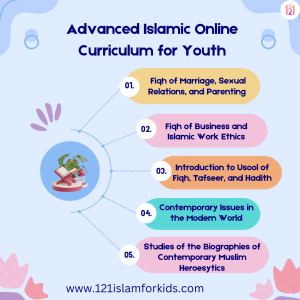
    Advanced Islamic Online Curriculum for Youth: Outline

    Advanced Islamic Online Curriculum for Youth Ages 14 to 16: Nurturing Informed and Confident Muslim Leaders

    Introduction:

    The 121 Islam for Kids Online Institute is proud to present an advanced Islamic curriculum designed for young Muslims aged 14 to 16 years old. This comprehensive program seeks to provide a deeper understanding of Islamic jurisprudence, principles, and values while addressing contemporary challenges in the modern world. Our goal is to empower youth to navigate complex issues, strengthen their faith, and inspire them to become proactive leaders in their communities and beyond.

    Module 1:

    Fiqh of Marriage, Sexual Relations, and Parenting

    Objective: To delve into the intricacies of Islamic jurisprudence concerning marriage, sexual relations, and parenting, fostering a responsible and balanced approach to family life.

    1.1 Islamic Laws of Marriage:

    • Explore the various types of marriages in Islam and their legal implications.
    • Discuss the importance of mutual respect and communication in a successful marriage.

    1.2 Sexual Ethics in Islam:

    • Address issues of consent, modesty, and the sanctity of intimacy in Islamic teachings.
    • Guide youth on how to develop healthy attitudes towards relationships and intimacy.

    1.3 Parenting with Islamic Values:

    • Examine Islamic principles on effective parenting and nurturing strong family bonds.
    • Empower youth to be responsible and caring parents in the future.

    Module 2:

    Fiqh of Business and Islamic Work Ethics

    Objective: To equip young Muslims with an understanding of ethical business practices and Islamic principles in the professional world.

    2.1 Islamic Business Contracts:

    • Delve into complex business transactions from an Islamic legal perspective.
    • Teach the concept of Ijarah (leasing) and Mudarabah (partnership) in business.

    2.2 Corporate Social Responsibility:

    • Encourage youth to consider the impact of business on society and the environment.
    • Promote ethical practices and honest dealings in the business world.

    Module 3:

    Introduction to Usool of Fiqh, Tafseer, and Hadith

    Objective: To provide a foundational understanding of the principles of Islamic jurisprudence, Quranic exegesis, and Hadith interpretation.

    3.1 Usool al-Fiqh: In-Depth Analysis:

    • Introduce advanced principles of Fiqh and their application in deriving rulings.
    • Foster critical thinking and analysis of complex legal issues.

    3.2 Advanced Tafseer of Selected Surahs:

    • Explore deeper meanings and context of selected Quranic verses.
    • Encourage independent study of the Quran for personal growth.

    3.3 Analyzing Hadith Narrations:

    • Teach methodologies for assessing the authenticity and reliability of Hadiths.
    • Equip youth with skills to apply Hadiths in their lives appropriately.

    Module 4:

    Contemporary Issues in the Modern World

    Objective: To facilitate open discussions on challenging topics related to Islam in the modern context, encouraging critical thinking and balanced viewpoints.

    4.1 Addressing Atheism and Secularism:

    • Analyze common arguments of atheism and provide Islamic responses.
    • Encourage youth to engage in constructive dialogues with non-Muslims.

    4.2 Reassessing Feminism and Women’s Rights:

    • Evaluate the compatibility of feminist ideas with Islamic teachings on gender equity.
    • Empower young women to embrace their rights and roles in Islam.

    4.3 Understanding Liberalism and Islamic Values:

    • Examine the principles of liberalism and their compatibility with Islamic beliefs.
    • Encourage a nuanced perspective on individual freedom and societal norms.

    Module 5: Dealing with Temptations and Traps of Shaitan (500 words)

    Objective: To guide youth in recognizing and resisting the various temptations and trials posed by Satan.

    5.1 Strengthening Iman (Faith):

    • Teach youth how to build and maintain strong faith through worship and self-reflection.
    • Encourage spiritual development and closeness to Allah.

    5.2 Recognizing Psychological Manipulation:

    • Educate youth on the tactics of Shaitan to mislead and deceive.
    • Provide strategies to safeguard against harmful influences.

    Module 6:

    Studies of the Biographies of Contemporary Muslim Heroes

    Objective: To inspire young Muslims with the exemplary lives of contemporary Muslim role models who have made significant contributions to society.

    6.1 Impactful Muslim Scholars, Innovators, and Humanitarians:

    • Introduce youth to influential Muslims in various fields, including academia, science, and philanthropy.
    • Showcase how these role models embody Islamic values in their achievements.

    6.2 Lessons from Exemplary Lives:

    • Extract life lessons and virtues demonstrated by contemporary Muslim heroes.
    • Inspire youth to emulate these qualities in their own lives.

    Conclusion:

    The advanced Islamic curriculum designed by 121 Islam for Kids Online Institute seeks to empower youth aged 14 to 16 with a deeper understanding of Islamic principles and values. Through interactive and engaging lessons, our program aims to equip young Muslims with the knowledge and critical thinking skills necessary to navigate complex challenges in the modern world. By addressing issues related to family life, business ethics, and contemporary debates, we hope to foster a generation of confident, informed, and compassionate Muslim leaders who can positively impact their communities and contribute to the betterment of society at large.

  • What are the teachings of surah ash-shams(91)? Easy tafsir

    What are the teachings of surah ash-shams(91)? Easy tafsir

    Unlock the lessons of Surah Ash Shams through a dynamic teaching method. Blend storytelling, tajweed, and reflection, fostering gratitude and choices for success.

    surah ash shams

    Introduction of Surah Ash Shams

    Sure! Surah Ash-Shams is like a magical story that teaches us important lessons. It tells us about a special messenger, Prophet Saleh, who was sent by Allah to guide a group of people called the Thamud.

    In this story, Allah gave the Thamud a unique camel as a sign of His power. Prophet Saleh warned them to be kind to the camel and to be grateful for Allah’s blessings. But some of the Thamud didn’t listen. They became proud and rebellious, and even after being warned, they harmed the special camel.

    Because of their bad choices, Allah was not pleased. His wrath came upon the Thamud, and their homes were leveled to the ground. The story teaches us that making good choices brings happiness and success while making bad choices leads to disappointment and failure.

    So, children, the lesson from Surah Ash-Shams is to be like the heroes in the story. Be kind, be grateful for the good things around you, and always listen to the wise advice given by those who guide you on the right path. This way, you’ll have a happy and successful tale filled with goodness.

    Words meaning and Tafsir

    Verse 1:

    Arabic: وَٱلشَّمْسِ وَضُحَىٰهَا

    English: “By the sun and its brightness,”

    Word Meaning:

    • وَ (Wa): By
    • الشَّمْسِ (Ash-Shams): the sun
    • وَضُحَىٰهَا (Wa Duhaaha): and its brightness

    “By the sun and its brightness,” (Quran 91:1)

    Now, let’s explore a children-friendly explanation inspired by Tafsir Ibn Kathir:

    Imagine the Quran is like a special guidebook that helps us understand the world and teaches us how to be good people. In this verse, Allah is talking about the sun, that bright and warm ball of light in the sky.

    When Allah says, “By the sun and its brightness,” it’s like saying, “Pay attention to the sun and the light it gives us.” The sun is essential for our world. It provides us with light during the day and makes everything bright and clear.

    Now, let’s think about why Allah might be mentioning the sun. Allah shows us how amazing His creations are and how everything in nature has a purpose. Just like the sun brightens our day, Allah wants us to bring brightness and goodness into the world.

    So, when you see the sun shining, remember that Allah is reminding you to spread kindness, just like the sun spreads light. Be a source of warmth and happiness for others, just like the sun is a source of warmth for the Earth.

    In summary, this verse is a beautiful way of teaching us to appreciate the sun and the light it brings. It’s also a reminder to be like the sun by spreading kindness and goodness to make the world a brighter place.

    Verse 2

    Arabic: وَٱلْقَمَرِ إِذَا تَلَىٰهَا

    English: “And [by] the moon when it follows it,”

    Word Meaning:

    • وَ (Wa): And
    • الْقَمَرِ (Al-Qamar): the moon
    • إِذَا (Idha): when
    • تَلَىٰهَا (Talaa): it follows it

    Now, let’s provide a children-friendly explanation inspired by Tafsir Ibn Kathir:

    Imagine the Quran is like a magical storybook that tells us about the wonders of the world. In this verse, Allah is talking about the moon, that shiny and gentle light we see at night.

    When Allah says, “And [by] the moon when it follows it,” it’s like saying, “Think about the moon and how it quietly follows the sun.” The moon doesn’t have its light; it reflects the light of the sun. So, when the sun goes away, the moon comes out and shares its gentle glow with us.

    Just like the moon follows the sun, Allah wants us to learn about the beauty of order and harmony in the world. It’s like having a friend who supports you, just like the moon supports the night by giving it a soft and peaceful light.

    So, when you see the moon in the sky, remember that Allah is teaching us about cooperation and sharing. Be like the moon in your life by helping and being a good friend to others, especially when they need a little light in their darkness.

    In summary, this verse teaches us to appreciate the moon’s gentle glow and reminds us to be supportive and kind, just like the moon follows the sun to light up the night.

    Verse 3

    Arabic: وَٱلنَّهَارِ إِذَا جَلَّىٰهَا

    English: “And [by] the day when it displays it,”

    Word Meaning:

    • وَ (Wa): And
    • النَّهَارِ (An-Nahaar): the day
    • إِذَا (Idha): when
    • جَلَّىٰهَا (Jallaa): it displays it

    Now, let’s provide a children-friendly explanation inspired by Tafsir Ibn Kathir:

    Imagine the Quran is like a treasure map, and in this verse, Allah is talking about something special: the daytime, when the sun shines bright.

    When Allah says, “And [by] the day when it displays it,” it’s like saying, “Look at the daytime when the sun makes everything bright and clear.” During the day, we can see the world around us, play, and learn new things because of the sunlight.

    Just like the daytime shows us the beauty of the world, Allah wants us to use our time wisely during the day. It’s like having a big playground where we can learn, be kind to others, and enjoy the blessings that Allah has given us.

    So, when you see the sun in the sky during the day, remember that Allah is reminding you to be active, learn, and make the most of your time. Be like the daytime by spreading happiness, just as the sunlight spreads across the earth.

    In summary, this verse encourages us to appreciate the brightness of the daytime and use our time wisely to learn, play, and be kind to others. It’s a reminder to be a source of light and joy, just like the day when the sun displays its radiant glow.

    Verse 4

    Arabic: وَٱلَّيْلِ إِذَا يَغْشَىٰهَا

    English: “And [by] the night when it covers it,”

    Word Meaning:

    • وَ (Wa): And
    • اللَّيْلِ (Al-Layl): the night
    • إِذَا (Idha): when
    • يَغْشَىٰهَا (Yaghshaa): it covers it

    Now, let’s provide a children-friendly explanation inspired by Tafsir Ibn Kathir:

    Imagine the Quran as a magical storybook that tells us about the wonders of the world. In this verse, Allah talks about something very special: the nighttime, when the world is covered by darkness.

    When Allah says, “And [by] the night when it covers it,” it’s like saying, “Think about the nighttime when everything is quiet and covered in darkness.” The night is like a soft, comforting blanket that covers the world, and it’s a time for rest and sleep.

    Just like the night covers the world, Allah wants us to appreciate the peacefulness of the night and understand the importance of rest. It’s like a gift from Allah, giving us a break to recharge our energy for the new day ahead.

    So, when you see the stars in the night sky, remember that Allah is reminding you to be grateful for the peacefulness of the night. Be like the night by bringing comfort and tranquility to others, just as the nighttime covers the world in a gentle embrace.

    In summary, this verse teaches us to appreciate the beauty and tranquility of the nighttime and reminds us of the importance of rest and peacefulness. It’s a reminder to be grateful for the calming moments that Allah has given us.

    Verse 5

    Arabic: وَٱلسَّمَاءِ وَمَا بَنَاهَا

    English: “And [by] the heaven and the One Who constructed it,”

    Word Meaning:

    • وَ (Wa): And
    • السَّمَاءِ (As-Samaa’): the heaven/sky
    • وَمَا بَنَاهَا (Wa Maa Banaha): and the One Who constructed it

    Now, let’s provide a children-friendly explanation inspired by Tafsir Ibn Kathir:

    Imagine the Quran is like a fascinating adventure book, and in this verse, Allah is talking about something incredible: the sky, that big, blue roof over our world.

    When Allah says, “And [by] the heaven and the One Who constructed it,” it’s like saying, “Think about the sky and how amazing it is. Allah is the One who made it so perfectly.” The sky is like a giant dome covering everything; Allah is the incredible builder who made it just right.

    Just like the sky protects us and makes our world beautiful, Allah wants us to appreciate His amazing creations. It’s like living in a big, open space where we can see the clouds, the sun, the moon, and the stars. Allah made it all so wonderfully!

    So, when you look up at the sky, remember that Allah reminds you of His greatness. Be like the sky by being open-hearted and kind to everyone. Just as the sky covers everything with its vastness, let your kindness and love cover the people around you.

    In summary, this verse teaches us to marvel at the beauty of the sky and appreciate the amazing way Allah created it. It’s a reminder to be kind and open-hearted, just like the vastness of the sky that Allah constructed so perfectly.

    Verse 6

    Arabic: وَٱلْأَرْضِ وَمَا طَحَاهَا

    English: “And [by] the earth and the One Who spread it!”

    Word Meaning:

    • وَ (Wa): And
    • الْأَرْضِ (Al-Ard): the earth
    • وَمَا طَحَاهَا (Wa Maa Ṭahaa): and the One Who spread it

    Now, let’s provide a children-friendly explanation inspired by the general understanding of the verse:

    Imagine the Quran is like a magical book full of secrets, and in this verse, Allah is talking about something extraordinary: the earth, the ground beneath our feet.

    When Allah says, “And [by] the earth and the One Who spread it,” it’s like saying, “Think about the ground you walk on and how Allah made it so perfect for us.” Allah is the One who made the earth flat and spread out, like a big, comfortable carpet for us to live on.

    Just like the earth gives us a place to walk, play, and build our homes, Allah wants us to appreciate the beauty and stability of the world. It’s like living in a big, wonderful garden that Allah created just for us.

    So, when you feel the ground beneath your feet, remember that Allah reminds you of His incredible power. Be like the earth by being strong and supportive, just as the ground supports everything on it.

    In summary, this verse teaches us to appreciate the earth, and our home, and to be grateful for the stable ground beneath our feet. It’s a reminder to be strong and supportive, just like the earth that Allah spread out so perfectly for us.

    Verse 7

    Arabic: وَنَفْسٍۢ وَمَا سَوَّىٰهَا

    English: “And [by] the soul and the One Who fashioned it,”

    Word Meaning:

    • وَ (Wa): And
    • نَفْسٍ (Nafs): the soul
    • وَمَا (Wa Maa): and the One Who
    • سَوَّىٰهَا (Sawwaa): fashioned it

    Now, let’s provide a children-friendly explanation inspired by the general understanding of the verse:

    Imagine the Quran is like a treasure map, and in this verse, Allah is talking about something truly special: the soul, the part of us that makes us who we are.

    When Allah says, “And [by] the soul and the One Who fashioned it,” it’s like saying, “Think about your heart and your feelings, and remember that Allah created each person uniquely and wonderfully.” Allah is the One who designed our souls, making each of us special and different.

    Just like a skilled artist creates beautiful paintings, Allah created our souls with love and care. He made us with feelings, thoughts, and the ability to choose between right and wrong. It’s like having a special gift that makes each person one of a kind.

    So, when you feel happy, sad, or even curious about the world, remember that Allah is reminding you of the beauty of your soul. Be like the soul by being kind, understanding, and appreciating the uniqueness in yourself and others.

    In summary, this verse teaches us to appreciate the uniqueness of our souls, which Allah fashioned with love and care. It’s a reminder to be kind and understanding, just as Allah beautifully designed each person’s soul.

    Verse 8

    Arabic: فَأَلْهَمَهَا فُجُورَهَا وَتَقْوَىٰهَا

    English: “Then [Allah] inspired it [with knowledge of] its wickedness and its righteousness.”

    Word Meaning:

    • فَأَلْهَمَهَا (Fa’alhamaha): Then inspired it
    • فُجُورَهَا (Fujura): its wickedness
    • وَتَقْوَىٰهَا (Wa Taqwa): and its righteousness

    Now, let’s provide a children-friendly explanation inspired by the general understanding of the verse:

    Imagine the Quran is like a wise friend, and in this verse, Allah is telling us about something fascinating: how He gave us a special gift called a conscience.

    When Allah says, “Then [Allah] inspired it [with knowledge of] its wickedness and its righteousness,” it’s like saying, “Allah gave us a little voice inside our hearts that helps us know the difference between right and wrong.” This special gift helps us make good choices in our lives.

    Just like a guidebook that tells us what’s right and what’s wrong, Allah inspired our hearts with a sense of what’s good (righteousness) and what’s not so good (wickedness). It’s like having a superhero power that helps us be kind, and honest, and make choices that make Allah happy.

    So, when you feel that little nudge inside your heart telling you to be good, remember that it’s Allah’s way of helping you choose the right path. Be like the heart by listening to that special voice and making choices that bring happiness and goodness to yourself and others.

    In summary, this verse teaches us about the special gift of a conscience that Allah has given us, helping us distinguish between right and wrong. It’s a reminder to listen to our hearts and make choices that bring joy and goodness into our lives.

    Verse 9

    Arabic: قَدْ أَفْلَحَ مَن زَكَّاهَا

    English: “Indeed, successful is the one who purifies it (the soul),”

    Word Meaning:

    • قَدْ (Qad): Indeed
    • أَفْلَحَ (Aflaha): Successful
    • مَن (Man): the one who
    • زَكَّاهَا (Zakkaaha): purifies it (referring to the soul)

    Now, let’s provide a children-friendly explanation inspired by the general understanding of the verse:

    Imagine the Quran is like a guidebook for life, and in this verse, Allah is teaching us about a special secret to success: keeping our hearts pure and clean.

    When Allah says, “Indeed, successful is the one who purifies it,” it’s like saying, “The person who takes care of their heart and makes good choices will be successful in life.” Just as we keep our bodies clean by taking a shower, Allah wants us to keep our hearts clean from bad thoughts and actions.

    So, what does it mean to purify the heart? It means being kind to others, telling the truth, helping those in need, and doing things that make Allah happy. When we do these good things, we are taking care of our hearts and making them pure.

    Now, here comes the superhero part: when we keep our hearts pure, Allah promises success. It’s like having a magic key to happiness and good things. Being successful doesn’t just mean having lots of toys or money; it means having a heart full of goodness and love.

    So, when you make choices that are kind and honest, remember that you’re on the path to success. Be like the heroes in your favorite stories by keeping your heart pure, and you’ll see how much joy and success you can bring to your life.

    In summary, this verse teaches us that success comes to those who keep their hearts pure by making good choices and being kind. It’s a reminder to be like the heroes and heroines in our favorite stories, making the world a better place through our actions and kindness.

    Verse 10

    Arabic: وَقَدْ خَابَ مَن دَسَّاهَا

    English: “And doomed is the one who corrupts it.”

    Word Meaning:

    • وَقَدْ (Wa Qad): And doomed is
    • خَابَ (Khaaba): the one who is doomed
    • مَن (Man): the one who
    • دَسَّاهَا (Dassaa-ha): corrupts it (referring to the soul)

    Now, let’s provide a children-friendly explanation inspired by the general understanding of the verse:

    Imagine the Quran is like a wise friend who cares about us, and in this verse, Allah is warning us about something very important: ruining our hearts.

    When Allah says, “And doomed is the one who corrupts it,” it’s like saying, “Uh-oh! The person who makes bad choices and does things that hurt their heart will face problems.” Allah is warning us to be careful because doing wrong things can make our hearts feel sad and troubled.

    So, what does it mean to corrupt the heart? It means being mean to others, telling lies, being greedy, and doing things that make Allah unhappy. When we do these things, it’s like putting muddy footprints on our hearts and making them feel yucky.

    But here’s the good news: we have the power to keep our hearts clean and pure by making good choices. If we listen to the good feelings inside us, like being kind and helpful, we can avoid making our hearts sad.

    So, when you’re faced with choices, remember to choose the path that keeps your heart happy and clean. Be like the heroes and heroines in your favorite stories by making choices that bring joy and goodness to your heart and the world around you.

    In summary, this verse warns us about the consequences of corrupting our hearts by making bad choices. It’s a reminder to be wise in our actions and to choose the path that keeps our hearts pure and happy.

    Verse 11

    Arabic: كَذَّبَتْ ثَمُودُ بِطَغْوَاهَآ

    English: “Thamûd rejected [the truth] out of arrogance.”

    Word Meaning:

    • كَذَّبَتْ (Kazzabat): rejected
    • ثَمُودُ (Thamûd): Thamûd (an ancient Arabian tribe)
    • بِطَغْوَاهَا (Biṭaghwaaha): out of arrogance

    Now, let’s provide a children-friendly explanation inspired by the general understanding of the verse:

    Imagine the Quran is like a storybook filled with lessons, and in this verse, Allah is telling us about a group of people called Thamûd who made a big mistake.

    When Allah says, “Thamûd rejected [the truth] out of arrogance,” it’s like saying, “There were some people in the past who didn’t want to listen to the good things Allah was telling them. They thought they knew better and didn’t want to be humble and learn.”

    Being arrogant is like having a big head and thinking we’re always right, even when we’re not. Thamûd didn’t want to accept the truth and be good, so they turned away from the guidance Allah was sending them.

    But here’s the important lesson: Allah wants us to be humble and open-hearted. We should be willing to learn and listen to what is right. If we make mistakes, it’s okay as long as we try to fix them and be better.

    So, when you hear something good or helpful, be like a wise explorer and be ready to learn. Don’t let arrogance stop you from growing and becoming a better person. Being humble and open to learning is a great way to make your heart happy.

    In summary, this verse teaches us about the mistake of Thamûd, who rejected the truth because of their arrogance. It reminds us to be humble, open to learning, and willing to accept what is right and good.

    Verse 12

    Arabic: إِذِ ٱنۢبَعَثَ أَشْقَىٰهَا

    English: “When the most wicked of them was roused [to kill the she-camel].”

    Word Meaning:

    • إِذِ (Idh): When
    • انبَعَثَ (Anba’atha): was roused
    • أَشْقَىٰهَا (Ashqaa-haa): the most wicked of them

    Now, let’s provide a children-friendly explanation inspired by the general understanding of the verse:

    Imagine the Quran is like a magical adventure book, and in this verse, Allah is telling us about a time when some people made a very bad decision.

    When Allah says, “When the most wicked of them was roused [to kill the she-camel],” it’s like saying, “There were people who were not being kind. The most wicked person among them wanted to hurt a special she-camel that Allah had sent as a sign.”

    The she-camel was a gift from Allah, and it was a test for the people to see if they would be grateful and take care of it. But the most wicked person, instead of being good, wanted to harm the camel.

    This story teaches us that sometimes people make bad choices because they are not being kind and grateful. Allah wants us to be good and thankful for the blessings He gives us, just like taking care of the she-camel.

    So, when you face choices, remember to be like the heroes in your favorite stories and make good decisions. Be kind, and grateful, and take care of the blessings Allah gives you, just like the people should have taken care of the she-camel.

    In summary, this verse tells us about a time when the most wicked person in a group wanted to harm a special she-camel from Allah. It’s a reminder for us to be kind, and grateful, and take care of the blessings Allah gives us in our lives.

    verse 13

    Arabic: فَقَالَ لَهُمْ رَسُولُ ٱللَّهِ نَاقَةَ ٱللَّهِ وَسُقْيَـٰهَا

    English: “But the Messenger of Allah warned them, ‘Allah’s she-camel and her turn to drink!’”

    Word Meaning:

    • فَقَالَ (Faqaala): But he said
    • لَهُمْ (Lahum): to them
    • رَسُولُ اللَّهِ (Rasoolullah): the messenger of Allah
    • نَاقَةَ اللَّهِ (Naqatullah): Allah’s she-camel
    • وَسُقْيَـٰهَا (Wa Suqyaha): and her turn to drink

    Now, let’s provide a children-friendly explanation inspired by the general understanding of the verse:

    Imagine the Quran is like a storybook filled with wise messengers, and in this verse, Allah is telling us about a special messenger who tried to guide the people to do what is right.

    When Allah says, “But the Messenger of Allah warned them, ‘Allah’s she-camel and her turn to drink!’” it’s like saying, “There was a special person sent by Allah to tell the people to be careful and not harm a special she-camel that Allah had given them.”

    The she-camel was a gift from Allah, and the messenger wanted to make sure the people understood how important it was to treat the camel kindly and let her drink water. Allah’s messenger was like a wise friend, reminding them to be grateful and take care of the blessings Allah gave them.

    This story teaches us about the importance of listening to messengers and being kind to the blessings Allah provides. Just like the people were warned not to harm the she-camel, we should be careful not to harm others and to appreciate the good things in our lives.

    So, when you hear wise advice, remember to be like the people who listened and did what was right. Be kind and thankful for the blessings around you, just like taking care of the she-camel.

    In summary, this verse tells us about a messenger of Allah warning the people to be careful and not harm a special she-camel. It’s a reminder for us to listen to wise advice, be kind, and appreciate the blessings Allah gives us.

    verse 14

    Arabic: فَكَذَّبُوهُ فَعَقَرُوهَا فَدَمْدَمَ عَلَيْهِمْ رَبُّهُم بِذَنبِهِمْ فَسَوَّاهَا

    English: “Still they defied him and slaughtered her. So their Lord crushed them for their crime, leveling all to the ground.”

    Word Meaning:

    • فَكَذَّبُوهُ (Fakazzaboo-hu): Still they defied him
    • فَعَقَرُوهَا (Fa’aqaroo-haa): and slaughtered her
    • فَدَمْدَمَ (Fadamdama): So their Lord crushed
    • عَلَيْهِمْ (Alayhim): them
    • رَبُّهُم (Rabbuhum): their Lord
    • بِذَنبِهِمْ (Bithanbihim): for their crime
    • فَسَوَّاهَا (Fasawwaha): leveling all to the ground

    Now, let’s provide a children-friendly explanation inspired by the general understanding of the verse:

    Imagine the Quran is like a guidebook for good choices, and in this verse, Allah is telling us about a sad time when some people made a really bad decision.

    When Allah says, “Still they defied him and slaughtered her,” it’s like saying, “Even after being warned, the people didn’t listen. They did something very wrong by hurting the special she-camel that Allah had given them.”

    The she-camel was a gift from Allah, and instead of being kind and grateful, the people chose to be mean and hurt it. This made Allah very sad, and He decided to teach them a lesson.

    So, when Allah says, “So their Lord crushed them for their crime, leveling all to the ground,” it means that Allah, in His wisdom, punished the people for their bad choices. Their homes and everything around them were leveled to the ground.

    This story teaches us about the importance of being kind, grateful and making good choices. Allah wants us to appreciate the blessings He gives us and not to harm others or His creations.

    So, when you face choices, remember to be like the people who make good decisions. Be kind, and thankful, and appreciate the blessings around you. Allah wants us to live in harmony and make the world a better place.

    In summary, this verse tells us about the consequences of a group of people who made a bad choice by hurting a special she-camel. It’s a reminder for us to be kind, and grateful, and make good choices to avoid negative consequences.

    verse 15

    Arabic: وَلَا يَخَافُ عُقْبَـٰهَا

    English: “He has no fear of consequences.”

    Word Meaning:

    • وَلَا (Wa La): And he has no
    • يَخَافُ (Yakhaafu): fear
    • عُقْبَـٰهَا (‘Uqbaaha): of consequences

    Now, let’s provide a children-friendly explanation inspired by the general understanding of the verse:

    Imagine the Quran is like a wise friend, and in this verse, Allah is talking about a person who makes good choices and doesn’t worry about bad consequences.

    When Allah says, “He has no fear of consequences,” it’s like saying, “There are people who do good things without expecting anything bad to happen to them. They are so good that they don’t worry about what might go wrong because they trust Allah.”

    This verse is like a superhero’s power. Imagine being so good and kind that you don’t have to be afraid of anything bad happening. Allah is telling us that when we make good choices and do things that make Him happy, He takes care of us.

    So, when you do good deeds and make kind choices, remember that Allah is watching over you. Trust in Him, and don’t be afraid of doing the right thing. It’s like having a magical shield of goodness that protects you from worries.

    In summary, this verse encourages us to be so good and kind that we don’t have to be afraid of bad consequences. Trust in Allah, make good choices, and you’ll have a magical shield of goodness around you.

    Teaching method for Surah Ash-Shams

    1. Introduction:

    Begin the lesson by introducing Surah Ash-Shams to the students. Provide information about when it was revealed and the historical context during Prophet Muhammad’s (PBUH) time in Makkah. Explain that the Surah emphasizes the consequences of human actions and the importance of recognizing and being grateful for Allah’s blessings.

    2. Tajweed and Recitation:

    Proceed with a session on Tajweed and recitation. Break down the verses of Surah Ash-Shams, focusing on correct pronunciation, elongation, and proper articulation. Encourage students to recite the verses, and provide individual guidance as needed.

    3. Words Meaning and Tafsir:

    After the recitation, delve into the meaning of the words and Tafsir (exegesis) of Surah Ash-Shams. Explain keywords and phrases, exploring their linguistic and contextual significance. Use Tafsir Ibn Kathir or other reputable sources to provide insights into the deeper meanings and lessons embedded in the Surah.

    4. Infographic:

    Create an infographic summarizing the main themes and lessons of Surah Ash-Shams. Include key points about the people of Thamud, the she-camel, the consequences of their actions, and the broader message of recognizing good and evil. Visual aids can enhance understanding and retention.

    5. Storytelling:

    Engage students with a storytelling session focused on the narrative of Surah Ash-Shams. Use age-appropriate language and emphasize the moral lessons of the story. Encourage participation by asking questions and prompting discussions about the characters, choices, and outcomes.

    6. Mindmap:

    Introduce a mindmap activity to visually organize the central themes of Surah Ash-Shams. Create a collaborative mindmap on a whiteboard or using digital tools, allowing students to contribute key concepts, characters, and lessons from the Surah. This visual representation aids in concept mapping and comprehension.

    7. Exercise:

    Conclude the lesson with an exercise that reinforces understanding. Design questions or activities that prompt students to reflect on the consequences of choices, relate the Surah to their lives or create personal connections. This can include journaling, group discussions, or short written reflections.

    By incorporating these elements into the teaching method, you can provide a comprehensive and engaging learning experience for students, ensuring they grasp both the linguistic aspects and the deeper spiritual lessons of Surah Ash-Shams.

    Surah Ash-Shams Mind Map:

    1. Introduction:
      • Early Makkah period
      • Strong opposition to Prophet Muhammad (pbuh)
    2. Main Theme:
      • Consequences of human actions
      • Distinction between good and evil
    3. Messenger:
      • Prophet Saleh (pbuh)
      • Sent to guide the people of Thamud
    4. She-Camel:
      • Miraculous sign from Allah
      • Symbolizes divine guidance
      • Specific schedule for drinking water
    5. People of Thamud:
      • Rebellion and defiance
      • Harm to the she-camel
      • Consequences of their actions
    6. Lesson Learned:
      • Importance of recognizing blessings
      • Making choices that lead to success
      • Consequences of corrupting the soul
    7. Application in Our Lives:
      • Recognizing good and evil
      • Making good choices
      • Being grateful for blessings
    8. Conclusion:
      • Timeless lessons for guidance

    Exercise

    Multiple Choice:

    1. What is the name of the Surah we are learning about?
    2. a. Surah Al-Fatiha b. Surah Ash-Shams c. Surah Al-Baqarah
    3. Where was Prophet Muhammad (pbuh) residing when Surah Ash-Shams was revealed? a. Madinah b. Makkah c. Taif
    4. What does the she-camel in the story symbolize? a. Divine guidance b. Water source c. Ordinary camel
    5. What did the people of Thamud do to the she-camel? a. Protected it b. Hamstrung it c. Ignored it
    6. What happened to the people of Thamud as a consequence of their actions? a. They were rewarded b. Their homes were leveled c. They were forgiven

    True/False: 6. Surah Ash-Shams teaches us that good and evil are the same. (True/False)

    1. Prophet Saleh (pbuh) was sent to guide the people of Thamud. (True/False)
    2. The she-camel had a special schedule for eating. (True/False)
    3. The people of Thamud listened to Prophet Saleh’s warnings. (True/False)
    4. The most wicked person among the Thamud hamstrung the she-camel. (True/False)

    Short Answer: 11. What is the main lesson Surah Ash-Shams teaches about good and evil?

    1. Who was the messenger sent to guide the people of Thamud?
    2. What was unique about the she-camel mentioned in the story?
    3. Why did the people of Thamud face consequences?
    4. How does Surah Ash-Shams emphasize the importance of recognizing blessings?
    5. Explain the symbolism of the she-camel in the story.
    6. What are the consequences of corrupting the soul according to Surah Ash-Shams?
    7. How can we apply the lessons from Surah Ash-Shams in our lives?
    8. Describe one example of a good choice mentioned in the story.
    9. Why is gratitude for Allah’s blessings an essential theme in Surah Ash-Shams?

    Answers:

    1. b, 2. b, 3. a, 4. b, 5. b, 6. False, 7. True, 8. True, 9. False, 10. True, 11. Answers may vary, but the emphasis should be on recognizing the differences between good and evil and making good choices.
    2. Prophet Saleh (pbuh), 13. It had a specific schedule for drinking water, 14. They harmed the she-camel and rejected Prophet Saleh, 15. By emphasizing the consequences of corrupting the soul, 16. It symbolizes divine guidance, 17. Failure, 18. Answers may vary, focusing on recognizing blessings and making good choices, 19. Protecting the she-camel, 20. Gratitude is essential to appreciate Allah’s guidance and blessings.

    Frequently Asked Questions (FAQs) about Surah Ash-Shams:

    1. Q: What is the main theme of Surah Ash-Shams?

    A: The main theme revolves around the consequences of human actions, the distinction between good and evil, and the importance of recognizing and being grateful for Allah’s blessings.

    2. Q: Who was the messenger mentioned in Surah Ash-Shams?

    A: The messenger was Prophet Saleh (PBUH), sent by Allah to guide the people of Thamud.

    3. Q: What was the significance of the she-camel in the story?

    A: The she-camel was a miraculous sign from Allah, symbolizing divine guidance and a test for the people of Thamud. It had a specific schedule for drinking water.

    4. Q: Why did the people of Thamud face consequences?

    A: The people of Thamud faced consequences due to their rebellion, defiance of Prophet Saleh’s guidance, and harm caused to the she-camel, a symbol of goodness.

    5. Q: What lesson does Surah Ash-Shams teach about good and evil?

    A: The Surah teaches that good and evil are distinct, contradictory, and have different consequences. It emphasizes making choices that lead to success by recognizing and developing good inclinations.

    6. Q: How does Surah Ash-Shams emphasize the importance of recognizing blessings?

    A: The Surah underscores the importance of recognizing and being grateful for Allah’s blessings by narrating the story of the people of Thamud and their failure to appreciate the divine signs.

    7. Q: What is the consequence of corrupting the soul according to Surah Ash-Shams?

    A: The consequence is failure. The Surah teaches that success depends on keeping the soul pure while corrupting it leads to disappointments and failures.

    8. Q: How can the lessons from Surah Ash-Shams be applied in our lives?

    A: The lessons can be applied by recognizing the differences between good and evil, making good choices, being grateful for blessings, and avoiding actions that corrupt the soul.

    9. Q: What role does the she-camel play in the story’s symbolism?

    A: The she-camel symbolizes divine guidance and a test for the people of Thamud. Its unique qualities and the people’s reaction to it highlight the importance of recognizing and following Allah’s signs.

    10. Q: Why is gratitude for Allah’s blessings emphasized in Surah Ash-Shams?

    A: Gratitude is emphasized to encourage appreciation for Allah’s guidance and blessings, fostering a sense of humility and recognition of the divine gifts in our lives.

    Resources

    Story of Surah AL-Layl Video

    Gallery

    Video Playlist English

    Video Playlist Urdu

    Books (Shop)

    My First Quran Picture Book

    My First Quran Stories Book

    Islamic education By Molvi Abdula Aziz Grade7

    Free Books (pdf)

  • Islamic Online Education: A Guide to Best Curriculum(8 to 10)

    Islamic Online Education: A Guide to Best Curriculum(8 to 10)

    Islamic Online Education Curriculum for Children Aged 8 to 10: Building Strong Foundations for 21st-Century Muslims

    online education

    Introduction:

    The 121 Islam for Kids Online Institute is dedicated to providing comprehensive and age-appropriate Islamic education for Muslim children aged 8 to 10 years old. Our curriculum is designed to instill a strong understanding of core Islamic beliefs, principles, and values while also fostering respect for diversity and promoting good character and manners. With a focus on interactive and engaging methods, our program aims to empower children to become confident, compassionate, and responsible young Muslims.

    Online Education Curriculum Modules:

    Module 1: Basic Fiqh

    Objective: To introduce children to the fundamental principles of Islamic Jurisprudence (Fiqh) and guide them in applying Islamic teachings to their daily lives.

    1.1 Five Pillars of Islam:

    1.2 Wudu and Salah:

    • Explain the importance of cleanliness (Taharah) and how to perform Wudu (ablution).
    • Guide children through the steps of performing Salah and its importance in daily life.

    Module 2: Core Islamic Beliefs

    Objective: To provide children with a strong understanding of the foundational beliefs of Islam.

    2.1 Oneness of Allah (Tawheed):

    • Teach the concept of Tawheed and the importance of monotheism in Islam.
    • Introduce the 99 Names of Allah (Asma-ul-Husna) and their meanings.

    2.2 Belief in Angels, Prophets, Scriptures, Books, and Day of Judgment:

    • Introduce the concept of angels and their roles in Islam.
    • Teach about the important prophets and their books, including Prophet Muhammad (PBUH), and the divine scriptures.
    • Fate and Day of Judgment

    Module 3: Introduction to Other World Religions

    Objective:

    To promote interfaith understanding and respect for diversity while reinforcing the uniqueness of Islamic beliefs. You can read this topic in detail ‘Understanding Religion and Its Role in Our Lives – A Guide for Muslim Kids (8-10)’

    3.1 Comparative Religion:

    • Introduce children to the basics of major world religions, such as Christianity, Judaism, and Hinduism.
    • Emphasize similarities and differences between these religions and Islam.

    Module 4: Tafseer of Short Surahs

    Objective: To help children understand the meanings and lessons behind short surahs (chapters) from the Quran.

    4.1 Surah Al-Fatiha:

    • Explore the significance of Surah Al-Fatiha as the opening chapter of the Quran.
    • Explain the meanings and implications of the verses within this surah.

    4.2 Surah Al-Asr and Surah Al-Ikhlas:

    • Provide a detailed explanation of Surah Al-Asr and its relevance to time management and mindfulness.
    • Elaborate on the profound meanings of Surah Al-Ikhlas, emphasizing the concept of Tawheed.

    Module 5: Explanation of Hadiths with Stories and Worksheets

    Objective: To engage children with stories and activities that illustrate the wisdom and guidance found in Hadiths.

    5.1 30 short Hadiths:

    • Share Hadiths that highlight the topics of hadith with an explanation.
    • Encourage children to emulate the Prophet’s (PBUH) compassionate character.

    5.2 Story related to the topic

    • We will tell stories from Seerah and prophets stories related to the topic
    • We encourage students to discuss and reflect on the lesson learned from the story
    • We encourage students to share the hadith and story with others.

    5.3 Worksheets and Interactive Activities:

    • Provide interactive worksheets and activities to reinforce the understanding of Hadiths and their practical application.

    Module 6: Seerah of Prophet Muhammad (PBUH) and Other Prophets

    Objective: To introduce children to the life and teachings of Prophet Muhammad (PBUH) and other esteemed prophets.

    6.1 Seerah of Prophet Muhammad (PBUH):

    • Narrate key events from the life of Prophet Muhammad (PBUH), highlighting his character and teachings.
    • Emphasize the importance of following his example in daily life.

    6.2 Stories of Other Prophets:

    • Introduce stories of Prophet Ibrahim, Prophet Musa, Prophet Isa, and others, underscoring the common message of monotheism and morality.

    Module 7: Islamic Manners and Etiquettes

    Objective: To instill good manners, etiquette, and the importance of respecting elders and peers.

    7.1 Dress Code in Islam:

    • Teach the significance of modesty and appropriate Islamic dress for boys and girls.
    • Explain the concept of hijab and its various interpretations.

    7.2 Rights of Parents and Elders:

    • Highlight the respect and kindness that children should show towards their parents and elders.
    • Encourage children to be grateful for their caregivers’ efforts.

    7.3 manners – 121 Islam for Kids:

    • Promote kindness, honesty, and integrity in children’s interactions with others.
    • Emphasize the value of empathy and compassion in Islam.

    Conclusion:

    At the 121 Islam for Kids Online Institute, we are dedicated to providing an interactive and all-inclusive curriculum that will help shape young Muslim minds. Our program is designed to focus on fundamental Islamic values, ethics, and manners, which will help to establish a strong foundation in faith and character. We also aim to instill a sense of open-mindedness and respect towards diverse beliefs, thereby encouraging children to actively participate as responsible members of their communities and the world at large. Through our curriculum, we strive to equip the next generation with the knowledge and tools needed to uphold the principles of Islam and make positive contributions to society.

    How does this guide Islamic online education curricula? Let us know in the Comment box

    Do you want to add any other module to this list?

  • Story 24 Urdu|”A Story of Friendship and Faith”

    Story 24 Urdu|”A Story of Friendship and Faith”

    “The Power of Good Companions: A Story of Friendship and Faith”

    میرے پیارے طلباء ، یہاں ایک بہت ہی خوبصورت کہانی کے ساتھ ہماری اگلی حدیث ہے۔

    Hadees:حدیث

    الْمَرْءُ مَعَ مَنْ أَحَبَّ

    انسان اس کے ساتھ ہے جس سے وہ محبت رکھتا ہے

    میرے پیارے طلباء ، اس حدیث میں ہمارے نبی صلی اللہ علیہ وسلم نے فرمایا ہے کہ اچھے دوست بنائیں کیونکہ آپ آخرت میں اپنے دوستوں کے ساتھ رہیں گے۔ لہذا اگر آپ اچھے دوست بنائیں گے تو وہ آپ کے نیک اعمال میں اضافہ کریں گے اور آپ جنت میں چلے جائیں گے ، لیکن اگر آپ برے دوست بنائیں گے تو وہ آپ کو دوزخ کی آگ میں لے جائیں گے۔

    ہر کوئی اس کے ساتھ زیادہ وقت گزارنا پسند کرتا ہے جس سے وہ محبت کرتا ہے ، نئے دوست بنانا اور اپنے دوستوں کے ساتھ کھیلنے اور تفریح ​​کے لئے زیادہ سے زیادہ وقت گزارنا پسند کرتا ہے۔ ہمیں اپنے دوستوں کو منتخب کرنے میں بہت محتاط رہنا چاہئے کیونکہ ہر ایک اچھا دوست نہیں بن سکتا۔ ہمارے تمام کلاس فیلو اور ہمارے پڑوسی ہمارے بہترین دوست نہیں بن سکتے ہیں۔ ہمیں اچھے دوست بنانا چاہئے ، کیونکہ ہم ان سے بہت ساری اچھی چیزیں سیکھیں گے۔

    تاہم ، ایک برا دوست ہماری اچھی عادات کو خراب کر سکتا ہے۔ اچھے دوست وہ ہوتے ہیں جو ہمیں اچھی چیزیں سکھاتے ہیں ، برے کاموں سے روکتے ہیں اور جو کسی پریشانی میں ہماری مدد کرتے ہیں۔ اگر اس دنیا میں ہمارے اچھے دوست ہیں تو اللہ ان شاء اللہ جنت میں ہمارے اچھے دوست کی صحبت فراہم کرے گا۔

    کہانی

    غار کے ساتھی

    ہمارا نبی صلی اللہ علیہ وسلم اس دنیا کے بہترین انسان تھے اور ان کے بہت سے اچھے  دوست تھے ۔ ان کے تمام ساتھی بہت ہی سچے مومن تھے اور انہوں نے زندگی کے ہر لمحے میں ہمارے نبی صلی اللہ علیہ وسلم کی مدد کی۔

    صحابہ میں حضرت ابوبکر صدیق رضی اللہ عنہ بہترین ساتھی تھے۔ وہ پیغمبر اکرم صلی اللہ علیہ وسلم کو بہت پسند کرتے تھے اور زندگی کی ہر مشکل میں ان کے ساتھ تھے۔ وہ اسلام سے پہلے آپ   صلی اللہ علیہ وسلم کے دوست تھے اور وہ سب سے   پہلے مسلمان بھی تھے۔

    جب ہمارے نبی صلی اللہ علیہ وسلم نے لوگوں کو اسلام قبول کرنے کے لئے بلایا تو مکہ مکرمہ میں ہر ایک محمد صلی اللہ علیہ وسلم کا دشمن بن گیا۔ بہت سے لوگوں نے آپ   صلی اللہ علیہ وسلم کی نافرمانی کی اور آپ  صلی اللہ علیہ وسلم کی راہ میں بہت سی روکاوٹیں  پیدا کیں۔   حضرت ابوبکر صدیق رضی اللہ عنہ  آپ   صلی اللہ علیہ وسلم کی حمایت میں نے ان کے ساتھ کھڑے ہوئے۔

    حضرت ابوبکر صدیق رضی اللہ عنہ بہت دولت مند تھے ، ان کا بہت اچھا کاروبار تھا اور انہوں نے اپنے دوست اور اللہ کے لئے اپنا سارا مال اور وقت وقف کردیا۔

    حضرت ابوبکر صدیق رضی اللہ عنہ کی بہترین قربانی اس وقت  دی   جب    پیغمبر اکرم صلی اللہ علیہ وسلم نے مدینہ جانے کا فیصلہ کیا ۔ کفار مکہ ہمارے نبی صلی اللہ علیہ وسلم کے بدترین دشمن بن گئے اور انہوں نے ہمارے نبی صلی اللہ علیہ وسلم کو قتل کرنے کا فیصلہ کیا۔ چنانچہ اللہ کے حکم سے پیغمبر اکرم صلی اللہ علیہ وسلم نے مدینہ جانے کا فیصلہ کیا۔ اس سفر کے دوران حضرت ابوبکر صدیق رضی اللہ عنہ آپ صلی اللہ علیہ وسلم کے ساتھ تھے ۔

    حضرت ابوبکر صدیق رضی اللہ عنہ دو اونٹ لے آئے اور وہ  رات کے وقت آپ صلی اللہ علیہ وسلم کے سا تھ مکہ مکرمہ سے چلے گئے۔ انہوں نے ایک غار میں پناہ لی۔ اس غار کا نام غار ثور ہے۔  غار ثور کئی سالوں سے بند تھا۔ ۔ حضرت ابوبکر صدیق رضی اللہ عنہ نے خود غار صاف کیا۔ غار میں بہت سارے سوراخ تھے جن میں بہت سے نقصان دہ کیڑے تھے۔ حضرت ابوبکر صدیق رضی اللہ عنہ نے اپنی قمیض پھاڑ کر  اس سے کچھ ٹکڑے لئے اور غار میں سوراخ بند کردیئے۔

     کفار   مکہ انہیں تلاش     کرتے   غار   تک  پہنچے۔ وہ غار کے باہر کھڑے تھے جہاں ہمارے نبی صلی اللہ علیہ وسلم  اور  حضرت ابوبکر صدیق رضی اللہ عنہ چھپے ہوئے تھے لیکن اللہ نے اپنے بندوں کو بچایا۔ اللہ نے وہاں ایک فاختہ بھیجی اور وہ  اس  گھونسلے میں بیٹھ گی اور انڈے دے  دیئے۔۔ پھر مکڑی نے جال بنانا شروع کیا۔ غار کا دروازہ اب مکڑی کے جال کے ساتھ بند کردیا گیا تھا۔ کافروں کا خیال تھا کہ اس گندی اور بند غار میں کوئی یہاں نہیں ہوسکتا ہے اور اس لئے وہ وہاں سے چلے گئے۔

    دونوں دوست بچ گئے اور انہوں نے غار میں کچھ آرام کرنے کا فیصلہ کیا۔

    حضرت ابوبکر صدیق رضی اللہ عنہ نے اپنے بہترین دوست سے کچھ آرام کرنے کو کہا۔ تو ہمارے نبی صلی اللہ علیہ وسلم  نے ان کی گود میں سر رکھا اور لیٹ گئے۔ اچانک وہاں ایک بچھو ظاہر ہوا۔ حضرت ابوبکر صدیق رضی اللہ عنہ نے اپنے دوست کو پریشان نہ کرنے کا فیصلہ کیا اور اس بچھو پر ہاتھ رکھ  دیا- 

    وہ بچھو حضرت ابوبکر صدیق رضی اللہ عنہ  کو کاٹتا رہا۔ یہ بہت تکلیف دہ  تھا اور ان کی آنکھوں  سے آنسو  بہنے لگے ۔ جب درد ناقابل برداشت ہو گئی   تو کی آنکھوں سے ایک قطرہ آنحضرت صلی اللہ علیہ وسلم پر پڑا۔ حضور صلی اللہ علیہ وسلم اٹھ  گئے اورحضرت ابوبکر صدیق رضی اللہ عنہ کی طرف دیکھا۔ حضرت ابوبکر صدیق رضی اللہ عنہ کا    ہاتھ زخمی تھا اور اس بچھو کے کاٹنے سے  وہ     بہت    تکلیف       میں تھے۔ 

    آنحضرت صلی اللہ علیہ وسلم نے حضرت ابوبکر صدیق رضی اللہ عنہ سے پوچھا ، “تم نے مجھے کیوں نہیں بتایا؟”

    حضرت ابوبکر صدیق رضی اللہ عنہ نے جواب دیا ، “میں آپ کو پریشان نہیں کرنا چاہتا تھا۔”

    حضور نبی کریم صلی اللہ علیہ وسلم نے اپنا تھوک زخموں پر لگایا اور درد کم ہوگیا ۔ حضرت ابوبکر صدیق رضی اللہ عنہ خوش تھے کہ انہوں نے اپنے دوست کو راحت بخشی۔

    یہ دوستی کی ایک حقیقی مثال ہے۔ یہ اخلاص ہے۔

    وہ ہر آزمائش اور زندگی کے ہر قدم میں ایک دوسرے کے ساتھ تھے۔

    اور موت کے بعد ان کی قبریں بھی ایک  ہی جگہ پر ہیں۔ اور اللہ کی نعمت سے جنت میں ایک دوسرے کے ساتھ رہیں گے۔ ان شاء اللہ.

    اگر ہم جنت میں پیغمبر اکرم صلی اللہ علیہ وسلم کے ساتھ رہنا چاہتے ہیں تو ہمیں ان سے پیار کرنا چاہئے اور اس کی سنت پر عمل کرنا چاہئے۔ ہمیں بطور دوست بہترین لوگوں کا انتخاب کرنا چاہئے۔ ہمیں اپنے دوستوں کے ساتھ اچھی چیزیں بانٹنا اور دین کی طرف لانا چاہئے۔

    مجھے امید ہے کہ آپ اس کہانی کو اپنے دوستوں کے ساتھ شیئر کریں گے۔ تاکہ وہ آپ کے بہترین دوست بھی بن سکیں۔

    یا راب ، ہمیں اچھے دوست مہیا کریں۔ آمین۔

    This story has been written for our Hadith with stories course designed for kids in English and Urdu. We also have prepared worksheets for kids. Visit the following links to read more about the course.

    30 short hadith with stories course Introduction

    Read This hadith with the introduction and explanation in Urdu and English

    Read This story in Urdu

    Buy our hadith workbook

    Worksheet for This hadith

    hadees
  • Story 24 Eng| New Islamic story of choosing good friends

    Story 24 Eng| New Islamic story of choosing good friends

    “Good Company: Hadith and Stories on Choosing Righteous Friends”

    Companions in Cave

    Assalamoualaikum

    My dear children, in a hadith our Prophet SAW said that make good friends because you will be with your friends in the hereafter. So if you will make good friends they will increase your good deeds and you will go to Jannah, but if you will make bad friends then they will lead you to hellfire.

     Everyone likes to spend more time with the one they love, make new friends and spend more and more time with their friends to play and have fun. We should be very careful in choosing our friends as not everyone can be good friends. Our all-class fellows and our neighbors could not be our best friends.

    We should make good friends because we will learn many good things from them. However, a bad friend can ruin our good habits. Good friends are those who teach us good things, forbid us from bad things, and help us in any trouble.  If we have good friends in this world, Allah will provide us with the company of our good friends in Jannah in sha Allah. 

    Our prophet SAW was the best man in this world and he had many good and nice friends. All of his companions were very true believers and they helped our Prophet in every moment of life. 

    Among the companions Hazarat Abu Baker Sadiq RA was the best fellow. He loved the Prophet SAW a lot and was with him in every hardship of life. He was his friend before Islam and he was also the first Muslim. 

    When Our prophet SAW called people to accept Islam, everyone in Makkah became the enemy of Muhammad SAW. Many people disobeyed him and made many troubles in his way. Abu Bakar RA stood beside him to support him.

    Abu Bakar  RA was very wealthy, he had a very good business and he donated all his wealth and time for His friend and Allah.

    His best sacrifice was on the Day of Hijra. Disbelievers of Makkah became the worst enemy of Our Prophet and they decided to kill our Prophet SAW. So by the order of Allah, Prophet SAW decided to go to Madina. Abu Bakr RA was with him during this journey and Abu Bakr RA saved him from Makkans.

    Abu Baker brought two camels and they left Makkah during the night. They took shelter in a cave. The name of this cave is Thaur (saoor) . The cave was closed for many years. It was so dirty and scary. Abu Baker cleaned the cave himself. There were many holes in the cave in which there were many harmful insects. Abu Baker RA took some pieces from his shirt and closed the holes before entering the cave.

    The Makkan followed them and reached there. Makkans were standing outside the cave where they were hiding but Allah saved His servants. Allah sent a dove there and that dove sat in her nest and started to lay eggs. Then a spider started to make a web. The door of the cave was now closed with the web. Disbelievers thought that no one could be here in this dirty and closed cave and so they left. 

    Both friends were saved and they decided to take some rest in the cave. 

      Abu Baker asked his best friend to have some rest. So Our Prophet SAW put his head into his lap and laid down. Suddenly a Scorpio appeared there.

    Abu Baker decided not to disturb His Friend and put his hand on that Scorpio. That Scorpio kept biting Abu Baker RA. It was very painful and hard to bear and his eyes started to weep. When the pain was unbearable, one drop from his eyes dropped on the Prophet SAW. The Holy Prophet woke up and looked at him. Abu Baker’s RA hand was wounded and there were many bites of that scorpion. He was worried. 

    He asked him, “Why didn’t you tell me?”

    Abu Baker replied, “I didn’t want to disturb you.” 

    The Holy Prophet SAW applied his spit onto the wounds and the pain was decreased. Abu Baker was happy that he provided comfort to his friend.

    It is a real example of friendship. This is sincerity. 

    They were with each other in every trial and step of life.

    And after death, their graves are also in the same place. And with the blessing of Allah they will be with each other in Jannah. In sha Allah.

    If we want to be with Holy Prophet SAW in Jannah we should love him and follow His Sunnah. We should choose the best ones as friends. We should share good things with our friends and bring them towards deen.

    This is true love. This is a true companionship to save each other from hellfire.

    In sha Allah.

    I hope you will share this story with your friends. So that they can also be your best friends. 

    Ya Rub, Provide us, with good friends. Ameen.

    This story has been written for our Hadith with stories course designed for kids in English and Urdu. We also have prepared worksheets for kids. Visit the following links to read more about the course.

    30 short hadith with stories course Introduction

    Read This hadith with the introduction and explanation in Urdu and English

    Read This story in Urdu

    Buy our hadith workbook

    Worksheet for This hadith

  • How to start Muslim homeschooling? 8 steps guide

    How to start Muslim homeschooling? 8 steps guide

    muslim homeschool

    Starting Muslim homeschooling can be a rewarding experience for both parents and children. As a parent, you have the opportunity to provide your child with a tailored education that aligns with your values and beliefs. Here is a detailed guide on how to start a Muslim homeschooling program:

    The first step in starting a Muslim homeschooling program is to research the legal requirements in your state or country. Laws and regulations can vary widely from one location to another. In the United States, for example, homeschooling is legal in all 50 states, but the specific requirements can vary depending on where you live. To ensure that you are in compliance with the law, start by researching the homeschooling laws and regulations in your area.

    Step 2: Goals and objectives

    Define Your Educational Goals and Objectives The next step is to define your educational goals and objectives. As a Muslim homeschooling parent, you have the flexibility to tailor your child’s education to your values and beliefs. Start by considering the subjects that are important to you and your family, such as Islamic Studies, Arabic Language, and Quranic Studies. You may also want to consider other subjects, such as Math, Science, and Social Studies.

    Step 3: Curriculum (Get Books)

    Choose a Curriculum Once you have defined your educational goals and objectives, the next step is to choose a curriculum. There are many options available online, including secular curricula that can be adapted to a Muslim homeschooling program, as well as specialized Muslim curricula.

    There are many curriculums and books available for Muslim homeschooling families. Here are some popular options:

    1. The Islamic Education Series: This is a comprehensive Islamic curriculum that covers all aspects of Islamic studies for children from kindergarten through grade 12. It is published by the International Islamic Publishing House.
    2. Noorart: Noorart offers a variety of Islamic curriculums and textbooks for children of all ages. Their curriculums cover Quran, Islamic studies, the Arabic language, and more.
    3. Islamic School Book: This is a series of textbooks published by the Islamic Services Foundation that cover Islamic studies, the Quran, and the Arabic language for children in grades 1-12.
    4. I Love Islam: (Get Books) This is a comprehensive Islamic curriculum for children from kindergarten through grade 5. It is published by the Islamic Services Foundation.
    5. A Guide to Islamic Studies: This is a comprehensive curriculum for Islamic studies for children from kindergarten through grade 12. It is published by the Muslim American Society.
    6. The Seerah Trail: (Get Book)This is a unique Islamic curriculum that teaches the life of the Prophet Muhammad (peace be upon him) through a trail format. It is designed for children aged 7-11.
    7. Learning Roots: (Get Books) Learning Roots offers a variety of Islamic books and resources for children of all ages. Their books cover topics such as Quran, Islamic studies, and Arabic language.

    These are just a few of the many curriculums and books available for Muslim homeschooling families. It’s important to research and find a curriculum that fits your family’s needs and goals.

    Some popular Muslim homeschool curricula include:

    Be sure to research the different curricula available to find the one that best meets your needs and goals.

    Step 4: Plan Your Lessons

    Plan your lessons With your curriculum in hand, it’s time to plan your lessons. Start by breaking down the curriculum into manageable units and then plan the lessons for each unit. Be sure to allocate enough time for each subject and use a variety of teaching methods to keep your child engaged.

    Step 5: Get the Necessary Resources

    To effectively homeschool your child, you will need the necessary resources. This may include textbooks, workbooks, educational software, and other materials. Many resources are available online, or you may be able to find them at local homeschooling stores or Islamic bookstores. ( View or Buy)

    When it comes to homeschooling, there are several resources that are necessary to ensure a successful and effective learning experience. Here are some essential homeschool resources:

    1. Curriculum: A curriculum is the backbone of homeschooling. It provides a structured framework for learning and ensures that the child is learning what they need to know. There are many options for homeschool curriculums, including religious-based curriculums, secular curriculums, and online curriculums.
    2. Learning Materials: Learning materials include textbooks, workbooks, worksheets, and other materials that are used to teach specific subjects. These materials are often part of the curriculum, but they can also be purchased separately or found online.
    3. Supplies: Homeschooling requires various supplies, such as pencils, paper, art supplies, and manipulatives for math. Having the necessary supplies on hand is important for ensuring that the child has everything they need to complete their work.
    4. Technology: In today’s world, technology is an essential part of homeschooling. Computers, tablets, and educational software can enhance the learning experience and provide a wealth of information and resources.
    5. Support: Homeschooling can be challenging, and having a support system is essential. This can include other homeschooling families, online groups, co-ops, and tutors.
    6. Field Trips: Field trips provide a hands-on learning experience and are an essential part of homeschooling. Trips to museums, historical sites, and other educational destinations can help bring learning to life.
    7. Assessment Tools: Assessment tools, such as tests, quizzes, and progress reports, are essential for tracking the child’s progress and ensuring that they are meeting learning objectives.

    These resources are essential for successful homeschooling. However, it’s important to remember that every family’s needs are different, and what works for one family may not work for another. It’s important to do research and find the resources that work best for your family’s unique needs and goals.

    Step 6: Join Muslim Homeschooling Group

    Joining a Muslim homeschooling group can provide valuable support and resources for both parents and children. These groups may offer online forums, in-person meetings, and other resources to help you connect with other Muslim homeschooling families. Some popular Muslim homeschooling groups include:

    • Muslim Homeschoolers Unite
    • Muslim Homeschooling Resources
    • Muslim Homeschool Network

    Some Muslim homeschool groups on Facebook

    There are many Muslim homeschooling groups on Facebook that offer support and resources to Muslim homeschooling families. Here are some of the popular Muslim homeschooling groups on Facebook:

    1. Muslim Homeschoolers Unite: This is a global community of Muslim homeschooling parents and educators. The group offers support, resources, and advice on Muslim homeschooling.
    2. Muslim Homeschooling Resources: This group is a resource hub for Muslim homeschooling parents. The group shares free resources, curriculum ideas, and tips for Muslim homeschooling.
    3. Muslim Homeschool Network: This group is for Muslim homeschooling parents and students. The group shares advice, resources, and support for Muslim homeschooling families.
    4. Muslimah Homeschool: This is a group for Muslim women who homeschool their children. The group offers support, resources, and advice on Muslim homeschooling.
    5. Islamic Homeschooling: This group is for Muslim homeschooling parents who are interested in using an Islamic curriculum. The group shares curriculum ideas, resources, and advice on Islamic homeschooling.
    6. Muslim Homeschooling Moms: This is a group for Muslim homeschooling moms to share their experiences, advice, and resources on Muslim homeschooling.
    7. Islamic Homeschooling for Little Muslims: This group is for Muslim homeschooling parents with young children. The group shares ideas, resources, and advice on teaching Islam to young children.

    These are just a few of the many Muslim homeschooling groups on Facebook. Joining a group can provide valuable support and resources for both parents and children.

    Step 7: Keep Records and Create a Portfolio (Get)

    Keeping records and creating a portfolio is essential for documenting your child’s progress and meeting legal requirements. Your portfolio should include samples of your child’s work, a record of lessons, and any assessments or evaluations.

    Step 8: Decorating and managing (view or buy)

    Decorating and managing a homeschooling space can be an important part of creating a productive and inspiring learning environment. Here are some tips for Muslim homeschool decor and management:

    1. Create a dedicated homeschool space: Designate a specific area in your home for homeschooling. This could be a separate room or a corner of a larger room. Having a dedicated space helps create a sense of structure and routine.
    2. Incorporate Islamic art and decor: Including Islamic art and decor in your homeschooling space can help create a sense of connection to Islamic culture and values. This could include Islamic calligraphy, paintings, or even decorative items such as prayer rugs or Islamic-themed wall hangings.
    3. Keep it organized: A well-organized homeschooling space can help create a calm and focused environment. Invest in storage solutions such as shelves, bins, and drawers to keep materials organized and easily accessible.
    4. Create a schedule: Having a schedule helps create structure and routine in your homeschooling day. Create a schedule that includes time for prayer, breaks, and different subjects. This can help keep your homeschooling day on track and ensure that you cover all necessary subjects.
    5. Utilize technology: Technology can be a valuable tool for homeschooling. Consider incorporating educational apps, online resources, and virtual field trips into your curriculum.
    6. Take breaks: It’s important to take regular breaks to avoid burnout and maintain focus. Encourage your child to take breaks throughout the day, and use this time to relax and recharge.
    7. Keep it comfortable: Creating a comfortable learning environment is important for ensuring that your child can focus and learn effectively. Make sure the space is well-lit, and consider adding comfortable seating or a cozy rug to create a warm and inviting atmosphere.

    These tips can help create an effective and inspiring Muslim homeschooling space. Remember to personalize your homeschooling space to fit your family’s unique needs and preferences.

    In summary, starting a Muslim homeschooling program requires careful planning and preparation. Research the legal requirements in your area, define your educational goals and objectives, choose a curriculum, plan your lessons, get the necessary resources, join a Muslim homeschooling group, keep records, and create a portfolio. With dedication and commitment, you can provide your child with a quality education that aligns with your values and beliefs.

    Here are some book suggestions for a Muslim homeschool library:

    1. “The Seerah of the Prophet Muhammad” by Ibn Kathir – This book provides a comprehensive account of the life of the Prophet Muhammad, including his teachings and character.
    2. The Quran (get)” – The Quran is the central religious text of Islam and is essential for Muslim education. Consider having a copy of the Quran in your homeschool library for reference and study.
    3. “Stories of the Prophets” by Ibn Kathir ( view books)– This book provides a collection of stories about the Prophets in Islam, including Adam, Noah, Abraham, Moses, and Jesus.
    4. “1001 Inventions: Muslim Heritage in Our World” by Salim Al-Hassani – (Get Book)This book explores the contributions of Muslim scholars and inventors to science, technology, and culture throughout history.
    5. “The Islamic Golden Age” by Jonathan Bloom and Sheila Blair – This book provides an overview of the Islamic Golden Age, a period of cultural, scientific, and artistic flourishing in the Muslim world from the 8th to the 14th century.
    6. “The Complete Idiot’s Guide to Understanding Islam” by Yahiya Emerick –(Get Book)This book provides an introduction to Islam, including its beliefs, practices, and history.
    7. “The Prophet’s Ramadan Handbook” by Dr. Taqi Hashmi and Dr. Abidullah Ghazi – This book provides guidance for observing Ramadan, including the history and significance of the holy month, fasting practices, and daily devotions.
    8. “The Muslim Family Guide to Successful Homeschooling” by Dr. Nafiisah Chowdhury – This book provides guidance and advice for Muslim families who are homeschooling their children. (Get Parenting Book)

    These books are a great starting point for a Muslim homeschool library, but there are many other books and resources available as well. It’s important to choose materials that align with your family’s values and goals for education.

    Here are some Muslim children’s books available on Amazon:

    1. “My First Quran Storybook” by Saniyasnain Khan
    2. “Allah Gave Me Two Hands and Feet” by Fatima D’Oyen
    3. “Under My Hijab” by Hena Khan
    4. “Ilyas & Duck and the Fantastic Festival of Eid-al-Fitr” by Omar Khawaja
    5. “The Story of the Elephant: Surah Al-Feel” by Hajera Memon
    6. “A to Z of Akhlaaq: Moral Values for Children” by Sr. Nafees Khan
    7. “Zaki’s Ramadan Fast” by Shaima Abdullah
    8. “What is Jannah?” by Shahada Abdul Haqq
    9. “The Adventures of Hakim: 2” by Wafa’ Tarnowska
    10. “The Perfect Gift” by J. Samia Mair

    Please note that this is just a small sample of the many Muslim children’s books available on Amazon, and there are many more titles and authors to explore.

    Muslim Parenting books to read

    Muslim children books

    121 Islam for Kids Online Classes for kids

    Online Quran classes for kids

    Online Quran Tafseer and Translation for Kids

    Online Hadith course for kids

    Islamic stories for kids